





 By
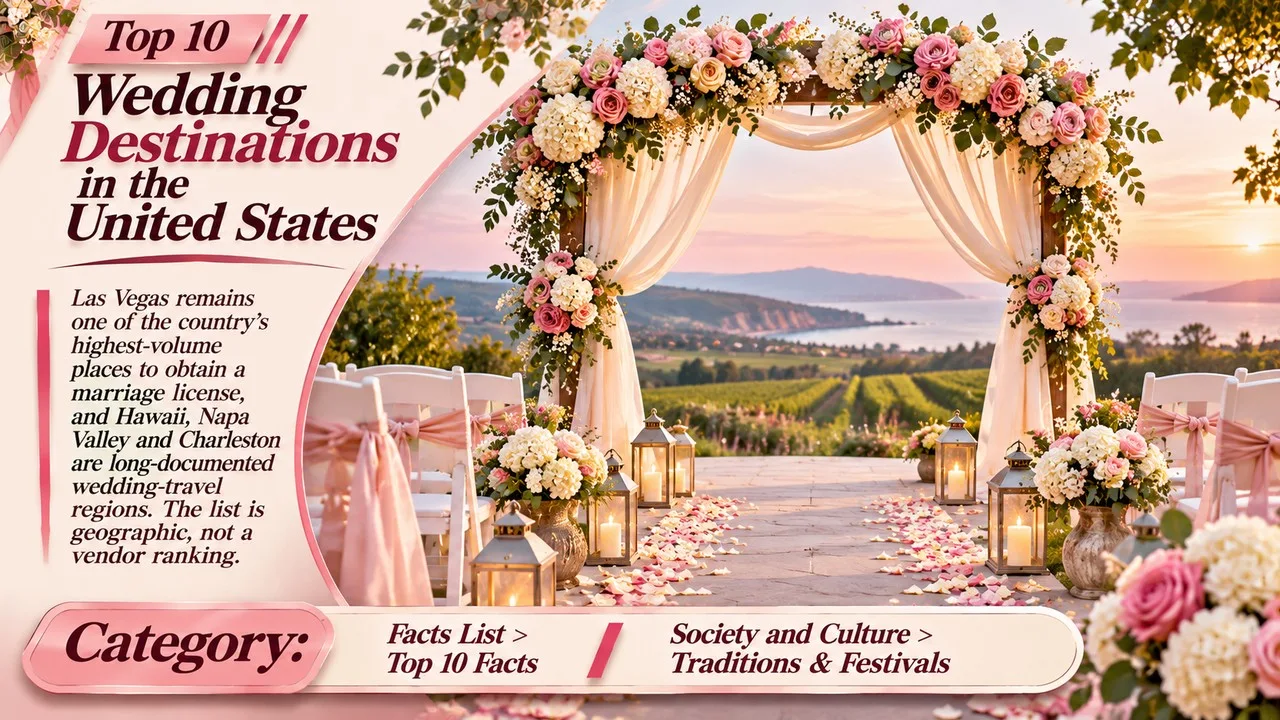
The wedding destinations in this list are documented places of wedding travel in the United States, not a ranking of vendors or venues. A destination here is a city, island group, or small region where couples have long gone to marry or to hold a ceremony, and where a county clerk, a park service, or a well-described civic setting is part of the public record [1][2]. It is not a list of "best wedding planners," and it is not a price survey.
Rank is editorial, by the strength of that documented wedding geography, from high-volume license cities to landscapes that require official permits. Marriage law is a state and county matter; anyone actually marrying should use the official clerk, not this article, as the last word on identification, waiting periods, and witnesses [1][3]. Weather, fire season, park caps and historic-house rules will change a plan faster than a ranked list will, which is why each row points to an official desk rather than to a floral preference.
Key Facts
Each entry is a place, not a hotel. Rank 1 is the most documented high-volume marriage-license destination in the country.
Wedding Destinations at a Glance
| Rank | Place | Setting | Documented hook | Practical official note |
|---|---|---|---|---|
| 1 | Las Vegas | Nevada | Very high volume of marriage licenses and a long chapel tradition | Clark County Marriage License Bureau is the legal source |
| 2 | Hawaii | Islands, especially Maui, Oahu and Kauai | A major official wedding-tourism state | State marriage license and park-permit rules |
| 3 | Napa Valley | California wine country | A long-documented region for ceremonies in vineyard country | County licenses; many sites are working farms |
| 4 | Charleston | South Carolina | Historic city and nearby coastal islands | City and plantation settings are historic places first |
| 5 | Santa Barbara | California coast | Courthouse, coast and nearby valleys | A civic courthouse is itself a famous backdrop |
| 6 | New York City | New York | City Hall licenses and a dense field of public and cultural sites | Parks and museums have their own permit desks |
| 7 | New Orleans | Louisiana | Historic neighbourhoods and a distinct legal and cultural setting | Courthouse and church traditions, plus public squares |
| 8 | Savannah | Georgia | Squares, river and a compact historic district | Outdoor ceremonies often need city or park permission |
| 9 | Sedona | Arizona | Red-rock landscape used as a ceremony setting | Public-land permits matter on forest and park ground |
| 10 | Asheville | North Carolina | Mountain city and nearby estate country | A mix of civic, forest and historic-house settings |
1. Las Vegas
Las Vegas, through the Clark County Marriage License Bureau, is the outstanding high-volume marriage-license destination in the United States, with a legal tradition of relatively straightforward licensing and a long parallel culture of chapels, some of them open at unusual hours [1]. The city is also a gambling and entertainment destination, treated separately in this batch; this entry is only the wedding geography. A ceremony in a chapel is a civil or religious event under Nevada law, not an extension of a casino floor, and the two should not be collapsed into one tourist product in a serious list.
It is first because the official license volume and the chapel tradition are documented public facts, not a hotel brochure [1]. A large number of ceremonies does not make every chapel a historic site. The county bureau is the legal fact that underlies the rest.
Waiting rules and identification requirements are the bureau's to set and to change. This article does not replace the clerk [1].
2. Hawaii
Hawaii is a major official wedding-tourism state, with couples travelling especially to Maui, Oahu and Kauai, and to a lesser extent the other islands, for ceremonies in state and national parks, hotels, and private gardens [2]. The State of Hawaii issues the marriage license, and public-land ceremonies typically need permits. The landscape is the attraction; it is also a set of regulated places.
It is second as the outstanding island wedding destination in the country, with a clear official legal path and a long visitor record [2]. A beach that looks empty in a photograph may be a park with a permit desk.
Sacred cultural sites and busy parks are not interchangeable backdrops. Official permit offices are the source [2].
Related: Made in Heaven: Unveiling the Lives of Delhi's Elite Wedding Planners
3. Napa Valley
Napa Valley, and neighbouring Sonoma County, form a documented wine-country wedding region, with ceremonies long held at wineries, barns, and valley ranches, in a landscape that is also a working agricultural economy [3]. Napa County and Sonoma County clerks issue licenses. Harvest, fire season, and traffic are seasonal realities.
It is third as the principal California inland wedding landscape, distinct from the state's beaches and from Las Vegas's license volume [3]. A vineyard is a farm. Access, insurance, and harvest schedules are part of using one as a ceremony site.
This is not a ranking of wineries. The region is the destination [3].
4. Charleston
Charleston, South Carolina, is a historic port city whose churchyards, houses, waterfront, and nearby sea islands have made it a long-documented South-eastern wedding destination [4]. The city's architecture and the surrounding Lowcountry are the setting. Many popular backdrops are historic or religious sites first, and wedding venues second.
It is fourth as a compact historic city with a deep ceremonial geography, including nearby islands that function as part of the same destination [4]. Summer heat and hurricane season are climate facts, not footnotes.
A historic house has conservation rules. Those rules outrank a floral arch [4].
5. Santa Barbara
Santa Barbara, on the California coast, is a long-established wedding destination whose Spanish-Revival courthouse, beaches, and nearby wine valleys offer a civic and coastal setting in one short radius [5]. The courthouse itself is a famous ceremonial backdrop, which is a public-building fact as well as a photographic one. Santa Barbara County issues licenses.
It is fifth as a coastal civic landscape, distinct from Napa's inland valley and from Los Angeles, which is nearby but not the same destination [5]. The courthouse gardens are a public place with rules.
Related: Top 10 Most Bizarre Phobias: Strange Fears That Exist
Fire, drought, and coastal weather can change outdoor plans. The clerk and the venue, not a colour palette, set the constraints [5].
6. New York City
New York City is a marriage-license and ceremony city on a different scale: the City Clerk's offices issue licenses, and Central Park, the waterfront, hotels, and cultural institutions host a very large number of ceremonies, many of them under formal permit schemes [6]. The city is also an everyday place to get married without a destination-wedding budget, at the clerk's office, which is part of the same geography.
It is sixth as the principal large-city wedding destination, where official desks and famous public landscapes coexist [6]. A Central Park lawn is not automatically available because it is famous.
Borough choice matters. Manhattan, Brooklyn and the others are different permit maps [6].
7. New Orleans
New Orleans offers a distinctive legal and cultural setting for weddings, with a courthouse tradition, historic church and courtyard ceremonies, and public neighbourhoods, especially in the French Quarter and along the river, that are themselves part of the city's visitor identity [7]. Louisiana marriage law and parish clerks are the legal frame. The city's festival calendar, including Halloween, treated elsewhere in this batch, can overlap with wedding weekends.
It is seventh as a historic Southern city whose ceremonial culture is documented and specific, not a generic "charming old town" label [7]. Summer weather and a busy events calendar are practical facts.
Related: Top 10 Oldest Buildings in the World
Cemetery and sacred-site photography has rules. They apply to wedding parties as to tourists [7].
8. Savannah
Savannah's historic district, squares, and riverfront form a compact, walkable wedding geography that visitor bureaus and the city have long promoted, with outdoor ceremonies often requiring parks or historic-site permission [8]. The city is also on the Halloween-towns list in this batch for a different October reason; the squares do both kinds of public life.
It is eighth as a smaller historic-district counterpart to Charleston, with a documented outdoor-ceremony culture [8]. Live oaks and Spanish moss are part of the landscape, not a rented decoration, and they are on public or institutional land.
Carriage and square rules can tighten on peak weekends. The city's permit office is the check [8].
9. Sedona
Sedona, Arizona, is a red-rock desert town that has become a documented destination for outdoor ceremonies, often on National Forest or other public land, where permits, group-size limits, and site-protection rules apply [9]. The geology is the attraction. The town is small; the surrounding land is the ceremony room.
It is ninth as a landscape destination rather than a historic-city one, and as a reminder that a famous view can be a regulated public resource [9]. A pull-off that looks empty may still need a permit.
Related: Top 10 Tallest Buildings in the World
Heat, monsoon storms, and fire restrictions are seasonal official facts. They are not optional atmosphere [9].
10. Asheville
Asheville, in the North Carolina mountains, is a documented wedding-travel city, with ceremonies in town, in nearby forest settings, and at historic estates in the surrounding county, including the well-known Biltmore estate as one, separately ticketed, historic-house option [10]. The city itself is the destination; a single estate does not own the rank.
It is tenth as a mountain-city wedding landscape in the East, a counterpart to Sedona's desert and to Napa's valley [10]. Autumn colour brings crowds. Winter ice is a real mountain fact.
Estate and forest rules differ. The relevant permit or private-site contract, not a scenic nickname, governs the day [10].
Conclusion
A United States wedding destination, on this list, is a place with a clerk, a landscape, and a documented habit of ceremonies: Las Vegas for license volume, Hawaii for official island wedding travel, Napa Valley, Charleston, Santa Barbara, New York City, New Orleans, Savannah, Sedona, and Asheville [1][2][6]. None of these entries is a vendor endorsement, and none replaces state marriage law.
A 2026 couple still starts at the official license office and, for public land, at the permit desk. The same city can appear in more than one Finepedia list without contradiction: Las Vegas is also a gambling destination, New Orleans and Savannah are also Halloween towns, and New York is also a general attraction city, because a wedding geography is only one of their public uses. A good 2026 plan names the county, checks the license appointment rules, and treats a famous photograph as a possible backdrop rather than as a reservation. That habit will matter as much in a red-rock pull-off as in a Manhattan park, and it is the same habit this article recommends at every official desk named above in the ten destination entries that follow the relevant city or county clerk official public office. For the wider visitor geography of some of the same cities, see the later attraction lists in this batch, including New York, and the Las Vegas attractions article planned in the following batch.
- ^ [1] Clark County Marriage License Bureau, official Las Vegas / Clark County marriage-license information. Clark County
- ^ [2] State of Hawaii marriage-license information and state and national park wedding-permit guidance. Hawaii marriage license
- ^ [3] Napa County and Sonoma County clerk information, and official wine-country visitor guidance. Napa County
- ^ [4] City of Charleston and Explore Charleston official visitor information. Explore Charleston
- ^ [5] Official City of Santa Barbara and County clerk information, including the historic courthouse. City of Santa Barbara
- ^ [6] New York City Clerk marriage-license information and NYC Parks ceremony-permit guidance. NYC Clerk
- ^ [7] Official New Orleans and Louisiana parish marriage-license information. City of New Orleans
- ^ [8] Visit Savannah and City of Savannah parks and historic-district event rules. Visit Savannah
- ^ [9] Coconino National Forest and City of Sedona guidance on wedding permits and public-land use. Coconino National Forest
- ^ [10] Explore Asheville official visitor information and Buncombe County clerk context. Explore Asheville






















Discussion
Log in with