






 By
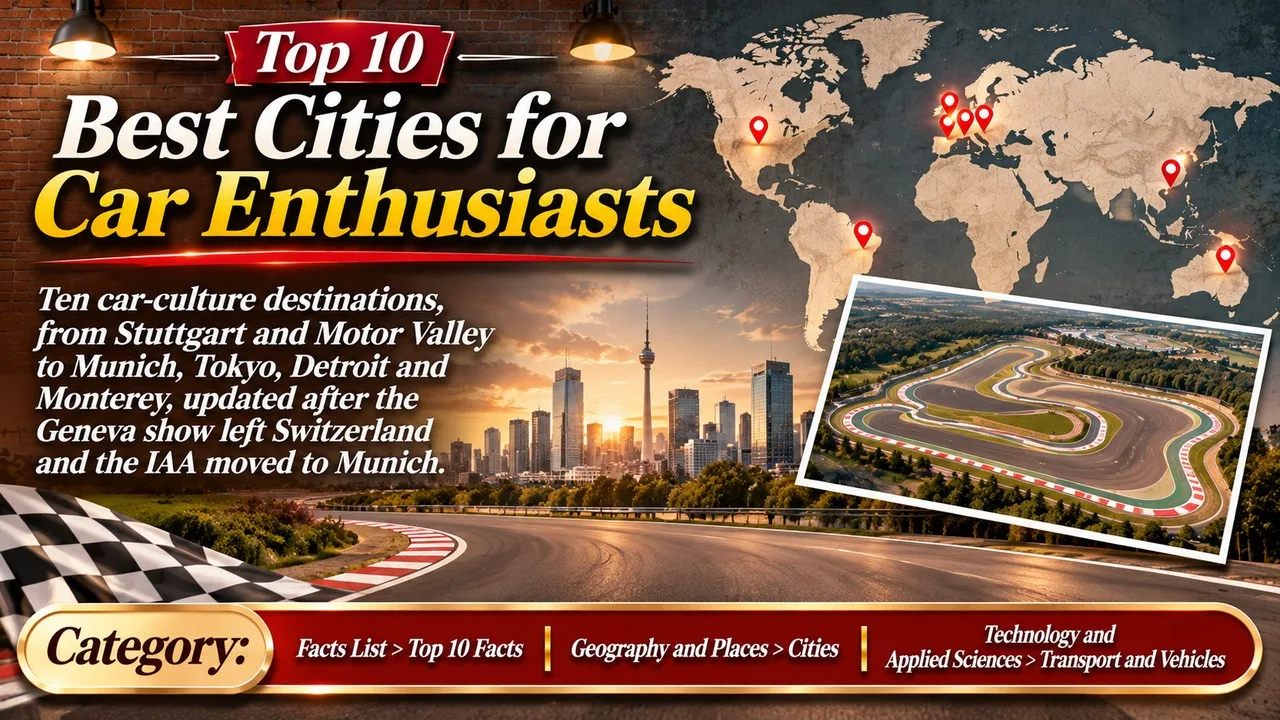
The best cities for car enthusiasts are the ones with museums, factories, historic roads or events that a visitor can still plan around in 2026. An older travel list from 2016 leaned on auto-show calendars that have since moved: the Geneva International Motor Show is no longer held in Geneva, and the IAA passenger-car show left Frankfurt for Munich [1][2].
This is a curated list of places, not a ranking of manufacturers. It favours cities and compact regions where a visitor can see collections, factory museums, or a genuine street and event culture in a few days. Some entries, including Monterey and Goodwood, are smaller than a typical capital; they are here because the event and the landscape are the destination [3][4].
Key Facts
"City" is used loosely for a visitor base, including Motor Valley around Modena and the Goodwood estate near Chichester. Status is as of November 2026.
Car-Enthusiast Cities at a Glance
| Rank | Place | Country | Why a car person goes | 2026 note |
|---|---|---|---|---|
| 1 | Stuttgart | Germany | Mercedes-Benz Museum and Porsche Museum, plus factory heritage | A year-round museum city, not only a show week |
| 2 | Modena and Motor Valley | Italy | Ferrari, Lamborghini, Maserati, Pagani and related museums | A compact region of factory visits, best booked ahead |
| 3 | Munich | Germany | BMW Museum, BMW Welt, and the IAA mobility show after it moved from Frankfurt | A museum city that now also hosts the big German show |
| 4 | Wolfsburg | Germany | Autostadt, the visitor city beside the Volkswagen plant | Built for visitors; a day is easy to fill |
| 5 | Tokyo | Japan | A dense car culture, from showrooms and museums to street and aftermarket scenes | The motor-show year is only one reason to go |
| 6 | Detroit and Dearborn | United States | The Henry Ford, the Rouge, and the historic American motor city | The culture outlasts any one auto-show cycle |
| 7 | Los Angeles | United States | Petersen Automotive Museum, car culture, and a still-important auto show | A year-round city, not only a November hall |
| 8 | Monterey and the Peninsula | United States | Car Week, including the concours at Pebble Beach | A seasonal peak in mid-August |
| 9 | Turin | Italy | The historic Italian industrial capital, with museums and former factory sites | A city visit rather than a single-event trip |
| 10 | Goodwood, near Chichester | United Kingdom | Festival of Speed and the Goodwood Revival | Two signature events on a historic estate |
1. Stuttgart
Stuttgart is first because two of the world's major car museums sit in the same city, in buildings designed as destinations: the Mercedes-Benz Museum and the Porsche Museum, each tied to a company that still has a deep local presence [3][5]. A visitor can spend a serious day in either building, then add factory-adjacent stops if tours are offered and booked.
It is not first because of a single motor show. Stuttgart's advantage is year-round. The museums stay when a show week ends, and the city's industrial landscape is part of the visit [5].
Tickets and timed entry should be checked, especially at weekends. The two museums are complementary rather than duplicates [3][5].
2. Modena and Motor Valley
Modena is the practical base for Italy's Motor Valley, the cluster of factory museums and sites associated with Ferrari in Maranello, Lamborghini in Sant'Agata Bolognese, Maserati, Pagani and other workshops in a relatively small region [3][6]. The visitor experience is a string of booked museum and factory-adjacent tours, not a single downtown showroom.
It is second because the density of important makers is unmatched, and because a 2026 trip still works if it is planned. Walk-up access is limited at some sites. A rental car or a well-organised transfer is part of the method [6].
Bologna is an alternative base. The point is the valley, not a rivalry between two hotels [3][6].
Related: Top 10 Fastest Cars in the World
3. Munich
Munich has the BMW Museum and BMW Welt as a year-round visitor pair, and it has also become the German home of the IAA mobility show after the passenger-car fair left Frankfurt [2][5]. That move is the main 2020s update in this part of the list: a city that already had a strong museum offer now also hosts the event that older lists attached to Frankfurt.
It is third as a complete car city: collections, a factory-brand campus, and a periodic international show. In a non-IAA year the museums and the city still justify the trip [5].
BMW is the headline, not the whole story. The city is also a base for Alpine driving country, which is a bonus rather than the ranking method [2][5].
4. Wolfsburg
Wolfsburg, built around the Volkswagen plant, offers Autostadt, a visitor park of pavilions, collections and factory-tour infrastructure that was designed for the public rather than added as an afterthought [3][5]. It is one of the most complete car-visitor sites in Europe, even though the town is not a historic capital.
It is fourth because a car enthusiast can have a full, organised day without waiting for a concours calendar. Factory-tour rules and any identity requirements should be read before arrival [5].
The trip is easy to combine with Berlin or Hanover by train, which is a practical fact rather than a reason to rank the place higher [3].
5. Tokyo
Tokyo is the richest Asian city on this list for a car person: flagship showrooms, a deep aftermarket and street-culture history, museums and brand spaces, and a motor-show calendar that still matters in the years when the Tokyo show is held [3][7]. It is also a city where ordinary traffic, railways and limited parking shape car life in a way Detroit or Los Angeles do not.
Related: Top 10 Best Candy Factory Tours in the World
It is fifth as a year-round culture, not as a single hall. A 2026 visitor should pick a lane: museums and showrooms, a day in a famous aftermarket district, or a show year if the calendar lines up. Daikoku and other meeting-spot folklore should be treated with current local rules, not with a copied 2010s night-time myth [7].
The city's car offer is wider than any one Japanese brand [3][7].
6. Detroit and Dearborn
Detroit, with Dearborn, remains the historic American motor city: the Henry Ford museum complex, the Rouge factory visit, neighbourhood and industrial landscapes, and a civic identity still tied to cars even after decades of economic change [3][8]. The large Chicago auto show, which older lists sometimes preferred as a visitor magnet, is a trade event in another city; Detroit's case is heritage plus living plants and collections.
It is sixth because the history is first-rank and still visitable. A 2026 trip can be built around The Henry Ford, a factory tour if it is on offer, and a clear-eyed look at the city, not around a single glitter show [8].
Dearborn is part of the same visit. Treat the two as one car-history base [8].
7. Los Angeles
Los Angeles has the Petersen Automotive Museum, a strong custom and entertainment-industry car culture, canyons and boulevards that still matter to driving, and an auto show that remains a significant industry event [3][8]. It is a year-round city in a way that Monterey, however spectacular in August, is not.
It is seventh as the main West Coast car metropolis. A 2026 visitor should put the Petersen on the list and then decide whether a show week, a cruise-related event, or simply the city's ordinary car landscape is the rest of the trip [8].
Traffic is the tax on the experience. That does not make the culture less real [3][8].
Related: Top 10 Most Bizarre Phobias: Strange Fears That Exist
8. Monterey and the Peninsula
Monterey, Carmel and Pebble Beach, on the California peninsula, become the centre of American collector-car culture during Car Week, whose best-known event is the concours at Pebble Beach, with auctions, tours and other gatherings around it [4][8]. The place is a visitor destination first, a large everyday city second.
It is eighth because the August week is one of the world's great car events, and because the coastal setting is part of the draw. Hotels and tickets are scarce and expensive at the peak. A 2026 plan should be made early, or it should aim at a quieter weekend and the scenery, not at a last-minute concours entry [4].
Outside Car Week the peninsula is still handsome, but this ranking is for the event [4][8].
9. Turin
Turin is the historic industrial capital of the Italian motor industry, a city of former factories, design history, and museums, including the national automobile museum, rather than a single still-booming production campus [3][6]. It is quieter than Motor Valley as a ticketed-factory circuit, and it is richer as a city in which cars were designed, built and lived with.
It is ninth as a heritage city that still rewards a visit, especially for someone who has already been to Modena and wants the urban and design side of the same national story [6]. A 2026 trip is a city-break with museums, not a queue for a theme park.
The Fiat heritage is part of the landscape, including later reuse of industrial sites [3][6].
Related: Top 10 Oldest Buildings in the World
10. Goodwood, near Chichester
Goodwood, on the estate near Chichester in West Sussex, hosts the Festival of Speed and the Goodwood Revival, two of the most distinctive historic-motor events in the world: one a hillclimb and manufacturer gathering, the other a period-dressed race meeting on a historic circuit [4][9]. The nearest town is the visitor base; the estate is the destination.
It is tenth as an event place rather than a museum city, and as the British counterpart to Monterey Week. Dates, tickets and lodging should be arranged early. A 2026 visitor who cannot attend either event will still find a park and a house, but this entry is for the car gatherings [9].
Geneva is not on this list as a current show city, because the salon in its historic Palexpo form has ended, with later GIMS editions staged outside Switzerland [1]. That is the kind of calendar fact a 2026 ranking has to take seriously [1][4].
Conclusion
The ten places above are museum cities, factory valleys, event peninsulas and one visitor-park town [3][4]. A weekend in any one of them will not look like a copied show-hall itinerary from 2016, and that is the point of rewriting the map around museums, factories and estates that are still open when the next salon changes city again. A useful 2026 list follows the collections and the events that still exist, not the auto-show map of 2016.
Book factory and concours tickets early, and treat show years as a bonus rather than as the only reason to visit Stuttgart, Munich, Tokyo or Los Angeles. The best car trip is often a museum day plus whatever the calendar happens to add [5][8]. That is also why Geneva drops out of a current list, and why Frankfurt is no longer the automatic German-show city: the collections and estates remain, while the halls on an outdated poster may not.
- ^ [1] Reporting on the end of the Geneva International Motor Show in Geneva, and later GIMS editions outside Switzerland. Reuters and organiser notices. Reuters on the Geneva salon
- ^ [2] IAA mobility show move from Frankfurt to Munich. Official IAA and city information. IAA Mobility
- ^ [3] National and factory car museums, including Mercedes-Benz, Porsche, BMW, Autostadt and Motor Valley. Official museum pages. Mercedes-Benz Museum
- ^ [4] Pebble Beach Concours d'Elegance, Monterey Car Week, and Goodwood events. Official pages. Pebble Beach Concours
- ^ [5] Stuttgart, Munich and Wolfsburg official museum and Autostadt visitor information. Porsche Museum
- ^ [6] Motor Valley and Turin automotive heritage. Official regional and museum pages. Motor Valley
- ^ [7] Tokyo motor culture and motor-show calendar overviews. Official tourism and show pages. Tokyo Motor Show
- ^ [8] The Henry Ford, Petersen Automotive Museum, and related US visitor sites. The Henry Ford
- ^ [9] Goodwood Festival of Speed and Goodwood Revival. Goodwood




















Discussion
Log in with