





 By
The best places to watch lava are legal viewing sites whose access and eruption status can change, and the notes below are dated to November 2026. An erupting volcano is not a guaranteed spectacle, and a famous name is not a permit. This list is limited to places that have been legally visitable in recent seasons from official lookouts, marked paths, or licensed guided routes. It is not a ranking of the most active or most beautiful volcanoes, subjects Finepedia already treats separately, and it is not advice to approach a flow, a vent, or a closed area [1][2].
Lava viewing is hazardous even when it is legal. Gases, projectiles, collapsing crust, wildfires, and sudden closures are normal parts of the story. A 2026 reader should check the volcano observatory, park service, or civil-protection notice on the day of a visit, not the paragraph below [1][3]. Rank is editorial, by reliability of legal viewing in recent years and by the quality of official information, not by fountain height.
Key Facts
Status notes are for November 2026 where an official source was checked, and are otherwise described as typical recent-season conditions. Rank 1 is the best-documented legal viewing site in the United States.
Lava Viewing Sites at a Glance
| Rank | Place | Country | Typical legal view | Status in November 2026 |
|---|---|---|---|---|
| 1 | Hawai'i Volcanoes, Kilauea | United States | Official park lookouts and webcams | Summit eruption paused after 5 November; next fountaining then forecast 16 to 21 November |
| 2 | Reykjanes Peninsula | Iceland | Marked paths to recent lava fields | No ongoing eruption; some 2023 to 2025 crater areas closed |
| 3 | Stromboli | Italy | Regulated climbs and shore views | Persistent activity; access depends on the alert level |
| 4 | Mount Etna | Italy | Guided upper routes and official terraces | Frequent eruptions; routes open or close with activity |
| 5 | Yasur, Tanna | Vanuatu | Designated crater-rim zones | Persistent activity; stay inside marked limits |
| 6 | Piton de la Fournaise | France (Reunion) | Official enclosure points when the prefecture allows | Frequent eruptions; the enclosure is often closed during a crisis |
| 7 | Acatenango, view of Fuego | Guatemala | Licensed overnight trails on a neighbouring peak | Fuego erupts often; the view is from a legal trail, not the vent |
| 8 | Masaya Volcano | Nicaragua | Park road to a crater viewpoint | Glow when the park is open; gas and closures are common |
| 9 | Villarrica | Chile | CONAF-regulated climbs and lakeside views | Access depends on alert level and authorised guides |
| 10 | Erta Ale | Ethiopia | Guided travel to a long-lived lava lake | Permit and security conditions required; not a casual stop |
1. Hawai'i Volcanoes, Kilauea
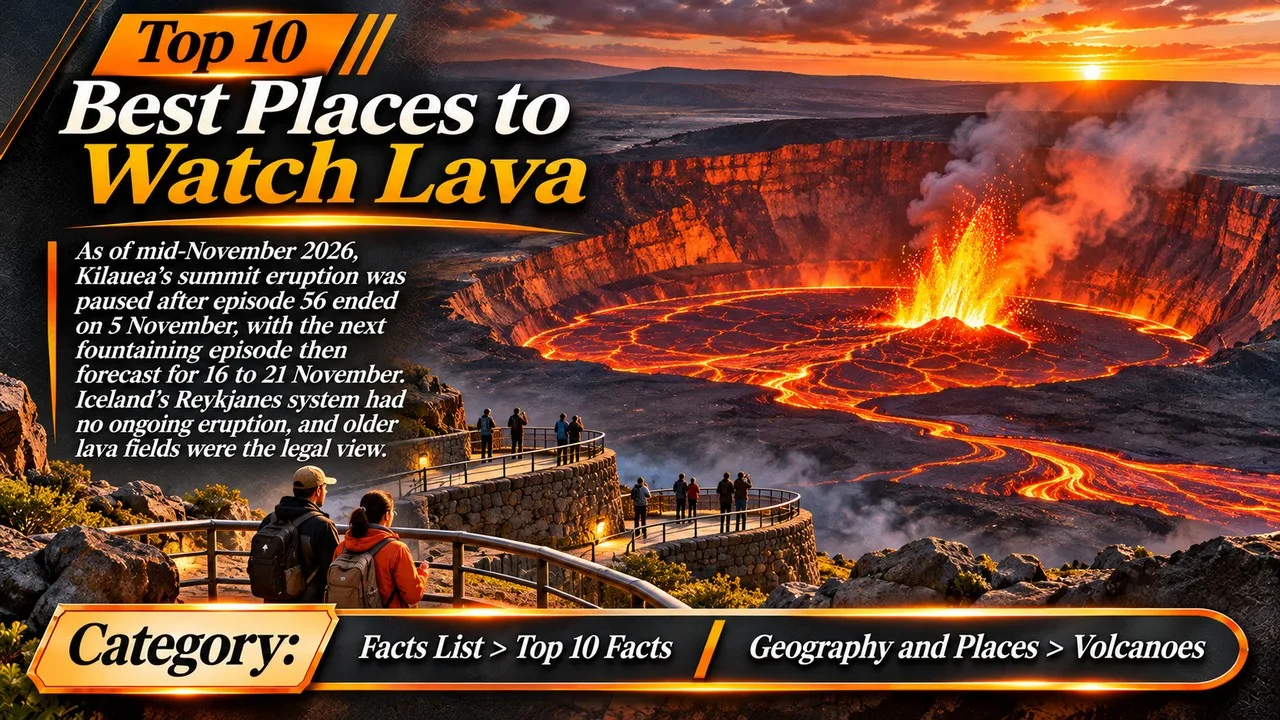
Kilauea, in Hawai'i Volcanoes National Park, is the most carefully documented legal lava-viewing landscape in the United States. The United States Geological Survey and the National Park Service publish frequent updates, webcams, and closure maps. In mid-November 2026, the Halema'uma'u summit eruption was paused after episode 56 ended on 5 November. The summit was reinflating, and the next fountaining episode was then forecast for 16 to 21 November [1][2].
It is first because official lookouts, when open, give a lawful view of a frequently active summit, and because the public information is good enough to date. A pause is not a permanent end, and a forecast window is not a ticket; both can move [1].
Night views from open park areas have been a lawful attraction in recent eruptive episodes. Leaving a trail, crossing a closed chain, or walking onto a flow is not part of that attraction [2].
2. Reykjanes Peninsula
The Reykjanes Peninsula in southwest Iceland has produced a series of eruptions since 2021, including the Fagradalsfjall and Sundhnukur fires. As of 11 November 2026 there was no ongoing eruption. The Sundhnuksgigar area remained closed to public access. Marked routes, including a path near Fagradalsfjall and a viewing area by road 43 near the Blue Lagoon, offered legal views of the 2023 to 2025 lava fields and craters [3][4].
It is second as the most closely watched European example of a new, accessible lava landscape, and as a case study in how quickly a "live lava" destination can become a "recent lava" walk. SafeTravel and the Icelandic Meteorological Office notices are the daily sources, not a souvenir map [3][4].
Gas, unstable crust, and sudden closures remain hazards even when the eruption has stopped. A closed sign is the last word [4].
Related: Top 10 Most Active Volcanoes in the World
3. Stromboli
Stromboli, in the Aeolian Islands, has been in almost continuous mild explosive activity for centuries, with occasional larger paroxysms. Legal viewing is from the sea, from the village of Stromboli, and from regulated paths whose upper limits change with the alert level and require authorised guides [5].
It is third as the classic Mediterranean place to see incandescent explosions from a lawful distance, not as an invitation to climb in the dark without a permit. Italian civil-protection rules have tightened after fatal paroxysms, including in 2019, and those rules govern any 2026 visit [5].
A postcard of the "Lighthouse of the Mediterranean" is not a status report. The day's permitted altitude is the status report [5].
4. Mount Etna
Mount Etna, on Sicily, is Europe's most frequently active large volcano, with summit craters and, in some years, flank eruptions that can be seen from official terraces, cable-car approaches, and licensed 4x4 or walking routes [5][6]. Those routes open and close with the activity and with snow.
It is fourth because, in many recent seasons, a visitor who used authorised operators could see active lava or a glowing crater without leaving a legal system of access. That is not true of every week, and a road that was open last month may be closed today [6].
Etna is also a densely settled mountain. Viewing from a lawful terrace is the point of this list; approaching a flow across private or closed land is not [5].
5. Yasur, Tanna
Yasur, on Tanna in Vanuatu, is a persistently active volcano with a long record of legal crater-rim viewing from designated zones. The activity is often Strombolian, with audible explosions and incandescent ejecta, which is why the site appears on almost every "watch lava" list [7].
Related: Top 10 Most Stunning Volcanoes in the World
It is fifth as the outstanding authorised Pacific viewpoint of this type, and it comes with a hard safety note. People have been killed by projectiles at Yasur. The designated zone exists because the rim is dangerous, not because it is a theatre box [7].
Local guides, park fees, and exclusion distances are part of a lawful visit. Wind, ash and a rising alert level can cancel the view on the day [7].
6. Piton de la Fournaise
Piton de la Fournaise, on Reunion, a French overseas department, is one of the most frequently erupting volcanoes on Earth. When an eruption begins, the prefecture and the Piton de la Fournaise Volcano Observatory manage an enclosure: sometimes official viewing points are opened, and often the enclosure is closed until the crisis is assessed [8].
It is sixth as a well-monitored legal system, not as a guarantee of a ringside flow. A Reunion eruption can be visible from a road one week and invisible behind a closure the next [8].
The observatory bulletins are the source to trust. A social-media video is not a permit [8].
7. Acatenango, view of Fuego
Volcan de Fuego, in Guatemala, erupts so often that overnight hikes on neighbouring Acatenango have become a standard way to watch its incandescent activity from a legal trail and camp, with licensed guides [9]. The view is of Fuego, not a walk onto Fuego's active vent.
It is seventh as a neighbouring-peak viewpoint that has been widely used in recent seasons, with the usual caveats of altitude, weather, ash fall, and operator quality. Pacaya, closer to Guatemala City, has also offered easier legal views in some seasons, and is a related, sometimes more accessible option when its park is open [9].
Related: Top 10 Most Bizarre Phobias: Strange Fears That Exist
A night photograph from Acatenango is not a forecast. Fuego's bursts vary, and a cloudy night can hide the cone [9].
8. Masaya Volcano
Masaya Volcano National Park, near Managua, has long offered a rare road-accessible crater viewpoint, with a glowing lava lake or incandescent vent visible in some years from a car park and platform when the park is open [10]. Sulphur gas is a routine problem, and the park closes when concentrations or rockfall risk are too high.
It is eighth as a legal, short-visit crater view, when it is open, rather than a multi-day expedition. Travel advice for Nicaragua, and the day's park notice, both have to be checked; a glowing crater in a guidebook may be a closed gate on arrival [10].
Standing on the official platform is the visit. Leaning over an unfenced rim or remaining in heavy gas is not [10].
9. Villarrica
Villarrica, above Pucon in southern Chile, is an ice-clad cone that has often held a lava lake or a glowing summit, with views from the lake town and, when the alert level allows, from CONAF-regulated climbs with authorised guides [11]. The climb can close quickly, and glacier, gas and avalanche hazards are real.
It is ninth as a South American legal-viewing counterpart to Etna or Yasur: famous, frequently active, and only as open as the day's official decision [11]. Lakeside or ridge views from open public areas can be enough when the summit route is shut.
Related: Top 10 Oldest Buildings in the World
A guide's radio and the CONAF notice outrank any published "best hike" paragraph, including this one [11].
10. Erta Ale
Erta Ale, in the Afar region of Ethiopia, is one of the world's long-lived lava-lake volcanoes, and it has been visited for years by guided expeditions with permits [12]. It is last because the logistics and the security environment are not those of a national-park lookout. Heat, distance, changing military or regional security conditions, and the state of the lake itself all have to be current before anyone treats this as a trip rather than as a place that exists on a map.
It is tenth as a documented, sometimes legally visitable lava lake, not as a casual destination and not as a dare. A 2026 traveller who cannot confirm permits and a reliable operator should not go [12].
Nyiragongo in the Democratic Republic of the Congo has held an even more famous lava lake, but access through Virunga has been repeatedly constrained by security. It is mentioned here as a historic site, not as a tenth-place recommendation for an ordinary visit [12].
Conclusion
Legal lava viewing, in November 2026, was a dated patchwork: Kilauea paused after 5 November with a mid-month forecast window, Reykjanes quiet with older fields still walkable on marked routes, and a ring of persistently or frequently active volcanoes in Italy, Vanuatu, Reunion, Guatemala, Nicaragua, Chile and Ethiopia open only as far as official rules allowed [1][3][5]. The right habit is to read the observatory note on the day, stay on the lawful side of the fence, and treat any article, including this one, as background rather than as a permit.
Eruptions will move these ranks. A flow that is visible this week can be a closed, toxic, or already cooled field next week. For volcanoes as mountains and as records of activity, see Finepedia's separate lists of notable volcanoes; this page is only about places where lava has been, recently, legal to watch.
- ^ [1] USGS Kilauea volcano updates, including the November 2026 pause after episode 56 and the mid-month fountaining forecast. USGS: Kilauea updates
- ^ [2] National Park Service, Hawai'i Volcanoes National Park, viewing areas and closures. Hawai'i Volcanoes National Park
- ^ [3] Icelandic Meteorological Office notices on the Reykjanes Peninsula. Icelandic Meteorological Office
- ^ [4] Visit Reykjanes and SafeTravel guidance on closed areas and marked lava-field routes, November 2026. SafeTravel Iceland
- ^ [5] Italian civil-protection and volcano-observatory guidance for Stromboli and Etna. Italian Civil Protection
- ^ [6] Parco dell'Etna and official Etna access notices. Etna Park
- ^ [7] Vanuatu Meteorology and Geo-Hazards Department and official Tanna / Yasur visitor guidance. Vanuatu Geo-Hazards
- ^ [8] Observatoire Volcanologique du Piton de la Fournaise and Reunion prefecture enclosure notices. IPGP / OVPF
- ^ [9] Instituto Nacional de Sismologia, Vulcanologia, Meteorologia e Hidrologia (INSIVUMEH) and authorised-guide practice for Fuego and Acatenango. INSIVUMEH
- ^ [10] Masaya Volcano National Park official notices and gas-hazard practice. Nicaraguan tourism / park notices
- ^ [11] CONAF and official Villarrica access and alert-level rules. CONAF
- ^ [12] Ethiopian authorities and standard scientific accounts of Erta Ale, with a security-and-permit caveat; historic context for Nyiragongo. Official Ethiopia travel information




















Discussion
Log in with