




 By
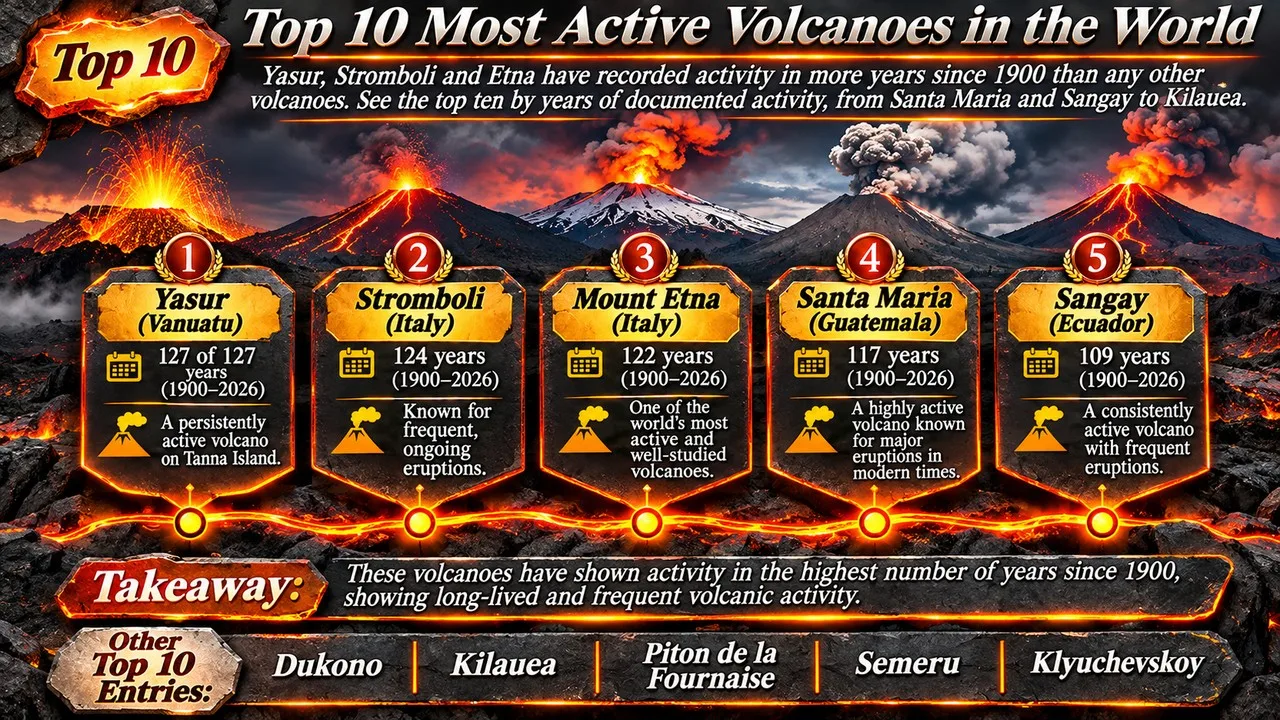
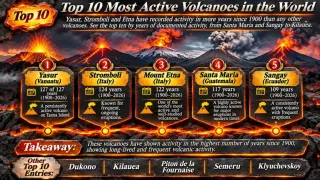
Yasur, Stromboli and Etna have been in eruption in more years since 1900 than any other volcanoes on Earth. The ranking below follows Smithsonian Institution Global Volcanism Program (GVP) records as of 2026 and counts how many calendar years from 1900 to 2026 each volcano had an eruption in progress [1][2].
The GVP treats activity as a single eruption until there is a pause of more than three months. That rule favours volcanoes that rumble almost without a break, such as Yasur and Stromboli, over peaks that produce many short, separate outbursts. Piton de la Fournaise on Réunion, for example, has started more eruptions since 1900 than any other volcano, but it ranks a little lower on time spent erupting [1].
Fame is not the same as persistence. Iceland's Eyjafjallajokull disrupted European air travel in 2010, and Vesuvius destroyed Pompeii in 79 AD, yet neither has been in almost continuous eruption in modern times. The ten below are the ones that have been active most often, and several were still listed by the GVP as continuing in March 2026 [2].
Key Facts
The table ranks volcanoes by the number of years with an eruption in progress from 1900 to 2026, and notes recent status from GVP data.
Most Active Volcanoes at a Glance
| Rank | Volcano | Country | Years erupting (1900-2026) | Notable fact |
|---|---|---|---|---|
| 1 | Yasur | Vanuatu | 127 of 127 | Current eruption dated from about 1270 and still continuing |
| 2 | Stromboli | Italy | 124 | Current eruption began in 1934; the type example of Strombolian activity |
| 3 | Mount Etna | Italy | 122 | 42 separate eruptions since 1900; Europe's most active volcano |
| 4 | Santa Maria | Guatemala | 117 | Santiaguito lava-dome complex has erupted since 1922 |
| 5 | Sangay | Ecuador | 109 | Steep Andean cone; current eruption began in 2019 |
| 6 | Dukono | Indonesia | 95 | Current eruption began in 1933 and was still continuing in 2026 |
| 7 | Kilauea | United States (Hawaii) | 94 | The United States' most active volcano; 37 eruptions since 1900 |
| 8 | Piton de la Fournaise | Réunion, France | 93 | 102 eruptions since 1900, the highest count in the GVP record |
| 9 | Semeru | Indonesia | 93 | Java's highest volcano; current eruption began in 2019 |
| 10 | Klyuchevskoy | Russia | 91 | 4,754 metres high, with 73 eruptions since 1900 |
1. Yasur
Yasur stands on Tanna Island in Vanuatu and is, by time spent erupting, the most active volcano on Earth. The GVP lists a single eruption that began about the year 1270 and was still continuing in March 2026, which means Yasur had activity in all 127 calendar years from 1900 to 2026 [1][2]. Its frequent, relatively small explosions have been observed for centuries and are a familiar sight to people living nearby and to visitors who watch from official viewpoints.
The mountain is a stratovolcano with a crater that often throws incandescent lava and ash a short distance above the rim. Because the activity is so regular, it is a type example of persistent Strombolian eruption in the Pacific, even though the style takes its name from an Italian island.
Access is controlled, and conditions can change quickly. The long record does not make Yasur harmless; it means that the volcano rarely falls quiet for long enough to be counted as dormant [1].
2. Stromboli
Stromboli, a small island in the Aeolian chain north of Sicily, has been called the Lighthouse of the Mediterranean because of the glow from its summit. The GVP records eruptive activity in 124 of the 127 years from 1900 to 2026, and the eruption that began on 2 February 1934 was still listed as continuing on 31 March 2026 [1][2][3].
The word Strombolian describes bursts of lava and gas that repeat every few minutes or tens of minutes, a style first studied in detail here. People have lived on the island's lower slopes for centuries, and the village of Stromboli still looks up at a crater that is often active at night.
Related: Top 10 Giant Sinkholes and Blue Holes
Larger explosions and lava flows do occur, and the island has been evacuated at times. Even so, no other European volcano except Etna comes close to Stromboli's record of almost unbroken modern activity [1].
3. Mount Etna
Mount Etna, on the east coast of Sicily, had an eruption in progress in 122 of the 127 years from 1900 to 2026 and has started 42 separate eruptions in that period [1]. NASA and many geological surveys describe it as Europe's most active volcano. Unlike Yasur and Stromboli, whose current episodes have lasted for decades, Etna often opens new vents on its flanks or at the summit, then pauses long enough for the next outburst to be counted as a new eruption.
The mountain rises more than 3,300 metres and is a UNESCO World Heritage site. Its lava flows have repeatedly threatened towns on the slopes, while the fertile volcanic soils also support farms and vineyards. Summit and flank activity continued into 2026 [1].
Etna is also one of the best-monitored volcanoes in the world, with a long written record that stretches back more than two thousand years. That history, plus the sheer number of modern eruptions, places it third on a list measured by years of activity [1].
4. Santa Maria
Santa Maria, in Guatemala's western highlands, is remembered first for the huge 1902 eruption, one of the largest of the twentieth century. After that blast, a lava-dome complex called Santiaguito began to grow in 1922 in the scar on the volcano's side, and it has been erupting ever since [1][2]. The GVP counts eruptive years in 117 of the 127 years from 1900 to 2026, and the eruption that started on 22 June 1922 was still continuing in 2026 [2].
Santiaguito produces lava domes, ash plumes and pyroclastic flows that can move down nearby valleys. The town of Quetzaltenango and many smaller communities lie close enough to be affected by ashfall.
Because the 1902 event and the long-lived dome growth are treated as part of the same modern history, Santa Maria ranks among the most persistently active volcanoes in the Americas [1].
5. Sangay
Sangay is a steep, ice-trimmed stratovolcano in Ecuador's eastern Andes and among South America's most frequently erupting peaks. It had eruptions in progress in 109 of the 127 years from 1900 to 2026, and the GVP lists a continuing eruption that began on 26 March 2019 and was still going in March 2026 [1][2].
Related: Natural Nuclear Fission Reactors: Unique Geological Phenomena Explained
The volcano is remote, standing inside Sangay National Park, a UNESCO World Heritage site, and is often wrapped in cloud. Activity typically includes ash emissions, lava flows and frequent small explosions at the summit. Because it is hard to approach, much of the modern record comes from satellite observations and distant reports.
Sangay's high rank reflects a long pattern of unrest rather than a single famous disaster. It is a reminder that some of the world's busiest volcanoes stand far from large cities [1].
6. Dukono
Dukono, on Halmahera in North Maluku, Indonesia, has been in almost continuous eruption since 13 August 1933. The GVP recorded activity in 95 of the 127 years from 1900 to 2026 and still listed that eruption as continuing in March 2026 [1][2]. Ash plumes from Dukono are among the most frequently reported in the region and can affect air routes in eastern Indonesia.
The volcano is a complex of cones rather than a single neat peak. Its activity is typically explosive, with ash and gas rather than long lava flows, and it has been a regular entry in weekly volcanic activity reports for decades.
Dukono is less famous than Indonesia's Merapi or Semeru, but on a measure of time spent erupting it outranks both, which is why it stands sixth on this list [1].
7. Kilauea
Kilauea, on the Island of Hawaii, is the United States' most active volcano. The GVP counts eruptive activity in 94 of the 127 years from 1900 to 2026 and 37 separate eruptions in that period [1]. A new eruption that began on 23 December 2024 was still listed as continuing on 25 March 2026 [2]. Earlier, the 1983-2018 episode at Pu'u'o'o and the 2018 lower East Rift Zone eruption, which destroyed more than 700 homes in the Puna district, were among the best-documented events in modern volcanology.
Related: Top 25 Interesting Facts About Earth
Kilauea is a broad shield volcano inside Hawaii Volcanoes National Park. It often produces relatively fluid basalt lava that can flow for long distances, and its summit caldera has held a lava lake at times. The U.S. Geological Survey monitors it closely.
On a worldwide list of time spent erupting, Kilauea ranks just below the almost continuous cones of the western Pacific and Italy, but no volcano in the United States comes close to its record [1].
8. Piton de la Fournaise
Piton de la Fournaise, on the French island of Réunion in the Indian Ocean, is the busiest volcano on Earth if the test is how many eruptions have started since 1900. The GVP lists 102 eruptions in that period and activity in 93 of the 127 years, tying it with Semeru on time spent erupting but placing it eighth because of that slightly lower year count [1]. Several eruptions also occurred in 2026 [1].
The volcano is a highly active shield, with lava often flowing into a caldera known as the Enclos Fouqué and sometimes reaching the sea. Most eruptions are relatively short, which is why the start-count is so high: the mountain frequently stops and then starts again after a gap of more than three months.
Réunion's observatory is one of the world's main volcano-monitoring centres, and the mountain is a well-studied example of a hotspot shield outside Hawaii [1].
9. Semeru
Semeru is the highest volcano on the island of Java, Indonesia, and had eruptions in progress in 93 of the 127 years from 1900 to 2026 [1]. The GVP lists a continuing eruption that began on 24 February 2019 and was still active in March 2026, with 26 eruptions recorded since 1900 [1][2]. The mountain often produces ash plumes, pyroclastic flows and lahars, and a major collapse and flow in December 2021 caused serious damage and loss of life on its south-eastern slopes.
Tengger Semeru National Park draws visitors to the region, but Semeru is a dangerous neighbour for communities in Lumajang and nearby districts. Officials regularly adjust exclusion zones as activity changes.
Related: Grand Canyon: A Geological Marvel Carved by the Colorado River
Tied with Piton de la Fournaise on years of activity, Semeru ranks ninth because it has started far fewer separate eruptions, but it is one of the most closely watched volcanoes in Indonesia [1].
10. Klyuchevskoy
Klyuchevskoy, or Kliuchevskoi, rises 4,754 metres on the Kamchatka Peninsula in Russia and is the highest active volcano in the GVP's north-west Pacific region [1]. It had eruptions in 91 of the 127 years from 1900 to 2026 and has started 73 eruptions in that time, one of the highest counts after Piton de la Fournaise [1]. Summit explosions and lava flows are frequent, and an eruption was recorded in 2025 [1].
The volcano is part of the Klyuchevskaya group, a cluster of large cones near the settlement of Klyuchi. Ash from Klyuchevskoy can reach high into the atmosphere and affect air traffic between Asia and North America, so it is monitored from the ground and by satellite.
Its combination of height, frequent eruptions and remote setting makes it the outstanding active volcano of Kamchatka and the tenth most persistent in the modern global record [1].
Conclusion
Measured by years in eruption since 1900, the world's most active volcanoes are not always the ones that make global headlines. Yasur, Stromboli, Dukono and Santa Maria's Santiaguito have been restless for decades at a time, while Etna, Kilauea and Piton de la Fournaise keep starting new episodes.
Status can change within months, so the ranks should be read with the GVP record as of 2026. For a different view of the same mountains, see the most stunning volcanoes in the world, which ranks peaks for appearance rather than how often they erupt.
- ^ [1] "Most Active Volcanoes in the World: Top 20 List". Magma Tribune (based on Smithsonian GVP data). Magma Tribune: Most active volcanoes
- ^ [2] "Current Eruptions". Smithsonian Institution Global Volcanism Program. GVP: Current eruptions as of 31 March 2026
- ^ [3] "Longest Eruptions". Smithsonian Institution Global Volcanism Program. GVP: Longest eruptions






















Discussion
Log in with