





 By
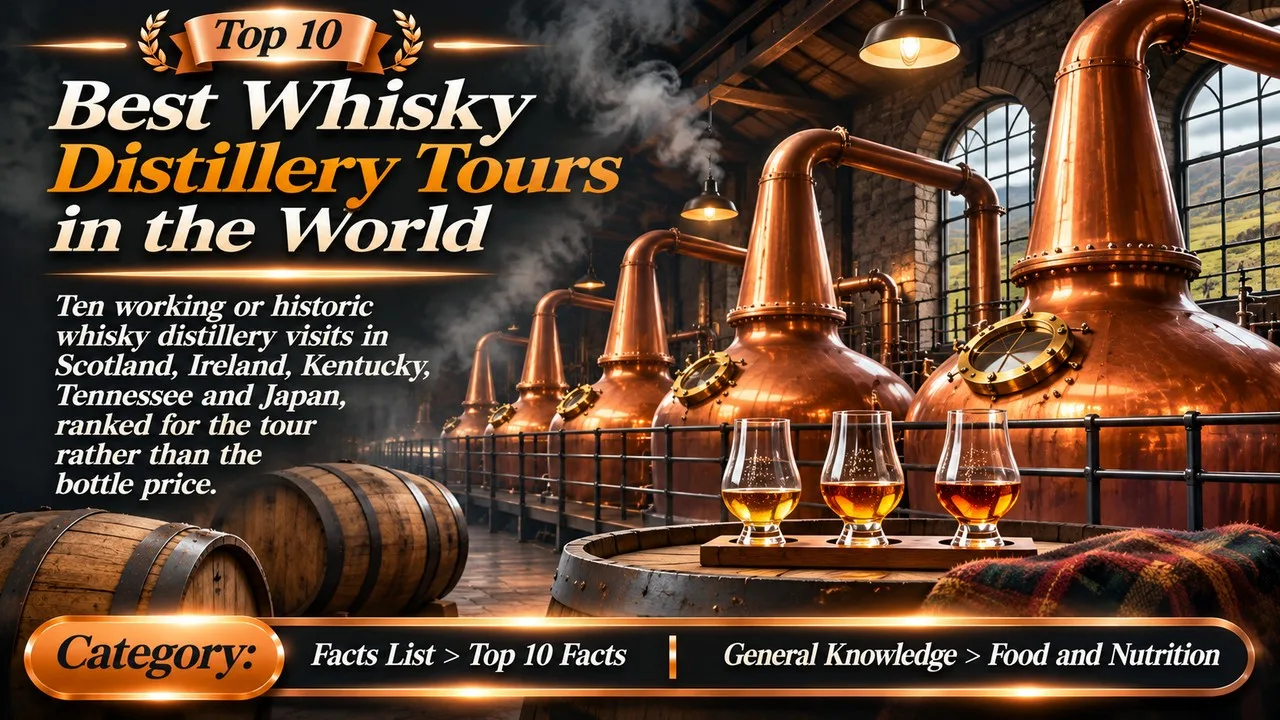
The best whisky distillery tours combine a working still house with a tasting that explains why the spirit tastes the way it does. A beautiful visitor centre is not enough on its own, and neither is a famous label if the tour never leaves a shop [1][2].
This is a curated 2026 list, not a ranking of the most expensive bottles or a score of which country makes the best whisky. It favours sites where visitors can still see mash tuns, stills or warehouses, then taste with some guidance. Several of the most popular distilleries now require timed tickets, and some Japanese tours are limited enough that a trip should be planned around a confirmed booking rather than a walk-up hope [3][4].
Key Facts
Whisky, whiskey and bourbon are treated together here as one visiting category. Status is as of November 2026. A brand home in a city is mentioned only when it is distinct from the working distillery.
Whisky Distillery Tours at a Glance
| Rank | Distillery | Location | Style | 2026 visitor note |
|---|---|---|---|---|
| 1 | The Macallan Distillery | Easter Elchies, Speyside, Scotland | Scotch single malt | New distillery and visitor experience opened in 2018; book ahead |
| 2 | Glenfiddich Distillery | Dufftown, Speyside, Scotland | Scotch single malt | Long-running working-plant tours on the original site |
| 3 | Old Bushmills Distillery | County Antrim, Northern Ireland | Irish whiskey | Working distillery tours in the village |
| 4 | Midleton Distillery | Midleton, County Cork, Ireland | Irish whiskey | The working Irish Distillers site; Bow Street in Dublin is a separate brand home |
| 5 | Jack Daniel's Distillery | Moore County, Tennessee, United States | Tennessee whiskey | Large, well-organised tours; Moore County is a dry county |
| 6 | Maker's Mark Distillery | Marion County, Kentucky, United States | Bourbon | Working campus with a strong grounds-and-still-house tour |
| 7 | Yamazaki Distillery | Yamazaki, Japan | Japanese single malt | Reservations are often essential and can be scarce |
| 8 | Laphroaig Distillery | Port Ellen, Islay, Scotland | Islay single malt | Peat, shore and a working distillery; check ferry and tour slots |
| 9 | The Glenlivet Distillery | Ballindalloch, Speyside, Scotland | Scotch single malt | Established visitor centre on a historic Speyside site |
| 10 | Woodford Reserve Distillery | near Versailles, Kentucky, United States | Bourbon | Historic site, still a working distillery tour |
1. The Macallan Distillery
The Macallan opened a new distillery and visitor experience on the Easter Elchies estate in 2018, in a building designed by Rogers Stirk Harbour + Partners, with a long, low roof set into the Speyside landscape and a still house displayed as part of the architecture [1][5]. The older plant on the estate had become too small for the company's plans, and the new building is both a working distillery and one of the most deliberate visitor designs in the category.
A 2026 tour is about process as well as spectacle: mash, distillation, cask influence and a tasting that is tied to those steps. Timed tickets remain the practical way in, and the more detailed tours cost more because they spend longer in the working areas and in the warehouse [1].
It is first not because Macallan bottles are the most expensive on a shelf, which would be a weak method, but because the site now combines a living still house with a visitor route that was designed around that plant [1][5].
2. Glenfiddich Distillery
Glenfiddich, in Dufftown, is still on the site where William Grant's distillery began production in 1887, and it remains one of the most complete working-plant tours in Speyside. The company has offered structured visitor tours for decades, from a standard look at the mash tuns and stills to longer sessions that spend more time in the warehouses [2][5].
The value of the visit is continuity. You are not only in a museum about a brand; you are in a large, active Speyside distillery that still bottles on a site with a late-nineteenth-century origin. That is a different experience from a city brand home, and it is why Glenfiddich stands just behind the newer Macallan building rather than being displaced by it [2].
Tours should be booked in peak months. Dufftown is also a practical base for other Speyside visits, which is a travel fact rather than a ranking argument [2][5].
Related: Top 10 Most Bizarre Phobias: Strange Fears That Exist
3. Old Bushmills Distillery
The Old Bushmills plant, in the village of the same name in County Antrim, is a working Irish whiskey distillery with a regular tour. The company presents a lineage that includes a 1608 licence to distil in the area; the later distillery on the present site is usually dated to the eighteenth century, and a careful tour will separate the licence story from the standing plant [5][6].
What the visitor gets in 2026 is a walk through a real still house and a tasting in a place that is still a whiskey village rather than a city museum. That combination is the reason it is third. The Giant's Causeway is nearby, which makes the stop easy to plan, but the distillery visit stands on its own [6].
As with the Scottish sites, a booked slot is wiser than a late walk-up in summer [6].
4. Midleton Distillery
Midleton, in County Cork, is the working distillery campus of Irish Distillers, where Jameson and several other Irish whiskeys are produced. The visitor experience there is the one that shows a living Irish industrial plant. The Bow Street site in Dublin is a separate, well-run brand home and museum in the building associated with John Jameson; it is worth a city visit, but it should not be confused with the Midleton tour [5][7].
Older popular lists often treated "the Jameson Experience" as a single place and leaned on the Dublin address. A 2026 list that cares about stills should send the traveller to Midleton first and mention Bow Street second [7].
The Midleton campus includes historic distillery buildings as well as modern production. Tours and tastings are ticketed, and formats change, so the official page is the one to check before travel [7].
5. Jack Daniel's Distillery
The Jack Daniel's site in Lynchburg, Tennessee, is one of the most visited whiskey plants in the United States. The distillery still offers a range of tours around the historic grounds, the still house and the story of charcoal mellowing, the step that the company treats as central to Tennessee whiskey [5][8].
Related: Top 10 Oldest Buildings in the World
Moore County is dry, which surprises some first-time visitors: tasting rules follow local law, and a tour is not the same as a free-wheeling bar visit. That legal fact is part of the site, not a footnote [8].
It is fifth as a large, still-running working tour with a clear process story. It is not a Speyside-style village distillery, and it should not be described as one. For a 2026 traveller, the practical task is to book the tour depth that actually enters the production areas you want to see [8].
6. Maker's Mark Distillery
Maker's Mark, at Loretto in Kentucky, is a working bourbon plant on a campus that is as much about the grounds and the house style as about a single still room. The black-and-red buildings, the dipping of bottles in red wax, and a tour that still walks through production have made it one of the more complete Kentucky visits [5][8].
The distillery is a useful counterpart to Jack Daniel's: smaller in celebrity volume, still industrial, and set in rural Kentucky rather than in a town that is already a tourist circuit. Tours remain ticketed in 2026, and the more detailed options spend longer with fermentation, distillation and warehousing [8].
It is sixth because the tour is strong and the site is still a working plant. Anyone building a Kentucky whiskey trip can pair it with Woodford Reserve, below, without treating either as a copy of the other [8].
7. Yamazaki Distillery
Yamazaki, between Kyoto and Osaka, is the Suntory malt distillery founded in 1923 by Shinjiro Torii and is generally treated as the starting point of the modern Japanese whisky industry. The site has a museum and a tasting room, and it offers tours, but access is often limited and reservations can be difficult to obtain, especially at busy periods [3][4].
That scarcity is not a reason to mythologise the place, but it is a practical 2026 fact. A trip to the Kyoto area should not assume a same-day walk-in. When a booking is confirmed, the visit is one of the few chances to see a Japanese malt distillery that is both historically first and still in production [3][4].
Related: Top 10 Tallest Buildings in the World
It is seventh, not lower, because the industrial and historical case is strong once you can actually get in. It is not first, because a list of tours has to weigh reliable access as well as importance [4].
8. Laphroaig Distillery
Laphroaig sits on the shore at Port Ellen on Islay, and the tour is one of the clearer ways to see how peat and place are built into an Islay malt. Visitors can usually see the working distillery and, on some tours, more of the floor maltings or warehouses, then taste on site [2][5].
Getting there is part of the planning: a ferry or flight to Islay, then a short trip along the island's southern shore. Tour slots and the Friends of Laphroaig plot visit, if offered, should be checked before travel. Weather can close or delay boats, which is a normal island constraint rather than a defect in the distillery [2].
It is eighth as the Islay representative that is both visitable and distinctive. Other island distilleries are also excellent; this list is not a claim that Laphroaig is the only one worth the ferry [2][5].
9. The Glenlivet Distillery
The Glenlivet, in the Livet valley at Ballindalloch, is one of Speyside's historic legal distilleries, with a visitor centre that has been built to handle a large number of guests without hiding the fact that this is still a working site [2][5]. The name is famous enough that the tour can feel like a brand visit; the still house is the reason to go.
A standard 2026 tour covers production and a tasting. Longer options exist for people who want more time in the warehouse or with cask samples. As with Glenfiddich and Macallan, a booked ticket is the normal way to visit in summer [2].
Related: Top 10 Facts About Dogs
It is ninth because two other Speyside tours already occupy higher places, not because the site is weak. A traveller spending several days in the area can, and often should, visit more than one of them [2][5].
10. Woodford Reserve Distillery
Woodford Reserve, near Versailles in Kentucky, occupies a historic distillery site that was restored in the 1990s and is still a working bourbon plant. The site has National Historic Landmark status, copper pot stills in a limestone building, and a tour that can move from fermenters to warehouses on a compact campus [5][8].
It is tenth as a historic working tour that complements Maker's Mark rather than repeating it. Woodford's buildings and its use of pot stills give the visit a different texture from a larger column-still plant. Tickets and tour types should be checked before a 2026 visit, especially around weekends and event days in the region [8].
Together with Lynchburg and Loretto, it shows that the American side of this list is about living plants, not only about gift shops attached to a famous name [5][8].
Conclusion
A useful whisky tour in 2026 is still a visit to a still house, a warehouse, or both, followed by a tasting that is tied to what you have just seen [1][2]. City brand homes can be excellent museums, but they are not the same as Midleton, Yamazaki or a Speyside plant.
Book early at the busiest sites, and treat Japanese and island tours as confirmed reservations rather than as casual stops. The ten entries here are a starting map, not a claim that no other distillery is worth the drive [4][5].
- ^ [1] The Macallan Distillery and visitor experience, Easter Elchies. The Macallan Estate
- ^ [2] Glenfiddich, Laphroaig and The Glenlivet official visitor information. Glenfiddich Distillery
- ^ [3] Suntory Yamazaki Distillery visitor information. Yamazaki Distillery
- ^ [4] "Yamazaki Distillery". Wikipedia. Wikipedia: Yamazaki Distillery
- ^ [5] "Whisky" and related distillery histories. Wikipedia. Wikipedia: Whisky
- ^ [6] Old Bushmills Distillery. Old Bushmills
- ^ [7] Midleton Distillery / Irish Distillers visitor information, distinct from Bow Street, Dublin. Jameson visits
- ^ [8] Jack Daniel's, Maker's Mark and Woodford Reserve official tour pages. Jack Daniel's






















Discussion
Log in with