






 By
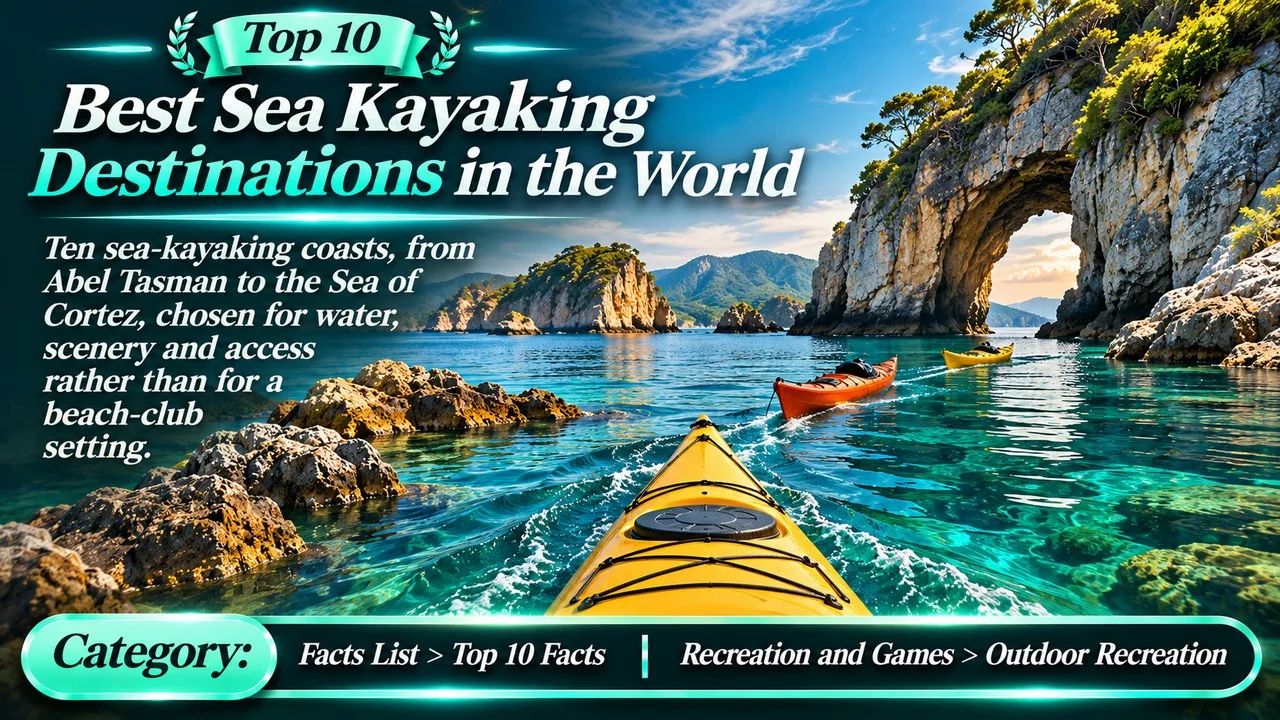
Sea kayaking is at its best where the coast, the water and the wildlife are the reason for the trip, not only a rented boat on a busy beach. A destination can be famous and still be a poor place to paddle if the water is overcrowded, poorly guided, or closed by rules that a brochure has ignored [1][2].
This is a curated 2026 list, not a count of tour-operator listings. It favours coasts where sea kayaks are a normal, documented way to travel among islands, fjords, cliffs or mangrove and cactus shores. Several of the strongest places, including the Galapagos and parts of Baja California, are regulated, seasonal, or both. A responsible visit starts with permits, local guides and wildlife distance, not with a high-speed photo stop [3][4].
Key Facts
"Sea kayaking" here means paddling on salt water or in large marine inlets, including fjords and island groups. Status and access notes are as of November 2026.
Sea Kayaking Destinations at a Glance
| Rank | Destination | Country | Why it is here | 2026 practical note |
|---|---|---|---|---|
| 1 | Abel Tasman National Park | South Island, New Zealand | Golden bays, granite headlands and a marked coastal track that can be combined with paddling | Popular; book water taxis and camps early |
| 2 | Baja California and the Sea of Cortez | Mexico | Desert islands, sea caves and marine wildlife | Seasonal; use licensed operators |
| 3 | Galapagos Islands | Ecuador | Unique wildlife, tightly controlled water access | Kayaking is regulated; go with a permitted operator |
| 4 | Phang Nga Bay | Thailand | Limestone karsts, lagoons and mangrove channels | The bay, not a beach strip in Phuket town, is the paddling ground |
| 5 | The Westfjords | Iceland | Steep fjords, bird cliffs and cold, clear water | Short season; weather is the main constraint |
| 6 | The Lofoten Islands | Norway | Arctic-circle peaks rising straight from the sea | Midnight sun in summer; wind and swell still matter |
| 7 | Sardinia | Italy | Cliffed coasts, sea caves and clear Mediterranean water | A long season, but the best coves are not the ferry ports |
| 8 | Kornati and the Dalmatian coast | Croatia | Island chains and stark limestone shores | Park rules apply in the Kornati archipelago |
| 9 | Johnstone Strait and Vancouver Island | Canada | Temperate rainforest shore and a famous orca passage | Go with wildlife-aware guides; keep legal distances |
| 10 | Lan Ha Bay and Ha Long Bay | Vietnam | Karst islands and sheltered paddling water | Lan Ha is often quieter than the busiest Ha Long routes |
1. Abel Tasman National Park
Abel Tasman National Park, at the north of New Zealand's South Island, is a classic sea-kayak coast: tidal golden beaches, granite headlands, clear water and a marked walking track that can be combined with paddling and water-taxi legs [1][5]. The park is first because the paddling is the point of being there, not a side activity added to a resort beach.
It is also popular, which is the main 2026 caveat. Camps, water taxis and kayak departures should be booked in peak months, and some beaches and islands have seasonal closures for nesting birds or for restoration. Tides in the larger inlets, including the well-known crossing to Adele Island and the tidal estuary at Awaroa, are part of the planning, not a surprise to discover at low water [1][5].
Independent paddlers need the usual coastal skills. Guided trips remain a good option for people who want the coast without having to judge every wind change on a first visit [1].
2. Baja California and the Sea of Cortez
The Gulf of California, often called the Sea of Cortez, along the Baja California peninsula, is one of the great desert-and-sea paddling grounds: isolated islands, cactus slopes, sea caves and a wildlife list that can include sea lions, dolphins and, in season, larger whales [2][4]. The scale is larger than Abel Tasman, and the logistics are more expedition-like.
A typical strong trip is a multi-day island-hopping route from a town such as Loreto, La Paz or Bahia de los Angeles, run by a licensed operator, with camping or simple shore camps. Summers can be extremely hot; late autumn through spring is the usual paddling season for many routes. Permits and protected-area rules apply around some islands [2][4].
It is second because the landscape and the marine life are exceptional, and because the trip rewards people who treat it as a planned expedition rather than as a casual hourly rental [2].
Related: Grand Canyon: A Geological Marvel Carved by the Colorado River
3. Galapagos Islands
Sea kayaking in the Galapagos is tightly controlled, and that is the first fact to state. Visitors paddle on approved routes, usually from a licensed vessel or with a permitted operator, and they do not have the freedom to land or approach animals at will. The islands remain one of the world's most distinctive places to be in a small boat among wildlife that is often unusually unafraid of people [3][4].
The destination is third, not first, because access is regulated and because a Galapagos trip is rarely a pure kayak expedition in the way a Baja island trip can be. When kayaking is part of a well-run visit, though, it is one of the few ways to move quietly along a shore that is otherwise seen from a larger ship [3].
Anyone considering this in 2026 should work only with operators who can show the correct permits. Informal paddling is not a loophole; it is a way to harm a protected archipelago [3][4].
4. Phang Nga Bay
Phang Nga Bay, on the Andaman coast of Thailand, is the limestone karst seascape that older lists often labelled simply as "Phuket." The paddling is among the towers, hongs (hidden lagoons) and mangrove channels of the bay, not along the main Phuket beach road [1][5]. That distinction is why the entry is named for the bay.
The water is usually sheltered compared with open ocean, which makes the area welcoming for less experienced paddlers, but it is also busy. A good 2026 trip starts early, uses a guide who knows which lagoons can be entered on the tide, and avoids crowding a single famous cave with a convoy of boats [5].
It is fourth as a spectacular, accessible karst coast. It is not higher because crowding can undo the quiet that kayaks are meant to provide [1][5].
5. The Westfjords
The Westfjords of Iceland, including the waters around Isafjordur, offer steep fjord walls, bird cliffs and cold, clear water that still feels remote by European standards. Sea kayaking here is a summer activity in practice: shoulder seasons are possible for experienced paddlers, but weather, water temperature and daylight are serious constraints [1][5].
Related: Mount Everest: The Pinnacle of Earth's Heights
The reward is a paddling landscape that is not a tropical postcard. You move under cliffs, across still fjord arms that can turn windy without much warning, and along shores where a village or a lonely farm is often the only settlement in view. Guided trips out of Isafjordur and nearby villages are the usual introduction [5].
It is fifth as a cold-water counterpart to the first four destinations, and as a reminder that "best" in this category is not the same as "warmest" [1].
6. The Lofoten Islands
The Lofoten Islands, north of the Arctic Circle in Norway, rise as sharp granite peaks straight from the Norwegian Sea. Sea kayaks move among fishing villages, sheltered passages and, on calmer days, more exposed walls of rock. In midsummer the midnight sun stretches the paddling day; the water remains cold, and wind and swell can still close a planned crossing [5][6].
Reinsfjorden, the waters around Reine and Hamnoy, and other inner sounds are popular starting areas, but the islands are not a theme park. A 2026 visit should be built around a weather window, dry suits or equivalent protection, and a realistic route, whether guided or independent [6].
Lofoten is sixth because the scenery is among the most dramatic on this list, while the skill and climate bar is higher than in Phang Nga or Abel Tasman. That is a feature of the place, not a flaw in the ranking [5][6].
7. Sardinia
Sardinia has a long, varied Mediterranean coastline of limestone cliffs, sea caves, hidden beaches and clear water. The best kayaking is not at the ferry ports. It is along stretches such as the Gulf of Orosei on the east coast, parts of the Maddalena archipelago, and other cliffed sections where a small boat is the practical way to reach coves [1][5].
The season is long compared with Iceland or Lofoten, which is one reason Sardinia remains a strong 2026 choice for paddlers who want sea cliffs without Arctic water. Summer weekends can be busy near the most famous grottoes; early starts and midweek days help [5].
Related: Top 10 Most Beautiful Slot Canyons
It is seventh as a reliable, beautiful limestone coast with genuine sea-cave paddling. It is not an expedition destination in the Baja sense, and it does not need to be [1].
8. Kornati and the Dalmatian coast
Croatia's Dalmatian coast, and the Kornati islands in particular, offer a different limestone world from Sardinia: bare, pale islands, stark channels and a park landscape that is almost architectural in its dryness. Kayaks are a good way to move through that maze at a human speed [1][5].
Kornati National Park has access rules and fees, and some landing points are restricted. The wider Dalmatian coast, including waters near Dubrovnik and the Elaphiti islands, is easier to reach but also more trafficked by trip boats. A useful 2026 plan is to treat the park islands as the core paddling day and the better-known walled towns as the evening stop, not the other way around [5].
It is eighth because the island geography is outstanding, while crowding and park rules need more attention than a casual brochure may suggest [1][5].
9. Johnstone Strait and Vancouver Island
Johnstone Strait, along the northeast side of Vancouver Island in British Columbia, is one of the better-known temperate-water kayak routes in North America, in part because it is a passage for orcas as well as a forested, tidal shore. The surrounding inlets and island groups, including parts of the Broughton archipelago, extend the paddling beyond a single strait [4][6].
Wildlife is the ethical test here. Distances from orcas and other marine mammals are regulated, and a good guide will stay well back rather than chase a photograph. Cold water, currents and ship traffic are the other planning facts. This is not a beginner rental in a closed lagoon [4][6].
Related: Top 10 Most Dangerous Roads in the World
It is ninth as a strong wildlife and rainforest coast, and as the Pacific Northwest representative on a list that would be weaker without a cold, forested shore to sit beside the desert and karst entries [6].
10. Lan Ha Bay and Ha Long Bay
Ha Long Bay is the world-famous karst seascape in northern Vietnam; Lan Ha Bay, around Cat Ba, is the neighbouring water that many paddlers now prefer because it can be less congested while sharing the same limestone towers and sheltered channels [5][6]. Kayaks, often launched from a junk or from the Cat Ba side, can enter lagoons and move among islands at a quieter pace than the large tourist boats.
The usual caveats apply. Some routes are busy, weather and visibility vary, and a low-quality tour can reduce the day to a short paddle among many engines. A 2026 trip should favour operators who spend real time on the water in Lan Ha or in less crowded corners of the bay [5].
It is tenth as a spectacular, accessible karst coast that still rewards a careful choice of route. It is a partner to Phang Nga rather than a copy of it [5][6].
Conclusion
The ten coasts above are strong in different ways: desert islands, cold fjords, temperate rainforest and crowded but spectacular karst bays [1][5]. A 2026 paddler should match the destination to skill, season and the local rules, especially where wildlife or a national park is the reason for going.
There are other excellent sea-kayak waters, from Scotland to Alaska and from Palawan to the Greek islands. This list is a starting map of places where a kayak is still one of the best ways to travel, not a claim that no other shoreline is worth a launch [4][6].
- ^ [1] "Abel Tasman National Park" and general sea-kayak destination notes. Department of Conservation, New Zealand. Abel Tasman National Park
- ^ [2] "Gulf of California" and Baja paddling geography. Wikipedia. Wikipedia: Gulf of California
- ^ [3] Galapagos National Park access and visitor rules. Galapagos National Park
- ^ [4] Wildlife-distance and protected-area guidance for sea kayakers, including Mexican and Canadian waters. NOAA Fisheries / Parks Canada summaries. NOAA Fisheries
- ^ [5] Regional paddling guides for Phang Nga, the Westfjords, Sardinia, Kornati and Ha Long / Lan Ha. Wikipedia and park pages. Wikipedia: Phang Nga Bay
- ^ [6] "Lofoten" and "Johnstone Strait" geographic overviews. Wikipedia. Wikipedia: Lofoten




















Discussion
Log in with