






 By
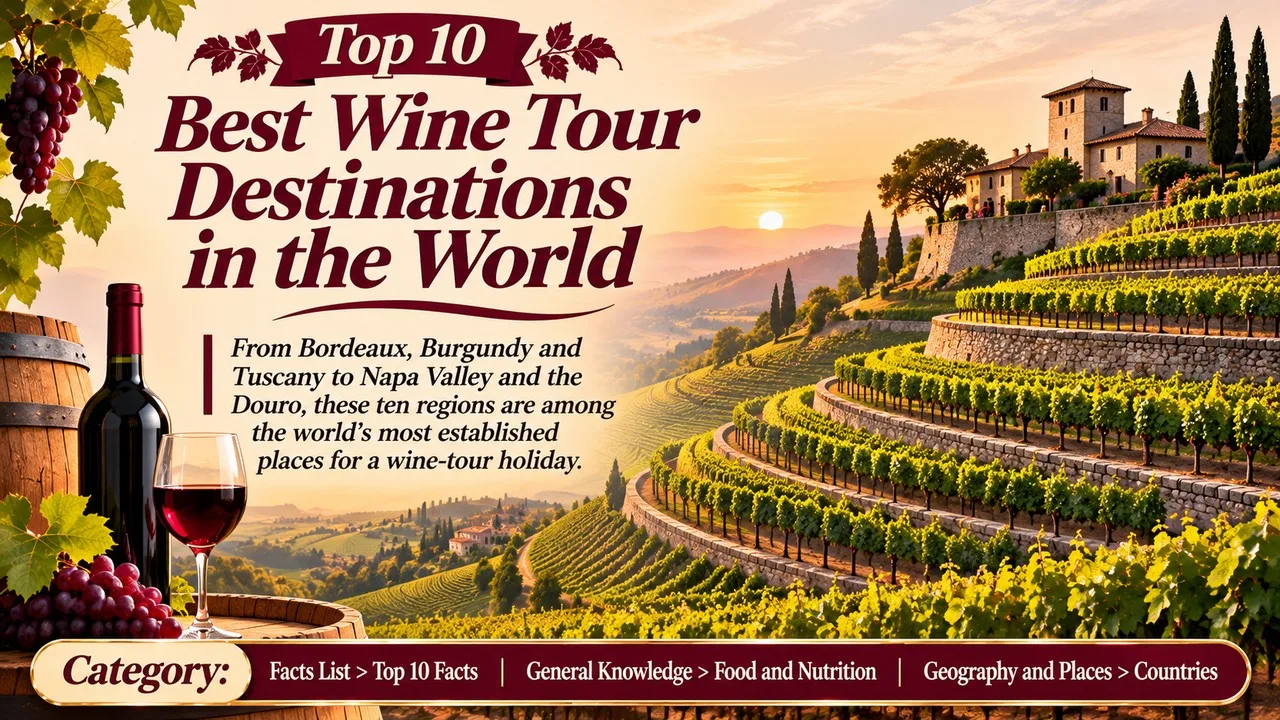
From Bordeaux and Tuscany to Napa Valley and the Douro, these ten regions are among the world's most established wine-tour destinations. There is no single official ranking of wine-tourism regions, so this list is a curated set of places with a long cellar-door tradition, distinctive wines and a travel infrastructure that visitors actually use [1].
The selection favours regions that are famous for wine travel itself, not only for production volume. That is why Burgundy and the Douro appear alongside larger New World names, and why famous areas such as Champagne, the Loire, Rioja's neighbours in Ribera del Duero, and New Zealand's Central Otago are noted at the end rather than forced into a longer list [1][2].
Visitor totals are not published on the same basis everywhere. Where a recent regional figure exists, it is dated. Otherwise the case rests on UNESCO status, historic wine landscapes and the density of wineries that receive guests. Figures are as of November 2026.
Key Facts
The table gives each region's country, a signature wine style or landscape, and why travellers go.
Wine Tour Destinations at a Glance
| Rank | Region | Country | Signature wines | Notable fact |
|---|---|---|---|---|
| 1 | Bordeaux | France | Cabernet-merlot blends, Sauternes | The world's best-known fine-wine region, with a dense chateau-tour map |
| 2 | Tuscany | Italy | Chianti, Brunello, Super Tuscans | Hill towns, vineyards and food culture in one trip |
| 3 | Napa Valley | United States | Cabernet Sauvignon, Chardonnay | About 3.8 million visitors and 2.8 billion dollars in wine-tourism spending in 2025 |
| 4 | Burgundy | France | Pinot Noir, Chardonnay | UNESCO-listed climats and some of the world's most studied vineyard plots |
| 5 | Douro Valley | Portugal | Port, Douro table wines | Terraced UNESCO vineyard landscape along the Douro River |
| 6 | Mendoza | Argentina | Malbec | High-altitude vineyards at the foot of the Andes |
| 7 | Cape Winelands | South Africa | Chenin Blanc, Bordeaux-style blends | Stellenbosch, Franschhoek and Constantia within reach of Cape Town |
| 8 | Barossa Valley | Australia | Shiraz | One of Australia's oldest and best-known wine-tourism regions |
| 9 | Rioja | Spain | Tempranillo blends | Spain's most famous wine denomination, with bodegas built for visitors |
| 10 | Mosel | Germany | Riesling | Steep slate slopes and riverside villages on a classic white-wine route |
1. Bordeaux
Bordeaux is the starting point for many first-time wine trips to Europe. The city sits on the Garonne, with the Medoc and Graves on the left bank and Saint-Emilion and Pomerol on the right, and a long tradition of classified chateaux that now receive visitors by appointment or through organised tours [3]. Saint-Emilion's vineyard landscape is inscribed as a UNESCO World Heritage site, which is one reason the region is as much a cultural destination as a tasting circuit [4].
The range is wide: grand cru classé estates, family properties, and the sweet wines of Sauternes and Barsac. A practical wine tour usually combines a day in the city - the Cite du Vin museum is the modern gateway - with visits in the Medoc or Saint-Emilion, rather than an attempt to cover every appellation [3].
Bordeaux's reputation can make it seem formal. In recent years more chateaux have opened tasting rooms aimed at travellers, not only at trade buyers, which has made a short visit more realistic than it once was [3].
2. Tuscany
Tuscany combines wine with the hill-town landscape that already draws visitors to Florence, Siena and the countryside between them. Chianti Classico, Brunello di Montalcino and Vino Nobile di Montepulciano are the historic denominations, while the so-called Super Tuscans, often bottled as IGT wines, added a later layer of international attention [5].
A wine tour here is almost never only about cellars. Olive oil, regional food and stays on agricultural estates are part of the same trip, which is why Tuscany remains one of the most booked wine-and-food regions in the world. The via Chiantigiana between Florence and Siena is the classic driving route; Montalcino and Montepulciano are slightly further south and are worth separate nights [5].
Related: Top 10 Most Bizarre Phobias: Strange Fears That Exist
Because the region is so popular, the best visits are often at smaller estates booked in advance, not at the most obvious roadside shops. The wines, and the landscape, still justify the planning [5].
3. Napa Valley
Napa Valley, in California, is the United States' best-known wine-tourism destination and one of the few regions that publishes substantial visitor-economy figures. Industry reports for 2025 put wine tourism at about 3.8 million visitors and about 2.8 billion dollars in spending, a reminder that cellar-door travel is a major local industry, not a sideline [6].
The valley is compact and easy to navigate, with a high density of tasting rooms along Highway 29 and the Silverado Trail. Cabernet Sauvignon from the valley floor and hillside vineyards is the signature, but the visitor offer also includes food, spa hotels and cycling. That infrastructure is a large part of why Napa, rather than a quieter California region, leads American wine travel [6][7].
It is also expensive and busy, especially at weekends. Visitors who want a calmer New World trip sometimes continue north to Sonoma or, further afield, to Oregon's Willamette Valley, which is noted below as a close counterpart [7].
4. Burgundy
Burgundy (Bourgogne) is smaller in volume than Bordeaux but, for many drinkers, even more specific. The Cote d'Or is divided into tiny vineyard plots, or climats, whose boundaries and names have been studied for centuries. The climats of the Burgundy vineyards were inscribed by UNESCO in 2015, which formally recognised a landscape already famous among wine travellers [8].
A tour here is about villages - Puligny-Montrachet, Vosne-Romanee, Meursault, Gevrey-Chambertin - and about the difference a few dozen metres can make in Pinot Noir or Chardonnay. That makes it a more intricate trip than a chateau circuit in the Medoc. Appointments are often essential, and allocations of the most famous wines may be tiny [8][2].
Beaune is the practical base, with the Hospices de Beaune as a civic as well as a wine landmark. Burgundy is included on this list for quality and for the clarity of its wine landscape, not for visitor volume [8].
5. Douro Valley
The Alto Douro wine region in northern Portugal is one of the most visually striking wine landscapes in the world: steep schist terraces along the Douro River, historically used for port and now also for unfortified Douro wines [9]. UNESCO listed the region in 2001, citing a wine-growing history of nearly two thousand years and a landscape shaped by terrace agriculture [9].
Related: Top 10 Oldest Buildings in the World
Wine tours here often combine a river cruise or train journey with quinta visits around Pinhao and Peso da Regua. Porto, at the river mouth, is the other half of the trip, with the historic port lodges of Vila Nova de Gaia [9].
The Douro is also a useful contrast to Bordeaux and Napa: the beauty of the journey is as important as the tasting room. Summer heat can be intense in the valley, so spring and autumn are the more comfortable seasons for a tour [9].
6. Mendoza
Mendoza, at the foot of the Andes in western Argentina, is South America's leading wine-tourism city. The region is best known for Malbec grown at high altitude in areas such as Lujan de Cuyo and the Uco Valley, where irrigation from Andean snowmelt makes viticulture possible in an otherwise arid climate [10].
Visitors usually base themselves in Mendoza city and fan out to bodegas that have invested heavily in restaurants and architecture as well as in wine. The setting - vineyards with a wall of mountains behind them - is a large part of the appeal and is difficult to match in Europe [10].
Mendoza is a long-haul destination for European and North American travellers, but it is a short flight from Buenos Aires and is now a standard stop on a South American wine itinerary, often paired later with a crossing to Chile's Maipo or Colchagua valleys [10].
7. Cape Winelands
The Cape Winelands around Stellenbosch, Franschhoek, Paarl and Constantia are South Africa's wine-tour heartland and are close enough to Cape Town to be visited on day trips as well as on overnight stays [11]. Constantia ranks among the earliest wine-growing districts in the Southern Hemisphere; Stellenbosch and Franschhoek provide the densest modern tasting and restaurant scene [11].
Related: The Science Behind Auroras: How Solar Winds Create Colorful Skies
The range of wines is wide, from Chenin Blanc and Pinotage to Bordeaux-style reds. What distinguishes the Cape for travellers is the combination of wine, food and mountain scenery within a small radius, plus the chance to combine a wine stay with the Cape Peninsula [11].
Wine tourism here, as in other countries, sits alongside a more complicated social history of land and labour. A serious visit can include that context rather than treating the estates as only a picturesque backdrop [11].
8. Barossa Valley
The Barossa Valley, north-east of Adelaide in South Australia, is Australia's best-known wine-tourism region and a specialist in old-vine Shiraz, as well as in Riesling from the neighbouring Eden Valley [12]. Regional tourism figures are smaller than Napa's, but the area is set up for cellar-door visits, with a dense cluster of wineries, bakeries and farm food around Tanunda, Nuriootpa and Angaston [12].
The Barossa's visitor identity is also cultural: a Lutheran and Silesian settler history that is still visible in place names, food and festivals. That gives a tour more texture than a simple tasting trail [12].
For a wider Australian trip, the Barossa is often combined with McLaren Vale or, for those with more time, with Margaret River in Western Australia. It is listed here because it remains the country's signature wine-travel name [12].
9. Rioja
Rioja, in northern Spain, is the country's most famous wine denomination and a mature wine-tourism region, with bodegas ranging from traditional underground cellars to landmark modern buildings by well-known architects [13]. Tempranillo, usually blended with Garnacha, Graciano or Mazuelo and aged in oak, is the core style, with a labelling system based on ageing that visitors quickly learn to read [13].
Haro, Logrono and the villages of Rioja Alavesa are the usual bases. The region is compact enough for a two- or three-day tour and is well connected to Bilbao and the Basque coast, which makes it easy to combine with a wider northern-Spain trip [13].
Related: Top 10 Tallest Buildings in the World
Rioja is sometimes overshadowed in fashion by Priorat or Ribera del Duero, but for a first wine tour in Spain it is still the most complete destination: history, a clear wine style, and a large number of cellars that are used to receiving guests [13].
10. Mosel
The Mosel, in Germany, is one of the classic white-wine landscapes: extremely steep slate slopes above a looping river, planted mainly with Riesling, and dotted with villages such as Bernkastel-Kues, Piesport and Cochem [14]. The combination of river travel, terraced vineyards and small family estates makes it a natural touring region, especially in late summer and early autumn.
A wine trip here is slower than in Napa or even Bordeaux. Many estates are small, the best vineyards are literally steep, and the pleasure is as much in the river setting as in any single famous bottle. Riesling from the Mosel can be dry or visibly sweet; visitors should not assume one style [14].
The region belongs on a global list because it is the clearest example of a northern European wine landscape that people travel to see, not only to taste. The Rhine's neighbouring stretches, including the UNESCO-listed Upper Middle Rhine Valley, offer a related but busier river-and-vineyards route [14][15].
Conclusion
These ten destinations run from the classified chateaux of Bordeaux and the climats of Burgundy to river terraces in the Douro and Mosel, hill towns in Tuscany and Rioja, and New World centres in Napa, Mendoza, the Cape and the Barossa. Together they cover the main ways people actually take a wine trip: estate visits, village-to-village drives and river journeys.
Close alternatives that could have been included are Champagne and the Loire in France, Ribera del Duero in Spain, Willamette Valley in Oregon, and Central Otago or Marlborough in New Zealand. Any of those would be a strong eleventh entry. The safer plan is to pick one region and stay long enough to visit a few estates properly, rather than to collect stamps from all ten.
- ^ [1] "Wine tourism". Wikipedia. Wikipedia: Wine tourism
- ^ [2] "Great Wine Capitals". Great Wine Capitals Global Network. Great Wine Capitals
- ^ [3] "Bordeaux wine". Wikipedia. Wikipedia: Bordeaux wine
- ^ [4] "Jurisdiction of Saint-Emilion". UNESCO World Heritage Centre. UNESCO: Jurisdiction of Saint-Emilion
- ^ [5] "Tuscan wine". Wikipedia. Wikipedia: Tuscan wine
- ^ [6] "Napa Valley wine tourism generated 2.8 billion in 2025". Vinetur. Vinetur: Napa Valley 2025 wine tourism
- ^ [7] "Napa Valley AVA". Wikipedia. Wikipedia: Napa Valley AVA
- ^ [8] "The Climats, terroirs of Burgundy". UNESCO World Heritage Centre. UNESCO: Climats of Burgundy
- ^ [9] "Alto Douro Wine Region". UNESCO World Heritage Centre. UNESCO: Alto Douro Wine Region
- ^ [10] "Mendoza wine". Wikipedia. Wikipedia: Mendoza wine
- ^ [11] "South African wine". Wikipedia. Wikipedia: South African wine
- ^ [12] "Barossa Valley (wine)". Wikipedia. Wikipedia: Barossa Valley wine
- ^ [13] "Rioja DOCa". Wikipedia. Wikipedia: Rioja
- ^ [14] "Mosel (wine region)". Wikipedia. Wikipedia: Mosel wine region
- ^ [15] "Upper Middle Rhine Valley". UNESCO World Heritage Centre. UNESCO: Upper Middle Rhine Valley






















Discussion
Log in with