






 By
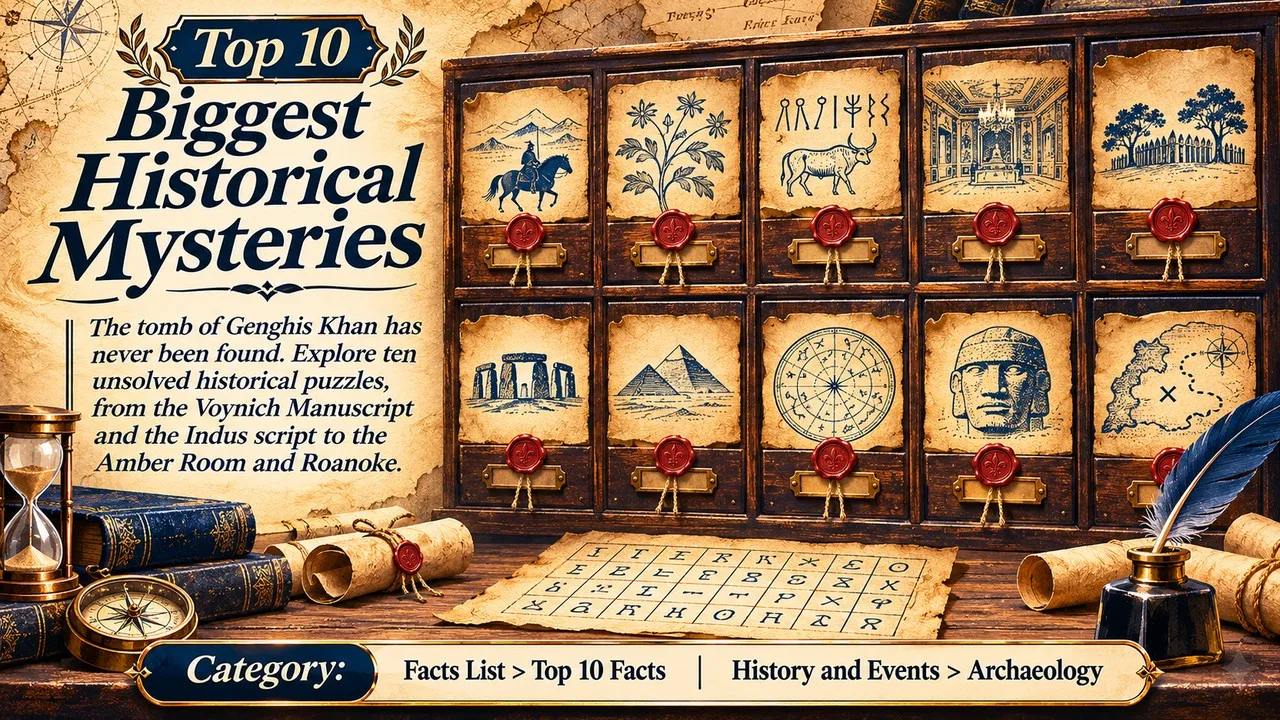
The tomb of Genghis Khan has never been found, and it remains one of history's most durable unsolved questions. After the Mongol emperor died in 1227, according to later tradition, his burial place was kept secret, and no excavation has yet produced a scholarly consensus on its location [1].
This list is limited to historical puzzles that serious researchers still discuss: missing tombs, undeciphered scripts, a vanished work of art, and two famous disappearances from early modern England and colonial North America. It leaves out speculative claims about ancient aliens, and it leaves out modern incidents that belong more to astronomy or true crime than to history. Finepedia already has a separate article on the search for Cleopatra's tomb, which is why that case is noted at the end rather than repeated here [1][2].
"Unsolved" does not mean that nothing is known. In several of these cases the range of plausible answers has narrowed. What is missing is a widely accepted final proof. The state of research below is as of November 2026.
Key Facts
The table gives each mystery, its period or place, and the core question that remains open.
Historical Mysteries at a Glance
| Rank | Mystery | Place or culture | Period | What remains unsolved |
|---|---|---|---|---|
| 1 | Tomb of Genghis Khan | Mongolia / northern China | 1227 | The burial site has not been identified |
| 2 | Voynich Manuscript | Europe (unknown author) | Early 15th century | The script and language are still undeciphered |
| 3 | Indus script | Indus Valley civilisation | c. 2600-1900 BCE | No accepted decipherment of the signs |
| 4 | Linear A | Minoan Crete | c. 1800-1450 BCE | The language behind the script is unknown |
| 5 | Phaistos Disc | Phaistos, Crete | 2nd millennium BCE | Purpose, language and meaning are all debated |
| 6 | Tomb of Alexander the Great | Egypt, after a death in Babylon | 323 BCE onwards | The later burial place in Egypt has been lost |
| 7 | Amber Room | Prussia, then Russia, then wartime Germany | 18th century-1945 | The original panels disappeared at the end of the Second World War |
| 8 | Princes in the Tower | England | 1483 | The fate of Edward V and his brother Richard is unproven |
| 9 | Roanoke Colony | Present-day North Carolina, United States | 1587-1590 | The settlers vanished; their exact fate is unknown |
| 10 | Rongorongo | Rapa Nui (Easter Island) | 19th century (glyphs older?) | The glyphs have not been deciphered |
1. Tomb of Genghis Khan
Genghis Khan, who founded the Mongol Empire, died in 1227 during a campaign against the Tangut Xia state. Later Mongol tradition holds that he was taken back for burial in a secret place, that the funeral escort killed witnesses, and that the grave was left unmarked [1]. Modern searches have focused on areas such as the Burkhan Khaldun massif in the Khentii mountains, a region with deep associations in The Secret History of the Mongols, but no tomb has been authenticated [1].
The problem is both archaeological and political. Mongolia has often been cautious about large-scale excavation at sites that may be sacred, and remote sensing has produced candidate features rather than a settled identification. Claims of a discovery appear from time to time and have not lasted under scrutiny [1].
Until a burial can be tied to the historical person by inscriptions, grave goods and a convincing landscape context, the tomb remains missing. That is rare for a ruler of this importance, and it is why the question still leads lists of unsolved historical problems [1].
2. Voynich Manuscript
The Voynich Manuscript is a richly illustrated codex, now at Yale University's Beinecke Library, written in an unknown script and conventionally dated to the early fifteenth century on the basis of radiocarbon tests of the parchment [3]. It contains drawings of unidentified plants, astronomical diagrams, and groups of nude female figures in pools, all accompanied by flowing text that has resisted a generally accepted decipherment [3].
The book is named after Wilfrid Voynich, who acquired it in 1912. Since then, professional cryptographers, linguists and amateur solvers have proposed Hebrew, Latin, a constructed language, a hoax, and many other explanations. None has become standard [3]. Statistical studies suggest that the text has some of the structure of a real language, which is one reason a simple "meaningless hoax" answer has not closed the case [3].
Related: Top 10 Things That Existed While Woolly Mammoths Were Still Alive
The mystery is unusually well documented because the object still exists and can be examined. What is missing is the key: a language, a cipher, or a proof that the text was never meant to be read [3].
3. Indus script
The Indus or Harappan script appears on seals, pottery and other objects from the Indus Valley civilisation, which flourished in parts of present-day Pakistan and north-west India in the third millennium BCE [4]. There are thousands of short inscriptions, but no bilingual text comparable to the Rosetta Stone, and the average inscription is only a few signs long [4].
Without longer texts, it is hard to prove whether the signs record a language, a system of names and titles, or something closer to a set of non-linguistic symbols. Proposed links to later Dravidian or Indo-Aryan languages remain unproven [4]. The script disappeared as the urban civilisation declined, which also cut off any later literate tradition that might have explained it.
A convincing decipherment would change what can be said about one of the world's earliest cities. Until then, Harappan political history has to be reconstructed mainly from archaeology, not from the people's own words [4].
4. Linear A
Linear A was the main script of Minoan Crete before Linear B, and it was used in the first half of the second millennium BCE [5]. Linear B was deciphered in the 1950s and shown to record an early form of Greek. Linear A looks related in its signs, but the underlying language is not Greek, and it has not been identified with any known tongue [5].
That leaves a strange situation: scholars can sometimes guess the meaning of a sign because of its later Linear B value, yet they still cannot read Linear A texts as a language. Most surviving inscriptions are short and administrative, which limits the material even further [5].
If Linear A were deciphered, it would open a direct written window on Minoan society, rather than one seen through later Greek myth and archaeology. For now it remains the more famous undeciphered cousin of a script that has already been solved [5].
5. Phaistos Disc
The Phaistos Disc is a fired clay disc, found in 1908 at the Minoan palace of Phaistos on Crete, stamped on both sides with a spiral of unique pictorial signs [6]. It is usually dated to the second millennium BCE, but even the date has been discussed, and there is no second object inscribed in the same way [6].
Related: Top 10 Oldest Continuously Inhabited Cities
Because the text is unique, statistical decipherment is almost impossible. Suggestions have ranged from a hymn or a game to a more mundane inventory, in languages from Minoan to something imported from elsewhere in the eastern Mediterranean. None has wide academic acceptance [6].
The disc is therefore a narrower mystery than Linear A or the Indus script, which at least exist in many examples. Its fame comes from the beauty of the object and from the fact that a single find can still resist explanation more than a century after it was dug up [6].
6. Tomb of Alexander the Great
Alexander the Great died in Babylon in 323 BCE. Ancient sources say that his body was taken on a long funeral journey and that Ptolemy I diverted it to Egypt, where a tomb, the Soma or Sema, later stood in Alexandria and was visited by Roman emperors [7]. At some point in late antiquity the tomb's location was lost, and it has not been identified in the modern city [7].
Archaeologists have searched in Alexandria and, at times, at other sites in the Nile Delta and in Macedonia. The work is hampered by the fact that ancient Alexandria now lies under a dense modern city and partly under water. Occasional announcements of a find have not produced a tomb that specialists accept as Alexander's [7].
The contrast with the well-studied royal burials at Vergina in Macedonia is sharp. Those tombs have been linked, with debate, to Alexander's family. His own burial, once a public monument in a major city, has slipped out of the archaeological record [7].
7. Amber Room
The Amber Room was a set of amber panels, mirrors and mosaics assembled in the eighteenth century for Prussian and then Russian royal palaces, and installed at Catherine Palace in Tsarskoye Selo near St Petersburg [8]. German forces dismantled the room in 1941 and took it to Konigsberg (now Kaliningrad). In the chaos at the end of the Second World War the panels disappeared [8].
Related: Top 10 Architectural Wonders of the Ancient World
The most common scholarly view is that the room was destroyed in the bombing and burning of Konigsberg Castle, but missing-crate theories have never entirely died, and fragments have occasionally surfaced. A full reconstruction, based on photographs and leftover material, was opened at Catherine Palace in 2003 [8].
The mystery is therefore about the original work, not about whether visitors can see an Amber Room today. The reconstruction is a separate, documented achievement. What happened to the eighteenth-century panels remains, at best, a well-argued inference rather than a closed file [8].
8. Princes in the Tower
In 1483, after the death of Edward IV, his sons Edward V and Richard, Duke of York, were lodged in the Tower of London and then vanished from public view [9]. Their uncle became Richard III. Later Tudor histories accused him of having the boys murdered, and two skeletons found under a staircase in the Tower in 1674 were placed in Westminster Abbey as the princes' remains, but they have not been tested in a way that would now be considered conclusive [9].
Alternative theories blame other political actors, or suggest that one or both boys survived for a time. The survival claims have not been proved either. The case sits at the meeting point of limited fifteenth-century evidence and a very large later literature [9].
Until the Abbey bones, or other remains, can be lawfully and conclusively identified, the princes' fate is a historical judgement, not a demonstrated fact. That is why the question remains open more than five centuries later [9].
9. Roanoke Colony
The Roanoke colony was an English settlement planted in 1587 on Roanoke Island, in what is now North Carolina. When the governor, John White, returned from a delayed supply trip in 1590, the colonists were gone. The letters "CROATOAN" had been carved on a post, and "CRO" on a tree, apparently as a pre-agreed sign, without the emergency marker that was supposed to accompany a forced departure [10].
The most plausible explanations are that the settlers moved to join Indigenous communities, possibly on Hatteras Island (then associated with the name Croatoan), or that they broke into smaller groups and later died or were killed. Archaeology has produced suggestive finds but not a full account of the colony's end [10].
Related: Top 10 Oldest Buildings in the World
Roanoke is often called "the Lost Colony", which can make it sound more supernatural than it is. The historical problem is ordinary and hard: a small group on a poorly supplied frontier, a missed rendezvous, and a thin paper trail [10]. For vanished cities rather than a single settlement, see Finepedia's list of lost cities that were rediscovered.
10. Rongorongo
Rongorongo is a system of glyphs found on wooden tablets from Rapa Nui (Easter Island). The tablets were collected in the nineteenth century, after the island's society had already been disrupted by raids, disease and conversion, and no reader who could clearly explain the signs has left a usable key [11]. About two dozen genuine objects survive, mostly in European and American museums [11].
Whether rongorongo is a full writing system, a memory aid for chants, or a mixture of the two is still debated. Attempts at decipherment have not reached the kind of agreement that followed the cracking of Linear B or Mayan glyphs [11]. The loss of oral knowledge in the nineteenth century is a large part of why the signs now stand almost alone.
Rongorongo matters because independent writing systems are rare in human history, and because it may be one of the few developed in the Pacific. Until the signs can be read, that "may" cannot be removed [11].
Conclusion
The ten cases above are unsolved in different ways. Some, such as the Voynich Manuscript and the Phaistos Disc, are objects in museums that still cannot be read. Others are absences: the tombs of Genghis Khan and Alexander, the Amber Room, the princes, and the Roanoke settlers. Linear A, the Indus script and rongorongo are whole writing traditions without a key.
None of these problems is empty of evidence, and some may be solved by a new inscription, a laboratory test or a better reading of a familiar source. Until that happens, they remain among the biggest historical mysteries that can be discussed without leaving the documentary and archaeological record. For a related royal-tomb search that already has its own Finepedia article, see the search for Cleopatra's tomb.
- ^ [1] "Tomb of Genghis Khan". Wikipedia. Wikipedia: Tomb of Genghis Khan
- ^ [2] "List of unsolved historical mysteries and proposed explanations". Wikipedia. Wikipedia: unsolved historical mysteries
- ^ [3] "Voynich manuscript". Wikipedia. Wikipedia: Voynich manuscript
- ^ [4] "Indus script". Wikipedia. Wikipedia: Indus script
- ^ [5] "Linear A". Wikipedia. Wikipedia: Linear A
- ^ [6] "Phaistos Disc". Wikipedia. Wikipedia: Phaistos Disc
- ^ [7] "Tomb of Alexander the Great". Wikipedia. Wikipedia: Tomb of Alexander the Great
- ^ [8] "Amber Room". Wikipedia. Wikipedia: Amber Room
- ^ [9] "Princes in the Tower". Wikipedia. Wikipedia: Princes in the Tower
- ^ [10] "Roanoke Colony". Wikipedia. Wikipedia: Roanoke Colony
- ^ [11] "Rongorongo". Wikipedia. Wikipedia: Rongorongo




















Discussion
Log in with