






 By
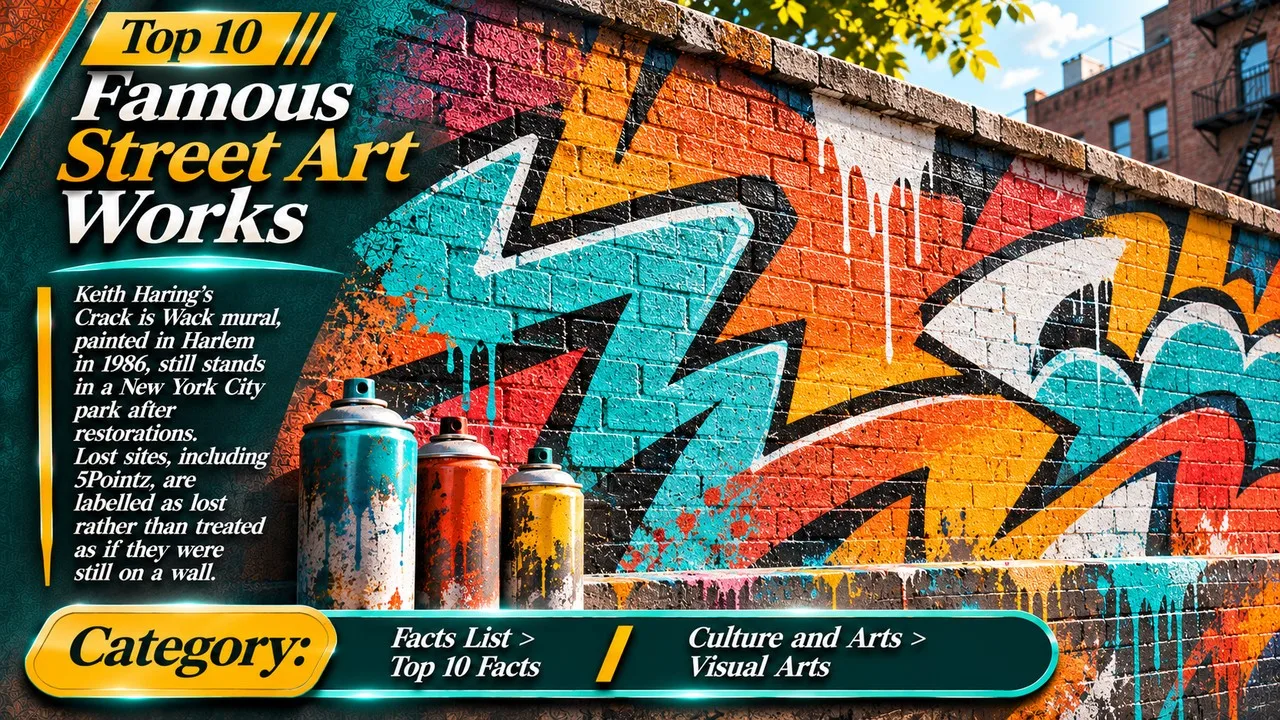
The street-art works in this list are documented public pieces, described rather than reproduced, and lost works are clearly labelled as lost. The images that made these works famous are almost all under copyright, so this article gives locations, dates and status, and it does not describe them stroke by stroke in a way that would stand in for a picture [1][2]. The featured-image brief for this post follows the same rule: no copies of real murals.
"Street art" here includes commissioned murals that began as unsanctioned or community work, legal memorial walls, and a demolished site whose legal afterlife is part of the story. Rank is editorial, by documentary fame and by whether a 2026 visitor can still find the work, or must understand that it is gone [3][4].
Key Facts
Status is given as existing, rotating, or lost. Rank 1 is a still-standing, officially recognised mural with a firm date.
Famous Street Art Works at a Glance
| Rank | Work or site | Place | Date | 2026 status |
|---|---|---|---|---|
| 1 | Crack is Wack | Harlem, New York | 1986 | Existing, in a city park, restored |
| 2 | Tuttomondo | Pisa, Italy | 1989 | Existing, on a church wall |
| 3 | East Side Gallery | Berlin, Germany | 1990 | Existing memorial stretch of the Berlin Wall |
| 4 | Chicano Park murals | San Diego, United States | From 1970 | Existing ensemble; a National Historic Landmark |
| 5 | Flower Thrower (Banksy) | Bethlehem area | About 2003 | Widely documented; street works can be painted over or protected, so status should be checked |
| 6 | Invader mosaics | Paris and other cities, from Paris | From 1998 | Many still exist as a scattered body of work |
| 7 | The Bowery Mural Wall | New York, United States | Site since the 1980s | Existing wall; the painting itself rotates |
| 8 | Vhils facade carvings | Lisbon, Portugal, and elsewhere | From the 2000s | Multiple existing carved facades |
| 9 | Ethnicities (Eduardo Kobra) | Rio de Janeiro, Brazil | 2016 | A major documented mural on the Olympic Boulevard; condition should be checked |
| 10 | 5Pointz | Long Island City, New York | 1990s to 2013 | Lost: whitewashed and demolished; important in court |
1. Crack is Wack
Keith Haring painted Crack is Wack in 1986 on a handball-court wall in a park along the Harlem River Drive service area in East Harlem, as a public warning during the crack-cocaine crisis [1]. The mural has been vandalised and restored and is now in the care of New York City Parks. It still stands in 2026 as a legal, visit-able work, which is rarer than Haring's temporary subway drawings.
It is first because the date, the site, and the continued public life of the wall can all be checked, and because the work is both a piece of art history and a dated public-health statement [1]. This article does not reproduce the figures on the wall.
A park mural can be damaged again. The official park, not a mural app, is the status source [1].
2. Tuttomondo
Tuttomondo is a large mural Keith Haring painted in 1989 on the rear wall of the church of Sant'Antonio Abate in Pisa, one of his last public works [2]. It remains in place and is maintained as a civic and tourist fact of the city, a legally painted wall rather than a hidden street corner.
It is second as a still-existing late Haring mural in Europe, with a clear date and a building that can be found without a rumour [2]. Together with Crack is Wack it shows two official afterlives of the same artist, one in a New York park and one on an Italian church.
Pisa's other fame is a tower. This wall is a separate, later monument [2].
3. East Side Gallery
The East Side Gallery is a roughly kilometre-long stretch of the Berlin Wall along the Spree, painted in 1990 by artists from many countries after the wall's opening, and later protected as a memorial [3]. Individual panels have been restored, contested, and in some cases damaged or boxed in; the ensemble still exists as a public outdoor gallery and historic monument.
Related: Top 10 Best Countries for Street Art
It is third as the outstanding surviving painted-wall memorial of 1990, a street-art site that is also official history [3]. Named panels, including Dmitri Vrubel's widely reproduced fraternal-kiss image, are copyrighted and are not copied here.
A memorial wall is not a free sketchbook. Conservation rules apply, and they have been the subject of public argument [3].
4. Chicano Park murals
Chicano Park, under the San Diego–Coronado approach in the Barrio Logan, has been painted by Chicano artists since 1970, after a community action to claim the land as a park [4]. The mural ensemble is now a National Historic Landmark. The works are a living set: some have been restored, some added, and the park remains a civic space, not a sealed museum.
It is fourth as a still-existing, officially recognised ensemble whose origin is a documented land struggle, not a gallery commission dropped onto a wall [4]. The park is the work as much as any single panel.
Visitors should treat the park as a neighbourhood place. Restoration is ongoing work, not a one-time reveal [4].
5. Flower Thrower (Banksy)
A Banksy stencil often called Flower Thrower, or Love is in the Air, appeared in the Bethlehem area about 2003, during the artist's West Bank works, and became one of the most widely circulated street-art images in the world [5]. Banksy works are copyrighted, frequently copied without permission, and sometimes removed, covered, or fitted with informal protection. This article records the work's fame and approximate date, and it does not reproduce the image.
It is fifth as a single, globally famous stencil whose 2026 existence on the original wall should be checked on the ground, because street walls in that landscape change [5]. Attribution follows the artist's documented body of work; many copycats exist.
Related: Top 10 Most Famous Paintings in the World
A souvenir shop print is not the mural. The site, if it remains, is [5].
6. Invader mosaics
The French artist known as Invader began tiling small space-invader mosaics on Paris walls in 1998 and later extended the system to many other cities, mapping the pieces as a kind of worldwide invasion [6]. Individual tiles are often still in place years later, because they are small, ceramic, and sometimes overlooked; others are stolen or destroyed. The "work" here is the documented series, not one tile.
It is sixth as a still-findable, systematically documented body of unsanctioned-or-semi-tolerated street mosaics, with a clear starting year in Paris [6]. The artist's maps are a primary record; they are also a commercial and legal object.
Removing a tile from a wall is theft, not collecting. That is worth stating [6].
7. The Bowery Mural Wall
The wall at the corner of Houston Street and the Bowery in Manhattan has been a painted landmark since the 1980s, including early work associated with Keith Haring, and it later became a curated, rotating mural site with a succession of invited artists [7]. The famous "work" is therefore the wall as a continuing institution: the painting you see in 2026 may not be the painting in a 2010 photograph.
It is seventh as a documented New York street-art site whose uniqueness is continuity plus change [7]. A rotating wall is not lost; it is also not a permanent mural, and this list keeps that distinction clear.
Official or lease-holder commissions now govern the wall. A spray-can nostalgia does not [7].
Related: Top 10 Most Popular Artists of All Time
8. Vhils facade carvings
Alexandre Farto, who works as Vhils, has since the 2000s carved and excavated monumental portrait faces into building facades, with an early and still-visible concentration in Lisbon [8]. The works are public, often legal or commissioned, and they last in a different way from paint: they are part of the plaster and brick. Several Lisbon examples remain visitable, though any single facade can be lost to redevelopment.
It is eighth as a distinctive, documented method, tied to a city, rather than as one copyrighted paint image to be copied [8]. The faces should not be reproduced in a featured image; the method can be described.
A carved wall is still someone's building. Access is from the street, not from a private courtyard unless it is open [8].
9. Ethnicities (Eduardo Kobra)
The Brazilian muralist Eduardo Kobra painted a large mural commonly called Ethnicities, or We Are All One, on Rio de Janeiro's Olympic Boulevard in 2016, a widely photographed commission around the Games [9]. It is a documented, dated work by a named artist. Outdoor murals in a redevelopment zone can fade or be altered; a 2026 visitor should check the wall's current condition rather than assume a ten-year-old photograph is still accurate.
It is ninth as a twenty-first-century commission on a global-event site, still discussed as a public landmark [9]. Like the others, it is not reproduced here.
Commissioned Olympic-era murals sit at the edge of "street art." This list includes it because of that public-wall fame, with the commission clearly stated [9].
Related: Top 10 Historic Prisons That Became Landmarks
10. 5Pointz
5Pointz, in Long Island City, Queens, was a factory complex covered in graffiti and murals that became a guided, photographed centre of New York aerosol art in the 1990s and 2000s [10]. In November 2013 the walls were whitewashed, and the buildings were later demolished for housing. Artists sued; a federal court later awarded substantial damages under the Visual Artists Rights Act, a legal landmark. The work is lost.
It is tenth because a famous street-art site can matter most after it is gone, and because labelling it lost is the honest 2026 fact [10]. Photographs survive; the walls do not.
A new building on the site is not 5Pointz. Memory and the court record are what remain [10].
Conclusion
A famous street-art work, in a careful list, is a date, a wall, and a status: Haring's 1986 Harlem mural and 1989 Pisa wall, still there; the East Side Gallery and Chicano Park, still there as ensembles; a Banksy stencil and an Invader series, documented but vulnerable; a rotating Bowery wall; Vhils facades and a 2016 Rio commission; and 5Pointz, which is gone and should be described as gone [1][3][10]. Reproducing the images is not required to rank them, and it is not permitted in this article's featured image.
For countries and scenes rather than individual works, see the later Finepedia list of countries for street art, planned in a following batch. For city visits, a mural is never a substitute for checking whether the wall still exists. A photograph from 2010 can outlive a facade, as 5Pointz already proved, and a rotating wall can honestly change without being lost. The date and the status line are therefore part of the work, not extras added after the title, and they are the only details this list asks a featured image to respect without painting the art itself on the page or on the accompanying featured image file here.
- ^ [1] New York City Parks information on Crack is Wack, East Harlem, 1986, and subsequent restorations. NYC Parks
- ^ [2] City of Pisa official information on Tuttomondo, 1989, church of Sant'Antonio Abate. City of Pisa
- ^ [3] Official East Side Gallery and Berlin Wall Foundation information, 1990 memorial. East Side Gallery
- ^ [4] National Historic Landmark and City of San Diego information on Chicano Park and its murals, from 1970. National Park Service / Chicano Park
- ^ [5] Documented catalogues and news archives of Banksy's mid-2000s West Bank works, including the Bethlehem-area Flower Thrower. Banksy's official site / contemporary reporting
- ^ [6] The artist's documented maps and histories of Invader mosaics, beginning in Paris in 1998. Invader
- ^ [7] Standard histories of the Houston-and-Bowery mural wall as a rotating official site. City and contemporary art-site records
- ^ [8] Artist and City of Lisbon documentation of Vhils facade works. Vhils / Alexandre Farto
- ^ [9] Official and contemporary accounts of Eduardo Kobra's 2016 Olympic Boulevard mural in Rio de Janeiro. City of Rio / contemporary reporting
- ^ [10] Court records and contemporary reporting on the 2013 whitewashing and later demolition of 5Pointz, and the Visual Artists Rights Act judgment. U.S. District Court, Southern District of New York, and news archives




















Discussion
Log in with