





 By
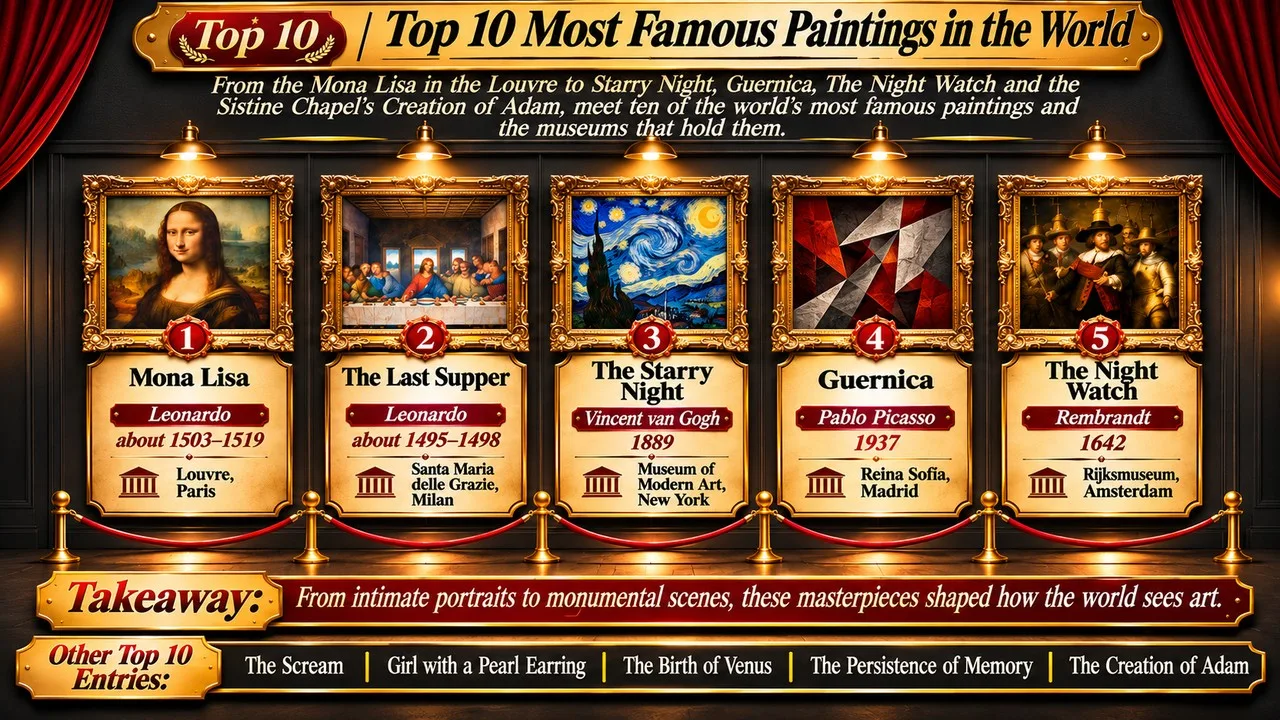
A handful of paintings are recognised worldwide, from the Mona Lisa in the Louvre to Starry Night, Guernica and the Sistine Chapel's Creation of Adam. Fame here is not the same as auction price: the most expensive picture ever sold is not necessarily the one most people can name [1][2].
This list ranks ten works by how widely they are known, how often they appear in books, films and teaching, and how central they are to the museums that hold them. Most are portable paintings. Two are painted on walls: Leonardo da Vinci's Last Supper in Milan and Michelangelo's Creation of Adam, painted on the Sistine Chapel ceiling. They are included because they are among the most famous painted images on Earth, even though they cannot be moved or sold as easel pictures [1].
Dates, materials and locations below are those accepted by the holding museums as of November 2026. For a list ranked by sale price instead, see the most expensive paintings ever sold.
Key Facts
The table gives each work's artist, date, home and the feature that has made it so widely known.
Most Famous Paintings at a Glance
| Rank | Work | Artist | Date | Home | Notable fact |
|---|---|---|---|---|---|
| 1 | Mona Lisa | Leonardo | About 1503-1519 | Louvre, Paris | The Louvre's most visited work |
| 2 | The Last Supper | Leonardo | About 1495-1498 | Santa Maria delle Grazie, Milan | Wall painting in a former monastery dining hall |
| 3 | The Starry Night | Vincent van Gogh | 1889 | Museum of Modern Art, New York | Painted from the window of an asylum in Saint-Rémy |
| 4 | Guernica | Pablo Picasso | 1937 | Reina Sofia, Madrid | Monumental protest against the bombing of Guernica |
| 5 | The Night Watch | Rembrandt | 1642 | Rijksmuseum, Amsterdam | Large militia group portrait, restored in public view |
| 6 | The Scream | Edvard Munch | 1893 | National Museum, Oslo | Several versions exist in paint and pastel |
| 7 | Girl with Pearl Earring | Vermeer | About 1665 | Mauritshuis, The Hague | A tronie, not a formal named portrait |
| 8 | The Birth of Venus | Sandro Botticelli | About 1485 | Uffizi, Florence | Venus arrives on a shell at the shore |
| 9 | Persistence of Memory | Salvador Dali | 1931 | Museum of Modern Art, New York | Small canvas of melting watches |
| 10 | The Creation of Adam | Michelangelo | 1508-1512 | Sistine Chapel, Vatican City | Fresco on the chapel ceiling |
1. Mona Lisa
The Mona Lisa, or La Gioconda, is a portrait in oil on a poplar panel, painted by Leonardo da Vinci in Florence and later in France, probably between about 1503 and 1519 [1]. It is the world's most famous painting, and the work that most visitors to the Louvre come to see. The sitter is generally identified as Lisa Gherardini, the wife of a Florentine merchant, though debate about the identification has never quite ended.
The picture is not large, yet the calm pose, the distant landscape and the slight smile have been copied, parodied and discussed for centuries. It was stolen from the Louvre in 1911 and recovered in 1913, an event that made the painting a global news story. Today it hangs behind protective glass in a dedicated room, and museum staff manage long queues around it [1].
Leonardo took the panel with him to France, which is why it entered the French royal collection and, after the Revolution, the Louvre. No other single painting is so closely identified with a museum [1][12].
2. The Last Supper
The Last Supper covers the end wall of the former refectory of Milan's Santa Maria delle Grazie. Leonardo painted it in the 1490s, about 1495 to 1498, using an experimental mix of tempera and oil on a dry wall rather than true fresco, which is one reason the surface began to fail within decades [3]. It shows Jesus announcing that one of the disciples will betray him, with the twelve apostles reacting in animated groups of three.
The work is a mural, not a canvas, and it can be seen only in the refectory, usually on a timed ticket that limits how long each group stays. Restorations in the twentieth century removed later overpainting and revealed how much of Leonardo's original surface had been lost [3].
Related: Top 10 Most Popular Artists of All Time
Even in its fragile state, the composition has shaped almost every later image of the same scene in churches, films and popular art. It is the most famous wall painting of the Italian Renaissance, with the possible exception of the Sistine ceiling [3].
3. The Starry Night
The Starry Night was painted by Vincent van Gogh in June 1889, while he was staying at the asylum of Saint-Paul-de-Mausole in Saint-Rémy-de-Provence [4]. The view is from his window, though he changed and intensified what he saw: a spinning night sky, a bright crescent moon, a tall cypress and a village that is more invented than copied from the town below. The painting is in oil on canvas and belongs to New York's Museum of Modern Art.
Van Gogh did not become famous in his lifetime, and this picture was not an immediate public icon. In the twentieth century it became one of the most reproduced images in modern art, used on posters, in classrooms and in popular music. Its swirling brushwork is often the first example people meet of Post-Impressionist painting [4].
The canvas is a reminder that fame can grow long after a work is made. It now stands beside the Mona Lisa among the few pictures that almost any visitor can recognise at a glance [4].
4. Guernica
Pablo Picasso painted Guernica in 1937 for the Spanish Republic's pavilion at the Paris International Exhibition, after German and Italian aircraft bombed the Basque town of Guernica in 1937 [5]. The huge canvas, in stark black, white and grey, shows a screaming horse, a fallen fighter, a mother with a dead child and a lamp-bearing figure, without naming the aircraft or the town in the picture itself.
After a long loan to MoMA in New York City, the painting was moved to Spain in 1981 and now hangs in the Museo Reina SofÃa in Madrid. Its size, about 3.5 metres high and almost 8 metres wide, makes it as much a public mural as an easel painting [5].
Guernica is the most famous political painting of the twentieth century. It is also a work whose meaning has been kept alive by protests, tapestries and the museum's own careful display, which treats it as both art and historical witness [5].
5. The Night Watch
In 1642 Rembrandt van Rijn finished The Night Watch as a group portrait of a company of Amsterdam civic guards under Captain Frans Banning Cocq [6]. The official title is long and formal; the popular name comes from a later darkened varnish that made the scene look like a night setting, even though it is a daytime patrol. The canvas is vast, and figures emerge from shadow into a shaft of light, with a young girl in gold at the side and a drummer at the edge of the crowd.
Related: Top 10 Iconic Statues Through the Ages
The painting is the centrepiece of the Rijksmuseum in Amsterdam. A major conservation project in recent years has been carried out in public view, so that visitors could watch restorers work on the surface [6].
As a portrait of a city militia, it is also a portrait of Dutch civic pride in the seventeenth century. Few group portraits have ever been so dramatic, or so famous outside their home country [6].
6. The Scream
Edvard Munch's The Scream exists in several versions, in paint, pastel and print, made in the 1890s. The best-known painted version, dated 1893, is in the National Museum in Oslo; another important version is in the Munch Museum in the same city [7]. A figure on a bridge clutches its head against a blood-red sky, and the scene has become a universal image of anxiety.
Two versions were stolen in separate museum thefts, in 1994 and 2004, and later recovered, which only added to the work's notoriety. A pastel version also set a record price at auction in 2012, a reminder that fame and the market can meet even when the most important examples are not for sale [7].
Munch wrote that he felt a great scream in nature while walking at sunset. The picture is less a portrait of one person than of a mood, which is why it has been copied so widely in cartoons, memes and political posters [7].
7. Girl with Pearl Earring
Girl with a Pearl Earring was painted by Johannes Vermeer in Delft around 1665. It is a tronie, a study of a face and costume rather than a formal portrait of a named sitter, and it belongs to the Mauritshuis in The Hague [8]. The girl turns toward the viewer over her shoulder, against a dark background, with a large pearl at her ear and a blue and yellow headscarf.
Related: Top 10 Most Bizarre Phobias: Strange Fears That Exist
The painting was not always as famous as it is now. Its rise in the late twentieth century, helped by exhibitions, books and a popular novel and film, has made it the best-known Dutch picture after The Night Watch and, for many visitors, the main reason to go to the Mauritshuis [8].
Vermeer's small output and his control of light give the work a quietness that is the opposite of Guernica or The Scream. It is famous for stillness, not for shock [8].
8. The Birth of Venus
Sandro Botticelli painted The Birth of Venus in Florence around 1484-1486, in tempera on canvas. It is now in the Uffizi Gallery [9]. Venus, the goddess of love, stands on a shell as she is blown to the shore by the winds, while a figure at the right steps forward with a cloak. The pale figure against the sea is one of the first large mythological nudes of the Italian Renaissance.
The picture was made for a member of the Medici circle and later passed into the Uffizi collections. Together with Botticelli's Primavera, it is among the most visited works in Florence and a standard example in any introduction to Renaissance art [9].
Unlike the Mona Lisa, it is large, decorative and openly mythological. Its fame comes from that graceful, almost weightless figure and from the way it has been used to stand for the idea of Beauty in later European culture [9].
9. The Persistence of Memory
Salvador Dalà painted The Persistence of Memory in 1931, a small oil on canvas that now hangs at New York's Museum of Modern Art, in the same collection as The Starry Night [10]. Soft watches droop over a barren Catalan-inspired landscape, with a strange fleshy form in the centre. The picture is only about 24 centimetres high, yet it is one of the most recognised images of Surrealism.
DalÃ's melting watches have been read as a comment on time, memory and the strangeness of dreams. The artist encouraged such readings without settling on a single official explanation, which has helped the work stay in circulation as a puzzle as well as a picture [10].
Related: The Evolution of Stranger Things: Seasons, Themes, and Characters
Its small size surprises many first-time visitors. Fame in this case does not depend on physical scale, but on an idea that can be remembered after a single look [10].
10. The Creation of Adam
The Creation of Adam is a fresco painted by Michelangelo on the Sistine Chapel ceiling, in Vatican City, between 1508 and 1512 [11]. God, surrounded by a sweep of drapery and figures, reaches out toward the languid figure of Adam, their fingers almost touching. That gap between the two hands is one of the most copied details in all of art.
The scene is one of nine central panels from the Book of Genesis on the chapel ceiling. It is not a portable painting, and it can be seen only as part of a visit to the Vatican Museums and the chapel itself, where photography rules and crowd control are strict [11].
It earns a place on a list of famous paintings because, for millions of people, it is the image that stands for the Sistine Chapel and for the idea of a divine spark. In that sense it is as well known as any canvas in a museum [11].
Conclusion
These ten works span fresco, mural and oil, from the 1480s to 1937, and they hang in Paris, Milan, New York, Madrid, Amsterdam, Oslo, The Hague, Florence and Vatican City. Several are smaller than people expect; a few, such as Guernica and The Night Watch, are huge. What they share is a level of public recognition that no later auction record has quite matched.
Fame is not a scientific measure, and other masterpieces could have been included. The aim of this list is to name the pictures that most often serve as a first meeting with art history, and to point each one back to the museum or chapel where it can still be seen.
- ^ [1] "Mona Lisa". Wikipedia. Wikipedia: Mona Lisa
- ^ [2] "List of most expensive paintings". Wikipedia. Wikipedia: List of most expensive paintings
- ^ [3] "The Last Supper (Leonardo)". Wikipedia. Wikipedia: The Last Supper
- ^ [4] "The Starry Night". Wikipedia. Wikipedia: The Starry Night
- ^ [5] "Guernica (Picasso)". Wikipedia. Wikipedia: Guernica
- ^ [6] "The Night Watch". Wikipedia. Wikipedia: The Night Watch
- ^ [7] "The Scream". Wikipedia. Wikipedia: The Scream
- ^ [8] "Girl with a Pearl Earring". Wikipedia. Wikipedia: Girl with a Pearl Earring
- ^ [9] "The Birth of Venus". Wikipedia. Wikipedia: The Birth of Venus
- ^ [10] "The Persistence of Memory". Wikipedia. Wikipedia: The Persistence of Memory
- ^ [11] "The Creation of Adam". Wikipedia. Wikipedia: The Creation of Adam
- ^ [12] "Musée du Louvre". Official site. Louvre: official site





















Discussion
Log in with