




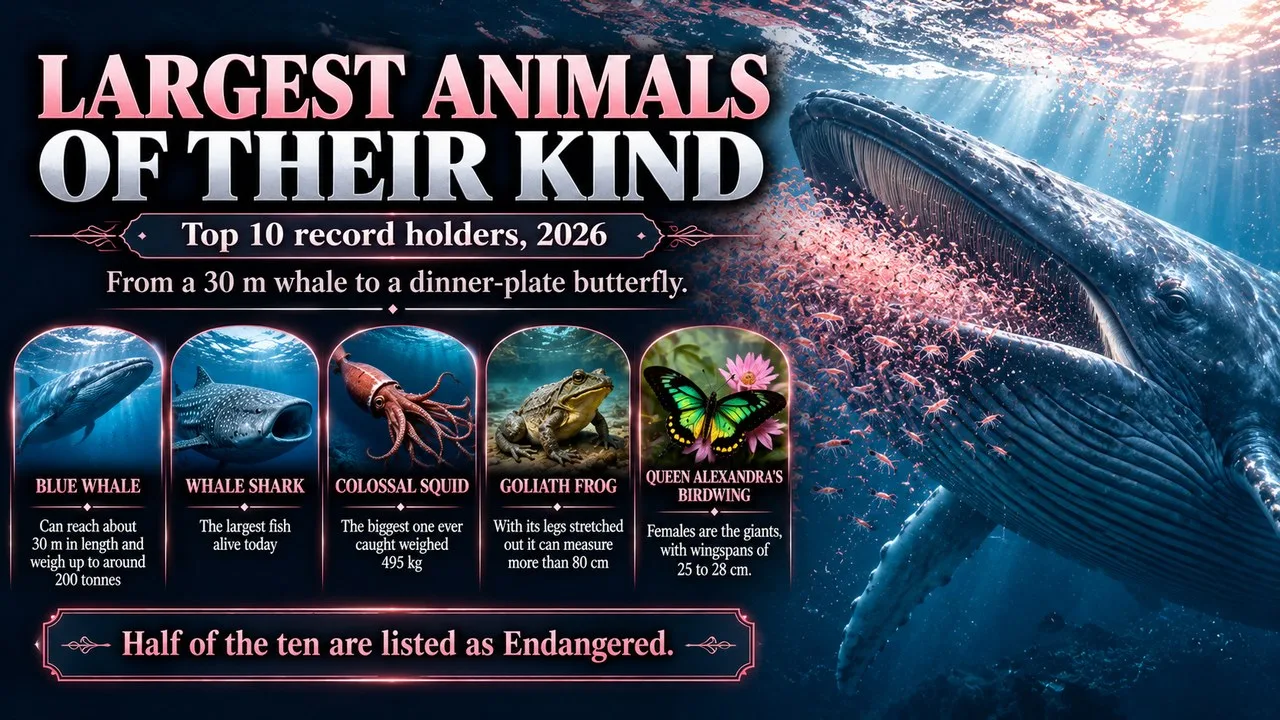
The largest animals of their kind run from the 30 m blue whale, the heaviest creature known, to a frog as big as a house cat and a spider weighing 175 g.
This Finepedia guide, written in October 2026, looks at ten record holders, each the biggest living member of its own group, from mammals and fish to insects and spiders. Each entry gives the animal's size, where it lives and one surprising fact about how it gets so big or stays alive. Figures come from wildlife bodies, museums and encyclopaedias. For more remarkable creatures, see the Finepedia guides Top 10 Deadliest Animals in the World and Top 10 Fascinating Spiders of the World.
How We Chose These
We picked one giant from each of ten well-known animal groups, so a single family cannot fill the list. Each animal holds a record that scientists broadly accept, based on the largest specimens that have been measured or weighed, not on legends or old fishing stories. Where experts measure size in different ways, such as weight for spiders and wingspan for butterflies, we say which record we mean. The list runs from the biggest to the smallest, and half of the ten are listed as Endangered.
The 10 Largest Animals of Their Kind at a Glance
| No. | Animal | Group | Record size | Where it lives |
|---|---|---|---|---|
| 1 | Blue whale | Mammals and all animals | about 30 m, up to about 200 t | all oceans |
| 2 | Whale shark | Fish | 18.8 m | warm seas |
| 3 | African bush elephant | Land animals | up to about 6.9 t on average | sub-Saharan Africa |
| 4 | Saltwater crocodile | Reptiles | 6 m, over 1,000 kg | India to Australia |
| 5 | Colossal squid | Invertebrates | 495 kg | Southern Ocean |
| 6 | Common ostrich | Birds | up to 2.75 m tall | Africa |
| 7 | Capybara | Rodents | up to 66 kg | South America |
| 8 | Goliath frog | Frogs | about 3.3 kg | Cameroon and Equatorial Guinea |
| 9 | Goliath birdeater | Spiders | 175 g | northern South America |
| 10 | Queen Alexandra's birdwing | Butterflies | wingspan up to 28 cm | Papua New Guinea |
1. The Blue Whale Outweighs Every Animal Ever Measured
The blue whale is a baleen whale that can reach about 30 m in length and weigh up to around 200 tonnes. No dinosaur or other animal that we know of has been clearly shown to beat it. It lives in every ocean and feeds almost entirely on krill, tiny shrimp-like animals that it gulps in huge mouthfuls.
Key Facts
- Length: usually up to about 30 m, with a few longer whales recorded by whalers
- Weight: up to around 190 to 200 tonnes
- Food: an average adult needs over a tonne of krill a day
- Status: Endangered, after heavy whaling in the 20th century
Did You Know?
A feeding blue whale charges into a cloud of krill with its mouth opened to about 80 degrees, takes in a vast gulp of water, then pushes the water out through its baleen plates. One mouthful can supply up to 240 times the energy the lunge used. Blue whale calls are among the loudest sounds made by any animal.
2. The Whale Shark Is the Biggest Fish in the Sea
The whale shark is a slow-moving shark and the largest fish alive today, as well as the biggest living animal that is not a whale.[1] Despite its size, it eats plankton and small fish, which it filters from the water. It swims in warm tropical seas, and divers can often get close to it safely.
Key Facts
- Largest reliably measured: about 18.8 m long
- Mouth: can be about 1.5 m wide on a large adult
- Skin: up to about 15 cm thick in places
- Status: Endangered since 2016
Why It Matters
Whale sharks gather at the same places each year, including Ningaloo Reef in Western Australia and the coast of Mexico's Yucatán Peninsula, which has made them a big draw for wildlife tourism. Every whale shark has its own pattern of pale spots, so researchers can identify individuals from divers' photographs.
3. The African Bush Elephant Rules the Land
The African bush elephant, also called the savanna elephant, is the largest animal living on land.[2] Fully grown bulls stand around 3 to 3.4 m at the shoulder and usually weigh between 5.2 and 6.9 tonnes. The largest bull on record stood almost 4 m tall and was estimated to weigh about 10.4 tonnes.
Key Facts
- Daily food: about 150 kg of plants
- Daily water: around 230 litres
- Pregnancy: about 22 months, longer than any other mammal
- Status: Endangered since 2021
Did You Know?
Elephants use their trunks to breathe, smell, drink, grab food and greet each other, and the trunk alone contains tens of thousands of muscle bundles. Ivory poaching cut their numbers sharply in the 1970s and 1980s, and a ban on the international ivory trade began in 1989.
4. The Saltwater Crocodile Tops All Reptiles
The saltwater crocodile lives along coasts, rivers and swamps from eastern India across Southeast Asia to northern Australia. Males can grow to about 6 m and weigh 1,000 to 1,500 kg, while females rarely pass 3 m. It can swim far out to sea, which explains how it has spread across so many islands.
Related: Top 10 Fascinating Spiders of the World
Key Facts
- Male length: about 6 m, rarely more than 6.3 m
- Male weight: 1,000 to 1,500 kg
- Hatchlings: about 28 cm long
- Range: from India to northern Australia
Why It Matters
As a top predator, the saltwater crocodile has the strongest bite measured in any living animal. Hunting for its skin cut the northern Australian population by about 95 percent by 1971, but legal protection, including in Australia from the early 1970s, has allowed many populations to recover.
5. The Colossal Squid Is the Heaviest Invertebrate
The colossal squid lives in the cold, deep waters of the Southern Ocean around Antarctica. The biggest one ever caught weighed 495 kg, making it the heaviest animal without a backbone that has been weighed. Its arms carry swivelling hooks, and it is thought to be a slow, patient hunter of fish.
Key Facts
- Heaviest specimen: 495 kg, caught in the Ross Sea in 2007
- Length: up to about 4.2 m without the tentacles
- Eyes: about 27 to 30 cm across, the biggest of any animal studied
- Home of the record squid: Te Papa museum in Wellington[3]
Did You Know?
For decades scientists knew the colossal squid mostly from hard beaks recovered from sperm whale stomachs. A confirmed live colossal squid, a small juvenile, was filmed alive in the deep sea for the first time on 9 March 2025, near the South Sandwich Islands.
6. The Ostrich Stands Taller Than Any Other Bird
The common ostrich of Africa is the largest living bird.[4] It cannot fly, but its long, powerful legs make it the fastest runner on two legs, able to hold about 55 km/h and sprint at close to 70 km/h. An adult male is about 2.1 m to 2.75 m tall and weighs 100 to 130 kg.
Related: Top 10 Remarkable Frogs of the World
Key Facts
- Height of the head: up to about 2.8 m above the ground
- Male weight: 100 to 130 kg
- Eggs: bigger than those of any other bird alive today
- Eyes: the largest of any land animal with a backbone
Why It Matters
An ostrich egg weighs about the same as two dozen chicken eggs. Ostriches have long been farmed for their feathers, meat and leather, and wild birds still roam large areas of Africa, which is why the species is not considered threatened.
7. The Capybara Is the Biggest Rodent
The capybara is a giant relative of guinea pigs that lives across most of South America, apart from Chile.[5] Adults are about 1.1 to 1.3 m long and usually weigh 35 to 66 kg. It is never far from water and has slightly webbed feet, which make it a strong swimmer that can hide underwater from predators.
Key Facts
- Length: about 106 to 134 cm
- Weight: usually 35 to 66 kg
- Heaviest wild records: 91 kg for a female in Brazil
- Social life: lives in groups
Did You Know?
Capybaras are famous online for their calm nature, and birds and other animals are often photographed sitting on their backs. They mostly eat grasses and water plants, and like rabbits they eat some of their own dung to get more goodness from tough plant food.
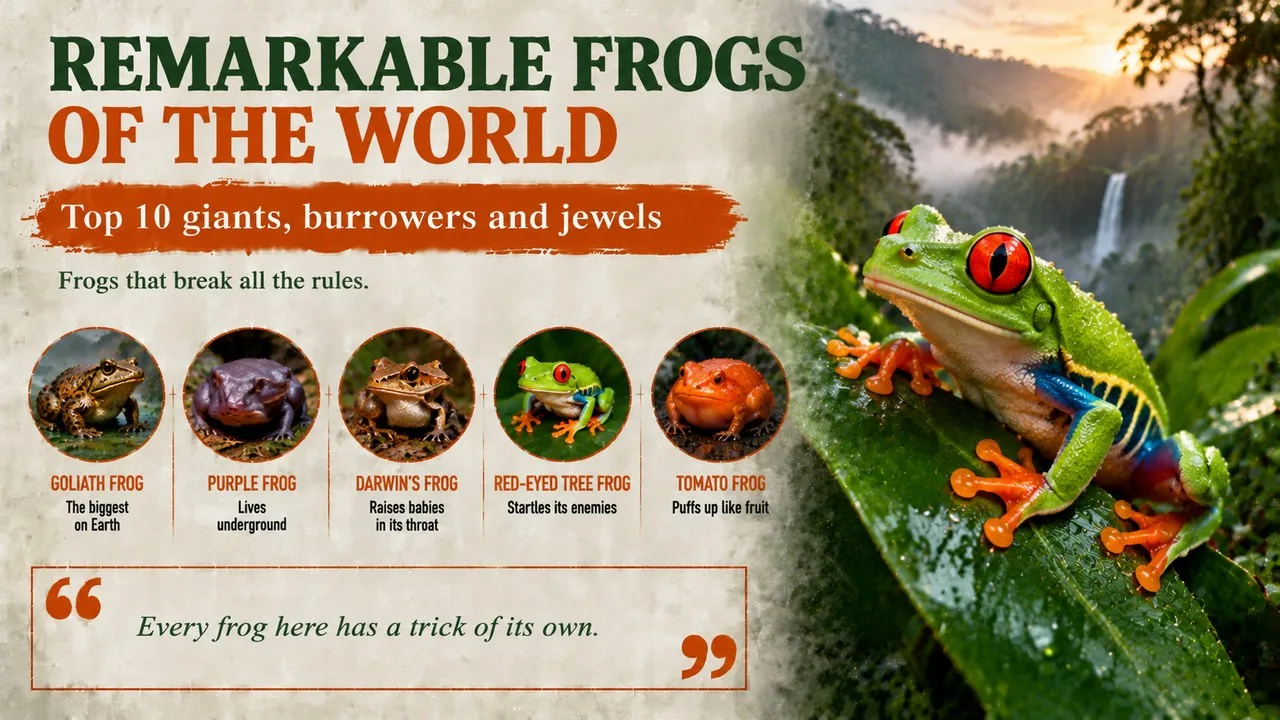
8. The Goliath Frog Can Weigh More Than 3 kg
The Goliath frog lives in fast-flowing rivers in the rainforests of Cameroon and Equatorial Guinea.[6] Its body can reach about 34 cm from snout to vent, and with its legs stretched out it can measure more than 80 cm. The heaviest verified Goliath frog, caught in 1960, weighed about 3.3 kg.
Key Facts
- Heaviest verified: 3,305 g
- Body length: up to about 35 cm
- Habitat: rivers with waterfalls and rapids
- Status: Endangered
Why It Matters
Researchers found in 2019 that Goliath frogs dig out pools on riverbanks, sometimes moving heavy stones, to make safe nurseries for their eggs. The species is threatened by hunting for food, the pet trade and the loss of its forest home.
Related: Top 10 Colourful Parrots of the World
9. The Goliath Birdeater Is the Heaviest Spider
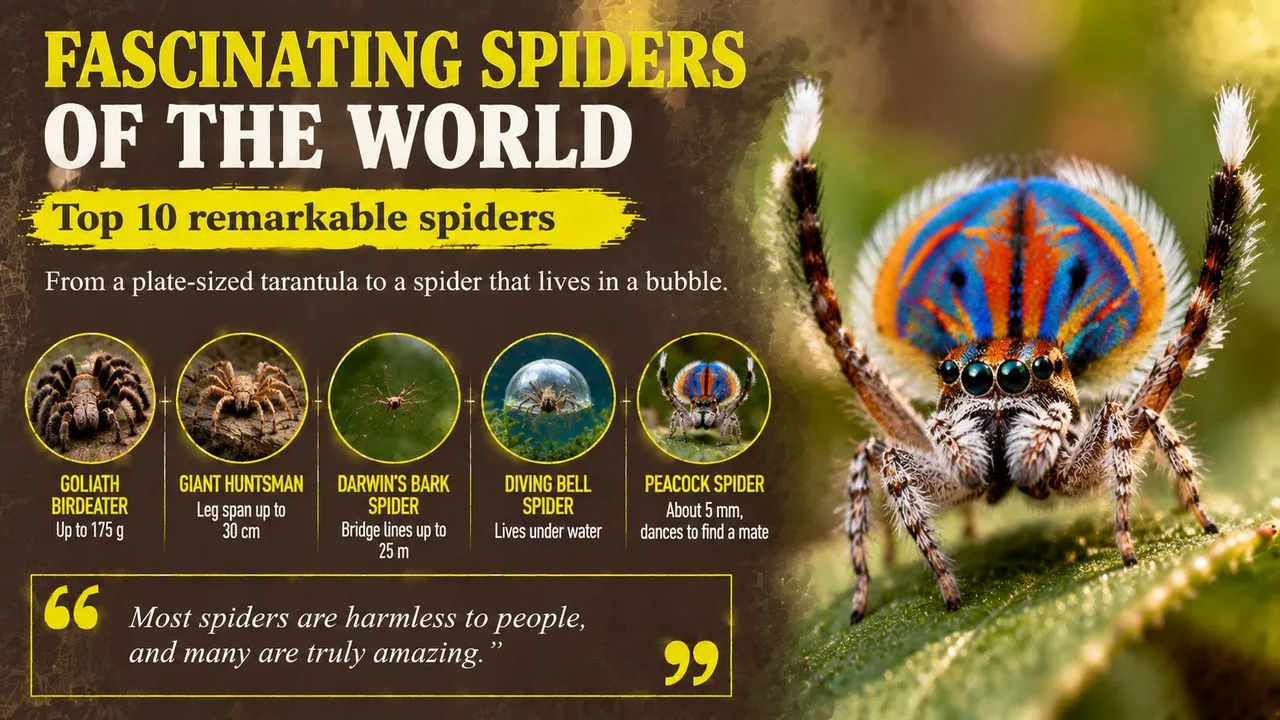
The Goliath birdeater is a tarantula found in rainforests across northern South America.[7] No known spider is heavier, at up to 175 g, and its body can reach 13 cm, with legs spanning as much as 30 cm. Its fangs alone can be 2 to 4 cm long.
Key Facts
- Weight: up to 175 g
- Legs: spanning as much as 30 cm
- Body: as long as 13 cm
- Home: burrows on the rainforest floor
Did You Know?
Despite its name, this spider rarely eats birds. It mostly hunts insects, worms and small animals such as frogs. When it feels threatened, it rubs its legs to make a hissing sound and flicks irritating hairs from its abdomen at the attacker.
10. Queen Alexandra's Birdwing Has the Widest Wings
Queen Alexandra's birdwing lives only in a small area of rainforest in Oro Province, Papua New Guinea.[8] Females are the giants, with wingspans of 25 to 28 cm and bodies about 8 cm long. Males are smaller, at about 16 to 20 cm across, but are far brighter, with blue-green and black wings.
Key Facts
- Female wingspan: 25 to 28 cm
- Female weight: up to about 12 g
- Named after: Alexandra, queen of Edward VII of the United Kingdom
- Status: Endangered
Why It Matters
This birdwing is so rare that international trade in it is banned, and it is protected by law in Papua New Guinea. Its caterpillars feed only on certain pipevine plants, so clearing forest for oil palm and other crops is the biggest threat to its survival.
Related: Top 10 Facts About Elephants
Frequently Asked Questions
Was any dinosaur bigger than the blue whale?
Some long-necked dinosaurs were longer than a blue whale, but scientists believe none was heavier. A few extinct sea animals, such as the ancient whale Perucetus, may have come close in weight, but the evidence is still debated.
What is the largest animal on land in history?
Giant plant-eating dinosaurs such as Argentinosaurus were the largest land animals that ever lived, with estimates of 50 tonnes or more. Today the African bush elephant holds the record among living land animals.
Conclusion
From a 30 m whale to a butterfly with wings as wide as a dinner plate, these ten giants show how far life can stretch within each group. Many grew huge where food was plentiful and enemies were few, yet half of them now need protection to survive. For more remarkable creatures, read the Finepedia guides Top 10 Deadliest Animals in the World and Top 10 Fascinating Spiders of the World.
- ^ [1] "Whale shark". Wikipedia. Wikipedia
- ^ [2] "African elephant". Wikipedia. Wikipedia
- ^ [3] "Museum of New Zealand Te Papa Tongarewa". Encyclopedia of Global Archaeology. DOI
- ^ [4] "Ostrich". Wikipedia. Wikipedia
- ^ [5] "Capybara". Wikipedia. Wikipedia
- ^ [6] "Goliath frog". Wikipedia. Wikipedia
- ^ [7] "Goliath birdeater". Wikipedia. Wikipedia
- ^ [8] "Queen Alexandra's birdwing". Wikipedia. Wikipedia




















Discussion
Log in with