





 By
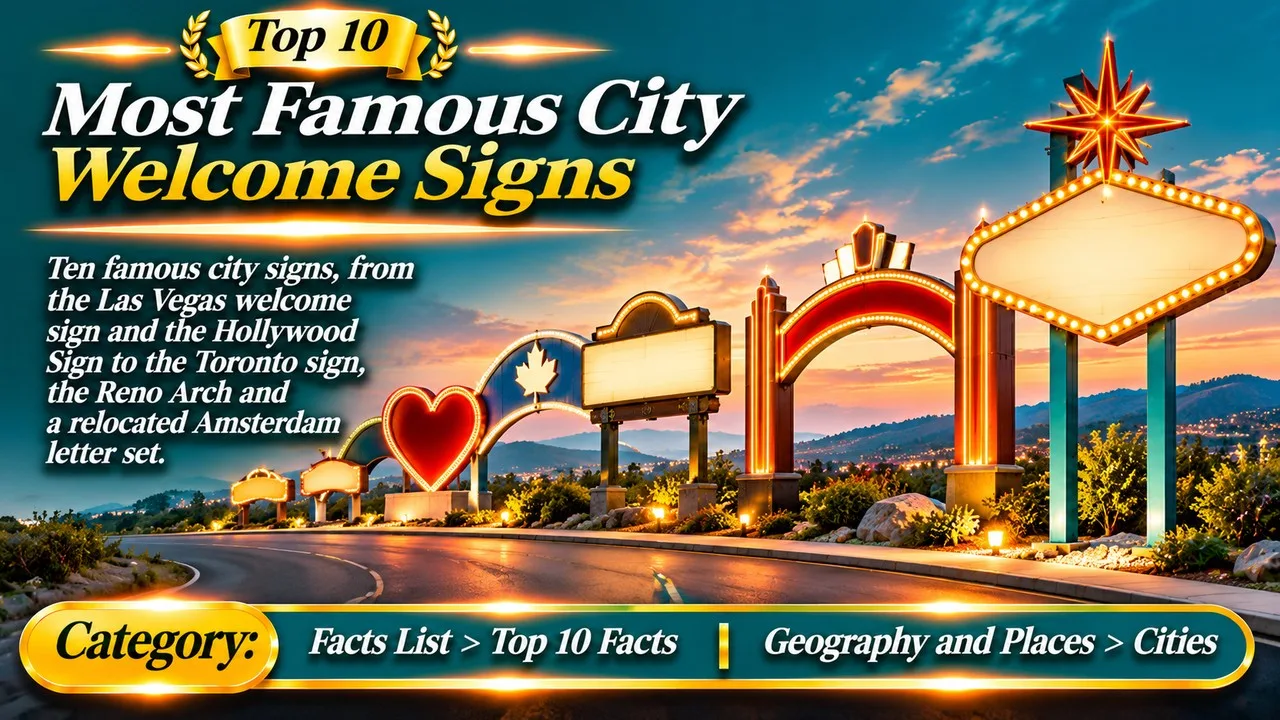
A city welcome sign becomes famous when it is both a marker at the edge of town and an image people travel to stand in front of. Some of the best-known examples are not, strictly, municipal "welcome" boards. The Hollywood Sign began as a property advertisement, and the Chicago Theatre marquee is a theatre sign that now stands in for the city [1][2].
This is a curated 2026 list, not a survey of every civic logo. It expands a much shorter older list that stopped after four American signs. Trademarked lettering should be treated carefully in photographs and in reproductions; the entries below describe the signs as landmarks, not as artwork to copy [3][4].
Key Facts
"Welcome sign" here includes gateway arches, hillside letters, pier signs and large civic letter sculptures that function as a city's greeting. Status is as of November 2026.
City Welcome Signs at a Glance
| Rank | Sign | City | Type | 2026 status |
|---|---|---|---|---|
| 1 | Las Vegas gateway sign | Las Vegas, Nevada, United States | Roadside gateway sign, 1959 | Standing on the median south of the Strip |
| 2 | The Hollywood Sign | Los Angeles, California, United States | Hillside letters, 1923, later rebuilt | Standing; viewed from official overlooks, not climbed |
| 3 | The Reno Arch | Reno, Nevada, United States | Over-street arch, with the "Biggest Little City" line | Standing over the downtown |
| 4 | The Toronto Sign | Toronto, Canada | Large 3D letters at Nathan Phillips Square, installed 2015 | Standing |
| 5 | Santa Monica Pier sign | Santa Monica, California, United States | Entrance arch to the pier | Standing |
| 6 | Chicago Theatre marquee | Chicago, Illinois, United States | Historic theatre sign used as a city emblem | Standing |
| 7 | Beverly Hills sign | Beverly Hills, California, United States | Landmark roadside letters on a grassy slope | Standing; a photo stop, not a climb |
| 8 | The Cleveland script sign | Cleveland, Ohio, United States | Public script letters, first installed in 2015-2016 | Standing, with additional letter sets in the city |
| 9 | Scranton Electric City sign | Scranton, Pennsylvania, United States | Historic "Electric City" rooftop sign | Standing as a restored city landmark |
| 10 | I amsterdam letters | Amsterdam, Netherlands | Large letter sculpture, 2004-05 | The Museumplein set was removed in 2018; a reconfigured set remains at Sloterplas |
1. Las Vegas gateway sign
The 1959 Las Vegas gateway sign, designed by Betty Willis, is the classic American city welcome sign: a roadside, double-sided gateway on the median of Las Vegas Boulevard, south of the built-up Strip [1][5]. People still stop there in 2026, in a small pull-off, to photograph a mid-century object that has outlasted many of the casinos it once announced.
It is first because it is, in the ordinary sense, a welcome sign, and because it became an international symbol of the city. Copies and jokes exist elsewhere; the original is the one on this stretch of the boulevard [5].
Traffic and a narrow median make the stop less casual than the photographs suggest. A short, careful visit is the practical version [1][5].
2. The Hollywood Sign
The Hollywood Sign, on the slope of Mount Lee above Los Angeles, was erected in 1923 as "Hollywoodland," a real-estate advertisement, and was later shortened and rebuilt as a city landmark [1][6]. It is not a roadside "welcome to Los Angeles" board, but it is the most famous set of city letters in the world, and a list of welcome signs that omitted it would be evasive.
It is second for that reason, with the category stretched on purpose. The letters are fenced and monitored; a 2026 visit is from official viewpoints, including Griffith Observatory and designated hiking overlooks, not from a walk up the letters [6].
The sign has been restored more than once. The landmark people photograph today is a maintained reconstruction of the hillside idea, not the original 1923 timber [1][6].
Related: Top 10 Famous Water Towers of the World
3. The Reno Arch
The Reno Arch stands over the downtown and carries the city's long-running "biggest little city" slogan, a line with roots in the early twentieth century and an arch tradition that has been rebuilt in later forms [1][5]. It is a true gateway sign: you pass under it, and the city uses it as a civic emblem.
It is third as the other great Nevada welcome arch, smaller in global fame than the Las Vegas sign but more like a municipal gate. The downtown around it has changed; the arch remains the photograph [5].
Night lighting is part of the object. A 2026 visit is a downtown walk, not a highway pull-off [5].
4. The Toronto Sign
The three-dimensional Toronto sign at Nathan Phillips Square was installed in 2015 for the Pan American Games and was kept as a permanent civic sculpture in front of City Hall [2][7]. It is a close cousin of the large letter signs that other cities installed in the 2010s, but it has lasted, in place, as a public meeting point.
It is fourth as the clearest recent example of a city that put its name on the square and left it there. People sit on the letters, photograph them, and use them as a downtown landmark [7].
Similar signs have appeared, and sometimes disappeared, in other cities. Toronto's is still where it was meant to be in 2026 [2][7].
5. Santa Monica Pier sign
The entrance sign to Santa Monica Pier, a brightly lettered arch at the start of the pier, is one of the most photographed welcome structures in California [1][6]. It marks a destination within a city rather than a municipal boundary, and it functions as a greeting to the coast as much as to Santa Monica itself.
Related: Top 10 Most Beautiful City Skylines in the World
It is fifth because the image is simple, durable and still in use. A 2026 visit is a walk onto a working pier, with the usual crowds, parking limits and the ordinary life of a popular beach [6].
Like the Chicago Theatre marquee, it is a functional sign that became a civic trademark [1].
6. Chicago Theatre marquee
The Chicago Theatre marquee, on North State Street, is a 1921 theatre sign whose large "CHICAGO" lettering has become a default emblem of the city, used in photographs, films and souvenirs [2][8]. It is not a welcome sign at the city limits. It is included because, for many visitors, it is the sign that says they have arrived.
It is sixth as a historic commercial sign that now does civic work. The theatre is a venue; the marquee is the public face. A 2026 visitor can see it at street level in the Loop without a ticket, then go inside if there is a show [8].
Reproductions of the lettering are common. The landmark is the object on State Street [8].
7. Beverly Hills sign
The Beverly Hills sign, a set of white letters on a small slope along a landscaped roadside, is a compact landmark that visitors treat as a welcome marker for the city, even though it is closer to a civic logo in three dimensions than to a highway board [1][6]. It is an easy, often crowded, photograph.
Related: Top 10 Largest Public Squares in the World
It is seventh as a well-known city-name sign that is actually in the place it names. The Hollywood Sign is visible from far away; this one is a close-range object. People should stay off the planting and treat it as a photo stop, not as a playground [6].
Several other Los Angeles-area signs, including studio and city-limit boards, are less distinctive. This is the one that became a destination [1][6].
8. The Cleveland script sign
Cleveland's script "Cleveland" sign, first installed at the lakefront around 2015 and later joined by other letter sets in the city, is a public sculpture that was designed to be sat on, photographed and used as a civic welcome [2][7]. It is one of the more successful American versions of the giant-letter idea, after Toronto and after Amsterdam's earlier experiment.
It is eighth as a still-standing, still-used city sign from the 2010s letter boom, in a city that wanted a friendly landmark rather than a gate on a highway [7]. Locations of additional sets can change; the lakefront original is the reference point.
A 2026 visit is a public-park photograph, usually without a ticket [2][7].
9. Scranton Electric City sign
The Electric City sign in Scranton, Pennsylvania, is a historic rooftop sign that advertised the city's early electric-streetcar identity and has been restored as a civic landmark [1][5]. It appeared on older short lists of welcome signs, and it deserves to remain, not as a peer of Las Vegas in fame, but as a genuine historic city sign that people still look up to.
It is ninth as a restored industrial-era sign, different in kind from a 2015 letter sculpture. The sign sits on a building, and the best view is from the street below, especially at night when it is lit [5].
Related: Top 10 Most Bizarre Phobias: Strange Fears That Exist
Scranton is not a tourist capital. The sign is one of the reasons a visitor looks up at all [1][5].
10. I amsterdam letters
The I amsterdam letters, designed as a city slogan sculpture in 2004-05, became world-famous on Museumplein, in front of the Rijksmuseum, and then became a case study in overtourism. The Museumplein letters were removed in December 2018. A reconfigured set remains at Sloterplas in Amsterdam Nieuw-West, where it has been used as a public-sport and freerunning object, and temporary placements have appeared for events. Visitor reports in 2026 also said the familiar airport installation was no longer in front of Schiphol arrivals [4][9].
It is tenth because the object is still famous, and because a 2026 list must say where it is not. People who fly in expecting the Museumplein photograph are more than seven years late. The honest visit, if someone still wants the letters, is to check the current Sloterplas site, not to look for a sculpture that the city removed from the museum square [9].
The slogan remains in use in other graphic forms. The giant letters are no longer the city's front-door sign, and a list that still ranks them as if they stood in front of the Rijksmuseum would be sending people to a square that has been empty of those letters since 2018 [4][9].
Conclusion
The ten signs above include roadside gateways, hillside letters, a pier arch, a theatre marquee and large civic letter sculptures [1][2]. Some are welcome signs in the strict sense. Others have become the image of a city even though they were built for a theatre, a pier or a housing advertisement.
A 2026 visitor should treat them as public objects with rules: stay off roofs and hillside letters, be careful on traffic medians, and do not assume a famous letter set is still in the square where a decade-old photograph was taken [6][9]. The same caution applies to copies, hotel-front replicas and souvenir versions, which can be entertaining and still leave a traveller in front of the wrong object, on the wrong street, with a photograph that is not the landmark they came to see.
- ^ [1] "Welcome to Fabulous Las Vegas Sign," "Hollywood Sign," "Reno Arch" and related landmark histories. Wikipedia. Wikipedia: Welcome to Fabulous Las Vegas sign
- ^ [2] Civic letter signs in Toronto, Cleveland and related public-art projects. City pages and Wikipedia. Nathan Phillips Square
- ^ [3] Notes on trademark and reproduction of famous signs, including hillside letters and mid-century gateway signs. Landmark and city guidance. Hollywood Sign
- ^ [4] "I amsterdam" letter sculptures, including the 2018 removal from Museumplein. Wikipedia and Amsterdam city notices. Wikipedia: I amsterdam
- ^ [5] Las Vegas, Reno and Scranton sign histories and visiting notes. Official tourism and landmark pages. Las Vegas
- ^ [6] Hollywood Sign, Santa Monica Pier and Beverly Hills visiting guidance. Hollywood Sign
- ^ [7] City of Toronto and City of Cleveland public-art / square information. City of Toronto
- ^ [8] Chicago Theatre, Landmark and venue information. Chicago Theatre
- ^ [9] Amsterdam city notices on the Sloterplas letters and reporting on later placements, including 2026 visitor notes about Schiphol. City of Amsterdam
















Discussion
Log in with