






 By
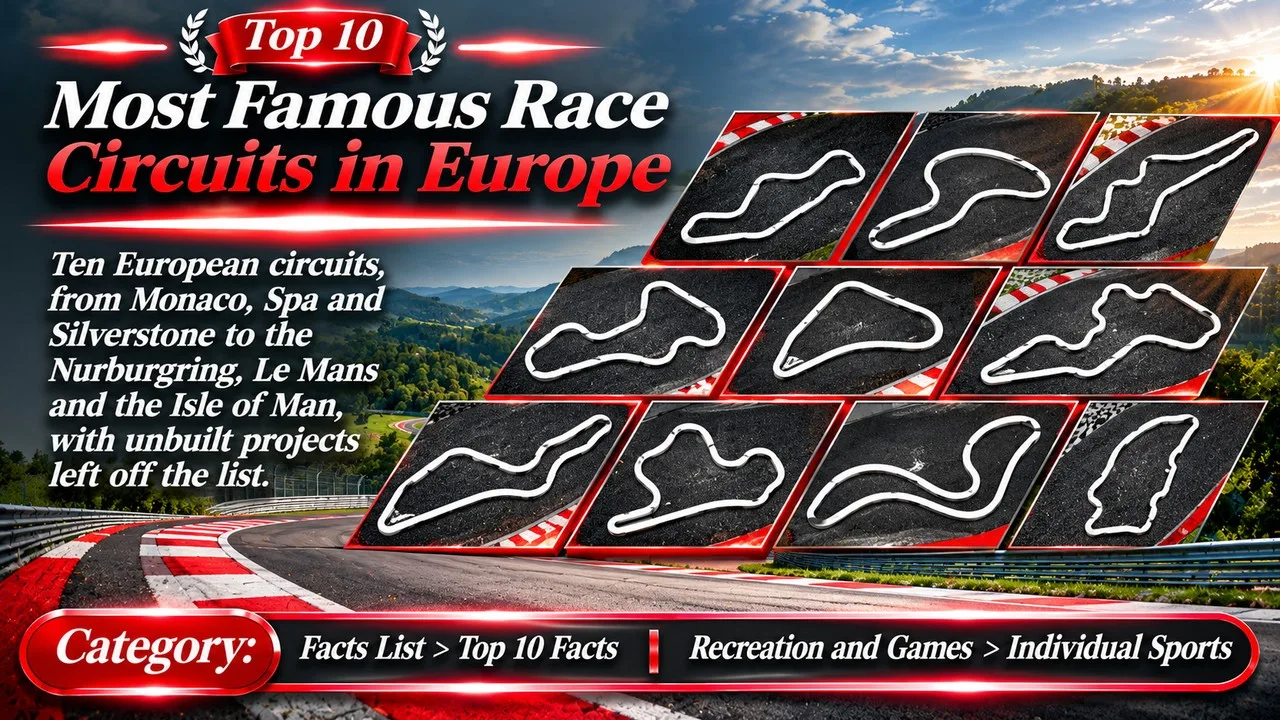
Europe's most famous race circuits are the tracks that still define a season, or a historic event, and that a visitor can still walk, watch or ride in 2026. An older popular list included Circuit of Wales, a project that was never built, and padded the ranking with smaller club tracks that do not belong beside Monaco or Monza [1][2].
This is a curated list of famous, still-existing circuits, not a driver ranking and not a claim about which track is the most dangerous. Public access varies: some sites have museums and track tours on non-race days, some are public roads closed for an event, and some are private circuits that open for paid experiences. A 2026 visit should start with the current calendar, not with a 2016 brochure [3][4].
Key Facts
"Circuit" here includes closed race tracks and the TT Mountain Course, a public-road course used on the Isle of Man. Status is as of November 2026.
Race Circuits at a Glance
| Rank | Circuit | Country | Why it is famous | 2026 visitor note |
|---|---|---|---|---|
| 1 | Circuit de Monaco | Monaco | The Formula One street circuit through the principality | Race week is the event; the streets are ordinary roads the rest of the year |
| 2 | Circuit de Spa-Francorchamps | Belgium | The Ardennes circuit, including Eau Rouge and Raidillon | Home to the Belgian Grand Prix and endurance races |
| 3 | Silverstone | United Kingdom | The home of the British Grand Prix, on a former airfield | A large visitor campus, museum and regular events |
| 4 | Autodromo Nazionale Monza | Italy | A high-speed park circuit with a deep Grand Prix history | Open for events and, on some days, visits in the park |
| 5 | The Nurburgring | Germany | The Nordschleife and the modern Grand Prix circuit | Tourist drives, races and a visitor industry around the old course |
| 6 | Circuit de la Sarthe | France | The public-road and permanent-track loop of the 24 Hours of Le Mans | The town and museum are visitable year-round; the full circuit appears on race weeks |
| 7 | Isle of Man Mountain Course | Crown dependency in the Irish Sea | The 37-mile public-road course of the TT | The roads are ordinary between events; race weeks transform the island |
| 8 | Imola | Italy | Autodromo Enzo e Dino Ferrari, back on the Formula One calendar in 2020 | A historic park circuit with a museum culture in the region |
| 9 | Circuit de Barcelona-Catalunya | Spain | A long-standing Formula One and motorcycle test and race venue | Regular racing and driving experiences |
| 10 | Circuit Zandvoort | Netherlands | A seaside circuit that returned to Formula One in 2021 | A compact, historic track in the dunes |
1. Circuit de Monaco
The Circuit de Monaco, laid out through the streets of Monte Carlo and La Condamine, is the most famous street circuit in motor racing. The Formula One Monaco Grand Prix has been run there, with interruptions, since 1929, and the tight harbour-front course remains a unique event on the calendar [1][3]. For most of the year the same streets are ordinary city roads.
It is first because fame, history and a still-running championship event coincide. A 2026 visitor who is not there in race week will see painted kerbs, a harbour and a city, not a permanent stadium. Race week is the moment when the circuit exists in full [3].
Tickets, hotels and simple access are expensive and scarce around the Grand Prix. That is part of the event, not an afterthought [1][3].
2. Circuit de Spa-Francorchamps
Spa-Francorchamps, in the Belgian Ardennes, is the great natural-terrain circuit of the modern calendar, with elevation change, long straights and the Eau Rouge-Raidillon climb that has become shorthand for the track [1][4]. It hosts the Belgian Grand Prix and major endurance races, and the present layout is a later, shortened form of an even longer public-road course.
It is second as a permanent circuit with the drama that a street track gets from buildings. Weather in the Ardennes can split the circuit in two, with rain at one corner and a dry line at another. A 2026 visitor can attend a race or, on some days, a track experience or tour [4].
The circuit is a drive from Liege, Brussels or the German border, and it is a destination rather than a city-centre stroll [4].
Related: Top 10 Largest Race Tracks in the US
3. Silverstone
Silverstone, in Northamptonshire, is the home of the British Grand Prix and one of the starting points of the Formula One world championship in 1950, built on a former Second World War airfield [1][5]. The layout has changed several times, but the site remains the centre of British circuit racing, with a museum, a large paddock complex and a full calendar beyond one Sunday in July.
It is third as a working national home of Grand Prix racing, not only as a historic airfield outline. A 2026 visitor can go to the Silverstone Museum, attend a race weekend, or book a driving experience on selected days [5].
The site is a campus. It rewards a planned visit more than a casual pass on the A43 [5].
4. Autodromo Nazionale Monza
Monza, in a royal park north of Milan, is the high-speed cathedral of Italian motor racing, a Grand Prix venue since the 1920s, with banked remnants of earlier layouts and a modern circuit that still rewards power and courage [1][4]. The Italian Grand Prix remains the event that defines the place for a worldwide audience.
It is fourth as a park circuit with a depth of history that few tracks can match. On non-race days the park is a public landscape, and access to the circuit itself depends on the calendar. A 2026 trip should be built around a race, a special event, or a confirmed tour [4].
The nearby towns and Milan make it easier to visit than a remote purpose-built complex [1][4].
5. The Nurburgring
The Nurburgring, in the Eifel, is two circuits in one story: the modern Grand Prix track and the Nordschleife, the long, demanding old course that is still used for racing, testing and tourist drives [1][6]. For many enthusiasts the Nordschleife is the reason to go, a public-access "tourist" session on a former championship track of extraordinary length and complexity.
Related: Top 10 Attractions in Monaco
It is fifth because that combination is unique, and because a visitor industry, including a visitor centre and paid sessions, still exists in 2026. Rules, opening days and closures for events change; the official page is the only safe source [6].
Calling the Nordschleife "the most dangerous track" as a slogan is less useful than saying it is long, fast, and unforgiving of a tourist in a rented car who treats it as a theme ride [6].
6. Circuit de la Sarthe
The Circuit de la Sarthe, around Le Mans, is the 24-hour race made into a place: a loop that mixes a permanent circuit with roads that are otherwise public, used once a year for the world's most famous endurance event [1][7]. The Musee des 24 Heures and the town are visitable throughout the year; the full circuit, including the long straight, appears in its race configuration during the event and related tests.
It is sixth as a course whose fame is an event and a city, not only a stadium. A 2026 visitor can go to the museum at any time and should treat race week as a separate, fully booked pilgrimage [7].
The 24 Hours remains the reason the name matters. Other races use parts of the site, but Le Mans is the one the world means [7].
7. TT Mountain Course
The Mountain Course on the Isle of Man is about 37 miles of public roads used for the TT and other motorcycle events, a closed-road circuit through towns, walls and mountain sections that has no real closed-track equivalent [1][8]. Between events, the same roads are ordinary island highways and streets.
It is seventh because it is famous, still used, and fundamentally different from Silverstone or Monza. A 2026 visit in race week is a motorcycle event on public roads, with all the seriousness that involves. A visit at any other time is a scenic drive on a course you can only imagine at race speed [8].
Related: Top 10 Most Bizarre Phobias: Strange Fears That Exist
This list will not treat the TT as a casual thrill. It is a historic event with a real human cost, and a spectator should follow official guidance [8].
8. Imola
Imola, formally the Autodromo Enzo e Dino Ferrari, is a park circuit in Emilia-Romagna that returned to the Formula One calendar in 2020 after a long gap, and that remains one of Italy's historic venues [1][4]. The surrounding Motor Valley, with factory museums in and around the region, makes a circuit visit part of a wider trip.
It is eighth as a famous, still-active track whose championship return is a 2020s fact, not a rumour. Event days and any tour offers should be checked for the current year [4].
The circuit has a difficult history, including the 1994 Grand Prix weekend. A serious visit can take in that history without turning it into a spectacle [1][4].
9. Circuit de Barcelona-Catalunya
The Circuit de Barcelona-Catalunya, at Montmelo near Barcelona, has been a Formula One and motorcycle venue since 1991 and a standard winter test track for many years, which is why teams and fans know its corners so well [1][4]. It is a modern purpose-built circuit rather than a public-road legend, and it is still a working championship venue in 2026.
It is ninth as a famous, visitable Iberian Grand Prix track, the one that belongs on a European list after the historic names above. Driving experiences and race meetings are the usual ways in [4].
Related: Top 10 Oldest Buildings in the World
Older lists that placed it last among obscure club tracks were at least right to include it; they were wrong to put unbuilt or minor circuits above it [2][4].
10. Circuit Zandvoort
Zandvoort, in the dunes on the Dutch coast, is a compact historic circuit that returned to Formula One in 2021, restoring a seaside track with a long national racing history to the world championship map [1][9]. The location, among sand and a beach town, is part of the identity.
It is tenth as the clearest 2020s update to a European fame list: a circuit people had to start taking seriously again because the championship came back. A 2026 visitor can aim at a race weekend or at other events on the local calendar [9].
Circuit of Wales, by contrast, remains an unbuilt project and has no place on a list of circuits you can visit [2].
Conclusion
The ten circuits above are famous because events and history made them so, and because they still exist [1][3]. A useful 2026 list drops unbuilt projects, separates the Nordschleife from a Grand Prix stadium, and treats the Isle of Man as a public-road course, not as a theme park.
Tickets, tourist-drive rules and race calendars change. The official circuit or event page is the last check before travel, especially at sites where public roads and race days share the same tarmac [6][8].
- ^ [1] "List of motor racing tracks" and circuit histories for Monaco, Spa, Silverstone, Monza and related venues. Wikipedia. Wikipedia: Circuit de Monaco
- ^ [2] Circuit of Wales, a proposed track that was never built. Wikipedia and Welsh Government records. Wikipedia: Circuit of Wales
- ^ [3] Automobile Club de Monaco and Monaco Grand Prix official information. Automobile Club de Monaco
- ^ [4] Official circuit sites for Spa-Francorchamps, Monza, Imola and Barcelona-Catalunya. Circuit de Spa-Francorchamps
- ^ [5] Silverstone Circuit and Silverstone Museum. Silverstone
- ^ [6] Nurburgring official visitor and tourist-drive information. Nurburgring
- ^ [7] 24 Hours of Le Mans and Musee des 24 Heures. Le Mans
- ^ [8] Isle of Man TT and Mountain Course official information. Isle of Man TT
- ^ [9] Circuit Zandvoort. Circuit Zandvoort





















Discussion
Log in with