




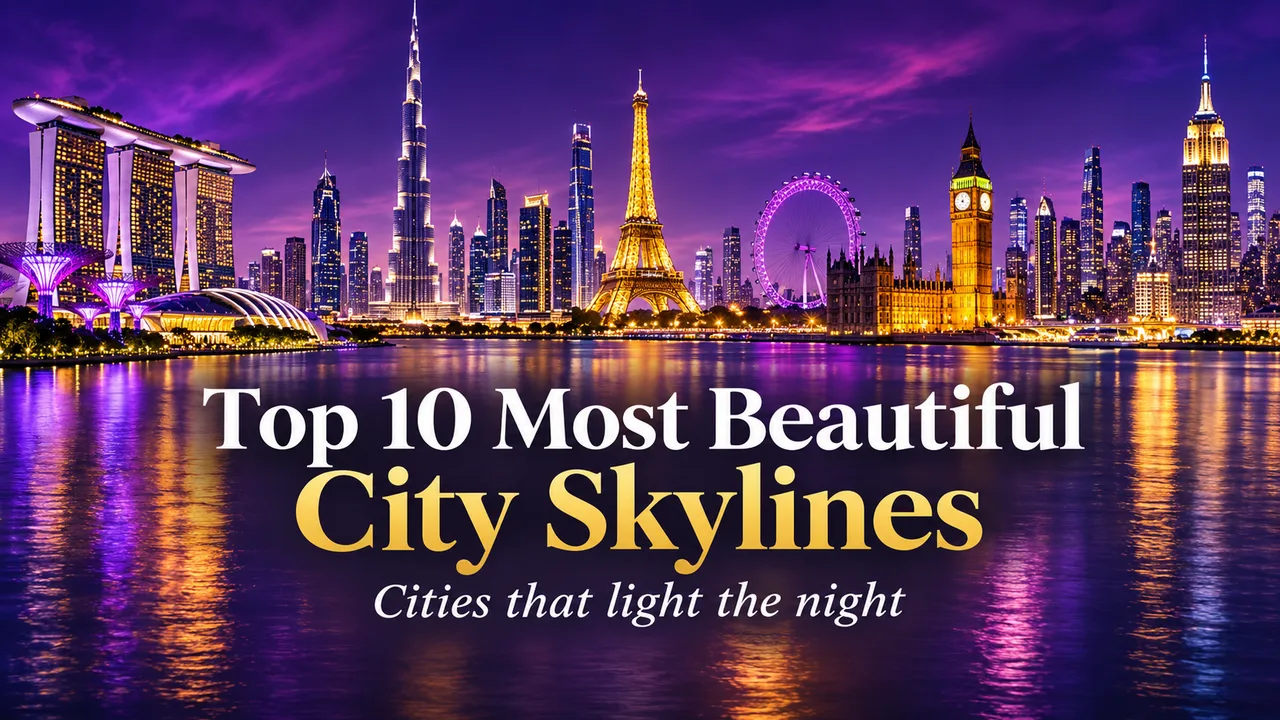
A city skyline is the silhouette of towers, bridges and landmarks against the sky. Some skylines grew around natural harbours. Others rose from deserts, river mouths or islands. The best known ones combine height, density and a setting that photographs well from water or a nearby hill.
This Finepedia list covers ten of the world's most beautiful city skylines. Beauty here means a mix of architecture, night lighting, geography and cultural recognition, not a single height ranking. Figures for tall buildings and populations are drawn from encyclopaedia and city sources and described as of late 2025 where dates matter [1][2].
The selection stretches from New York and Chicago to Shanghai, Dubai, Hong Kong, Singapore, Tokyo, Sydney, London and Toronto. Each entry notes what shapes the view and why travellers and locals keep returning to the same vantage points.
Key Facts
The table below summarizes the ten city skylines in this list, with location, a signature landmark and a short note on what defines the view.
Beautiful City Skylines at a Glance
| Rank | City | Region | Signature landmark | Notable fact |
|---|---|---|---|---|
| 1 | New York City | USA | Empire State and One World Trade | Classic Manhattan island silhouette from the harbour |
| 2 | Shanghai | China | Oriental Pearl and Shanghai Tower | Pudong financial district across the Huangpu |
| 3 | Hong Kong | China | International Commerce Centre | Towers squeezed between harbour and peaks |
| 4 | Dubai | UAE | Burj Khalifa | Desert city with the world's tallest building |
| 5 | Singapore | Singapore | Marina Bay Sands | Gardens, bay and towers in a compact frame |
| 6 | Tokyo | Japan | Tokyo Skytree | Vast low rise with scattered towers and neon |
| 7 | Chicago | USA | Willis Tower | Birthplace of the modern skyscraper skyline |
| 8 | Sydney | Australia | Sydney Opera House | Harbour, bridge and shells in one postcard view |
| 9 | London | UK | The Shard | Historic core with a growing cluster of towers |
| 10 | Toronto | Canada | CN Tower | Lake Ontario waterfront with a needle landmark |
1. New York City
New York City's skyline is the template many people imagine when they hear the word skyscraper. Manhattan packs Midtown and Lower Manhattan clusters onto a narrow island, so from the harbour, Brooklyn or New Jersey the towers form a continuous wall of glass and stone [1].
Icons such as the Empire State Building, Chrysler Building and One World Trade Center give the silhouette an instantly readable profile. Night lighting turns office floors into a glittering grid, and bridges frame the view from almost every direction.
The skyline has changed after each boom and after the destruction of the original World Trade Center, yet the combination of density and water approaches still defines urban beauty for millions of visitors. Few cities reward a ferry ride or a rooftop as consistently as New York.
Photographers favour Brooklyn Bridge Park, the Staten Island Ferry and Jersey City waterfronts because they show Midtown and downtown in one frame. Seasonal events such as New Year fireworks and fleet weeks add temporary drama without changing the permanent outline of the towers.
2. Shanghai
Shanghai's most famous skyline sits across the Huangpu River in Pudong. The Oriental Pearl Tower, Jin Mao Tower, Shanghai World Financial Center and Shanghai Tower rise in a tight group that looks almost unreal from the Bund at dusk [2].
Shanghai Tower, completed in the mid-2010s, is among the tallest buildings on Earth and twists as it rises. Across the river, historic Bund facades face the new towers, creating a dialogue between early twentieth-century banks and twenty-first-century megastructures.
River cruises and Bund promenades pack with spectators every evening. The contrast of old and new, plus coloured lights on the towers, makes Shanghai one of Asia's most photographed city views.
Related: Top 10 Famous Opera Houses of the World
Pudong's planned financial district is only a few decades old, which is why the skyline feels so coherent compared with cities that grew tower by tower over a century. Smog and humidity can soften distant detail, so clear autumn evenings are prized for photography.
3. Hong Kong
Hong Kong's skyline is famous for how little flat land it has. Towers climb from the harbour edge up the slopes of Hong Kong Island, while Kowloon mirrors them across Victoria Harbour [3].
Peaks such as Victoria Peak offer classic lookouts where the city appears as a dense carpet of lights. The International Commerce Centre and Two International Finance Centre are among the tallest points in the composition.
Symphony of Lights and nightly building illuminations add colour to the water. Typhoons and steep terrain shape building codes, but the resulting vertical city remains one of the most dramatic harbour skylines in the world.
Trams, ferries and the Peak Tram remain part of how residents experience the vertical city. From a Star Ferry crossing at twilight, advertising lights and apartment windows stack so densely that the harbour feels enclosed by glowing cliffs of glass.
4. Dubai
Dubai built a skyline almost from scratch in a few decades. The Burj Khalifa, opened in 2010 and still the world's tallest building at 828 metres, anchors a cluster along Sheikh Zayed Road and Downtown Dubai [4].
Palm islands, the Dubai Marina and the creek add water to a desert setting. Night lasers and fountain shows around Burj Khalifa turn the core into a spectacle that draws travellers from every continent.
The extreme height and rapid growth make Dubai's skyline a symbol of modern Gulf cities. From desert dunes to glass needles, the view is intentionally cinematic.
Newer clusters at Dubai Creek Harbour and along the canal continue to push the skyline farther along the coast. Heat haze can blur midday photos, so many visitors wait for the cooler blue hour when lights switch on across the Burj Khalifa district.
5. Singapore
Singapore's skyline wraps around Marina Bay. Marina Bay Sands, with its three towers and sky park, sits beside the Gardens by the Bay conservatories and a growing ring of hotels and offices [5].
Related: Top 10 Most Bizarre Phobias: Strange Fears That Exist
The city-state's limited land encourages tall, efficient towers, while strict planning keeps green edges and water views open. Merlion Park and the bayfront offer classic postcard angles.
Evening light reflections on the bay give Singapore a polished, almost resort-like skyline. Compact geography means a short walk can take in most of the signature towers.
Supertree Grove light shows and the ArtScience Museum's lotus shape add playful forms beside corporate towers. Because the centre is walkable, visitors can photograph the skyline from lawns, bridges and hotel terraces within a single evening.
6. Tokyo
Tokyo's skyline is less a single wall of towers and more a vast metropolitan tapestry. Landmark needles such as Tokyo Skytree and Tokyo Tower rise above neighbourhoods of lower buildings, while Shinjuku, Shibuya and Roppongi hold their own high-rise clusters [6].
Neon signs, rail lines and elevated highways add layers that look especially striking from observation decks at night. Mount Fuji sometimes appears on clear winter days behind the western skyline.
Beauty here comes from scale and atmosphere rather than one postcard row of identical towers. Tokyo rewards long views from bay bridges, Skytree and hilltop parks.
Earthquake engineering shapes how tall buildings sway and how densely they can be built, so Tokyo's beauty is also a story of resilience. Observation floors at Skytree and government buildings sell timed tickets that fill quickly on clear days.
7. Chicago
Chicago invented the modern skyscraper skyline after the Great Fire of 1871. Along Lake Michigan, the Loop and Near North Side present a textbook progression from early steel frames to glass giants such as Willis Tower and Trump International Hotel and Tower [7].
The Chicago River and lakefront provide open foregrounds that many inland cities lack. Architecture boat tours treat the skyline as an outdoor museum of design movements.
Related: The Science Behind Auroras: How Solar Winds Create Colorful Skies
Winter light on glass and summer fireworks over the lake keep the view changing through the year. For students of architecture, Chicago remains the essential American skyline after New York.
Millennium Park and the riverwalk give pedestrians green foregrounds that balance the hard geometry of steel and glass. Architects still pilgrimage here to see how a city can treat its skyline as public culture rather than only private real estate.
8. Sydney
Sydney's skyline is inseparable from its harbour. The Sydney Opera House's shell roofs and the steel arch of the Harbour Bridge form a foreground that no other city can copy, with Circular Quay towers rising behind [8].
Ferry wakes, sailing boats and the Botanic Garden lawns soften the hard edges of commercial towers. From Mrs Macquarie's Chair or a harbour cruise, the composition looks designed for photographs.
Height limits and harbour protection rules have shaped where towers can rise, preserving the Opera House's dominance in many frames. That balance of landmark and city is why Sydney ranks among the world's most beautiful skylines.
Ferry routes from Manly and Parramatta add long approaches that reveal the Opera House and bridge gradually. Strict heritage rules around the harbour mean new towers must negotiate views, which keeps the postcard composition relatively stable from decade to decade.
9. London
London's historic skyline once meant church spires and the dome of St Paul's Cathedral. In recent decades a cluster of towers at the City and Canary Wharf, including The Shard, 22 Bishopsgate and One Canada Square, has rewritten the profile [9].
The River Thames remains the best viewing corridor. Bridges, embankments and the London Eye offer changing angles on old and new together.
Protected sightlines toward St Paul's still limit some developments, so the skyline grows in pockets rather than a single wall. That layered history is part of London's visual appeal.
Related: Top 10 Facts About Dogs
Canary Wharf's separate cluster to the east creates a second skyline node visible from Greenwich and the Emirates Air Line cable car. Sunset light on The Shard's glass facets is a favourite of Thames-side photographers.
10. Toronto
Toronto's skyline lines the north shore of Lake Ontario. The CN Tower, completed in the 1970s and long the world's tallest free-standing structure, still punctuates a rising forest of condominiums and bank towers [10].
From Toronto Islands or the harbour, the needle and the Rogers Centre dome create an easy-to-read silhouette. Night lighting on the tower changes colour for holidays and civic events.
Rapid residential high-rise growth has filled gaps along the waterfront, making the skyline denser each decade. For Canada, Toronto is the definitive big-city view.
Sports nights and Canada Day colour the CN Tower in team or national hues, turning the landmark into a civic billboard. Condos continue to rise west and east of downtown, so the waterfront silhouette grows broader even when no single tower overtakes the needle.
Conclusion
Beautiful skylines mix height with setting. Harbours, rivers, deserts and mountains give towers a stage, while lighting and landmarks give them character.
The ten cities above show how different cultures build the same idea: a recognisable outline against the sky. Whether you prefer New York's density, Shanghai's river lights or Sydney's harbour shells, each skyline rewards a slow look from the water or a high terrace.
Travellers chasing skyline views should check observation deck hours, ferry schedules and haze forecasts. A beautiful skyline is as much about timing and vantage as about which building is tallest.
- ^ [1] "New York City". Encyclopaedia Britannica. Britannica: New York City
- ^ [2] "Shanghai". Wikipedia. Wikipedia: Shanghai
- ^ [3] "Hong Kong". Wikipedia. Wikipedia: Hong Kong
- ^ [4] "Burj Khalifa". Wikipedia. Wikipedia: Burj Khalifa
- ^ [5] "Marina Bay Sands". Wikipedia. Wikipedia: Marina Bay Sands
- ^ [6] "Tokyo". Wikipedia. Wikipedia: Tokyo
- ^ [7] "Chicago". Encyclopaedia Britannica. Britannica: Chicago
- ^ [8] "Sydney Opera House". UNESCO World Heritage Centre. UNESCO: Sydney Opera House
- ^ [9] "The Shard". Wikipedia. Wikipedia: The Shard
- ^ [10] "CN Tower". Wikipedia. Wikipedia: CN Tower






















Discussion
Log in with