






 By
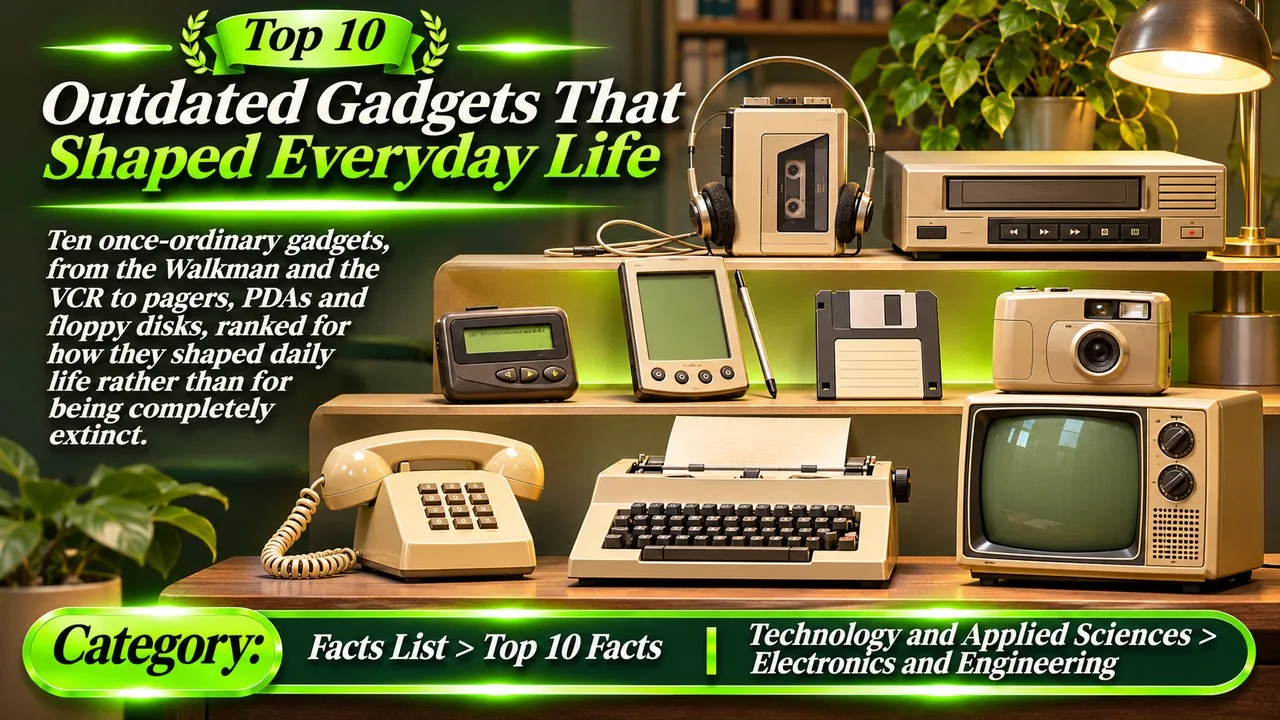
Some outdated gadgets mattered because they were once ordinary, and because the jobs they did are now built into phones, laptops and cars. A list that says "no one uses these anymore" is already out of date in places: film cameras have a revival, fax machines still sit in some offices, and a pager is not unknown in a hospital [1][2].
This is a curated 2026 list of devices that were once everyday tools and are no longer the default way most people listen, watch, navigate, compute or communicate. It is not a claim that every example is extinct, and it is not a collector's price guide. The ranking favours gadgets that changed habits for millions of people, then handed those habits on to a later device [1][3].
Key Facts
"Outdated" here means no longer the mainstream consumer tool for its job. Niche, professional and enthusiast use can still exist.
Outdated Gadgets at a Glance
| Rank | Gadget | Mainstream era | What replaced it as the default | 2026 residue |
|---|---|---|---|---|
| 1 | The cassette Walkman | 1980s-1990s | Portable digital audio, then the smartphone | A design icon; cassettes have a small revival |
| 2 | The VCR and the VHS tape | 1980s-1990s | DVD, then streaming and files | Attics, archive rooms and some artists |
| 3 | The floppy disk | 1970s-1990s | Optical discs, then USB drives and the cloud | A save-icon ghost and specialist use |
| 4 | The pager | 1980s-1990s | Mobile phones and later smartphones | Still used in some hospitals and emergency work |
| 5 | The PDA | 1990s-early 2000s | The smartphone | A missing link in the museum case |
| 6 | The portable CD player | 1990s-early 2000s | Digital files and streaming | Second-hand shelves and nostalgia |
| 7 | The CRT television | Mid-twentieth century to mid-2000s | Flat-panel TVs | Recycled stacks, retro gaming, a few studios |
| 8 | The standalone car GPS | Mid-2000s to early 2010s | Smartphone maps | Older cars, some professional fleets |
| 9 | The fax machine | 1970s-1990s as an office default | Email, scans and secure portals | Still required in some legal, medical and government workflows |
| 10 | The everyday feature phone | 1990s-2000s | The smartphone as the default handset | Still sold, but no longer the centre of everyday life for most users |
1. The cassette Walkman
Sony's Walkman, launched in 1979, made private, portable music an ordinary street habit. Headphones, a belt clip, and a cassette you chose before leaving the house changed how people used public space, and every later pocket music player, including the smartphone in a commuter's hand, still works inside that idea [1][4].
It is first because the social change was larger than the mechanism. The cassette itself was already common; the Walkman made it mobile and personal. By 2026 the default is a phone and a streaming account, but the habit of a private soundtrack in a shared place is a Walkman inheritance [4].
Cassettes and Walkman-style players have a small enthusiast revival. That does not put the cassette back at the centre of popular listening, and it should not be used to pretend the device never left the mainstream [1][4].
2. The VCR and the VHS tape
The video cassette recorder, especially in the VHS format that won the consumer standard fight, put movie night and time-shifted television into ordinary living rooms. Rental shops, recorded soaps, and the clock that blinked 12:00 on a million machines were part of the same everyday system [1][5].
It is second because it changed not only a gadget shelf but a whole retail and domestic ritual. DVD, then discs on demand, then streaming, took the job away. In 2026 a VHS tape is an archive object, a loft box, or a tool for a handful of artists and collectors, not the way most households get a film [5].
The format also shows how a "universal" standard can still vanish. A tape that played in almost every home is now a machine-and-media problem [5].
Related: History of Human Civilization: From Ancient Times to the Modern Age
3. The floppy disk
The floppy disk, from the eight-inch and five-and-a-quarter-inch disks through the familiar 3.5-inch square, was how ordinary people carried a file from one computer to another [1][3]. Schoolwork, office drafts and early home computers all depended on a disk you could lose, forget, or ruin with a magnet.
It is third because it taught a generation the idea of a portable file, then left that idea inside USB sticks, email attachments and cloud folders. The little diskette is still the "save" icon on many screens, a ghost of a gadget that most offices have not used as a default for twenty years [3].
Specialist machines, some industrial equipment and a few government systems have lingered with floppies longer than the living room did. That lag is part of the story, not a reason to call the disk current [1][3].
4. The pager
The pager, or beeper, could do one thing extremely well: reach a person with a short message when they were not at a desk. Doctors, dispatchers, teenagers in the 1990s and on-call workers all used that one-way, later two-way, poke as a social and professional tool [2][6].
It is fourth because it shaped an etiquette of being reachable before the mobile phone became cheap and ordinary. The smartphone swallowed the function, but it did not make the pager's reliability in some hospitals and emergency systems completely vanish. A 2026 list that says "no one uses pagers" is too clean [6].
What ended for most people was the pager as a teenage or general-purpose gadget. What remains is a narrow professional tool [2][6].
5. The PDA
The personal digital assistant, from early organisers through Palm and Pocket PC devices, was a pocket computer for calendars, contacts and notes, sometimes with a stylus and a handwriting system that people had to learn [1][3]. It was the missing step between a paper diary and the smartphone.
Related: Mark Zuckerberg: The Rise of a Social Media Pioneer
It is fifth because the category was huge in the late 1990s and early 2000s, then collapsed almost as soon as a phone could do the same jobs without a second device. In 2026 the PDA is a museum object and a collector's curiosity, not an everyday tool [3].
The lesson is brutal and useful: a gadget can be advanced, popular, and still disappear when a slightly more convenient object absorbs it [1][3].
6. The portable CD player
The portable CD player, including Sony's Discman and a crowd of cheaper copies, was the 1990s way to take an album on a train without a cassette. It was clearer than tape, more fragile in motion, and still a physical disc you had to carry [1][4].
It is sixth as the short, bright successor to the Walkman that digital files then replaced. Anti-skip buffers got better; they did not make a spinning disc the right pocket format once a thousand songs could sit in flash memory [4].
In 2026 a portable CD player is a nostalgia or surplus object. The compact disc itself has a modest enthusiast afterlife, like the cassette, but it is not how most people carry a library [1][4].
7. The CRT television
The cathode-ray-tube television was the living-room screen for half a century: deep, heavy, curved or nearly flat at the end, and central to how families watched news and drama [1][5]. Flat-panel sets, first expensive and then cheap, removed it from shops and then from most houses in the 2000s.
It is seventh because the object organised furniture, evening time and a whole repair trade, then became a recycling problem. A few people still want CRTs for retro video games or for a particular studio look. That is a niche, not a return of the default living-room set [5].
Related: Top 10 Accidental Inventions That Changed Everyday Life
The computer monitor in the same tube technology followed a similar path, only faster, once LCD panels took over desks [1][5].
8. The standalone car GPS
For a few years in the 2000s, a suction-cup sat-nav on the windscreen was the ordinary way to get turn-by-turn directions in a car: TomTom, Garmin and their rivals sold a dedicated box with maps on a memory card and a calm, or not so calm, spoken voice [3][7]. Then phones got good enough maps, and the extra device started to look like a PDA on the dashboard.
It is eighth because it mass-marketed digital navigation just before the smartphone took the job. In 2026 some older cars, rental fleets and professional users still have a dedicated unit, and some drivers prefer a fixed screen, but the default tool for most people is a phone or a built-in car system [7].
The gadget also taught a habit, sometimes a bad one, of following a voice even when the road in front said otherwise [7].
9. The fax machine
The fax machine, as an everyday office tool, moved signed papers across phone lines when that was the fastest legal-looking way to send a copy. For a time it was as ordinary as a photocopier [2][8]. Email, scanners and later secure portals took most of that work away.
It is ninth, not higher, because its cultural glamour was always lower than the Walkman's, and because it has not quite died. In 2026 some medical, legal and government offices still ask for a fax, a fact that is either a security habit or an institutional lag, depending on who is asked [8].
Related: Top 10 Most Bizarre Phobias: Strange Fears That Exist
Calling it extinct is wrong. Calling it the default office tool is also wrong. That in-between state is why it belongs on a careful list [2][8].
10. The everyday feature phone
The everyday mobile phone before the smartphone, the candybar or flip handset that made calls, sent text messages and perhaps took a poor photograph, was the device that made personal calling ordinary [1][6]. It is easy to forget, now that a phone is a computer, that the first mass habit was just "I have a phone in my pocket."
It is tenth because the category still exists: simple handsets are still sold, and some people prefer them. What ended is the feature phone as the default centre of everyday life. The smartphone took that role in the 2010s, and in 2026 it still has it [6].
Early "brick" phones and later slim feature phones are different objects. This entry is about the ordinary pocket phone as a superseded default, not about a single model [1][6].
Conclusion
The ten gadgets above are outdated as defaults, not always as objects [1][2]. Film cameras, which older lists sometimes declared dead, are a warning: a format can leave the mainstream and still come back as a craft. That is why this article does not treat a camera as vanished, and why it is careful about pagers and fax machines.
What remains, in 2026, is the habit each gadget taught. We still walk around inside a private soundtrack, still watch something we did not see live, still carry files, still expect to be reachable, and still follow a map that talks. The machines changed; the habits mostly did not [3][4].
- ^ [1] "Walkman," "Videocassette recorder," "Floppy disk" and related device histories. Wikipedia. Wikipedia: Walkman
- ^ [2] "Pager" and "Fax" as professional and office tools, including remaining uses. Wikipedia and industry notes. Wikipedia: Pager
- ^ [3] "Personal digital assistant," floppy-disk and digital-storage overviews. Wikipedia. Wikipedia: Personal digital assistant
- ^ [4] Portable audio, from the Walkman to the Discman and later digital players. Sony corporate history and Wikipedia. Walkman
- ^ [5] "VHS" and "Cathode-ray tube" consumer-technology histories. Wikipedia. Wikipedia: VHS
- ^ [6] Mobile paging and the shift from feature phones to smartphones. Wikipedia. Wikipedia: Feature phone
- ^ [7] Standalone satellite-navigation devices and the move to smartphone maps. Wikipedia. Automotive navigation system
- ^ [8] Remaining institutional uses of fax, including healthcare and legal contexts. Contemporary reporting and Wikipedia. Wikipedia: Fax






















Discussion
Log in with