






 By
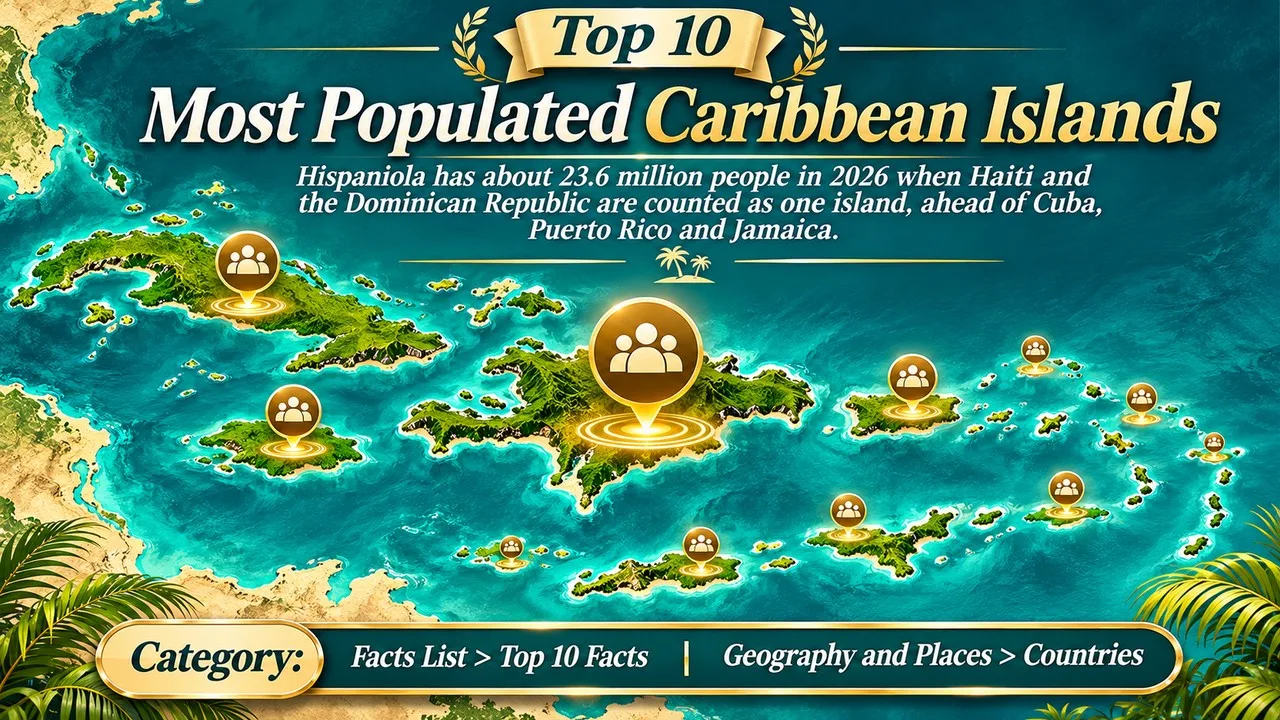
Hispaniola is the most populous Caribbean island, with about 23.6 million people in 2026 when Haiti and the Dominican Republic are counted together. Haiti is estimated at 12,037,506 and the Dominican Republic at 11,609,500 on World Population Review's 2026 presentation of United Nations medium-variant figures [1][2].
A 2016 list of "populated Caribbean islands" often ranked those two countries separately and put Cuba first. That is a list of political units, not of islands. This article ranks islands. Cuba is second as an island (and as a state), Puerto Rico is third, and Jamaica is fourth. Smaller islands then follow, using the same 2026 estimates where a territory is essentially one main island, and a slightly earlier official or encyclopedic figure where only the island (not the whole country) has been published [1][3].
Figures for 2026 from this source are medium-scenario projections from 2024 onward, not census counts. They are dated here as of November 2026 and will move when official enumerations are released. Mainland states such as Guyana, Suriname and Belize, sometimes included in cultural definitions of the Caribbean, are omitted because they are not islands [1][2].
Key Facts
Unless noted, population is the 2026 World Population Review / United Nations medium estimate for the political unit that coincides with the island, or the sum of the two states on Hispaniola.
Most Populated Caribbean Islands at a Glance
| Rank | Island | Political units | Population | Notes |
|---|---|---|---|---|
| 1 | Hispaniola | Haiti and the Dominican Republic | About 23.65 million (2026) | One island, two countries |
| 2 | Cuba | Cuba | About 10.89 million (2026) | The main island holds nearly all of the national total |
| 3 | Puerto Rico | Puerto Rico (United States) | About 3.22 million (2026) | A US territory; slightly below older peaks |
| 4 | Jamaica | Jamaica | About 2.83 million (2026) | Fourth among islands, fifth if Hispaniola is split |
| 5 | Trinidad | Trinidad and Tobago | About 1.49 million (2024 island figure) | The larger of the country's two main islands |
| 6 | Isla Margarita | Venezuela (Nueva Esparta) | About 490,000 (2022) | In the Caribbean Sea, off the Venezuelan mainland |
| 7 | Martinique | France | About 337,711 (2026) | A single main island and French overseas department |
| 8 | Barbados | Barbados | About 282,724 (2026) | An independent state on one main island |
| 9 | Curacao | Netherlands | About 185,440 (2026) | A constituent country of the Kingdom of the Netherlands |
| 10 | Saint Lucia | Saint Lucia | About 180,488 (2026) | Just behind Curacao on the 2026 estimates |
1. Hispaniola
Hispaniola is the only Caribbean island that is split between two sovereign states. Adding the 2026 estimates for Haiti (12,037,506) and the Dominican Republic (11,609,500) gives about 23.65 million people, more than twice Cuba's total [1][2]. The border, the island's mountain spine and two very different official languages are all part of why older popular lists treated the states as if they were separate islands.
Haiti's population is younger and denser; the Dominican Republic's is slightly smaller in this series and less densely settled on a similar land area [1]. Port-au-Prince and Santo Domingo are the largest urban centres. The island is also the second-largest in the Caribbean by area, after Cuba [3].
Counting Hispaniola as one place is the geographically honest method. Readers who want a country ranking can still use the same figures and place Haiti first, the Dominican Republic second and Cuba third [1][2].
2. Cuba
Cuba, as a country, is estimated at 10,892,659 people in 2026, which also makes the main island the second most populous in the Caribbean [1]. A small share of the national total lives on other Cuban islands, notably Isla de la Juventud (about 84,000 in a 2022 figure), so the main island's population is slightly lower than the state total [3]. The difference is not large enough to change its rank.
Cuba is the largest Caribbean island by area, and its 2026 estimate is lower than mid-2010s figures often quoted in older lists, reflecting a population that has been stable or slightly falling in official reporting [1][2]. Havana is the dominant city.
Related: Top 10 Largest Islands in the World
On a country list Cuba would be third, behind both Haitian and Dominican totals. On an island list it is a clear second [1][3].
3. Puerto Rico
Puerto Rico is estimated at 3,222,688 in 2026, third among islands [1]. It is a US territory, and its population has been below the peaks recorded before the mid-2010s, after recession, migration and Hurricane Maria. A 1 July 2025 official figure cited on Wikipedia's country list was 3,184,195, in the same range as the 2026 projection [2].
Almost all residents live on the main island; Vieques, Culebra and smaller islands add only a small number. San Juan is the capital and largest urban area. In language and culture Puerto Rico is part of the Spanish-speaking Greater Antilles, together with Cuba and the two Hispaniolan states.
Third place is stable on any recent island ranking. No smaller island is close to three million people [1][3].
4. Jamaica
Jamaica is estimated at 2,833,403 in 2026, fourth among islands and the most populous English-official island in the Caribbean [1]. The figure is close to older census-based totals; Wikipedia's country table cites 2,734,092 as a 1 July 2019 official figure and a mid-2023 UN estimate a little above 2.8 million [2].
The island is much smaller in area than the three above it, so its density is higher than Cuba's. Kingston is the capital. Jamaica is a single main island with only minor offshore cays, so the national total and the island total are effectively the same [3].
On a list that split Hispaniola, Jamaica would be fifth, after Cuba, Haiti, the Dominican Republic and Puerto Rico. As an island ranking, fourth is the correct place [1].
5. Trinidad
Trinidad is the larger island in the Republic of Trinidad and Tobago. Wikipedia's list of Caribbean islands by area cites a 2024 population of 1,487,245 for Trinidad itself [3]. The 2026 estimate for the whole country is 1,513,268, the difference being mainly Tobago and smaller islands [1]. Trinidad alone is still comfortably fifth.
Related: Top 10 Most Populous Countries in the World
The island lies on the South American continental shelf and is the southernmost large island usually grouped with the Caribbean. Port of Spain is the capital. Energy production and a diversified urban economy make it demographically and economically distinct from the tourism-heavy Windward Islands [2].
Older 10-country lists often used a combined Trinidad-and-Tobago total and ranked the state sixth or so, after Jamaica. Separating the islands does not change Trinidad's place in the top five, because Tobago is far smaller [1][3].
6. Isla Margarita
Isla Margarita, in Venezuela's Nueva Esparta state, had a population of 489,917 in a 2022 figure reported on Wikipedia's list of Caribbean islands by area [3]. That is enough to place it sixth, well below Trinidad and well above any of the French Antillean departments.
Some Caribbean country lists omit Margarita because it is part of a South American mainland state. Geographically it is a Caribbean island, in the Caribbean Sea, and a population ranking of islands should include it [3]. Porlamar is the main urban centre.
The 2022 figure is older than the 2026 projections used for independent states and French or Dutch territories. Even a substantial later change would be unlikely to push Margarita above Trinidad or below Martinique [1][3].
7. Martinique
Martinique, a French overseas department and a single main island, is estimated at 337,711 in 2026 [1]. That is lower than some mid-2010s figures, in line with a population that has been roughly stable or slightly falling, and it is still seventh on this island list.
Related: Top 10 Most Bizarre Phobias: Strange Fears That Exist
Fort-de-France is the capital. The island is part of the Windward chain and, unlike Guadeloupe, is not a pair of almost equal main islands joined by a short crossing. That makes the department total a good proxy for the island total [1][3].
Guadeloupe as a whole is estimated at 372,453 in 2026, which would outrank Martinique if it were one island, but it is not: Basse-Terre and Grande-Terre are separate islands, and this list does not combine them [1][3].
8. Barbados
Barbados is estimated at 282,724 in 2026, eighth among the islands counted here [1]. It is an independent state whose territory is essentially one main island, so the national and island figures coincide. Bridgetown is the capital, and the island has one of the higher population densities in the eastern Caribbean [1].
The 2016 popular list that used country units also placed Barbados tenth, with a similar population. The rank on this island list is a little higher because Hispaniola is merged, Trinidad is separated from Tobago, and Margarita is included [1][3].
No other independent micro-state in the region approaches Barbados in population. The next independent island countries on the 2026 table are much smaller, apart from those already ranked above [1].
9. Curacao
Curacao, a constituent country of the Kingdom of the Netherlands, is estimated at 185,440 in 2026 [1]. It is a single main island (with the tiny uninhabited Klein Curacao) and therefore belongs here as an island as well as a political unit. Willemstad is the capital and a UNESCO-listed historic harbour.
The 2026 estimate is in the same range as recent official figures, though national counts have varied with methodology. Even so, Curacao sits above Saint Lucia and below Barbados with a comfortable margin on this set of numbers [1][2].
Related: Top 10 Oldest Buildings in the World
It is the most populous of the Dutch Caribbean islands, ahead of Aruba and Sint Maarten, which are smaller both as islands and as populations [1].
10. Saint Lucia
Saint Lucia is estimated at 180,488 in 2026, tenth on this list, just behind Curacao [1]. Castries is the capital. Like Barbados, it is an independent state on one main island, so the national total is the island total.
Several other islands and island-territories sit close below this threshold, including Aruba (108,164 in the same 2026 series) and, depending on the year and the definition, New Providence in the Bahamas, where Nassau is located. New Providence is densely populated but is one island in an archipelago, and a clean 2026 island figure was not used here in preference to national estimates that would have mixed many Bahamian islands together [1][3].
Tenth place is therefore a close one. A new census could swap Saint Lucia with Curacao or bring another island into the frame, but it would not disturb the top five [1].
Conclusion
As of the 2026 medium estimates, three Greater Antillean islands account for the overwhelming majority of the Caribbean's population: Hispaniola, Cuba and Puerto Rico, with Jamaica close behind [1][3]. Treating Haiti and the Dominican Republic as separate islands, as older country lists did, hides that fact.
All of these numbers should be read as estimates. They are useful for order of magnitude and for ranking, not as substitute census totals. For area rather than population, Cuba is first and Hispaniola is second, a reminder that the two measures do not produce the same order [3].
- ^ [1] "Caribbean Population 2026". World Population Review. World Population Review: Caribbean population 2026
- ^ [2] "List of Caribbean countries by population". Wikipedia. Wikipedia: Caribbean countries by population
- ^ [3] "List of Caribbean islands by area". Wikipedia. Wikipedia: Caribbean islands by area




















Discussion
Log in with