






 By
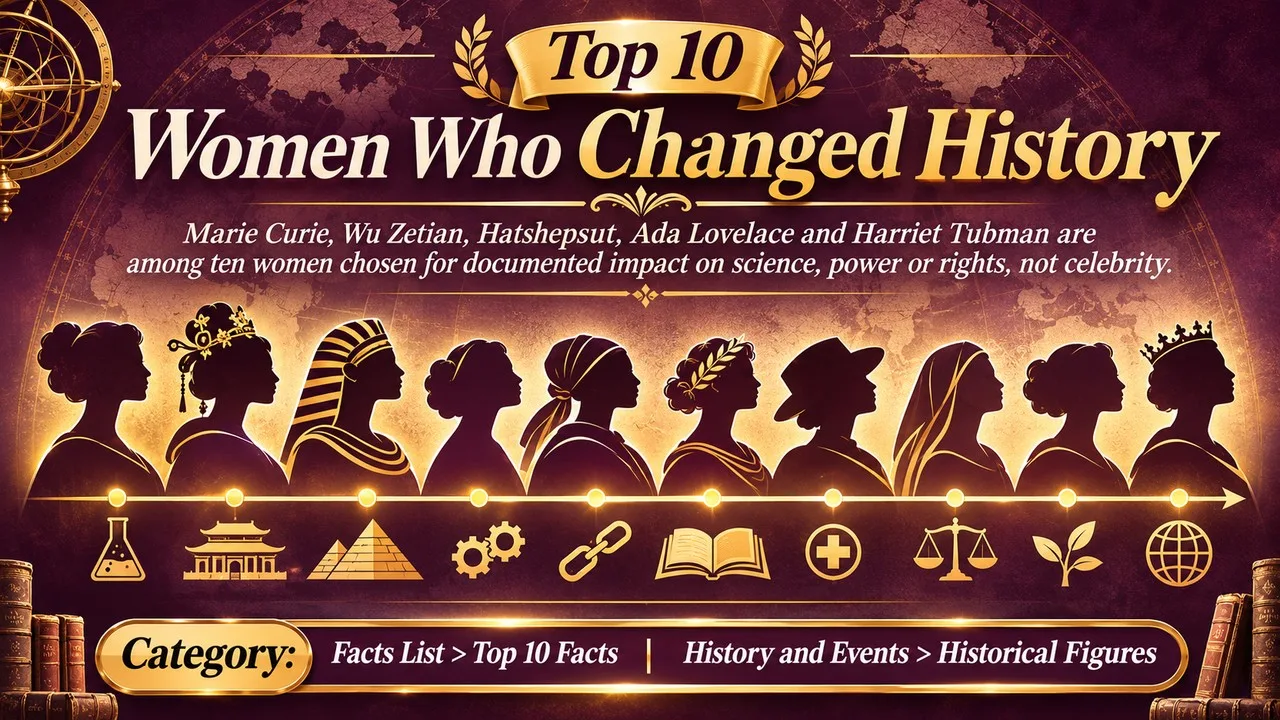
Marie Curie remains the only person to win Nobel Prizes in two scientific fields, one reason she heads this editorial list of women who changed history. There is no official ranking of historical influence. The ten people below were chosen for documented, lasting effects on science, law, political power or civil rights, and for geographic range, not for celebrity or for a quotation book [1][2].
A 2017 popular list on the same theme mixed serious historical figures with film stars and treated Cleopatra mainly as a beauty story. This article does not do that. Finepedia already covers Cleopatra in dedicated pages, including the search for her tomb. Living political celebrities of the last few years are also omitted, so the list can rest on sources that have had time to settle [3].
Each entry states what is firmly known and, where later myth has grown around the person, says so. Dates and prizes are given as of the historical record, which does not change with a 2026 news cycle [1].
Key Facts
The order is editorial. It is not a score of moral worth, and it is not complete.
Women Who Changed History at a Glance
| Rank | Person | Dates | Main field | Lasting fact |
|---|---|---|---|---|
| 1 | Marie Curie | 1867-1934 | Physics and chemistry | Two Nobel Prizes, in two sciences |
| 2 | Wu Zetian | 624-705 | Political rule | Only woman to rule China as emperor in her own name |
| 3 | Hatshepsut | c. 1507-1458 BCE | Political rule | Egyptian king whose reign left major monuments |
| 4 | Ada Lovelace | 1815-1852 | Computing | Early published algorithm intended for a general machine |
| 5 | Harriet Tubman | c. 1822-1913 | Abolition and war | Underground Railroad organiser and Civil War scout |
| 6 | Emmeline Pankhurst | 1858-1928 | Political rights | Leader of a militant British suffrage campaign |
| 7 | Tu Youyou | b. 1930 | Medicine | Nobel Prize for artemisinin, a malaria treatment |
| 8 | Wangari Maathai | 1940-2011 | Environment and politics | Nobel Peace Prize; Green Belt Movement in Kenya |
| 9 | Rosa Parks | 1913-2005 | Civil rights | The 1955 Montgomery bus arrest that fuelled a mass boycott |
| 10 | Mary Wollstonecraft | 1759-1797 | Political thought | Author of A Vindication of the Rights of Woman |
1. Marie Curie
Maria Sklodowska Curie, born in Warsaw and later a French citizen, isolated radium and polonium and pioneered the study of radioactivity. She received the 1903 Nobel Prize in Physics with Pierre Curie and Henri Becquerel, and the 1911 Nobel Prize in Chemistry in her own right, the only person so far to have won the prize in two scientific fields [1][2].
Her laboratories, her wartime X-ray work and the later medical use of radioactive materials all grew from that research. The cost was also real: she died in 1934 of an illness widely attributed to long radiation exposure. The prizes, the elements and the institutional path she opened for later women in science are the documented record, not a later slogan [1].
Curie is first here because the achievement is unusually precise: two peer-judged international prizes, two disciplines, and a body of work that is still cited as a foundation of nuclear science [2].
2. Wu Zetian
Wu Zetian is the only woman in Chinese history to have ruled as emperor in her own name, founding the short-lived Zhou dynasty in 690 after years as consort, empress and then regent of the Tang [3]. The political facts are not in serious dispute; the later portraits of her as either a uniquely cruel usurper or a flawless feminist heroine are another matter, and should be read as later argument.
Her reign involved court violence, as Tang politics often did, and also a widening of recruitment into the bureaucracy and a public use of Buddhist legitimacy. She was forced to yield the throne in 705 and died the same year [3].
Related: Top 25 Interesting Facts About the Solar System
A list of women who changed political history that omitted her would be geographically narrow. She is the clearest example of a woman holding the summit of a major imperial system, not a ceremonial title [3].
3. Hatshepsut
Hatshepsut ruled Egypt in the Eighteenth Dynasty, at first as regent for the young Thutmose III and then as king, with the full royal titulary, from about 1479 to 1458 BCE [4]. Her mortuary temple at Deir el-Bahri, the expedition to Punt and a large building programme are the hard evidence of a substantial reign, not a footnote.
Later in the dynasty, images and names of Hatshepsut were chiselled out on many monuments. Egyptologists have debated whether this was a sudden damnatio or a more gradual political revision; either way, it is why her career had to be reconstructed from archaeology as well as from surviving inscriptions [4].
She is here as a documented female king of a major ancient state, a category that is small and often distorted by later storytelling [4].
4. Ada Lovelace
Ada Lovelace, daughter of Lord Byron and collaborator with Charles Babbage, wrote extensive notes on Babbage's planned Analytical Engine. In those notes, published in 1843, she set out a method for the engine to compute Bernoulli numbers, which is widely described as the first published algorithm intended for a general-purpose machine [5].
She also saw, more clearly than some of her contemporaries, that a machine which could manipulate symbols might go beyond pure arithmetic. The Analytical Engine was never built in their lifetimes, so her work remained a paper achievement until later computer history recovered it [5].
Popular writing sometimes inflates this into a claim that she "invented the computer." The accurate statement is already strong enough: she left a foundational text in the idea of programmable calculation [5].
5. Harriet Tubman
Harriet Tubman escaped slavery in Maryland and then returned, repeatedly, to guide other enslaved people to freedom on the Underground Railroad. During the American Civil War she worked as a scout, spy and nurse for the Union, including on the 1863 Combahee River raid that freed hundreds of people [6].
Related: Top 10 Mythical Creatures in World Mythology - That Inspired Myths Across Civilizations (unchanged)
The exact number of her pre-war rescue missions has been debated, and later retellings sometimes enlarge it. The core is not in doubt: she risked recapture many times, became a public advocate after the war, and remains a central figure in the history of abolition and of the Civil War [6].
She is on this list for organised, documented action that changed the lives of specific people and became a national political symbol, not for a single legend [6].
6. Emmeline Pankhurst
Emmeline Pankhurst created the WSPU in 1903 and led a militant British campaign for the vote, including demonstrations, hunger strikes and attacks on property that divided both her movement and the wider public [7]. British women over 30 who met property qualifications received the vote in 1918; equal terms with men followed in 1928, the year she died.
She was not the only leader of British suffrage, and she was a controversial one. A list that named only a later, quieter symbol would understate how the legal change was actually fought. The Representation of the People Acts are the measurable result [7].
Pankhurst is here as a political organiser whose campaign is tied, in the historical record, to a concrete change in who could vote [7].
7. Tu Youyou
Tu Youyou, a Chinese pharmaceutical chemist, led the work that extracted artemisinin from sweet wormwood as a malaria treatment, a project begun under a 1960s research programme and later recognised with the 2015 Nobel Prize in Physiology or Medicine, shared with two other scientists [8]. Artemisinin-based therapies have since been central to malaria treatment worldwide.
Related: Top 25 Interesting Facts About the Universe
Her path was not a Western university career. She worked from traditional materia medica as well as from laboratory method, and the prize came decades after the key findings. That delay is part of the story of how scientific credit travels [8].
She is the most recent Nobel laureate on this list, and the one whose work has the most direct, countable effect on deaths from a major infectious disease [8].
8. Wangari Maathai
Wangari Maathai founded the Green Belt Movement in Kenya in 1977, organising tree planting, rural women's work and later political opposition to land grabbing and authoritarian rule. She received the Nobel Peace Prize in 2004, the first African woman to do so, and served in Kenya's parliament after the country's political opening [9].
The movement's tree counts are large and sometimes rounded in publicity, but the organisation itself, and Maathai's repeated arrests and public confrontations with officials, are documented. She died in 2011 [9].
She connects environmental work to democratic politics in a way few other people on this list do, and she places an East African civic movement in a set that would otherwise lean too heavily on Europe and the United States [9].
9. Rosa Parks
Rosa Parks was arrested in Montgomery, Alabama, on 1 December 1955, after refusing to give up her bus seat under segregation laws. The arrest was used by local organisers, including the Montgomery Improvement Association led by Martin Luther King Jr., to launch a 381-day bus boycott that ended with a federal court ruling against segregated seating [10].
Parks was already an NAACP investigator and activist, not a tired accidental passenger, a correction historians have stressed against a simpler schoolbook version. The political effect of the boycott is not in doubt [10].
Related: Top 25 Weird Facts About Left-Handed People
She is ninth not because the event was small, but because this list is spread across science, sovereignty and rights, and because the boycott was a collective action in which many named and unnamed people took part [10].
10. Mary Wollstonecraft
Mary Wollstonecraft published A Vindication of the Rights of Woman in 1792, arguing that women should be educated as rational citizens rather than as ornaments. It is a founding text of modern liberal feminism, written in the middle of the French Revolutionary debate and still assigned as a primary source [11].
Her life was short and often scandalised by later Victorian readers; the work's influence is the reason she is here. Later suffrage campaigns, including Pankhurst's, drew on a language of rights that this book helped to set down in English [11][7].
A list of "women who changed history" that only counted rulers and prize-winners would miss the people who changed the terms of the argument. Wollstonecraft is the clearest such case in the English-language canon [11].
Conclusion
This is an editorial ten, not a closed canon. Many other names, from Hypatia and Sor Juana Ines de la Cruz to Katherine Johnson, Indira Gandhi and Funmilayo Ransome-Kuti, would fit the same criteria on another day. The aim here is a defensible, sourced shortlist that does not confuse fame with historical effect.
What the ten share is a paper trail: prizes, laws, inscriptions, expeditions, books, arrests, or institutions that can still be checked in 2026. A different editor, using the same rule, could justifiably swap two or three names and still be standing on firm ground.
- ^ [1] "Marie Curie". Wikipedia. Wikipedia: Marie Curie
- ^ [2] "The Nobel Prize" laureate records for Marie Curie. Nobel Prize Outreach. Nobel Prize: Marie Curie
- ^ [3] "Wu Zetian". Wikipedia. Wikipedia: Wu Zetian
- ^ [4] "Hatshepsut". Wikipedia. Wikipedia: Hatshepsut
- ^ [5] "Ada Lovelace". Wikipedia. Wikipedia: Ada Lovelace
- ^ [6] "Harriet Tubman". Wikipedia. Wikipedia: Harriet Tubman
- ^ [7] "Emmeline Pankhurst". Wikipedia. Wikipedia: Emmeline Pankhurst
- ^ [8] "Tu Youyou". Wikipedia. Wikipedia: Tu Youyou
- ^ [9] "Wangari Maathai". Wikipedia. Wikipedia: Wangari Maathai
- ^ [10] "Rosa Parks". Wikipedia. Wikipedia: Rosa Parks
- ^ [11] "Mary Wollstonecraft" and "A Vindication of the Rights of Woman". Wikipedia. Wikipedia: A Vindication of the Rights of Woman























Discussion
Log in with