










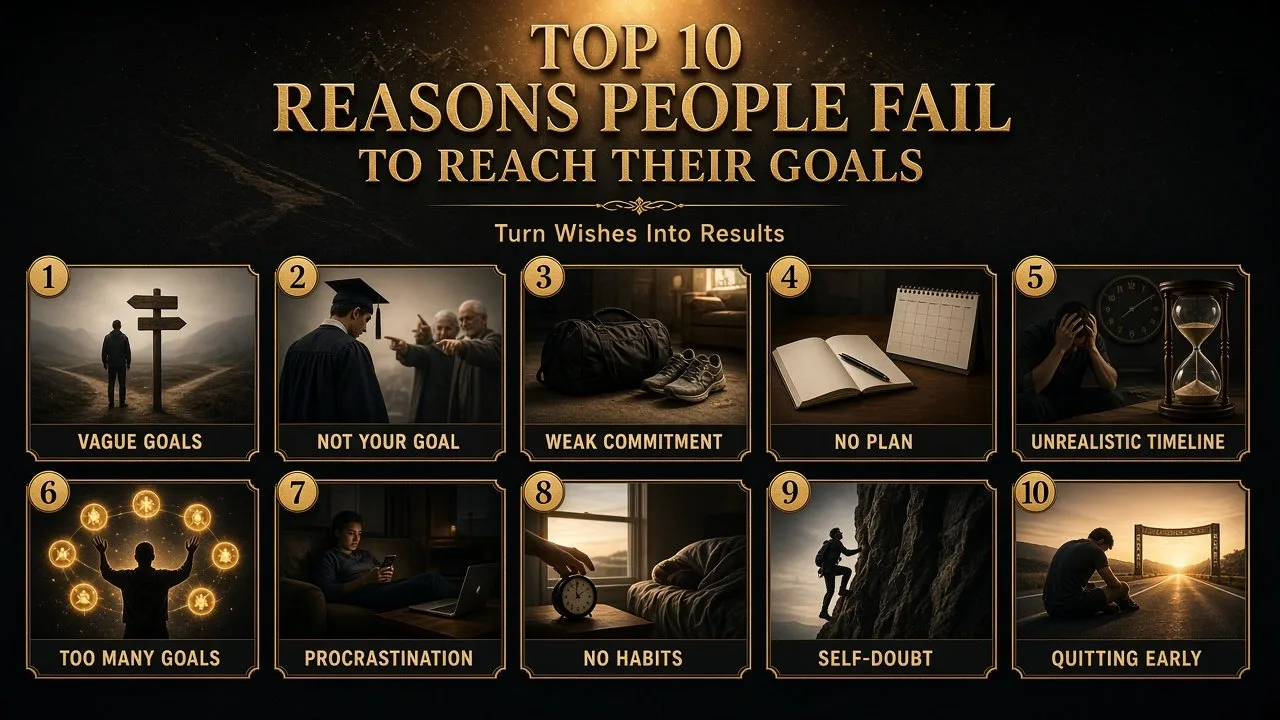
People fail to reach their goals for fixable reasons: vague targets, weak commitment, no plan, procrastination, distraction, self-doubt and quitting early.
Almost everyone sets goals, whether it is a promotion, a fitter body, a savings target, a finished degree or a new business. Far fewer people reach them. The gap between wanting something and actually getting it is one of the most studied subjects in psychology, and the research points to a surprisingly consistent set of causes. Most of them have little to do with talent or luck.
This guide explains the ten most common reasons people fall short of their goals, what the science says about each one, the warning signs to look for, and practical ways to fix them. It draws on decades of research into goal setting, habits, procrastination and motivation rather than on slogans.
How We Chose These 10 Reasons
This is an editorial list, not a scientific ranking. Each reason was included because it is backed by a recognised body of psychological research and because it shows up again and again in how people describe their own failed goals. The list runs roughly in the order problems tend to appear: first in how a goal is set, then in how it is planned, and finally in how people respond once progress gets hard.
Many of these reasons overlap. A vague goal is easier to procrastinate on, and a person who doubts themselves is more likely to quit after a setback. Fixing even one or two of them often makes the others easier to handle.
Reasons People Fail to Reach Their Goals at a Glance
| No. | Reason | Stage Where It Strikes | Key Research Idea | Quick Fix |
|---|---|---|---|---|
| 1 | Vague goals | Setting the goal | Goal-setting theory (Locke and Latham) | Define a specific, measurable target |
| 2 | Goals that are not really yours | Setting the goal | Self-concordance | Link the goal to your own values |
| 3 | Weak commitment | Setting the goal | Goal commitment | Decide what you will give up for it |
| 4 | No concrete plan | Planning | Implementation intentions (Gollwitzer) | Write "when X, I will do Y" plans |
| 5 | Underestimating time and effort | Planning | Planning fallacy (Kahneman and Tversky) | Add a buffer and plan for obstacles |
| 6 | Too many goals and distractions | Doing the work | Goal conflict and attention | Pick one priority goal at a time |
| 7 | Procrastination and excuses | Doing the work | Procrastination research (Steel) | Make the first step tiny and scheduled |
| 8 | Relying on willpower instead of habits | Doing the work | Habit formation (Lally, Wood) | Tie actions to a fixed daily cue |
| 9 | Self-doubt and fear of failure | Facing setbacks | Self-efficacy (Bandura), mindset (Dweck) | Build confidence through small wins |
| 10 | Not tracking progress and quitting too soon | Facing setbacks | Progress monitoring, grit | Measure progress and review it weekly |
1. Vague Goals
| Attribute | Details |
|---|---|
| What it looks like | Goals such as "get fit", "save more" or "grow the business" |
| Why it fails | There is no clear finish line, so effort and progress cannot be judged |
| Key research | Edwin Locke and Gary Latham's goal-setting theory, developed from 1968 onwards |
| Warning sign | You cannot say exactly what success looks like or when it is due |
| Fix | Turn the wish into a specific, measurable target with a deadline |
What It Looks Like
A vague goal sounds positive but gives no direction. "I want to be healthier" could mean anything from drinking more water to running a marathon. Because there is no clear standard, almost any level of effort can feel like enough, and it is easy to drift for months without noticing that nothing has changed.
What the Research Says
American psychologist Edwin Locke began studying goals in the 1960s and published his first paper on the subject in 1968. Working with Gary Latham over the following decades, he found that specific and challenging goals lead to better performance than easy goals or the instruction to simply "do your best". A 1981 review by Locke and colleagues reported that around 90 percent of the laboratory and field studies they examined showed this pattern.
The same year, consultant George T. Doran published the SMART framework in the November 1981 issue of Management Review. His acronym, now usually read as specific, measurable, achievable, relevant and time-bound, became one of the most widely used goal-setting tools in business, education and coaching.
Signs to Watch For
- The goal has no number, date or observable result attached to it
- You describe the goal differently each time you talk about it
- You cannot tell whether last week moved you closer or not
- The goal is really a feeling, such as "be happier", with no behaviour attached
How to Fix It
Rewrite the goal so that a stranger could check whether you achieved it. "Get fit" becomes "run 5 km without stopping by 31 March". "Save more" becomes "put aside 10 percent of each salary payment into a separate account for the next 12 months". The goal should be hard enough to stretch you but not so extreme that it feels impossible from the start.
Interesting Facts
- Locke drew the idea that purpose can drive action from Aristotle's concept of final causes.
- Goal-setting theory suggests difficult goals work best when people have the ability to reach them and are genuinely committed.
- Doran himself noted that not every objective can be measured precisely, especially in some management roles.
2. Goals That Are Not Really Yours
| Attribute | Details |
|---|---|
| What it looks like | Pursuing a goal because parents, a partner, a boss or social media expect it |
| Why it fails | Motivation fades quickly when the goal does not reflect personal values |
| Key research | The self-concordance model (Sheldon and Elliot, 1999) |
| Warning sign | You feel relief rather than disappointment when you skip the work |
| Fix | Connect the goal to a reason that matters to you, or change the goal |
What It Looks Like
Some goals are borrowed. A person may chase a law degree because the family expects it, train for a race because colleagues are doing it, or aim for a certain income because it looks like success online. These goals can be reached, but they are hard to sustain because the drive behind them comes from outside.
What the Research Says
Psychologists Kennon Sheldon and Andrew Elliot described this problem in their self-concordance model, published in 1999. Their research found that people make more sustained effort, and feel better, when pursuing goals that fit their own interests and values than when pursuing goals driven by guilt, pressure or the wish to please others. This fits a wider body of work on intrinsic motivation, which shows that interest and personal meaning keep people going longer than rewards or obligations alone.
Signs to Watch For
- You talk about the goal using "should" and "have to" rather than "want to"
- You mainly picture other people's reactions when you imagine reaching it
- The goal keeps slipping down your list without any real regret
- You struggle to explain why it matters to you personally
How to Fix It
Ask why the goal matters, then ask why again until you reach a reason that feels true. If the answer is something like "I want to keep up with my children" or "I want the freedom to choose my work", write it down and keep it visible. If you cannot find any personal reason, it may be better to drop or reshape the goal and put the energy into one that you actually care about.
Interesting Facts
- Self-concordant goals are linked not only to more progress but also to greater well-being when they are achieved.
- A goal can begin as an outside expectation and become personal once a meaningful reason is attached to it.
- Many coaches use a simple "five whys" exercise to uncover the real motive behind a goal.
3. Weak Commitment
| Attribute | Details |
|---|---|
| What it looks like | Treating the goal as something you will do "if there is time" |
| Why it fails | Without commitment, harder goals do not lead to better results |
| Key research | Goal commitment as a condition in Locke and Latham's theory |
| Warning sign | The goal is always the first thing to be dropped when life gets busy |
| Fix | Decide what you will sacrifice for the goal and make the commitment visible |
What It Looks Like
Many goals are really hopes. People like the idea of finishing a book or launching a side business, but they have not decided to give up anything for it, whether that is evening television, weekend lie-ins or spending money. When effort competes with comfort, comfort usually wins.
What the Research Says
Goal-setting theory is clear that commitment is a precondition, not a bonus. Locke and Latham state that, holding ability constant and given commitment, higher goals lead to higher performance. Without commitment the link breaks down, because a difficult goal that a person does not really accept tends to be quietly abandoned. Research in this area also shows that commitment rises when people believe the goal is important and believe they can achieve it.
New Year's resolutions show both sides of this. In a well-known 2002 study by psychologist John Norcross and colleagues, 46 percent of people who made a resolution were still succeeding six months later, compared with only 4 percent of people who wanted to make the same change but had not formally committed to it.
Signs to Watch For
- You have not changed anything in your schedule to make room for the goal
- You only work on it when you feel motivated
- You have not told anyone about it, partly so you can drop it quietly
- You give it less priority than minor, easy tasks
How to Fix It
Make a clear decision and attach a cost to it. Block regular time in your calendar, decide what you will stop doing to free that time, and consider telling a trusted friend, mentor or group who will ask about progress. Writing down the reasons for the goal and the price you are willing to pay turns a vague wish into a firm choice.
Interesting Facts
- Norcross's study found that people who made formal resolutions were about ten times more likely to report success than those who did not.
- Goal acceptance, meaning whether a person agrees with a goal set by someone else, is treated as part of commitment in goal-setting research.
- Public commitments tend to work best when the people you tell will offer support and follow-up rather than just praise.
4. No Concrete Plan
| Attribute | Details |
|---|---|
| What it looks like | A clear goal but no idea what to do on Monday morning |
| Why it fails | Good intentions often fail to turn into action at the right moment |
| Key research | Implementation intentions (Peter Gollwitzer, from the 1990s) |
| Warning sign | You know what you want but not when, where or how you will work on it |
| Fix | Create "if-then" plans that link actions to specific situations |
What It Looks Like
Someone may know exactly what they want, such as passing a professional exam, yet still make little progress because the next step is never defined. Without a plan, every day starts with a decision about whether to work on the goal, and that decision is easy to postpone.
What the Research Says
Psychologists call this the intention-behaviour gap. Research summarised by Paschal Sheeran and others suggests that intentions explain only about 20 to 30 percent of the variation in what people actually do. In other words, wanting something is a weak predictor of doing it.
German psychologist Peter Gollwitzer developed a simple tool to close that gap, known as implementation intentions. These are plans in the form "when situation X arises, I will do Y", such as "when I finish lunch on weekdays, I will study for 30 minutes at my desk". A 2006 review by Gollwitzer and Sheeran pooled 94 independent studies and found that forming such plans had a medium-to-large positive effect on reaching goals. In one often-cited study on breast self-examination, every woman who formed an implementation intention carried out the check, compared with 53 percent of those who did not.
Signs to Watch For
- Your goal has no first step that you could start today
- You have not decided when or where the work will happen
- You keep waiting for the "right moment" to begin
- You have not thought about what you will do when obstacles appear
How to Fix It
Break the goal into milestones, then break the next milestone into actions that take less than an hour. For each action, write an if-then plan that names the time and place. Add a few if-then plans for likely obstacles too, such as "if I work late, I will do a 10-minute version before bed". Psychologist Gabriele Oettingen combined this kind of planning with imagining obstacles in a method called WOOP, which stands for Wish, Outcome, Obstacle, Plan.
Interesting Facts
- Gollwitzer formally introduced the term implementation intentions in a 1999 paper.
- Plan-making prompts have been tested in public health, and studies have linked them to higher flu-shot and voting rates.
- WOOP is based on Oettingen's research into mental contrasting, which compares a desired future with the obstacles in the present.
5. Underestimating Time and Effort
| Attribute | Details |
|---|---|
| What it looks like | Expecting to lose 10 kg in a month or write a book in a few weekends |
| Why it fails | Unrealistic timelines lead to early disappointment and quitting |
| Key research | The planning fallacy (Daniel Kahneman and Amos Tversky, 1979) |
| Warning sign | Your past projects almost always took longer than you expected |
| Fix | Base timelines on past experience and add a generous buffer |
What It Looks Like
People are often optimistic about how quickly they can change. They plan for perfect weeks with no illness, work emergencies or family commitments. When real life gets in the way, the original plan looks like a failure, even though steady progress is still being made.
What the Research Says
Psychologists Daniel Kahneman and Amos Tversky first described the planning fallacy in 1979: the tendency to underestimate how long a task will take, even when similar tasks have run late before. In 2003, Dan Lovallo and Kahneman widened the idea to include underestimating costs and risks while overestimating benefits. In a classic study of students writing their final theses, only about 30 percent finished within the time they had predicted.
Unrealistic expectations also show up in surveys about resolutions. In a 2014 report on New Year's resolutions, 35 percent of people who failed said their goals had been unrealistic.
Signs to Watch For
- Your plan assumes everything will go right
- You feel like a failure after one slow week
- You set deadlines based on how much you want something rather than on evidence
- You often start several ambitious projects at once
How to Fix It
Look at how long similar efforts took you, or other people, in the past and plan from that, not from your best-case hopes. Add a buffer of extra time, break long goals into shorter checkpoints, and judge yourself on whether you kept going rather than on whether you hit an optimistic date.
Interesting Facts
- The planning fallacy affects large public projects as well as individuals, with many building and infrastructure projects running late and over budget.
- People tend to be more accurate when predicting how long other people's tasks will take than their own.
- Kahneman and Lovallo recommended reference class forecasting, which bases estimates on how similar past projects actually turned out, as a way to correct the bias.
6. Too Many Goals and Too Many Distractions
| Attribute | Details |
|---|---|
| What it looks like | Trying to get fit, learn a language, change jobs and save money all at once |
| Why it fails | Time, energy and attention are split too thinly to make real progress |
| Key research | Research on goal conflict and limited attention |
| Warning sign | You are busy every day but no single goal is clearly moving forward |
| Fix | Choose one priority goal and protect time for it |
What It Looks Like
Enthusiasm often leads people to set many goals at the same time, especially at the start of a year. Each one competes for the same limited hours, and phones, notifications and urgent but unimportant tasks fill whatever time is left. The result is a lot of activity with very little finished.
What the Research Says
Studies of goal pursuit show that goals which compete for the same resources, such as time or money, can undermine each other, while goals that support each other, such as better sleep and more exercise, are easier to pursue together. Surveys of failed New Year's resolutions point the same way: in the 2014 report mentioned above, a share of respondents said they simply made too many resolutions, and 23 percent said they forgot about them altogether.
Signs to Watch For
- You cannot name your single most important goal right now
- You often switch between projects before finishing any of them
- Your phone or email regularly interrupts time set aside for the goal
- New goals keep appearing before old ones are completed
How to Fix It
Write down all your goals, then choose the one that would make the biggest difference if achieved. Give it priority for the next few months and put the rest on hold or reduce them to maintenance. During goal time, turn off notifications, close unrelated tabs and keep your phone out of reach, so attention stays on the task.
Interesting Facts
- Goals that support each other, such as eating better and exercising more, can strengthen one another instead of competing.
- Many productivity methods, from time blocking to single-tasking, are designed mainly to protect attention.
- Writing goals down makes it easier to see when there are simply too many of them.
7. Procrastination and Excuses
| Attribute | Details |
|---|---|
| What it looks like | Repeatedly delaying the work while doing easier or more pleasant things |
| Why it fails | Time passes, deadlines slip and the goal gets harder to start |
| Key research | Piers Steel's 2007 review of procrastination research |
| Warning sign | You often say "I'll start properly next week" |
| Fix | Shrink the first step and schedule it for a fixed time |
What It Looks Like
Procrastination is the habit of putting off a task you intend to do, even though you know delay will make things worse. It often comes with excuses: no time, wrong moment, not enough money, not ready yet. Some excuses are real, but many are a way of avoiding the discomfort of starting something difficult.
What the Research Says
Canadian psychologist Piers Steel reviewed hundreds of studies in a 2007 paper and defined procrastination as voluntarily delaying an intended course of action despite expecting to be worse off for the delay. His work estimated that procrastination affects a large majority of college students and a significant minority of adults, and found that it is strongly linked to impulsiveness and to tasks that feel unpleasant or have distant rewards.
Excuses can also work as protection. Psychologists Steven Berglas and Edward Jones described self-handicapping in 1978: people sometimes create obstacles or excuses in advance so that, if they fail, they can blame the circumstances rather than their ability.
Signs to Watch For
- You spend time preparing, planning or researching instead of doing the work
- You wait until you "feel ready" or "in the mood"
- You often blame lack of time but find time for entertainment
- You feel relief when a session is cancelled
How to Fix It
Make the first step so small that it feels almost silly to avoid, such as writing one paragraph or walking for five minutes. Schedule it for a specific time, and allow yourself to stop after the small step if you want; most people keep going once they start. When you notice an excuse, ask whether it is a real barrier that needs a plan or a feeling that will pass once you begin.
Interesting Facts
- Steel's research led to temporal motivation theory, which explains why rewards that are far away feel weaker than immediate pleasures.
- Many researchers now see procrastination mainly as a problem of managing emotions such as boredom, anxiety or frustration, rather than simply a problem of time management.
- A 1984 University of Vermont study found that 46 percent of students "always" or "nearly always" put off writing papers.
8. Relying on Willpower Instead of Habits
| Attribute | Details |
|---|---|
| What it looks like | Starting with a burst of motivation and expecting it to last |
| Why it fails | Motivation rises and falls, but goals need steady repeated action |
| Key research | Phillippa Lally's 2010 habit study, Wendy Wood's research on daily habits |
| Warning sign | Your progress depends entirely on how you feel each day |
| Fix | Link goal actions to a fixed cue so they become automatic |
What It Looks Like
Many goals start with high energy: a new gym membership, a fresh notebook, a strict plan. A few weeks later the excitement fades, and every session requires a fresh fight with yourself. People who rely on willpower alone often conclude that they lack discipline, when the real problem is that the behaviour never became routine.
What the Research Says
A 2002 study by habit researcher Wendy Wood and colleagues found that about 43 percent of daily behaviours are performed out of habit, often while people are thinking about something else. Habits run with little effort, which makes them far more reliable than willpower for long-term goals.
How long does a new habit take? In a 2010 study led by Phillippa Lally at University College London, volunteers repeated a chosen daily behaviour in the same context. It took an average of 66 days for the behaviour to become automatic, with a range of 18 to 254 days depending on the person and the habit. Missing a single day did not seriously disrupt the process.
Signs to Watch For
- You only work on the goal when you feel inspired
- Each session starts at a different time and place
- After a missed day, you find it hard to restart
- You treat discipline as a personality trait you either have or do not
How to Fix It
Tie the new behaviour to an existing routine, such as doing 10 minutes of language practice right after your morning coffee. Keep the time and place consistent, make the action easy to start, and reduce friction, for example by laying out workout clothes the night before. Expect the behaviour to feel effortful for several weeks, and do not panic if you miss a day.
Interesting Facts
- The popular claim that habits take exactly 21 days to form is not supported by Lally's research.
- Simpler habits, such as drinking a glass of water, tended to become automatic faster than more demanding ones, such as exercise.
- Changing your environment, for example keeping snacks out of sight, is often more effective than trying harder to resist temptation.
9. Self-Doubt and Fear of Failure
| Attribute | Details |
|---|---|
| What it looks like | Not starting, aiming lower than you want, or giving up at the first sign of difficulty |
| Why it fails | People avoid tasks they believe they cannot do well |
| Key research | Albert Bandura's self-efficacy theory (1977), Carol Dweck's work on mindset |
| Warning sign | Worry about failing keeps you from taking action |
| Fix | Build belief through small, achievable successes |
What It Looks Like
Self-doubt can show up as endless preparation, choosing safe goals instead of meaningful ones, or quietly expecting to fail. Fear of failure is closely related: the worry about embarrassment, judgement or disappointment becomes so strong that avoiding the goal feels safer than trying.
What the Research Says
Canadian-American psychologist Albert Bandura introduced the idea of self-efficacy in 1977, meaning a person's belief in their ability to succeed at a specific task. People with high self-efficacy tend to treat difficult tasks as challenges to master, while people with low self-efficacy are more likely to avoid them. Bandura found that the most powerful way to build self-efficacy is through mastery experiences, that is, actually succeeding at progressively harder tasks. Watching similar people succeed, encouragement from others and managing stress also help.
Stanford psychologist Carol Dweck popularised the idea of fixed and growth mindsets in her 2006 book Mindset. People with a fixed mindset see ability as unchangeable and may read failure as proof they lack talent, while those with a growth mindset see ability as something that develops with effort. Later studies have found mixed results for how much mindset alone predicts achievement, so it is best seen as one helpful factor rather than a cure-all.
Signs to Watch For
- You keep researching and preparing but never feel ready to begin
- You set smaller goals than you want so that you cannot be disappointed
- One mistake makes you question whether you should continue
- You compare yourself mainly with people far ahead of you
How to Fix It
Start with a version of the goal you are almost sure you can achieve, then raise the difficulty step by step. Keep a record of what you have done, because evidence of progress is more convincing than positive thinking. Treat mistakes as information about what to change, and look for people with a similar starting point who have made the same journey.
Interesting Facts
- The extreme form of fear of failure is sometimes called atychiphobia.
- Bandura argued that self-efficacy differs from general confidence, because it is tied to specific tasks and situations.
- Dweck has highlighted the word "yet", as in "I can't do this yet", as a simple way to frame skills as learnable.
10. Not Tracking Progress and Quitting Too Soon
| Attribute | Details |
|---|---|
| What it looks like | Working on a goal without measuring results, then giving up when it feels slow |
| Why it fails | Without feedback, progress is invisible and setbacks feel bigger than they are |
| Key research | Harkin and colleagues' 2016 meta-analysis on progress monitoring, Duckworth's research on grit |
| Warning sign | You cannot say how much closer you are than a month ago |
| Fix | Measure progress regularly and review the plan instead of abandoning the goal |
What It Looks Like
Most meaningful goals take months or years. Early progress is often slow and uneven, and without a clear record people underestimate how far they have come. When a plateau or a setback arrives, it is easy to decide that the goal is not working and move on to something new, starting the cycle again.
What the Research Says
A 2016 meta-analysis led by Benjamin Harkin, published in Psychological Bulletin, combined 138 studies with nearly 20,000 participants and found that monitoring goal progress improved the chances of reaching goals. The effect was stronger when progress was physically recorded or shared with others. In the 2014 resolution survey mentioned earlier, 33 percent of people who failed said they had not kept track of their progress.
Persistence matters too. Psychologist Angela Duckworth and colleagues defined grit in 2007 as perseverance and passion for long-term goals. Later research, including a large review of 88 samples covering more than 66,000 people, found that grit's link to performance is moderate and comes mostly from the perseverance part, the willingness to keep working through difficulty.
Signs to Watch For
- You have no regular point at which you check your progress
- You judge success by how you feel rather than by results
- You often switch goals after a few weeks of slow progress
- A single bad week makes you consider giving up entirely
How to Fix It
Choose one or two simple measures, such as kilometres run, pages written or money saved, and record them every week. Set a fixed review time to ask what worked, what did not and what to change. When progress stalls, adjust the method before abandoning the goal: try a different routine, ask for advice or lower the weekly target temporarily while keeping the long-term aim.
Interesting Facts
- Harkin's meta-analysis found that progress monitoring helped more when the results were reported to someone else or made public.
- Duckworth's early grit research included studies of cadets at the United States Military Academy at West Point and of spelling bee competitors.
- Some critics argue that grit overlaps heavily with conscientiousness, a long-established personality trait.
A Simple Goal Check-Up
Before starting a new goal, or when an existing one has stalled, it can help to run through a short check. Each question below matches one of the ten reasons in this guide.
| Question | If the Answer Is No | Reason It Addresses |
|---|---|---|
| Could someone else check whether I reached it? | Add a number, a result and a deadline | 1. Vague goals |
| Do I personally care about this goal? | Find a real reason or change the goal | 2. Goals that are not yours |
| Have I decided what I will give up for it? | Block time and name the trade-off | 3. Weak commitment |
| Do I know my next step, and when and where I will take it? | Write an if-then plan | 4. No concrete plan |
| Is my timeline based on past evidence? | Add a buffer and shorter checkpoints | 5. Underestimating effort |
| Is this my top priority right now? | Pause or reduce other goals | 6. Too many goals |
| Can I start today in under 10 minutes? | Shrink the first step | 7. Procrastination |
| Is the action tied to a fixed daily cue? | Attach it to an existing routine | 8. Willpower instead of habits |
| Have I had a small success recently? | Set an easier short-term target | 9. Self-doubt |
| Do I record progress every week? | Choose one or two simple measures | 10. Not tracking progress |
Why Fresh Starts Help, and Their Limits
Many people launch goals on New Year's Day, birthdays or the first day of a month. Researchers Hengchen Dai, Katherine Milkman and Jason Riis described this as the fresh start effect in a 2014 study, showing that searches for the word "diet" and gym visits rise after such dates. These moments make people feel separated from their past failures, which can boost motivation.
A fresh start is useful only if it is followed by the steps above. Motivation from a new date tends to fade within weeks, so the goal still needs to be specific, planned, prioritised and turned into a habit. Waiting for the next fresh start can also become another form of procrastination, since any day can serve as a starting point.
Frequently Asked Questions
What is the main reason people fail to reach their goals?
There is rarely a single cause, but research points most strongly to vague goals and the gap between intention and action. People often know what they want without deciding exactly what success looks like or when and how they will work on it. Specific goals combined with concrete if-then plans are among the best-supported fixes in psychology.
How can I stay motivated to reach my goals?
Choose goals that matter to you personally, break them into small steps, and track progress so you can see improvement. Motivation naturally rises and falls, so it helps to turn key actions into habits linked to fixed daily cues. Sharing progress with a supportive friend or group can also keep you going on difficult days.
Are SMART goals really effective?
SMART goals, introduced by George Doran in 1981, reflect the core finding of goal-setting research that specific, measurable goals improve performance. They are a useful starting point, especially at work. However, SMART does not address motivation, planning for obstacles or habit building, so it works best combined with if-then plans and regular progress reviews.
How long does it take to form a habit that supports a goal?
In Phillippa Lally's 2010 study at University College London, it took an average of 66 days for a new daily behaviour to become automatic, with a range from 18 to 254 days. Simple actions became habits faster than demanding ones. Missing an occasional day did not ruin progress, so consistency matters more than perfection.
Why do most New Year's resolutions fail?
Common reasons include unrealistic goals, not tracking progress, forgetting about them and making too many at once, according to resolution surveys. Even so, research by John Norcross found that 46 percent of people who made a resolution were still succeeding after six months, far more than those who wanted to change but did not commit.
Should I tell other people about my goals?
It can help, especially if the people you tell will ask about progress and offer support. A 2016 meta-analysis found that monitoring progress worked better when results were reported to others or made public. Simply announcing a goal for praise is less useful than regular, honest updates to someone who will hold you accountable.
Conclusion
Most people who fail to reach their goals are not lazy or untalented. They usually fall into a few predictable traps: goals that are vague or borrowed, commitments that are never really made, plans that do not exist or assume perfect conditions, too many competing priorities, procrastination, reliance on willpower, self-doubt and giving up before progress becomes visible.
The encouraging news is that each of these problems has a well-tested fix. Setting a specific goal, linking it to your own values, writing simple if-then plans, focusing on one priority, building habits and tracking progress each week can turn a wish into a realistic plan. Readers interested in how stress and worry can get in the way of progress may also find our guide to the physical symptoms of anxiety useful.
- Locke EA, Latham GP, Building a practically useful theory of goal setting and task motivation, American Psychologist, 2002
- Doran GT, There's a S.M.A.R.T. way to write management's goals and objectives, Management Review, November 1981
- Gollwitzer PM, Sheeran P, Implementation intentions and goal achievement: a meta-analysis of effects and processes, Advances in Experimental Social Psychology, 2006
- Steel P, The nature of procrastination: a meta-analytic and theoretical review of quintessential self-regulatory failure, Psychological Bulletin, 2007
- Lally P et al., How are habits formed: modelling habit formation in the real world, European Journal of Social Psychology, 2010
- Harkin B et al., Does monitoring goal progress promote goal attainment? A meta-analysis of the experimental evidence, Psychological Bulletin, 2016
- Norcross JC, Mrykalo MS, Blagys MD, Auld lang syne: success predictors, change processes, and self-reported outcomes of New Year's resolvers and nonresolvers, Journal of Clinical Psychology, 2002
- Bandura A, Self-efficacy: toward a unifying theory of behavioral change, Psychological Review, 1977
- Sheldon KM, Elliot AJ, Goal striving, need satisfaction, and longitudinal well-being: the self-concordance model, Journal of Personality and Social Psychology, 1999
- Dai H, Milkman KL, Riis J, The fresh start effect: temporal landmarks motivate aspirational behavior, Management Science, 2014
- Encyclopaedic overviews of goal setting, SMART criteria, implementation intentions, procrastination, habit, self-efficacy, mindset, grit and the planning fallacy, used to cross-check figures

















Log in with