











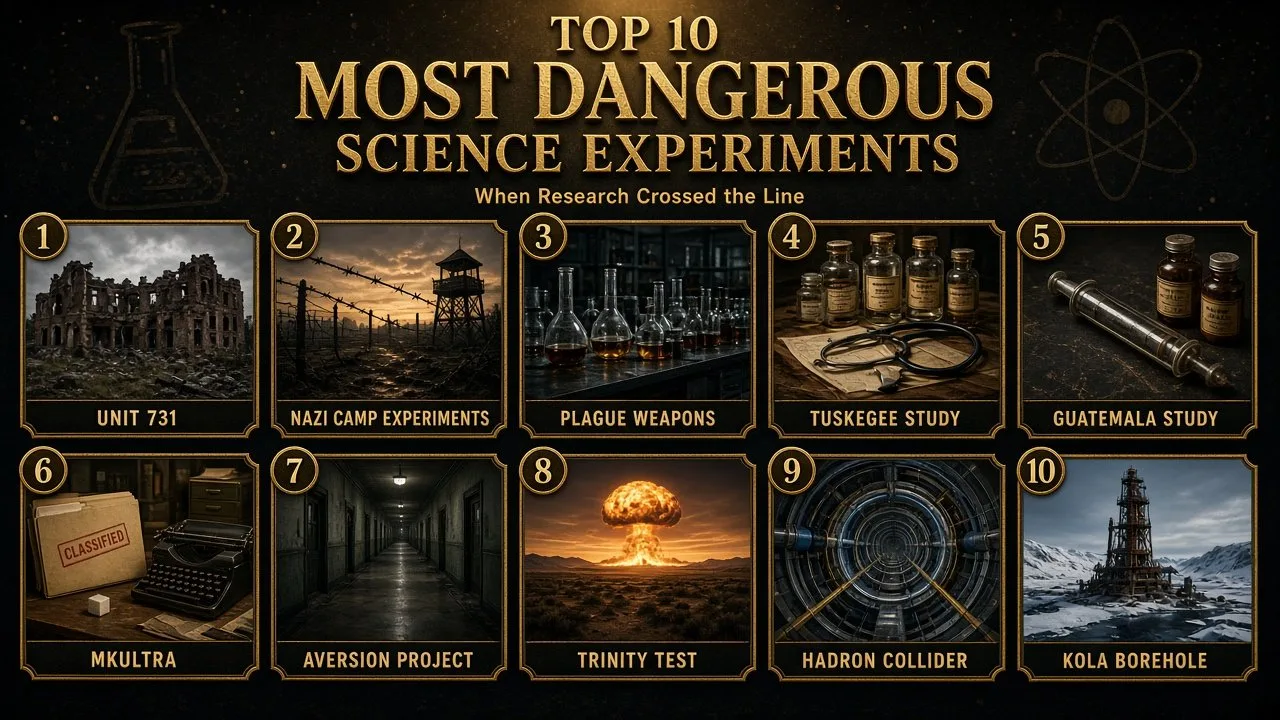
The most dangerous science experiments in history include Unit 731, Nazi camp experiments, Soviet plague weapons, the Tuskegee study and the Trinity test.
Science has given the world vaccines, electricity and space travel, but it has also been used to harm people on a terrible scale. Some experiments were dangerous because researchers treated human beings as raw material. Others were dangerous, or at least frightening, because scientists were pushing into territory nobody had explored and could not be completely sure what would happen.
This guide covers both kinds. Seven of the ten entries are programmes that injured or killed real people, usually prisoners, patients, soldiers or poor communities who never gave consent. The last three are physics and earth-science projects that sparked fears of global catastrophe, and it explains what actually happened in each case. Together they show why modern research is bound by rules on consent, oversight and safety review.
How We Chose the Most Dangerous Science Experiments
There is no official ranking of dangerous experiments, so this list is an editorial judgement. Each entry was weighed against four questions.
- Harm caused: how many people were injured, infected or killed, and how severely.
- Consent: whether the subjects knew what was being done to them and agreed to it.
- Scale of risk: how much damage the work could have done if it had gone wrong or been used as intended.
- Lasting impact: whether the experiment changed laws, research ethics or public trust.
Programmes that deliberately harmed people rank highest. The three physics and drilling projects at the bottom are included because of the fears they raised, not because they hurt anyone; the evidence on each is explained in its section. Some descriptions below involve torture and death, and they are kept factual rather than graphic.
The Most Dangerous Science Experiments at a Glance
| Rank | Experiment | Where | When | Why It Was Dangerous |
|---|---|---|---|---|
| 1 | Unit 731 | Pingfang, near Harbin, China | 1930s to 1945 | Lethal human experiments and biological warfare by the Imperial Japanese Army |
| 2 | Nazi concentration camp experiments | Dachau, Auschwitz, Ravensbrück and other camps | 1942 to 1945 | Painful, often deadly experiments on thousands of prisoners without consent |
| 3 | Soviet plague weapons programme | Biopreparat network, Soviet Union | 1974 to at least 1991 | Plague and smallpox weaponised and stockpiled in breach of a treaty |
| 4 | Tuskegee syphilis study | Macon County, Alabama, United States | 1932 to 1972 | Hundreds of Black men left untreated for syphilis for decades |
| 5 | Guatemala STD experiments | Guatemala | 1946 to 1948 | People deliberately infected with syphilis and gonorrhoea |
| 6 | Project MKUltra | More than 80 institutions in the US and Canada | 1953 to 1973 | Covert drug and mind-control testing on unwitting people |
| 7 | The Aversion Project | South Africa | 1971 to 1989 | Abusive "conversion" treatments forced on military conscripts |
| 8 | Trinity test | New Mexico desert, United States | 16 July 1945 | First nuclear explosion, carried out amid real uncertainty |
| 9 | Large Hadron Collider | Near Geneva, France–Switzerland border | 2008 to present | Feared doomsday scenarios, ruled out by safety reviews |
| 10 | Kola Superdeep Borehole | Kola Peninsula, Russia | 1970 to 1995 | The deepest hole ever drilled, wrongly feared to be risky |
1. Unit 731
| Attribute | Details |
|---|---|
| Run by | Imperial Japanese Army, led by General Shirō Ishii |
| Location | Pingfang district of Harbin, in Japanese-occupied Manchuria (now Northeast China) |
| Years active | Founded in 1933, operated until Japan's defeat in 1945 |
| Victims | Mainly Chinese civilians and prisoners, along with Russians, Koreans and others, including women and children |
| Aftermath | Twelve members tried by the Soviet Union in 1949; Ishii and other leaders granted immunity by the United States in exchange for their data |
Background
Unit 731 was a secret biological and chemical warfare research centre run by the Imperial Japanese Army. Its official cover story told local authorities it was a lumber mill. At its peak the complex had about 3,000 staff, some 150 buildings and room to hold up to 600 prisoners at a time, and it sat within a wider network of related units that employed more than 10,000 people by 1939.
What Happened
Prisoners at Pingfang were stripped of their names and given numbers. Staff referred to them as "maruta", meaning logs. They were deliberately infected with plague and other diseases, used in frostbite and pressure-chamber tests, exposed to chemical agents and explosives, and subjected to vivisection, often without anaesthesia. Estimates of the number killed inside the facility run into the thousands, with some put as high as 14,000.
The unit's work also reached far beyond its walls. Japanese forces spread disease through water supplies, food and crops in Chinese towns and villages, and historians estimate that these attacks killed around 200,000 people.
Why It Was So Dangerous
- It combined lethal human experimentation with the development of weapons meant to cause epidemics among civilians.
- Its research targeted diseases such as plague, which can spread from person to person far beyond the original target.
- Many of the people responsible never faced trial, because the United States shielded key figures in return for their research results.
Legacy
For decades, Unit 731 was far less widely known than Nazi medical crimes. Information has continued to emerge, and in April 2018 the National Archives of Japan released a near-complete list of 3,607 people who had served in the unit.
Interesting Facts
- The site of the Pingfang complex in Harbin now houses a museum about the unit's crimes.
- Before Pingfang, Ishii ran an earlier experimental prison at Zhongma Fortress, closed after a prisoner escape in 1934.
- Japanese army surgeon Ken Yuasa later said vivisection on prisoners was routine among doctors serving in China, even outside Unit 731.
2. Nazi Concentration Camp Experiments
| Attribute | Details |
|---|---|
| Carried out by | German physicians and scientists, including the SS and the air force |
| Main locations | Dachau, Auschwitz, Ravensbrück, Sachsenhausen, Natzweiler, Buchenwald and Neuengamme |
| Years | Mainly 1942 to 1945 |
| Victims | Thousands of prisoners, including Jews, Roma, Polish political prisoners and Soviet prisoners of war |
| Aftermath | The Doctors' Trial at Nuremberg (1946 to 1947) and the Nuremberg Code on research ethics |
Background
From 1933 the Nazi regime promoted "racial hygiene" and enlisted doctors, geneticists and psychiatrists to carry out its racial health policies. During the Second World War, concentration camps gave some physicians a supply of prisoners who could be used for research with no rights and no consent. The United States Holocaust Memorial Museum (USHMM) groups the experiments into three categories.
The Three Types of Experiment
- Military survival: at Dachau, air force doctors put prisoners in low-pressure chambers that simulated very high altitude and forced others to sit in tanks of freezing water to study hypothermia. Prisoners were also used to test ways of making seawater drinkable.
- Drugs and treatments: prisoners were infected with diseases such as malaria, typhus and tuberculosis to test vaccines and drugs. At Ravensbrück, women were wounded to test sulfa drugs and bone grafts, and at Natzweiler and Sachsenhausen prisoners were exposed to phosgene and mustard gas.
- Racial ideology: Josef Mengele carried out experiments on twins at Auschwitz, and sterilisation experiments at Auschwitz and Ravensbrück sought a cheap method of mass sterilisation for groups the regime considered undesirable.
Why It Was So Dangerous
These experiments were cruel by design and often fatal. They also lacked basic scientific standards, and modern scientists overwhelmingly reject using their results. The USHMM notes that only a few of the doctors and experts involved were ever charged or professionally disciplined, and many continued their careers after the war.
The Doctors' Trial and the Nuremberg Code
In the Doctors' Trial, held at Nuremberg from December 1946 to August 1947, seven defendants were sentenced to death, five to life imprisonment and four to prison terms of 10 to 20 years, while seven were acquitted. Two American medical advisers to the trial drafted a ten-point statement on permissible medical experiments. It became the Nuremberg Code, which made voluntary informed consent the first principle of ethical research.
Interesting Facts
- Records studied by historian Paul Weindling show that Mengele gathered 582 twins for his research.
- Women experimented on at Ravensbrück, known in the camp as "rabbits", secretly photographed their scarred legs as evidence.
- The seven doctors and officials sentenced to death were hanged at Landsberg Prison on 2 June 1948.
3. The Soviet Plague Weapons Programme
| Attribute | Details |
|---|---|
| Run by | Soviet military, largely through the civilian-looking agency Biopreparat |
| Biopreparat founded | April 1974 |
| Scale | About 30,000 to 40,000 staff across research institutes and production plants |
| Agents weaponised | Plague, smallpox and Q fever, among others |
| Revealed by | Defector Vladimir Pasechnik in 1989 and former deputy director Ken Alibek in 1992 |
Background
Plague is one of history's deadliest diseases. The Black Death, which swept through Europe from 1346 to 1353, is estimated to have killed between 30% and 60% of Europe's population. During the Cold War, Soviet scientists set out to turn the bacterium behind it, Yersinia pestis, into a strategic weapon.
What Happened
The Soviet Union signed the 1972 Biological Weapons Convention, which banned such weapons, yet it went on to build the largest offensive biological weapons programme known. Biopreparat, created in 1974, posed as a civilian pharmaceutical agency while running military research and production. Plague, smallpox and Q fever were weaponised and stockpiled, and annual production capacity for weaponised smallpox alone was reported at 90 to 100 tons.
When Vladimir Pasechnik defected to the United Kingdom in 1989, he told British officials that Soviet scientists had engineered a strain of plague resistant to antibiotics. Ken Alibek, who had been Biopreparat's first deputy director, confirmed the programme's size after moving to the United States in 1992 and later described it in his book Biohazard (1999).
Why It Was So Dangerous
- Pneumonic plague and smallpox spread between people, so an attack or an accident could have triggered an uncontrollable epidemic.
- Engineering resistance to antibiotics would have removed the main treatment for plague.
- The programme operated in secret and in breach of an international treaty, so the outside world could not assess or limit the risk.
A Warning from Sverdlovsk
The danger of this kind of research was shown in 1979, when anthrax escaped from a military facility in Sverdlovsk and killed at least 64 people. Soviet officials blamed contaminated meat for years. In the 1990s, Russian president Boris Yeltsin admitted both the offensive programme and the true cause of the outbreak.
Interesting Facts
- Biopreparat included five major military research institutes, three pilot plants and five dual-use production plants.
- Smallpox was declared eradicated in 1980, yet the Soviet programme kept producing it as a weapon.
- Ken Alibek's original name was Kanatzhan Alibekov; he adopted the shorter name after leaving.
4. The Tuskegee Syphilis Study
| Attribute | Details |
|---|---|
| Run by | United States Public Health Service (USPHS) |
| Location | Macon County, Alabama |
| Years | 1932 to 1972 |
| Participants | 600 Black men: 399 with latent syphilis and 201 without the disease as a control group |
| Aftermath | $10 million settlement in 1974, the National Research Act, and a presidential apology in 1997 |
Background
The USPHS study set out to observe the natural course of untreated syphilis. It recruited 600 poor Black men, most of them sharecroppers. According to the Centers for Disease Control and Prevention (CDC), the men were not purposely infected; the 399 in the syphilis group already had the disease when they were recruited.
What Happened
The men were never told they had syphilis and were not asked for informed consent. Many believed they were receiving free government health care. By 1947, penicillin had become the standard cure for syphilis, but the study withheld it and continued for another 25 years.
The study ended in 1972, after Public Health Service employee Peter Buxtun took his concerns to the press and news reports exposed it. By then, only 74 of the original subjects were still alive. Of the 399 men with syphilis, 28 had died of the disease and 100 of related complications, 40 of their wives had been infected and 19 of their children had been born with congenital syphilis.
Why It Was So Dangerous
- It deliberately denied a known cure to sick men for decades.
- The harm spread beyond the subjects to their wives and children.
- It damaged trust in medicine among Black Americans, an effect public health officials say is still felt today.
Legacy
The scandal led Congress to pass the National Research Act in 1974, which led to the 1979 Belmont Report and rules requiring institutional review boards to approve research on people. In 1997, President Bill Clinton formally apologised on behalf of the United States and announced funding for what became the National Center for Bioethics in Research and Health Care at Tuskegee University.
Interesting Facts
- Under the 1974 settlement, living men from the syphilis group received $37,500 each.
- No women were enrolled, but some wives caught syphilis from husbands in the study.
- The CDC marked the 50th anniversary of the study's end with a public event in November 2022.
5. The Guatemala STD Experiments
| Attribute | Details |
|---|---|
| Run by | United States Public Health Service, with Guatemalan officials |
| Lead researcher | Dr John Charles Cutler |
| Years | 1946 to 1948 |
| Subjects | 1,308 people confirmed exposed, including prisoners, soldiers, psychiatric patients and sex workers |
| Aftermath | Formal US apology in October 2010 and a presidential bioethics commission report |
Background
Just after the Second World War, US government doctors wanted to test whether penicillin could prevent sexually transmitted infections. Instead of recruiting volunteers at home, they ran experiments in Guatemala on people who had little or no power to refuse.
What Happened
Researchers deliberately exposed prisoners, soldiers, patients at a psychiatric hospital and others to syphilis, gonorrhoea and chancroid, at first through infected sex workers and later by direct inoculation. In total, 1,308 people were confirmed to have been part of the experiments. Of about 5,500 people involved in all the related research, 83 had died by the end of 1953, although how many deaths were caused by the experiments is not documented.
The experiments stayed hidden for decades. Historian Susan Reverby of Wellesley College found them in 2005 in Cutler's archived papers while researching the Tuskegee study, on which Cutler had also worked.
Why It Was So Dangerous
- Subjects were infected on purpose with serious diseases, without their knowledge or consent.
- Many were among the most vulnerable people in the country, including psychiatric patients and prisoners.
- Officials knew it was wrong: Surgeon General Thomas Parran is quoted as telling Cutler, "You know, we couldn't do such an experiment in this country."
Legacy
On 1 October 2010, the US president, secretary of state and secretary of health and human services formally apologised to Guatemala. A presidential bioethics commission reviewed more than 125,000 pages of documents and titled its report "Ethically Impossible". Lawsuits followed, including a $1 billion claim filed in 2015 against Johns Hopkins University and others, but the courts ruled against the plaintiffs, and victims' families say they have never been compensated.
Interesting Facts
- Doctors kept taking tissue samples and performing autopsies on former subjects until 1958.
- Cutler began experimenting with gonorrhoea on Guatemalan soldiers in 1947.
- The commission's report was also published in Spanish so that Guatemalans could read it.
6. Project MKUltra
| Attribute | Details |
|---|---|
| Run by | US Central Intelligence Agency (CIA) |
| Led by | Chemist Sidney Gottlieb, on the order of CIA director Allen Dulles |
| Years | Approved in April 1953; experiments halted in 1972 and most files destroyed in 1973 |
| Scope | More than 150 funded subprojects at over 80 institutions, including universities, hospitals and prisons |
| Revealed by | The Church Committee and Rockefeller Commission in 1975, and Senate hearings in 1977 |
Background
In the early Cold War, the CIA feared that the Soviet Union and its allies had found ways to control or break the human mind. MKUltra was its secret effort to develop drugs and techniques for interrogation and covert operations, much of it disguised as ordinary academic or medical research.
What Happened
The programme gave LSD and other drugs to people who did not know they were being drugged, including mental patients, prisoners, drug users and sex workers. Some subjects also faced electroshock, sensory isolation and extremes of temperature. Gottlieb reportedly arranged for the CIA to buy the entire available supply of LSD for $240,000.
The most famous victim was Frank Olson, an army scientist who was secretly given LSD by his CIA supervisor in 1953. Nine days later he fell to his death from a 13th-floor window of a New York hotel. The experiments continued afterwards.
Why It Was So Dangerous
- People were drugged without consent, sometimes repeatedly, with unpredictable mental effects.
- The work was hidden inside respectable institutions, so neither subjects nor many researchers knew the CIA was involved.
- Destroying the records in 1973 meant the full scale of the harm could never be established.
How It Came to Light
In 1973, CIA director Richard Helms ordered all MKUltra files destroyed. Investigators in 1975 had to rely on testimony and the few papers that survived. In 1977, a Freedom of Information Act request turned up about 20,000 documents that had been misfiled in a financial records building, leading to Senate hearings that year.
Interesting Facts
- Gottlieb later dismissed the whole MKUltra effort as useless.
- Documents released in 1976 showed the CIA had considered buying 10 kilograms of LSD, enough for about 100 million doses.
- MKUltra has inspired countless films, novels and television series about government mind control.
7. The Aversion Project
| Attribute | Details |
|---|---|
| Run by | South African Defence Force (SADF) medical services during apartheid |
| Led by | Army psychiatrist Dr Aubrey Levin |
| Years | 1971 to 1989 |
| Victims | Conscripts identified as gay, and some who used drugs, many aged 16 to 24 |
| Methods | Electric shock "aversion therapy", chemical castration and, according to later reports, forced surgery |
Background
Under apartheid, South Africa drafted young white men into the army. Homosexuality was widely treated as a mental illness at the time, and the military set out to "cure" conscripts it identified as gay, as well as some who used drugs, at military hospitals.
What Happened
Between 1971 and 1989, conscripts were subjected to electric shock treatment and chemical castration. Later investigations and reporting said that as many as 900 conscripts underwent forced sex reassignment surgery, often left incomplete, and were then abandoned without the hormones and care they needed. Levin claimed his patients were volunteers.
Why It Was So Dangerous
- The treatments had no scientific basis and caused lasting physical and psychological harm.
- The subjects were young conscripts under military authority, with little ability to refuse.
- The programme operated in secret within a state that already denied basic rights to most of its population.
Legacy
After apartheid, South Africa's Truth and Reconciliation Commission warned Levin, along with a group of other doctors, that their conduct violated human rights and that they risked being named as perpetrators of abuses. Levin moved to Canada in 1995 and became a professor of clinical psychiatry at the University of Calgary. In 2013, in a separate case, a Canadian court convicted him of sexually assaulting patients, and he was sentenced to five years in prison.
Interesting Facts
- Levin had sought to present his electric shock treatment for gay men and lesbians to a South African parliamentary committee as early as 1968.
- Permanent military personnel were banned from being gay, while conscripts were not, so conscripts were sent for "treatment" instead.
- In 1995, the South African Medical Association publicly apologised for the profession's past wrongdoing.
8. The Trinity Test
| Attribute | Details |
|---|---|
| Run by | United States Army, Manhattan Project |
| Date and time | 5:29 a.m. Mountain War Time, 16 July 1945 |
| Location | Jornada del Muerto desert, New Mexico, about 35 miles southeast of Socorro |
| Device | "The Gadget", an implosion-type plutonium bomb, the same design later used on Nagasaki |
| Yield | About 25 kilotons of TNT, give or take 2 kilotons |
Background
Trinity was the world's first nuclear explosion. Manhattan Project scientists had to test the complicated plutonium implosion design before it could be used as a weapon. Directed by physicist Kenneth Bainbridge under Los Alamos director J. Robert Oppenheimer, the test was watched by leading scientists including Enrico Fermi, Hans Bethe, Richard Feynman and Edward Teller.
The Fear of Igniting the Atmosphere
In 1942, some Manhattan Project scientists raised the possibility that a large enough nuclear explosion might set off fusion reactions in the atmosphere. Hans Bethe was assigned to study the question and concluded that such a reaction could not sustain itself, because the fireball would cool too quickly. Even so, the idea lingered: on the day of the test, Fermi offered to take bets on whether the atmosphere would ignite, and whether it would destroy only New Mexico or the whole planet. Most historians treat this as dark humour, as the calculations had already ruled the scenario out.
Why It Was So Dangerous
- It released nuclear energy on a scale nobody had seen, and its exact yield was unknown in advance.
- Planners worried the bomb might fizzle and built "Jumbo", a huge steel vessel to recover the plutonium, though it was not used.
- Radioactive fallout drifted across nearby communities, and residents who lived downwind have long campaigned for recognition and compensation.
Legacy
Less than a month later, atomic bombs destroyed Hiroshima and Nagasaki. The Trinity Site was declared a National Historic Landmark district in 1965. The test opened the nuclear age and the arms race that followed.
Interesting Facts
- Before testing, General Leslie Groves worried about explaining the loss of "a billion dollars worth" of plutonium if the test failed.
- Eight possible sites in New Mexico, Colorado, California and Texas were considered before the Jornada del Muerto was chosen.
- A New York Times science reporter, William Laurence, was attached to the Manhattan Project to document the work.
9. The Large Hadron Collider
| Attribute | Details |
|---|---|
| Run by | CERN, the European Organization for Nuclear Research |
| Location | Tunnel up to 175 metres underground beneath the France–Switzerland border near Geneva |
| Size | Ring about 27 kilometres in circumference |
| First operation | 10 September 2008 |
| Best-known result | Discovery of the Higgs boson, announced in 2012 |
Background
The Large Hadron Collider (LHC) is the world's largest and most powerful particle accelerator. Built between 1998 and 2008 with more than 10,000 scientists from over 100 countries, it smashes protons or lead nuclei together at close to the speed of light to study the basic building blocks of matter.
The Doomsday Fears
As the start-up date approached, some critics claimed the collider could create a black hole that would swallow the Earth, or produce hypothetical particles called strangelets that would convert ordinary matter. A few opponents went to court in the United States and Europe to try to stop it.
What the Evidence Shows
CERN commissioned safety reviews in 2003 and 2008. Both concluded that the collisions pose no danger. The key argument is that cosmic rays striking the Earth, the Moon and other bodies in space have far higher energies than anything the LHC produces, and they have been doing so for billions of years without causing any catastrophe. None of the court challenges succeeded, and the LHC has run safely for well over a decade.
The Real Hazards
The LHC's genuine risks are engineering ones. On 19 September 2008, nine days after start-up, a faulty electrical connection caused a magnet quench and a release of liquid helium that damaged more than 50 superconducting magnets. Repairs delayed full testing by 14 months, and the machine restarted in November 2009.
Interesting Facts
- The collider uses 1,232 main dipole magnets, each weighing 35 tonnes.
- About 96 tonnes of superfluid helium keep the magnets colder than outer space, making the LHC the world's largest cryogenic facility at liquid helium temperature.
- CERN confirmed on 14 March 2013 that the new particle it had found was indeed the Higgs boson.
10. The Kola Superdeep Borehole
| Attribute | Details |
|---|---|
| Run by | Soviet scientific drilling programme |
| Location | Pechengsky District, Kola Peninsula, Russia, near the border with Norway |
| Drilling period | 24 May 1970 to 1995 |
| Maximum depth | 12,262 metres (40,230 feet), reached in 1989 |
| Record | Deepest human-made hole on Earth since 1979 |
Background
The Kola Superdeep Borehole, known as SG-3, was a purely scientific project to bore further down through the planet's crust than anyone had before and learn what lies beneath. The hole is only about 23 centimetres (9 inches) wide, and several branches were drilled from the main shaft.
Why People Feared It
Drilling so deep into the planet led to popular worries that it might trigger earthquakes or volcanic activity, and the borehole later became the subject of an internet hoax claiming drillers had recorded screams from hell. None of this has any basis. The borehole penetrated only about a third of the way through the continental crust in that region, a tiny scratch compared with the thickness of the Earth.
What It Actually Found
- Geologists expected to hit a layer of basalt at around 7 kilometres, but it never appeared; instead they found granite extending deeper than predicted.
- Water was found several kilometres down, trapped after seeping up through the rock.
- Microscopic plankton fossils turned up 6 kilometres below the surface.
- The drilling mud came up "boiling" with unexpectedly high levels of hydrogen gas.
Why Drilling Stopped
The real obstacle was heat. Temperatures reached about 180 °C at depth, far hotter than planners expected, which made further progress impractical. Drilling of the last branch stopped in 1992, the project ended in 1995 for lack of funding, and the site was abandoned after the operating company was liquidated in 2008.
Interesting Facts
- The borehole was originally planned to reach 7,000 metres.
- It broke the depth record on 6 June 1979, overtaking the Bertha Rogers hole in Oklahoma.
- A Qatari oil well became longer in 2008, at 12,289 metres along its curved path, but it reaches a depth of only about 1,387 metres.
Comparing the Most Dangerous Science Experiments
| Experiment | Human Subjects | Consent Given | People Harmed | Changed Rules or Ethics |
|---|---|---|---|---|
| Unit 731 | Yes | No | Yes | Partly; key figures escaped trial |
| Nazi camp experiments | Yes | No | Yes | Yes, the Nuremberg Code |
| Soviet plague weapons | Limited records | Not applicable | Risk to millions; Sverdlovsk leak killed at least 64 | Exposed treaty violations |
| Tuskegee study | Yes | No | Yes | Yes, National Research Act and Belmont Report |
| Guatemala experiments | Yes | No | Yes | Yes, a bioethics commission review |
| Project MKUltra | Yes | No | Yes | Exposed by Congress; spurred oversight |
| Aversion Project | Yes | No | Yes | Exposed after apartheid |
| Trinity test | No | Not applicable | Fallout exposure downwind | Opened the nuclear age |
| Large Hadron Collider | No | Not applicable | No | Formal safety reviews before start-up |
| Kola Superdeep Borehole | No | Not applicable | No | No |
What These Experiments Taught Science
Almost every safeguard in modern research exists because of cases like these. The key lessons can be summed up in a few principles.
- Informed consent comes first: people must understand an experiment and freely agree to take part, the central rule of the Nuremberg Code.
- Independent review: research on people must be approved by an ethics committee or institutional review board, not just the researchers themselves.
- No denial of proven treatment: once a cure exists, withholding it from study participants is unacceptable.
- Protection for the vulnerable: prisoners, patients, children, soldiers and poor communities need extra safeguards.
- Transparency: secret research, shredded files and cover stories make abuse more likely and harder to correct.
- Safety review for frontier science: big physics projects now publish formal risk assessments before they start.
Frequently Asked Questions
What is the most dangerous science experiment ever conducted?
In terms of human harm, Unit 731 is often regarded as the worst. The Imperial Japanese Army's secret unit carried out lethal experiments on thousands of prisoners in occupied China and spread disease among civilians, attacks that historians estimate killed around 200,000 people. Nazi camp experiments are similarly notorious.
Why was the Tuskegee study unethical?
The men were never told they had syphilis and never gave informed consent. Researchers also withheld penicillin after it became the standard cure in 1947, letting the disease progress for another 25 years. Many men died, and some wives and children were infected. The CDC lists both the missing consent and withheld treatment as the core failures.
Did the Large Hadron Collider ever pose a real risk to Earth?
No. Safety reviews commissioned by CERN in 2003 and 2008 concluded that LHC collisions pose no danger. Cosmic rays have been hitting Earth and the Moon with far greater energies for billions of years without creating planet-destroying black holes or strangelets. The machine's real hazards are engineering ones, such as the 2008 magnet incident.
Did scientists really think the Trinity test could destroy the world?
The concern was real but was studied before the test. In 1942, scientists asked whether a nuclear blast could ignite the atmosphere, and Hans Bethe's calculations showed it could not sustain such a reaction. Enrico Fermi still joked on the day about taking bets on the outcome, which added to the legend.
What is the Nuremberg Code?
The Nuremberg Code is a ten-point set of principles for ethical medical research. It was drafted by two American medical advisers during the Doctors' Trial of Nazi physicians in 1946 and 1947. Its first and best-known rule is that the voluntary, informed consent of the human subject is absolutely essential.
Is the Kola Superdeep Borehole still open?
No. Drilling ended in 1995 because of a lack of funding, and the site was abandoned in 2008 when the operating company was liquidated. The hole, which reached 12,262 metres in 1989, remains the deepest human-made hole on Earth. Stories about sounds from hell are a hoax.
What happened to the people behind MKUltra?
Most were never prosecuted. CIA director Richard Helms ordered the files destroyed in 1973, which hampered later investigations. Programme head Sidney Gottlieb retired in 1972 and later called the project useless. Congressional investigations in 1975 and Senate hearings in 1977 brought the programme into public view.
Conclusion
The most dangerous science experiments in history were rarely the ones that sounded most like science fiction. Black holes at the LHC and a crust-cracking borehole at Kola turned out to be groundless fears. The real danger came from people in authority who decided that prisoners, patients, conscripts and poor communities could be used as test subjects, from Unit 731 and the Nazi camps to Tuskegee, Guatemala and MKUltra.
Those abuses reshaped science. Informed consent, ethics committees, independent safety reviews and treaties on biological weapons all trace back, in part, to the cases on this list. Remembering them is one of the best ways to make sure research continues to serve people rather than harm them.
- United States Holocaust Memorial Museum, Holocaust Encyclopedia: Nazi Medical Experiments
- Centers for Disease Control and Prevention, About the Untreated Syphilis Study at Tuskegee, September 2024
- Presidential Commission for the Study of Bioethical Issues, "Ethically Impossible": STD Research in Guatemala from 1946 to 1948
- US Senate Select Committee on Intelligence, Project MKUltra, the CIA's Program of Research in Behavioral Modification, joint hearing, 1977
- Ken Alibek, Biohazard, 1999
- Encyclopaedic summaries of Unit 731, the Doctors' Trial, Biopreparat and the Soviet biological weapons programme, the Black Death, the Aversion Project, the Trinity test, the Large Hadron Collider and its safety reviews, and the Kola Superdeep Borehole

















Log in with