








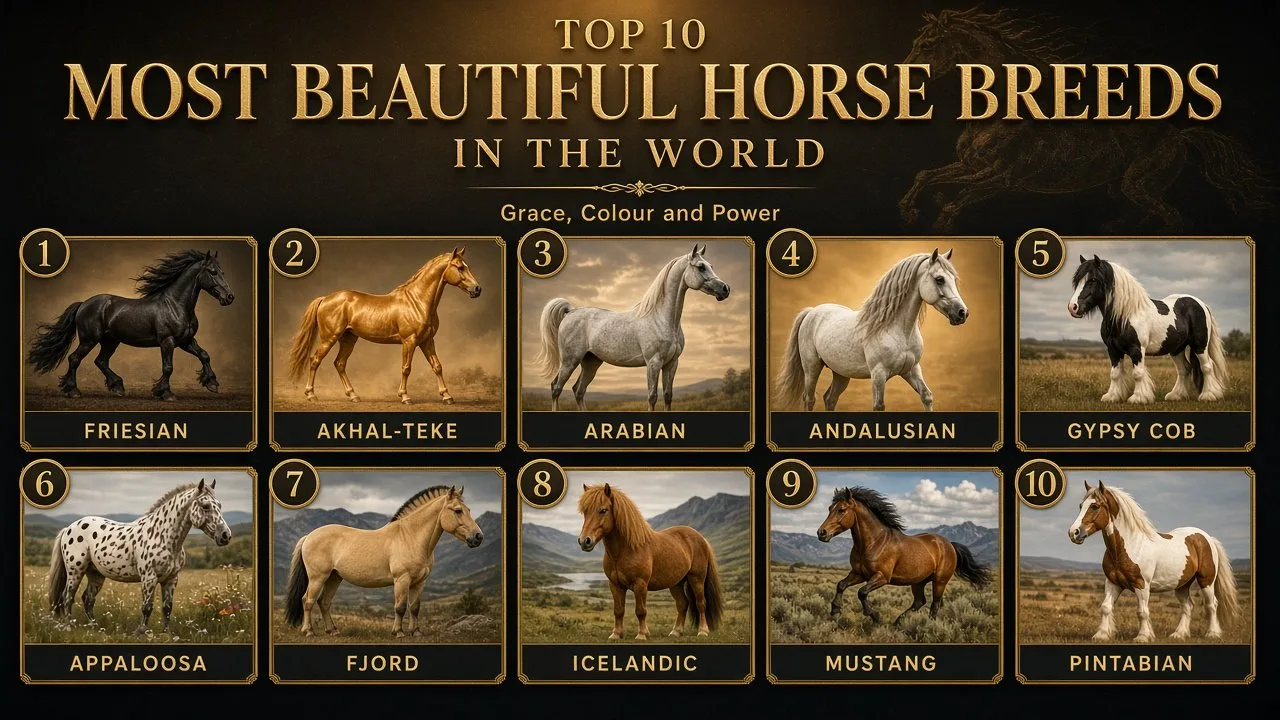
The most beautiful horse breeds in the world include the jet-black Friesian, the metallic Akhal-Teke, the Arabian and the Andalusian, loved for coat and grace.
Beauty in horses is partly a matter of taste, but some breeds stop people in their tracks wherever they appear. A gleaming coat, a long flowing mane, an arched neck or a striking spotted pattern can make a horse instantly memorable, and many of the breeds on this list have been shaped by centuries of careful breeding for exactly those qualities.
This guide looks at ten horse breeds widely celebrated for their looks. Each entry covers where the breed comes from, what makes it stand out, how it is used today and a few facts that most horse lovers never hear. Along the way you will meet war horses, desert horses, Viking horses and the free-roaming mustangs of the American West.
How We Chose the Most Beautiful Horse Breeds
There is no official ranking of horse beauty, so this list is an editorial selection. Each breed was judged against four questions.
- Striking appearance: a coat colour, pattern, mane or body shape that is instantly recognisable.
- Movement: how elegant the horse looks at the walk, trot and canter, or in special gaits.
- Breed identity: a clear history, a recognised breed standard and a registry that protects its type.
- Recognition: how often the breed appears in art, film, ceremonies and international sport.
The order reflects how distinctive each breed's look is, not which horse is best to ride or own. Every breed here has loyal fans who would happily put their favourite at number one.
The Most Beautiful Horse Breeds at a Glance
| Rank | Breed | Origin | Typical Height | Signature Look |
|---|---|---|---|---|
| 1 | Friesian | Friesland, Netherlands | 15 to 16 hands (152 to 163 cm) | All-black coat, flowing mane, feathered legs |
| 2 | Akhal-Teke | Turkmenistan | 14 to 16 hands (144 to 160 cm) | Metallic, shimmering coat |
| 3 | Arabian | Arabian Peninsula and West Asia | About 14.1 to 15.1 hands | Dished face and high tail carriage |
| 4 | Andalusian | Spain | Average about 15.1 hands | Arched neck, thick mane, often grey |
| 5 | Gypsy Cob | Britain and Ireland | 13 to 16 hands (132 to 163 cm) | Piebald coat and heavy feathering |
| 6 | Appaloosa | Pacific Northwest, United States | 14 to 16 hands (142 to 163 cm) | Leopard-spotted coat |
| 7 | Norwegian Fjord | Western Norway | 135 to 150 cm recommended | Dun coat and crescent-cut mane |
| 8 | Icelandic Horse | Iceland | 13 to 14 hands (132 to 142 cm) | Thick mane and a huge range of colours |
| 9 | Mustang | Western United States | 14 to 15 hands (142 to 152 cm) | Rugged, free-roaming look |
| 10 | Pintabian | United States | About 14.2 to 15.2 hands (147 to 157 cm) | Arabian shape with tobiano patches |
A hand is the traditional unit for measuring horses and equals 4 inches (10.16 cm). Height is measured at the withers, the ridge between the shoulder blades.
1. Friesian
| Attribute | Details |
|---|---|
| Origin | Province of Friesland, northern Netherlands |
| Height | Typically 15 to 16 hands (152 to 163 cm) |
| Weight | About 1,250 to 1,450 lb (570 to 660 kg) |
| Colour | Black, with no white markings |
| Registry | KFPS (Royal Friesian Horse Studbook), founded 1879 |
Origins and History
The Friesian comes from Friesland, a province in the far north of the Netherlands, where horses of this type were used for riding, farm work and pulling carriages. At times Andalusian horses were crossed with Friesians, producing lighter animals that were better suited to work as elegant carriage horses.
The Friesian came close to disappearing more than once. As farmers switched to heavier draught horses and later to machines, numbers fell so sharply that by the early 20th century only three breeding stallions were available. A society founded in 1913 worked to protect the breed, and the official studbook, known today as the KFPS and first established in 1879, now oversees Friesians around the world.
Key Features
- A glossy, solid black coat; the official studbook registers only black horses and screens stallions for chestnut genes.
- A long, thick, wavy mane and tail that are usually left untrimmed.
- Feathering, or long silky hair, on the lower legs.
- A high head carriage and a powerful, high-stepping trot.
- A calm, willing temperament that suits riding and driving.
Significance
Today the Friesian is classed as a light draught horse and is used under saddle, in dressage and in carriage driving. Most KFPS-registered horses live in the Netherlands, Germany and North America. Young horses are presented at inspections called keuringen, where Dutch judges decide whether they meet the standard for breeding.
In Popular Culture
Because of their dramatic black coat and calm nature on set, Friesians are a favourite of film and television makers, especially for historical and fantasy dramas. They are also used to pull vintage carriages in parades and ceremonies, including a traditional Frisian two-wheeled cart called a sjees.
Interesting Facts
- The breed's survival was so uncertain that just three stallions were once available for breeding.
- Friesians carry Andalusian blood from crosses made centuries ago.
- Like other feathered breeds, Friesians can suffer from a skin condition on the lower legs, so the feathering needs careful care.
2. Akhal-Teke
| Attribute | Details |
|---|---|
| Origin | Akhal oases, Turkmenistan |
| Height | About 144 to 160 cm (14 to 16 hands) |
| Weight | About 430 to 500 kg (950 to 1,100 lb) |
| Nickname | The Golden Horses |
| Population | About 6,600 worldwide |
Origins and History
The Akhal-Teke is a Turkmen breed and is thought to be one of the oldest horse breeds still in existence. Its name combines Akhal, a line of oases on the northern slopes of the Kopet Dag mountains, with Teke, the Turkmen tribe that lived there. The tribes bred these horses for raiding and long desert journeys, and they kept pedigrees by memory rather than on paper.
The breed's studbook was closed in 1932, and the Soviet Union published its first breed registry in 1941, listing more than 700 horses. In 1935 a group of Turkmen riders completed a famous ride of about 4,200 km (2,600 miles) from Ashgabat to Moscow, and the purebred horses finished in noticeably better condition than the part-breds.
Key Features
- A fine, thin coat with a natural metallic sheen that seems to glow in sunlight, especially in dun and palomino colours.
- A long, lean body, long neck and slim legs, built for speed and endurance.
- A thin, often sparse mane and tail.
- An alert, intelligent character and a strong bond with its rider.
Significance
The Akhal-Teke is adapted to harsh heat and cold, and it is treasured as a national symbol in Turkmenistan. Most of the world's roughly 6,600 Akhal-Tekes live there, with smaller populations in Europe and North America. Breeders value the horses for endurance riding, show jumping and dressage.
In Sport
The most famous Akhal-Teke was the stallion Absinthe, ridden by Sergei Filatov. The pair won the individual dressage gold medal at the 1960 Rome Olympics and individual bronze at the 1964 Tokyo Games, and Absinthe then helped the Soviet team win gold at the 1968 Mexico City Olympics.
Interesting Facts
- The golden shimmer is a natural feature of the breed's fine coat, and some people claim it once helped the horses blend into the desert.
- Turkoman horses, the Akhal-Teke's likely ancestors, contributed to the development of the Thoroughbred.
- In 1995 the Nez Perce tribe began crossing Appaloosas with Akhal-Tekes to create a new breed, the Nez Perce Horse.
3. Arabian
| Attribute | Details |
|---|---|
| Origin | Arabian Peninsula and wider West Asia |
| Height | Usually about 14.1 to 15.1 hands |
| Known for | Dished face, large eyes, high tail carriage |
| Main sport | Endurance riding |
| Registered in the US | More than 660,000 (as of 2013) |
Origins and History
The Arabian is one of the oldest and most recognisable breeds in the world. Archaeological evidence shows horses resembling modern Arabians in the Middle East about 3,500 years ago, although DNA can only confirm breed purity for the last couple of centuries. The breed was developed by the nomadic Bedouin, who prized their mares so highly that they sometimes brought them into the family tent for shelter and protection from thieves.
Through war and trade, Arabians spread across Asia, Africa and Europe. Three stallions brought to England in the 18th century, the Darley Arabian, the Byerly Turk and the Godolphin Arabian, became the foundation sires of the Thoroughbred racehorse.
Key Features
- A short, wedge-shaped head with a concave, or dished, profile and large, expressive eyes.
- A slight bulge between the eyes that the Bedouin called the jibbah.
- An arched neck and a naturally high-carried tail, especially when the horse is excited.
- A compact body; some Arabians have 17 pairs of ribs instead of 18 and five lumbar vertebrae instead of six.
Significance
Arabian bloodlines are found in almost every modern breed of riding horse, where they add refinement, stamina and strong bone. The breed dominates endurance riding, including events such as the Tevis Cup that cover up to 160 km (100 miles) in a day, and competes in dressage, showing and many other disciplines. The United States has the largest Arabian population of any country.
In Popular Culture
The Arabian's elegant outline has inspired artists for centuries, and the breed features in famous children's stories such as The Black Stallion. Arabians were also prized diplomatic gifts; US President Ulysses S. Grant received the Arabian stallion Leopard from the Ottoman sultan Abdul Hamid II.
Interesting Facts
- A Bedouin legend says the Arabian horse was created from the south wind.
- Arabians are known for their sensitivity and intelligence, so they reward calm, confident handling.
- Purebred Arabians do not carry the genes for pinto or leopard-spotted coat patterns.
4. Andalusian
| Attribute | Details |
|---|---|
| Other name | Pura Raza Española (PRE), Pure Spanish Horse |
| Origin | Andalusia and the wider Iberian Peninsula |
| Height | Average about 15.1 hands (155 cm) |
| Usual colour | Grey, also bay, black and other shades |
| Population | More than 185,000 registered (2010) |
Origins and History
The Andalusian, officially known in Spain as the Pura Raza Española, has been recognised as a distinct breed since the 15th century, and its build has changed very little since then. In the late 15th century, Carthusian monasteries in Jerez, Seville and Cazalla set up breeding studs, and the monks carefully protected their bloodlines. The Carthusian strain is still prized by breeders today.
For centuries the Andalusian was the war horse of choice for European nobility and earned the nickname "Horse of Kings". Spanish kings used the horses as diplomatic gifts, and they were seen at royal courts and riding academies across Europe. Exports from Spain were restricted until the 1960s, but the breed has since spread worldwide.
Key Features
- A strong, compact yet elegant body with a broad chest and a thick, arched neck.
- A long, thick mane and tail, often left flowing.
- Grey is the most common colour, and many Andalusians lighten to almost white with age.
- A naturally elevated, rhythmic action that suits classical dressage.
- A reputation for intelligence, sensitivity and a gentle temperament.
Significance
The Andalusian helped shape many other breeds, including European warmbloods, the Friesian, the Lipizzaner and several breeds in the Americas. In modern sport, two Andalusians were part of the Spanish dressage team that won bronze at the 2002 World Equestrian Games and silver at the 2004 Athens Olympics.
In Popular Culture
Its proud bearing makes the Andalusian a film star. The breed has appeared in The Lord of the Rings trilogy, King Arthur, The Chronicles of Narnia: The Lion, the Witch and the Wardrobe, Gladiator and Braveheart. The University of Southern California's mascot horse, Traveler, is an Andalusian.
Interesting Facts
- In 1832 an epidemic devastated Spain's horses, and only a small herd survived at a monastery stud.
- By 1576, Spanish horses made up about a third of the horses in some British royal studs.
- The closely related Lusitano is Portugal's version of the Iberian horse.
5. Gypsy Cob
| Attribute | Details |
|---|---|
| Other names | Gypsy Vanner, Irish Cob, Traditional Gypsy Cob |
| Origin | Britain and Ireland |
| Height | Usually 13 to 16 hands (132 to 163 cm) |
| Usual colour | Piebald (black and white), also skewbald and solid |
| First US imports | 1996 |
Origins and History
The Gypsy Cob is closely associated with Irish Travellers and English Romanichal Travellers. From about 1850, travelling families used these horses to pull their painted wooden caravans, called vardos. Breeders wanted a strong, steady horse that could work hard and stay healthy on modest grazing, and they blended Shire and Clydesdale blood with smaller native breeds such as the Dales and Fell ponies.
The breed's colourful look was refined after the Second World War. There was no studbook until 1996, the same year Dennis and Cindy Thompson imported the first known Gypsy horses to the United States. They coined the name Gypsy Vanner and founded a breed society, and several registries now record pedigrees in Europe, North America and Australasia.
Key Features
- A compact, muscular cob build with a short back and deep chest.
- Abundant feathering on the lower legs, plus a long, heavy mane and tail.
- A bold piebald or skewbald coat, although no colour is required by the main breed standards.
- A sweet, refined head and a kind, gentle nature.
Significance
The Gypsy Cob combines draught-horse strength with a friendly, people-oriented temperament, which makes it popular for driving, leisure riding and showing. In 2004 the United States Dressage Federation accepted the Gypsy Vanner Horse Society as an affiliate, opening dressage competition to registered horses.
In Popular Culture
With their flowing feathers and patched coats, Gypsy Cobs are a favourite subject for equine photographers. They are shown and traded at traditional horse fairs, including the Appleby Horse Fair in England, the largest in Europe, where many Travellers still arrive in horse-drawn caravans.
Interesting Facts
- In the Netherlands the breed's studbook knows it as the Tinker horse.
- The heavy feathering needs regular care to prevent skin problems in wet conditions.
- Over the decades, many Romani breeders have favoured smaller horses, so average height has fallen.
6. Appaloosa
| Attribute | Details |
|---|---|
| Origin | Nez Perce lands, Pacific Northwest, United States |
| Height | About 14 to 16 hands (142 to 163 cm) |
| Weight | About 950 to 1,250 lb (430 to 570 kg) |
| Signature trait | Leopard complex spotted coat |
| Registry | Appaloosa Horse Club (ApHC), founded 1938 |
Origins and History
Horses with leopard spots appear in prehistoric cave paintings in Europe and in art from ancient Greece, Persia and Han dynasty China. In North America, the Nez Perce people of the Pacific Northwest developed the spotted horses that became the Appaloosa. Settlers called them Palouse horses, probably after the Palouse River, and the name gradually became Appaloosa.
The Nez Perce lost most of their horses after the Nez Perce War of 1877, and the breed declined for decades. A small group of breeders led by Claude Thompson formed the Appaloosa Horse Club in 1938, and between then and 2007 the club registered more than 670,000 horses.
Key Features
- Coat patterns caused by the leopard complex gene, from scattered spots to a white blanket over the hips.
- Mottled skin, especially around the muzzle and eyes.
- A white sclera, the area around the iris, that is more visible than in most horses.
- Striped hooves in many individuals.
Significance
The Appaloosa is one of the most popular breeds in the United States and was named the state horse of Idaho in 1975. It is best known as a western stock horse but competes in trail riding, racing, endurance, jumping and many other disciplines.
In Popular Culture
Appaloosas have appeared in many westerns. Examples include Marlon Brando's film The Appaloosa, John Wayne's horse Zip Cochise in El Dorado (1966) and Matt Damon's mount in True Grit. An Appaloosa also serves as a mascot for the Florida State Seminoles.
Interesting Facts
- Some Appaloosa foals are born with little pattern and develop spots as they age.
- The leopard complex gene is linked to a form of night blindness, and the breed is prone to an eye disease called equine recurrent uveitis.
- Appaloosa stallions were exported to Denmark to add new blood to the spotted Knabstrupper breed.
7. Norwegian Fjord
| Attribute | Details |
|---|---|
| Origin | Mountainous western Norway |
| Height | 135 to 150 cm recommended (no fixed limits) |
| Weight | About 400 to 500 kg (880 to 1,100 lb) |
| Colour | Always dun, in five recognised shades |
| History | Selectively bred for at least 2,000 years |
Origins and History
The Fjord horse is one of the world's oldest breeds. Archaeological finds at Viking burial sites suggest horses of this type have been selectively bred for at least 2,000 years, and the Vikings used them as war mounts. For centuries afterwards, Fjords were the farm horses of western Norway, ploughing steep fields and pulling loads along mountain tracks.
The breed's five dun shades have been officially recognised in Norway since 1922. About 90 percent of Fjords are brown dun, the shade called bay dun in other breeds.
Key Features
- A dun coat with primitive markings: a dorsal stripe along the back, darker mane and tail, and sometimes zebra-like bars on the legs.
- A thick mane that is usually clipped into a stiff crescent 5 to 10 cm high.
- A two-toned mane, with a dark central stripe running through lighter outer hair, which the crescent cut shows off.
- A small but muscular, sturdy body with a broad forehead and large eyes.
Significance
Classed as a light draught horse, the Fjord is used both in harness and under saddle. Its calm, friendly temperament has made it popular well beyond Norway as a family horse and a driving horse.
Interesting Facts
- The crescent mane is a grooming tradition, not a natural shape; left alone, the mane grows long and heavy.
- The breed standard discourages heavy feathering on the legs.
- The dark stripe running through the middle of the mane is called the midtstol in Norwegian.
8. Icelandic Horse
| Attribute | Details |
|---|---|
| Origin | Iceland, from horses brought by Norse settlers |
| Height | Average 13 to 14 hands (132 to 142 cm) |
| Weight | About 330 to 380 kg (730 to 840 lb) |
| Special gaits | Tölt and flying pace |
| Registered worldwide | Around 300,000 horses, living and dead |
Origins and History
The ancestors of the Icelandic horse arrived with Norse settlers in the 9th and 10th centuries, roughly between 860 and 935 AD. Centuries of isolation and harsh weather shaped a small, tough and long-lived horse. In the 1780s much of the population was wiped out after the Laki volcanic eruption, but the breed recovered, and Iceland's first breed society was founded in 1904.
Iceland protects its horses with strict laws. No horses may be imported, and any horse that leaves the country can never return. As a result, the breed suffers from very few of the diseases found elsewhere.
Key Features
- A small, stocky body; although pony-sized, it is officially called a horse.
- A thick, double-layered winter coat and a full, heavy mane and forelock.
- An extraordinary range of colours; Icelandic has more than 100 words for horse colours and patterns.
- Two extra gaits: the smooth four-beat tölt and the fast flying pace.
Significance
The Icelandic is the only horse breed in Iceland and is still used to gather sheep in the highlands. It is also popular for leisure riding, showing and racing, and as of 2024 organisations in 22 countries belong to the International Federation of Icelandic Horse Associations. The WorldFengur database, set up in 2000, is the breed's official registry.
Interesting Facts
- The breed is long-lived and hardy, a result of Iceland's rugged conditions.
- Icelandic horses were once exported to Britain to work as pit ponies in coal mines.
- Their strong bones and weight-carrying ability are one reason the breed is classed as a horse rather than a pony.
9. Mustang
| Attribute | Details |
|---|---|
| Origin | Western United States, from Spanish colonial horses |
| Height | Usually 14 to 15 hands (142 to 152 cm) |
| Status | Feral (descended from domestic horses) |
| Protection | Wild Free-Roaming Horses and Burros Act of 1971 |
| Population | About 61,500 horses on BLM land (March 2026 estimate) |
Origins and History
The mustang descends from horses brought to the Americas by Spanish conquistadors. Escaped and released horses formed free-roaming herds, and later many other breeds were added to the mix. Because their ancestors were domesticated, mustangs are formally classed as feral rather than truly wild horses.
Herds once numbered in the millions, but capture and removal cut them to an estimated 25,000 by the 1950s. In 1971 the US Congress passed the Wild Free-Roaming Horses and Burros Act, declaring the animals "living symbols of the historic and pioneer spirit of the West", and the Bureau of Land Management (BLM) now manages most herds.
Key Features
- A compact, hardy build with strong legs and tough hooves.
- Every coat colour, from bay and black to roan, dun, palomino and pinto.
- Thick manes and tails grown long in the open range.
- Sharp survival instincts and great endurance.
Significance
As of 1 March 2026, the BLM estimated about 61,500 wild horses on the public lands it manages, most of them in Nevada, far above the level the agency considers sustainable for the range. Population control is debated, and many rounded-up mustangs are offered for adoption, where they can become excellent riding horses.
Interesting Facts
- Some isolated herds are still very close to the original Spanish horses.
- The Pueblo Revolt of 1680 put large numbers of horses into the hands of Native American peoples.
- Scientists still debate whether mustangs restore a native animal or represent an introduced species.
10. Pintabian
| Attribute | Details |
|---|---|
| Origin | United States |
| Height | About 14.2 to 15.2 hands (147 to 157 cm) |
| Weight | About 900 to 1,100 lb (410 to 500 kg) |
| Breeding | Over 99 percent Arabian blood with tobiano markings |
| Name | Used by the registry since 1992, trademarked 1995 |
Origins and History
The Pintabian is a modern American breed created to combine the Arabian's shape with bold pinto colouring. Purebred Arabians do not carry the tobiano spotting pattern, so foundation breeders crossed tobiano horses back to purebred Arabians for at least seven generations. The result was a horse with more than 99 percent Arabian blood and the large, rounded white patches of the tobiano pattern.
The Pintabian Horse Registry began using the name Pintabian in 1992 and trademarked it in 1995. It is the official registering authority for the breed worldwide.
Key Features
- An Arabian-style head, arched neck and high-set tail.
- Tobiano markings, usually white legs with large white patches crossing the back.
- A short back, well-sprung ribs and a fairly level croup.
- The alert, friendly temperament of its Arabian ancestors.
Significance
To be registered, a Pintabian must show tobiano markings, and at least one parent must be a registered Pintabian with tobiano colouring. Despite their very high Arabian ancestry, Pintabians cannot be registered as purebred Arabians. They are used for trail riding, showing and endurance.
Interesting Facts
- Non-tobiano offspring of the same crosses are recorded separately as pleasure horses.
- Pintabians can be any base colour, including grey, dun and cream.
- The breed shows how modern registries can create a new breed with a clearly defined look.
Honourable Mentions
Several other breeds are often praised for their beauty and could easily have made this list.
- Lipizzaner: the famous white horses of the Spanish Riding School in Vienna, born dark and turning grey with age.
- Marwari: an Indian breed from Rajasthan with distinctive inward-curving ears.
- Knabstrupper: a Danish breed with leopard spots similar to the Appaloosa.
- Lusitano: Portugal's elegant relative of the Andalusian.
Comparing the Breeds
| Breed | Best Known For | Temperament | Popular Uses |
|---|---|---|---|
| Friesian | Black coat and feathering | Calm, willing | Dressage, driving, film |
| Akhal-Teke | Metallic sheen | Alert, loyal | Endurance, jumping, dressage |
| Arabian | Dished face and stamina | Sensitive, intelligent | Endurance, showing |
| Andalusian | Arched neck and thick mane | Gentle, docile | Classical dressage, film |
| Gypsy Cob | Piebald coat and feathers | Kind, steady | Driving, leisure riding |
| Appaloosa | Spotted coat | Versatile, sturdy | Western riding, trail |
| Norwegian Fjord | Dun coat and crescent mane | Friendly, steady | Driving, family riding |
| Icelandic Horse | Tölt gait and colour range | Hardy, willing | Trekking, sheepherding |
| Mustang | Free-roaming heritage | Independent, hardy | Adoption, trail riding |
| Pintabian | Arabian shape with patches | Alert, friendly | Trail riding, showing |
Frequently Asked Questions
What is the most beautiful horse breed in the world?
There is no official answer, because beauty is personal. The Friesian, Akhal-Teke, Arabian and Andalusian are the breeds most often named. The Friesian is admired for its solid black coat and flowing mane, while the Akhal-Teke's metallic sheen makes it look almost polished in sunlight.
Why do Akhal-Teke horses shine?
The Akhal-Teke's coat has a natural metallic sheen that comes from the structure of its fine hair, which reflects light more than ordinary horse hair. The effect is strongest in dun and palomino horses, which can look golden. This shimmer earned the breed its nickname, the Golden Horses.
Are Friesian horses always black?
Yes, in the official studbook. The Royal Friesian Horse Studbook (KFPS) registers black horses without white markings. Occasional chestnut foals have been born since 1991, so the studbook now requires stallions to be genetically tested and refuses to register those carrying chestnut genes.
What is the oldest horse breed?
Several breeds claim to be among the oldest. The Arabian has roots traced through archaeology about 3,500 years into the past, the Akhal-Teke is thought to be one of the oldest surviving breeds, and the Norwegian Fjord has been selectively bred for at least 2,000 years.
Are mustangs really wild horses?
Not strictly. Mustangs descend from domesticated horses brought to the Americas by the Spanish, so scientists classify them as feral. In the United States they are legally protected as wild free-roaming horses under a 1971 law, and the Bureau of Land Management manages most herds on public land.
Why is the Fjord horse's mane cut short?
Owners traditionally clip the Fjord's thick mane into a stiff crescent about 5 to 10 cm high. The cut is purely a grooming custom, but it shows off the breed's two-coloured mane, with a dark central stripe running through lighter hair, and highlights its strong, arched neck.
What is a tölt?
The tölt is a smooth, four-beat ambling gait performed by many Icelandic horses. Because one foot is always on the ground, the rider feels very little bounce, even at speed. Horses that can tölt and perform the flying pace, as well as walk, trot and canter, are considered the best of the breed.
Conclusion
The most beautiful horse breeds in the world each tell a story of the people who shaped them. The Friesian survived near extinction in the Netherlands, the Akhal-Teke carried Turkmen riders across deserts, the Arabian lived alongside the Bedouin, and the Andalusian carried kings into battle. Breeds like the Gypsy Cob, Appaloosa and Fjord show how working horses can be stunning too.
Whether your idea of beauty is a gleaming black coat, a spotted pattern, a golden shimmer or a free-roaming mustang on the open range, every one of these breeds rewards a closer look. For more animal stories, explore Finepedia's articles on dog breeds and other remarkable creatures.
- Bureau of Land Management, Wild Horse and Burro Program Data: population estimates as of 1 March 2026
- Royal Friesian Horse Studbook (KFPS) breed information, as summarised in encyclopaedic breed accounts
- Appaloosa Horse Club and Pintabian Horse Registry breed standards, as summarised in encyclopaedic breed accounts
- Encyclopaedic breed accounts used to cross-check facts: Friesian horse, Akhal-Teke, Arabian horse, Andalusian horse, Gypsy horse, Appaloosa, Fjord horse, Icelandic horse, Mustang (horse), Pintabian

















Log in with