









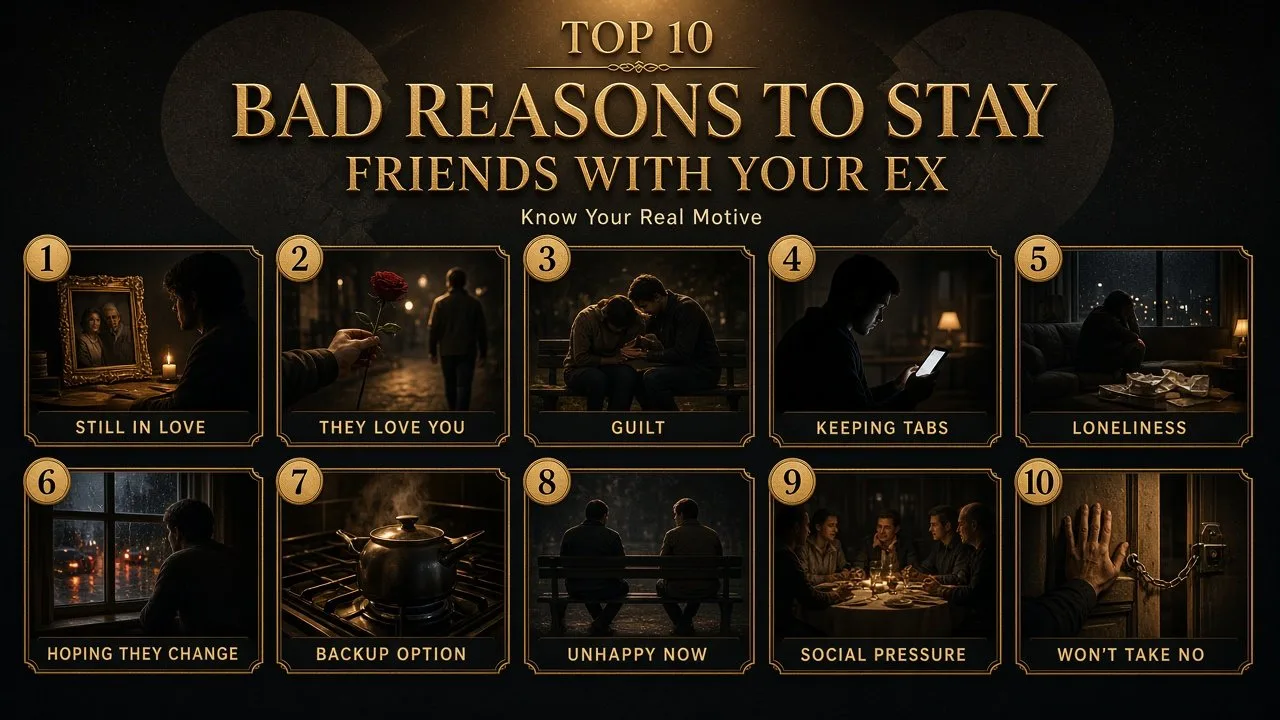
Staying friends with your ex can work, but guilt, lingering love, loneliness, jealousy and keeping a backup are bad reasons that usually prolong heartbreak.
After a breakup, "let's stay friends" can sound like the mature, kind and easy way forward. You shared years, months or at least an important chapter of your life with this person, and cutting them off completely can feel cruel or wasteful. Many former couples do manage the switch, especially when they were friends before they dated and the split was mutual.
The trouble is that the reason behind the friendship matters far more than the label. Psychologists who study post-breakup relationships have found that some motives tend to produce healthy, lasting friendships, while others keep old wounds open and make it harder for both people to move on. This guide covers the ten worst reasons for staying friends with an ex, what the research says about each one, the warning signs to look for and what to do instead.
How We Chose These 10 Reasons
This is an editorial list rather than a scientific ranking. Each reason was included because it appears in published research on friendships between former partners, on-again/off-again couples or contact with exes, and because it is a common motive people describe in their own lives. The list moves roughly from motives rooted in your feelings about your ex, to motives rooted in your own needs, to pressures that come from outside.
None of this means friendship with an ex is always a mistake. Near the end of the article you will find the reasons that research links to better outcomes, plus a short self-check to help you decide.
Bad Reasons for Staying Friends With Your Ex at a Glance
| No. | Bad Reason | Main Risk | Related Research Idea | Better Option |
|---|---|---|---|---|
| 1 | You still love them | Repeated heartbreak and stalled recovery | Unresolved romantic desires (Griffith and colleagues, 2017) | Take a clear no-contact break |
| 2 | They still love you | False hope for your ex | Unequal romantic desire in ex friendships | Reduce contact so they can heal |
| 3 | You feel guilty or sorry for them | Dependence and confusion | Visible versus invisible support | Let other people support them |
| 4 | You want to keep tabs on them | Jealousy, distress and slower healing | Facebook surveillance study (Marshall, 2012) | Mute, unfollow or unfriend |
| 5 | You are lonely or bored | Sliding into an on-off cycle | On-again/off-again research (Dailey and colleagues) | Lean on friends and new routines |
| 6 | You hope they will change | Disappointment and old patterns | Relational uncertainty | Judge change only from a distance |
| 7 | You want a backup option | Unfairness and weaker new relationships | Back burner research (Dibble and Drouin, 2014) | Close the door before opening another |
| 8 | You are dissatisfied with your current partner | Lower commitment to your relationship | Contact with exes and commitment (Rodriguez and colleagues, 2016) | Address the problem with your partner |
| 9 | Your friends and family expect it | Forced closeness you do not want | Network support as a barrier or resource (Busboom and colleagues, 2002) | Stay civil without being close |
| 10 | They will not take no for an answer | Harassment and safety risks | CDC data on stalking by partners and exes | Set firm boundaries and seek help |
1. You Are Still in Love With Them
| Attribute | Details |
|---|---|
| The motive | Hoping that closeness will eventually lead to getting back together |
| Why it is risky | Every meeting reopens the loss and keeps hope alive |
| Key research | Griffith, Gillath and colleagues identified "unresolved romantic desires" as a motive tied to negative outcomes |
| Warning sign | You read meaning into every message, smile or invitation |
| Better option | A period of little or no contact while feelings settle |
What It Looks Like
You tell yourself and your ex that you are fine being friends, but privately you are waiting for them to realise what they lost. You say yes to every invitation, keep your evenings free in case they call and feel a jolt of anxiety when they mention someone new. The friendship is really a holding pattern for the relationship you still want.
What the Research Says
In a 2017 paper in Personal Relationships, Rebecca Griffith, Omri Gillath and colleagues at the University of Kansas grouped the reasons people stay friends with exes into four types: security, practical reasons, civility and unresolved romantic desires. Friendships kept up because of unresolved romantic desires were linked to more negative outcomes, such as jealousy and lingering heartbreak. Paradoxically, these friendships also tended to last longer, which suggests people stay in them even when they get little benefit.
Earlier work points the same way. A 2000 study by Carl Schneider and David Kenny compared people's friendships with former partners to their friendships with opposite-sex friends they had never dated. Friendships with exes were rated less positively and carried more romantic desire, leading the authors to conclude that they are qualitatively different from ordinary platonic friendships.
Signs to Watch For
- You still imagine a future together when you spend time with them
- You feel hurt or jealous when they date someone else
- You plan your schedule around the chance of seeing them
- You agree to things you do not enjoy just to stay close
A Better Approach
Be honest with yourself that friendship is not what you want right now. A clean break of a few weeks or months gives your feelings a chance to fade without constant reminders. If a genuine friendship is possible later, it will still be possible once you can see your ex without hoping for more.
2. They Are Still in Love With You
| Attribute | Details |
|---|---|
| The motive | Enjoying their attention, company or admiration |
| Why it is risky | Your friendship can feed their hope of reconciliation |
| Key research | Studies find more romantic desire in friendships between exes than in platonic friendships |
| Warning sign | They ask when you might "try again" or treat outings like dates |
| Better option | Step back and give them room to recover |
What It Looks Like
You ended the relationship, but your ex has not let go. Spending time with someone who adores you can feel pleasant and flattering, and it may even ease your own guilt about the breakup. You may sincerely believe you have been clear that you only want friendship.
Why It Backfires
When one person still has romantic feelings, the friendship is not on equal terms. People who are hoping for a reunion tend to notice and remember every friendly signal and explain away the clear ones. A late-night text, a hug or an inside joke can carry far more weight for them than it does for you.
Staying close can also delay their recovery. Every interaction keeps the relationship alive in their mind, which makes it harder for them to grieve, meet someone new or rebuild their confidence.
Signs to Watch For
- They regularly bring up the past relationship or "what went wrong"
- They seem upset or withdrawn when you mention dating
- They offer favours, gifts or help far beyond what a friend would
- You avoid being fully honest because you do not want to hurt them
A Better Approach
The kindest choice is often to reduce contact, even if it feels harsh. Explain once, clearly and gently, that you care about them but do not want to get back together, and that some distance will help you both. Then follow through, rather than undoing the message with frequent check-ins.
3. You Feel Guilty or Sorry for Them
| Attribute | Details |
|---|---|
| The motive | Softening the pain of a breakup you started |
| Why it is risky | You become their main source of comfort, which keeps them attached |
| Key research | Studies on "invisible support" suggest obvious help can make people feel worse |
| Warning sign | You stay in contact mainly because you dread their reaction if you do not |
| Better option | Encourage support from their friends, family or a counsellor |
What It Looks Like
Your ex is struggling, and you feel responsible. Turning down their request to stay friends seems like kicking them while they are down, so you agree to calls, coffees and long conversations about how they are feeling. Over time you become their emotional lifeline.
What the Research Says
Psychologist Niall Bolger and colleagues have studied what they call invisible support: help that the person receiving it does not notice as help. In a well-known 2000 study of couples, support was most useful when the recipient was not aware of it, while obvious, visible support was linked to more distress. Being openly cared for can make people feel needy or indebted.
That finding helps explain why comfort from the person who ended the relationship can backfire. Your support may be well meant, but it reminds your ex of what they have lost and can keep them leaning on you instead of building a life without you.
Signs to Watch For
- Most of your conversations are about their pain or the breakup
- You feel drained or anxious after spending time with them
- You keep postponing honest boundaries because "they are not ready"
- You are the first person they call when anything goes wrong
A Better Approach
You can care about someone without being the one who looks after them. If you owe them an apology, give it sincerely and once. Then step back and trust them to lean on friends, family or a professional, people who can comfort them without making the loss harder.
4. You Want to Keep Tabs on Them
| Attribute | Details |
|---|---|
| The motive | Knowing who they are seeing and what they are doing |
| Why it is risky | Monitoring fuels jealousy, longing and distress |
| Key research | Tara Marshall's 2012 study of 464 people on Facebook monitoring of exes |
| Warning sign | You check their profiles or ask mutual friends about them regularly |
| Better option | Mute, unfollow or unfriend them, at least for a while |
What It Looks Like
Even when you know the relationship is over, it can sting to picture your ex enjoying life with a new partner. Friendship gives you a front-row seat to their dating life, and sometimes a chance to influence it. You may end up as their confidant, hearing about new partners while quietly comparing yourself.
What the Research Says
In a 2012 study published in Cyberpsychology, Behavior, and Social Networking, psychologist Tara Marshall surveyed 464 people about their exes. Those who kept checking an ex-partner's Facebook page reported more distress about the breakup, more negative feelings, more sexual desire and longing for the ex, and less personal growth. These links held even after accounting for offline contact and personality.
The results for simply staying Facebook friends were mixed. People who remained online friends with an ex reported less negative feeling and longing than those who did not, but also lower personal growth. The study was correlational, so it cannot prove that monitoring causes slower recovery, but the pattern is consistent with the idea that constant exposure keeps the relationship alive in your mind.
Signs to Watch For
- You check their social media more than any other friend's
- You feel a spike of anxiety or jealousy when they post photos with someone new
- You ask questions about their love life that you would not ask other friends
- You feel relief when their new relationship seems to be going badly
A Better Approach
Limit what you can see. Most social platforms let you mute or unfollow someone without telling them, and unfriending is a reasonable step if you cannot resist checking. Redirect the energy into things that are about your life rather than theirs.
5. You Are Lonely or Bored
| Attribute | Details |
|---|---|
| The motive | Filling the gap the relationship left in your evenings and weekends |
| Why it is risky | Familiar comfort can slide back into an unstable on-off relationship |
| Key research | René Dailey's studies of on-again/off-again dating couples |
| Warning sign | You only contact your ex when you are sad, bored or have had a drink |
| Better option | Build new routines and reconnect with other friends |
What It Looks Like
A breakup leaves a hole. The person you used to spend Friday nights with is gone, and meeting new people or calling old friends takes effort. Texting your ex for a takeaway and a film is easy and comfortable. Sometimes the evening ends with more than a film.
What the Research Says
Communication researcher René Dailey and colleagues have studied on-again/off-again couples, who break up and get back together repeatedly. In a 2009 study in Personal Relationships, people in these cyclical relationships reported less love, understanding and satisfaction, and more conflict, communication problems and uncertainty, than people whose relationships had no history of breakups and renewals.
Mogilski and Welling's 2017 study of reasons for post-breakup friendship also found that "sexual access" was one of seven distinct motives people gave, rated as more important by men than by women. Falling back into intimacy with an ex because you are lonely can blur the line between friendship and relationship, which is how many on-off cycles start.
Signs to Watch For
- Your contact with your ex rises when you feel low and falls when life is busy
- You turn down other plans in favour of easy time with them
- The friendship includes occasional physical intimacy with no clear agreement
- You feel worse, not better, the day after seeing them
A Better Approach
Treat loneliness as a signal to widen your circle, not to retreat into the past. Plan regular time with friends and family, try a class or club, and give yourself time alone to adjust. Those steps are slower than a call to your ex, but they actually move you forward.
6. You Hope They Will Change
| Attribute | Details |
|---|---|
| The motive | Staying close so you can be there when they finally become the partner you wanted |
| Why it is risky | Your ex may focus on looking changed rather than changing |
| Key research | Cycling couples report more relational uncertainty than stable couples |
| Warning sign | You think of the friendship as a trial period |
| Better option | Let change be proven over time and at a distance |
What It Looks Like
The relationship ended because of something specific: dishonesty, heavy drinking, unreliability or a lack of commitment. You still see the good in your ex and believe they could change. Staying friends feels like a way to support that change, and to be first in line if it happens.
Why It Backfires
Hope for reconciliation can occasionally motivate people to improve. But if your ex senses that getting you back will be easy, the incentive can shift from real change to simply seeming changed. The friendship then becomes an audition, and you end up watching closely for evidence while your own life is on hold.
This kind of arrangement also keeps uncertainty high. Dailey's research on on-again/off-again couples found that relational uncertainty was one of the clearest features distinguishing couples who kept cycling from those whose relationships were stable or definitely over.
Signs to Watch For
- You keep a mental scorecard of their good and bad behaviour
- You excuse the same problems that ended the relationship
- Your friends are worried that you are being drawn back in
- You feel you cannot fully move on "until you know"
A Better Approach
Real change takes time and does not need an audience. If the issue is serious, such as addiction or controlling behaviour, it is your ex's responsibility to seek help. Step back, and if you ever consider reconciling, judge them on sustained behaviour over many months, not on promises made while you are still close.
7. You Want to Keep Them as a Backup
| Attribute | Details |
|---|---|
| The motive | Keeping your ex available in case nobody better comes along |
| Why it is risky | It is unfair to them and can weaken your commitment to someone new |
| Key research | Dibble and Drouin's 2014 study of "back burners" and technology |
| Warning sign | You think of your ex as a safety net rather than a friend |
| Better option | Close the door honestly before you try to open a new one |
What It Looks Like
This is the more calculating cousin of hoping they will change. You do not necessarily want your ex back now, but you like knowing they are there. A friendly message every few weeks keeps the connection warm, just in case.
What the Research Says
Researchers Jayson Dibble and Michelle Drouin use the term back burner for a potential or past romantic partner with whom someone keeps in touch without being committed to them. In their 2014 survey of 374 people, published in Computers in Human Behavior, using texts and social media to stay in contact with back burners was common, and men reported more back burners than women.
A 2016 study of college students led by Lindsey Rodriguez found that about 40 percent were in contact with an ex. Contact was generally linked to lower commitment to a current partner, and keeping an ex around as a backup was among the patterns associated with poorer satisfaction and commitment in the current relationship.
Signs to Watch For
- You reach out when a new relationship or date goes badly
- You would be upset if your ex stopped replying, even though you do not want them back
- You keep the details of your contact vague with new partners
- You rarely see your ex as a friend, only as an option
A Better Approach
Ask yourself honestly whether you would still want this friendship if romance were completely off the table for good. If the answer is no, let it go. Keeping someone on hold blocks their chance to move on, and it can stop you from giving a new relationship your full attention.
8. You Are Unhappy in Your Current Relationship
| Attribute | Details |
|---|---|
| The motive | Escaping problems with your partner by turning to someone familiar |
| Why it is risky | It erodes commitment and adds a third person to a strained relationship |
| Key research | Contact with exes is linked to lower commitment to current partners |
| Warning sign | You talk to your ex about your partner's faults |
| Better option | Raise the issues directly with your partner or seek counselling |
What It Looks Like
Your new relationship has hit a rough patch, and your ex suddenly looks better in memory. You do not live with their irritating habits anymore, so it is easy to remember only the good times. Talking to them feels like a safe escape.
Why It Backfires
This is the "grass is greener" trap. Comparing your partner to an idealised version of your ex is a contest your partner cannot win, and it can make dissatisfaction grow. The research on contact with exes points the same way: in the Rodriguez study, staying in touch with an ex was generally tied to lower commitment to a current partner.
Bringing your ex into a struggling relationship also adds secrecy and jealousy to whatever problems already exist. Even if nothing romantic happens, your partner may feel betrayed if they learn your ex has become your confidant.
Signs to Watch For
- You are more open with your ex than with your partner
- You hide or downplay how often you talk to your ex
- You find yourself comparing your partner unfavourably to your ex
- Conversations with your ex leave you less patient with your partner
A Better Approach
Take the problem to the person it concerns. Tell your partner what is bothering you, and consider couples counselling if you keep going in circles. If the relationship is truly not working, ending it honestly is fairer than drifting back toward an ex.
9. Your Friends and Family Expect It
| Attribute | Details |
|---|---|
| The motive | Avoiding awkwardness in a shared friend group or family |
| Why it is risky | You force a closeness you do not feel and cannot heal properly |
| Key research | Busboom and colleagues (2002) found network support shapes friendship quality between exes |
| Warning sign | You stay friends only because it would be awkward not to |
| Better option | Be polite and civil without keeping a close friendship |
What It Looks Like
You and your ex share a friend group, a workplace or relatives who adored you as a couple. Everyone hopes you can "stay friends" so gatherings are not uncomfortable. You go along with it to keep the peace.
What the Research Says
In a 2002 study of 386 college students in Personal Relationships, Amy Busboom and colleagues found that a lack of support from friends or family was one of the barriers to good friendship quality between former partners. In other words, the people around a former couple influence whether a friendship works. Mogilski and Welling's 2017 study also listed social relationship maintenance, such as avoiding awkwardness among friends, as one of the main motives people give.
Social harmony is a reasonable goal, but it is a weak reason on its own for a close friendship. Being forced to share your recovery with the person you are recovering from can slow it down.
Signs to Watch For
- You dread group events because your ex will be there
- You feel you must act happy and relaxed around them for others' sake
- Mutual friends pass messages between you
- You have never asked yourself whether you actually want the friendship
A Better Approach
There is a difference between being civil and being close. You can greet your ex politely at parties and work together in a group without spending one-on-one time with them. It is also fine to skip some events for a while, or to ask friends to see you separately.
10. They Will Not Take No for an Answer
| Attribute | Details |
|---|---|
| The motive | Giving in to pressure because refusing feels difficult or frightening |
| Why it is risky | Persistent unwanted contact can escalate into stalking or harassment |
| Key research | CDC survey data show current or former partners are a leading source of stalking |
| Warning sign | Your ex ignores your boundaries, shows up uninvited or monitors you |
| Better option | Set a clear boundary, keep records and contact the authorities if needed |
What It Looks Like
You do not want to stay friends, but your ex keeps pushing. They message repeatedly, turn up where you are, get angry when you set limits or recruit friends to persuade you. Agreeing to "just be friends" can feel like the only way to make it stop.
What the Research Says
Unwanted contact from an ex is more serious than it may seem. According to the US Centers for Disease Control and Prevention's National Intimate Partner and Sexual Violence Survey for 2016 and 2017, about 31.2 percent of US women and 16.1 percent of US men have experienced stalking in their lifetime. A current or former intimate partner was the stalker for 43.4 percent of female victims and 32.4 percent of male victims.
Friendship given under pressure is not really friendship, and it often teaches a controlling person that pushing works. Saying no to a friendship with an ex is always your right.
Signs to Watch For
- Repeated calls, messages or emails after you have asked for space
- Showing up at your home, work or social events uninvited
- Tracking your location, accounts or social media closely
- Anger, threats or guilt-tripping when you set a boundary
A Better Approach
State your boundary once in plain words, then stop engaging. Keep a record of messages and incidents, tell people you trust, and block contact where you can. If you feel unsafe, contact local police or a domestic violence or stalking helpline in your country.
Good Reasons vs Bad Reasons
Not every friendship with an ex is a mistake. The same research that flags unhealthy motives also points to healthier ones. In the Griffith study, friendships based on security (valuing the person's trust and support) and practical reasons (such as shared children, work or money) were linked to more positive outcomes, and civility-based friendships were also common.
| Healthier Reasons | Riskier Reasons |
|---|---|
| You were good friends before you dated | You secretly hope to get back together |
| You share children and need to co-parent well | You feel guilty and want to ease their pain |
| You trust and respect each other as people | You want to monitor their love life |
| The breakup was mutual and feelings have faded | You are lonely and want easy company |
| You work together and need a cooperative relationship | You want to keep them as a backup |
| Your current partners are comfortable with the friendship | You are unhappy with your current partner |
A Quick Self-Check Before You Stay Friends
Before deciding, answer these questions honestly. If several answers point toward the risky column, a break from contact is probably wiser for now.
| Question | Healthy Sign | Warning Sign |
|---|---|---|
| Would I want this friendship if romance were impossible forever? | Yes | Not really |
| Can I hear about their new partner without pain? | Mostly yes | It still hurts badly |
| Would I be comfortable if my partner saw all our messages? | Yes | I would edit or hide them |
| Do I feel better or worse after seeing them? | Usually better | Usually worse |
| Did we both agree to stay friends freely? | Yes | One of us is pushing |
| Has enough time passed for strong feelings to settle? | Yes | The breakup is still raw |
A useful test is whether you could comfortably spend time with your ex while your current partner is present, and whether your ex could do the same with theirs. If the idea makes either of you uneasy, the friendship probably still carries unfinished romantic business.
Frequently Asked Questions
Can you really stay friends with your ex?
Yes, some people do, especially those who were friends before dating, ended things mutually and no longer have romantic feelings. Research suggests outcomes depend on motives. Friendships based on trust, practical needs or civility tend to fare better than those based on unresolved romantic feelings, which are linked to jealousy and lingering heartbreak.
How long should you wait before being friends with an ex?
There is no fixed timeline. The right time is when you can see or hear about your ex without strong longing, jealousy or hope of getting back together. For many people that means at least several weeks or months of little or no contact after the breakup, so that feelings can settle naturally.
Is it a bad sign if my partner is still friends with their ex?
Not necessarily. Many friendships between exes are platonic, particularly when they share children, work or a long friendship. Warning signs include secrecy, frequent private contact, comparing you to the ex or turning to the ex during conflicts with you. Open, honest conversation about boundaries is the best starting point.
Should I unfollow my ex on social media?
If you find yourself checking their profiles often, unfollowing or muting is a good idea. A 2012 study of 464 people found that monitoring an ex's Facebook page was linked to more distress, longing and negative feelings, and less personal growth. Limiting what you see can make moving on easier.
Is it normal to miss your ex even if you do not want them back?
Yes. Missing the companionship, routines and shared memories of a relationship is a normal part of a breakup, even when ending it was the right choice. Missing someone is not the same as wanting to be with them. Leaning on friends and new routines usually eases the feeling with time.
What should I do if my ex will not leave me alone?
State your boundary clearly once, then stop responding. Keep a record of messages, calls and visits, block contact where possible and tell people you trust. If the behaviour continues or you feel unsafe, contact local police or a domestic violence or stalking support service in your country.
Conclusion
Staying friends with your ex is neither always healthy nor always doomed. What makes the difference is why you are doing it. Guilt, lingering love, loneliness, curiosity about their dating life, hoping they will change or keeping them as a backup tend to keep both people stuck, while trust, shared responsibilities and genuine mutual respect give a friendship a far better chance.
If you are unsure, take a break first. Time apart costs little and often makes the answer obvious. A friendship that is meant to last will still be there once the breakup has stopped hurting, and if it is not, you have lost a complication rather than a friend. For more on the science of how people think and act, see our article on interesting psychological facts about human behavior.
- Griffith, R. L., Gillath, O. and colleagues (2017). Staying friends with ex-romantic partners: Predictors, reasons, and outcomes. Personal Relationships.
- Mogilski, J. K. and Welling, L. L. M. (2017). Staying friends with an ex: Sex and dark personality traits predict motivations for post-relationship friendship. Personality and Individual Differences, 115, 114-119.
- Schneider, C. S. and Kenny, D. A. (2000). Cross-sex friends who were once romantic partners: Are they platonic friends now? Journal of Social and Personal Relationships, 17(3), 451-466.
- Busboom, A. L., Collins, D. M., Givertz, M. D. and Levin, L. A. (2002). Can we still be friends? Resources and barriers to friendship quality after romantic relationship dissolution. Personal Relationships, 9(2), 215-223.
- Marshall, T. C. (2012). Facebook surveillance of former romantic partners: Associations with postbreakup recovery and personal growth. Cyberpsychology, Behavior, and Social Networking, 15(10), 521-526.
- Dailey, R. M., Pfiester, A., Jin, B., Beck, G. and Clark, G. (2009). On-again/off-again dating relationships: How are they different from other dating relationships? Personal Relationships, 16(1), 23-47.
- Dibble, J. L. and Drouin, M. (2014). Using modern technology to keep in touch with back burners: An investment model analysis. Computers in Human Behavior, 34, 96-100.
- Rodriguez, L. M., Øverup, C. S., Wickham, R. E., Knee, C. R. and Amspoker, A. B. (2016). Communication with former romantic partners and current relationship outcomes among college students. Personal Relationships.
- Bolger, N., Zuckerman, A. and Kessler, R. C. (2000). Invisible support and adjustment to stress. Journal of Personality and Social Psychology, 79(6), 953-961.
- Smith, S. G., Basile, K. C. and Kresnow, M. The National Intimate Partner and Sexual Violence Survey: 2016/2017 Report on Stalking (updated release). Centers for Disease Control and Prevention.
















Log in with