











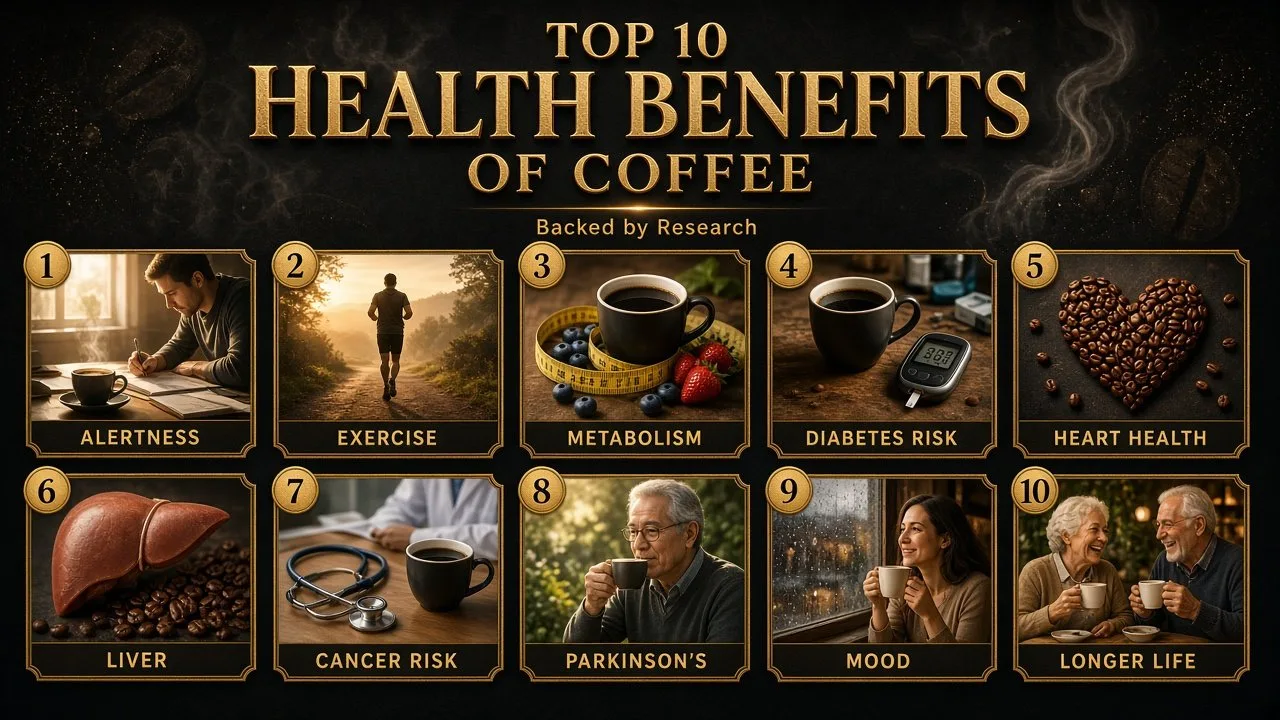
The health benefits of coffee range from sharper focus and better workouts to lower risks of type 2 diabetes, liver disease and early death in large studies.
Coffee is one of the most widely consumed drinks on the planet, and for many people the first cup of the day is a ritual as much as a pick-me-up. For decades it also carried a slightly guilty reputation, blamed for jitters, heart trouble and bad habits. Research over the past twenty years has changed that picture a great deal. Very large studies that followed hundreds of thousands of people for years now suggest that moderate coffee drinking is more often linked with benefit than with harm.
This guide looks at ten of the best-supported effects of drinking coffee. For each one you will find a Quick Facts table, what the research actually found, how coffee might produce the effect and the important caveats. The evidence comes from peer-reviewed studies and reviews, including a 2017 umbrella review in The BMJ that pulled together more than 200 meta-analyses, along with guidance from the US Food and Drug Administration and the Harvard T.H. Chan School of Public Health. It is general information, not medical advice, so talk to your doctor if you have a health condition or take regular medication.
How We Chose These Effects
We started with the benefits most often claimed for coffee and kept only those backed by large human studies, systematic reviews or expert position statements. Short-term effects such as alertness and exercise performance are supported by controlled experiments in which people are given caffeine or a placebo. Long-term effects such as lower disease risk come mainly from observational studies, which track what people drink and what happens to their health over time.
That difference matters. Observational studies can show that coffee drinkers tend to have lower rates of a disease, but they cannot prove that coffee is the cause. Coffee drinkers may differ from non-drinkers in other ways, and the best studies adjust for factors such as smoking, alcohol, weight and exercise. Where the evidence is only an association, we say so.
Health Benefits of Coffee at a Glance
| No. | Effect | Type of evidence | Key finding |
|---|---|---|---|
| 1 | Sharper alertness and focus | Controlled trials and reviews | Low to moderate caffeine doses improve alertness, attention and reaction time |
| 2 | Better exercise performance | Trials, sports nutrition position stand | 3 to 6 mg of caffeine per kg of body weight improves many types of exercise |
| 3 | Small boost to metabolism | Controlled laboratory study | 100 mg of caffeine raised resting metabolic rate by 3 to 4 percent |
| 4 | Lower risk of type 2 diabetes | Meta-analysis of 28 cohort studies | Each daily cup linked with about a 9 percent lower risk |
| 5 | Heart health | Umbrella review and UK Biobank study | 2 to 3 cups a day linked with less cardiovascular disease |
| 6 | Liver protection | Meta-analysis | Two extra cups a day linked with a 44 percent lower risk of cirrhosis |
| 7 | Lower risk of some cancers | Meta-analyses | Lower rates of liver and endometrial cancer in coffee drinkers |
| 8 | Lower risk of Parkinson's disease | Meta-analysis of 13 studies | Regular caffeine intake linked with about a 20 percent lower risk |
| 9 | Better mood | Large cohort studies | Lower rates of depression and suicide among regular coffee drinkers |
| 10 | Longer life | Cohort studies and umbrella review | 3 to 4 cups a day linked with the lowest risk of early death |
What Is in a Cup of Coffee?
Coffee is far more than caffeine and water. Harvard's Nutrition Source describes it as a complex mixture of more than a thousand chemical compounds. Alongside caffeine, a cup contains small amounts of vitamin B2 (riboflavin) and magnesium, and plant compounds called polyphenols, the best known of which is chlorogenic acid. Coffee also contains diterpenes such as cafestol and kahweol, which matter for cholesterol, as explained later in this guide.
According to Harvard, an 8-ounce cup of brewed coffee contains about 95 mg of caffeine, although the real amount depends on the bean, the roast, the grind and the brewing method. A coffee-shop cup is often much larger than 8 ounces, so it may contain far more.
Coffee is also a major source of antioxidants in many diets. A Norwegian study published in the Journal of Nutrition in 2004 estimated that adults took in about 17 mmol of antioxidants a day, and that coffee supplied about 11.1 mmol of that total, far more than fruits (1.8 mmol), tea (1.4 mmol) or vegetables (0.4 mmol). This does not mean coffee is healthier than vegetables, which bring fibre, vitamins and minerals that coffee lacks. It does show how much a daily habit can contribute.
1. Sharper Alertness and Focus
| Attribute | Details |
|---|---|
| Main compound | Caffeine |
| How it works | Blocks adenosine receptors in the brain |
| Effective dose | About 40 mg to 300 mg of caffeine |
| Strongest effects | Alertness, vigilance, attention and reaction time |
| Weaker effects | Memory and complex decision making |
What the Research Shows
The most familiar effect of coffee is also the best proven. A detailed 2016 review in Neuroscience and Biobehavioral Reviews, written by researchers including scientists from the US Army Research Institute of Environmental Medicine, examined how caffeine affects thinking and physical performance. It found that low doses of around 40 mg and moderate doses of around 300 mg improve alertness, vigilance, attention and reaction time.
The same review found less consistent effects on memory and on higher-level skills such as judgement and decision making. In other words, coffee helps you stay awake and focused on a task, but it will not necessarily make you smarter or a better problem solver.
How It Works
During the day a chemical messenger called adenosine builds up in the brain and gradually makes you feel tired. Caffeine has a similar shape to adenosine and blocks its receptors, so the brain receives a weaker sleepiness signal. That is why a cup of coffee can make a tired person feel more awake within a short time.
Caveats
- Harvard notes that doses of about 50 to 300 mg may increase alertness, energy and concentration, while higher doses can cause anxiety, restlessness, insomnia and a faster heart rate.
- Caffeine taken late in the day can disturb sleep, which can leave you more tired the next day.
- Regular drinkers build up some tolerance, so part of the morning lift is simply the relief of caffeine withdrawal.
Interesting Facts
- Caffeine is the most widely used stimulant of the central nervous system in the world.
- The 2016 review notes that more than 80 percent of US adults consume caffeine.
- Many occupations that require long shifts, such as transport and the military, have studied caffeine as a tool to maintain performance.
2. Better Exercise Performance
| Attribute | Details |
|---|---|
| Main compound | Caffeine |
| Effective dose | 3 to 6 mg per kg of body weight |
| Common timing | About 60 minutes before exercise |
| Most consistent benefit | Aerobic endurance |
| Key authority | International Society of Sports Nutrition, 2021 position stand |
What the Research Shows
Coffee is not only a desk-side drink. Caffeine is one of the most studied performance aids in sport, and in 2021 the International Society of Sports Nutrition (ISSN) published a position stand that summarised the evidence. It concluded that caffeine can acutely improve many aspects of exercise performance, including muscular endurance, strength, sprinting, jumping and throwing, although not every study finds a benefit.
The ISSN found the most consistent moderate-to-large benefits in aerobic endurance exercise such as running and cycling. It reported that doses of 3 to 6 mg per kilogram of body weight reliably improve performance, while very high doses of around 9 mg per kilogram cause many side effects and do not seem to be needed. For a 70 kg adult, 3 mg per kilogram is about 210 mg of caffeine.
How It Works
Caffeine acts on the brain and nervous system rather than simply adding energy. The ISSN notes that it improves attention and vigilance in most people, which helps in sports that demand quick reactions, and that it may help performance under sleep deprivation in some people.
Caveats
- People respond very differently. The ISSN links these differences partly to genes that control how fast caffeine is broken down, and to how much caffeine a person usually consumes.
- Caffeine can disturb sleep and raise anxiety, both of which can hurt recovery.
- A cup of coffee is an imprecise dose, because caffeine content varies widely from cup to cup.
Interesting Facts
- The ISSN says caffeine appears to help both trained athletes and untrained people.
- Caffeine also seems to help performance in the heat and at altitude at doses of 3 to 6 mg per kilogram.
- Caffeinated gums, gels and mouth rinses have all been tested as alternatives to coffee.
3. A Small Boost to Metabolism
| Attribute | Details |
|---|---|
| Main compound | Caffeine |
| Key study | Dulloo and colleagues, American Journal of Clinical Nutrition, 1989 |
| Single dose effect | 100 mg raised resting metabolic rate by 3 to 4 percent |
| Repeated doses | About 150 extra calories a day in lean volunteers |
| Realistic verdict | A modest effect, not a weight-loss solution |
What the Research Shows
Caffeine is a common ingredient in fat-burning supplements, and there is a real effect behind the marketing, even if it is small. In a classic 1989 study at King's College London, published in the American Journal of Clinical Nutrition, a single 100 mg dose of caffeine raised the resting metabolic rate of both lean volunteers and people who had previously been obese by 3 to 4 percent over two and a half hours.
When the volunteers took 100 mg of caffeine every two hours over a 12-hour day, their energy expenditure during that period rose by 8 to 11 percent. Over a full day this added up to about 150 extra calories in the lean volunteers and 79 extra calories in the formerly obese volunteers. The effect did not continue overnight.
How It Works
Caffeine stimulates the nervous system and increases thermogenesis, the body's production of heat. This slightly raises the number of calories the body burns at rest.
Caveats
- The extra calories burned are small and can easily be cancelled out by sugar, syrups, cream or a pastry on the side.
- The 1989 study used repeated doses spread across the day in a laboratory, which is not how most people drink coffee.
- Coffee is best seen as a calorie-free drink when taken black, rather than as a tool for losing weight.
Interesting Facts
- Black coffee contains almost no calories.
- A large flavoured coffee with whipped cream can contain more calories than a small meal.
- The 1989 researchers suggested caffeine may help energy balance, but they did not test long-term weight loss.
4. Lower Risk of Type 2 Diabetes
| Attribute | Details |
|---|---|
| Key study | Ding and colleagues, Diabetes Care, 2014 |
| Size | 28 cohort studies, more than 1.1 million people, 45,335 cases |
| Main finding | Each extra daily cup linked with about a 9 percent lower risk |
| Decaf | Also linked with lower risk |
| Type of evidence | Observational |
What the Research Shows
Type 2 diabetes is one of the areas where the evidence for coffee is strongest. A 2014 meta-analysis in Diabetes Care, led by researchers at the Harvard School of Public Health, combined 28 prospective studies involving 1,109,272 people, of whom 45,335 developed type 2 diabetes. Follow-up ranged from 10 months to 20 years.
Compared with people who drank no coffee or very little, the risk of diabetes was 8 percent lower for one cup a day and fell steadily with more cups, reaching 33 percent lower for six cups a day. Each extra daily cup was linked with a 9 percent lower risk for caffeinated coffee and a 6 percent lower risk for decaffeinated coffee.
How It Works
Because decaf showed a similar link, scientists think caffeine is not the whole story. Harvard suggests that the polyphenols and minerals in coffee, such as magnesium, may help the body use insulin and process glucose more effectively.
Caveats
- Harvard notes that caffeine can raise blood sugar in the short term, even though long-term coffee drinkers have a lower risk of diabetes.
- The studies are observational, so they show a link, not proof that coffee prevents diabetes.
- Sugary coffee drinks add sugar and calories that work against any benefit.
Interesting Facts
- The link held for both caffeinated and decaffeinated coffee.
- The pattern was dose-dependent, which means more cups were linked with lower risk, up to six a day.
- People with diabetes should follow their own doctor's advice on caffeine.
5. Heart Health
| Attribute | Details |
|---|---|
| Key studies | Poole and colleagues, The BMJ, 2017; Chieng and colleagues, European Journal of Preventive Cardiology, 2022 |
| Umbrella review finding | 3 to 4 cups a day linked with 15 percent less cardiovascular disease |
| UK Biobank size | 449,563 people followed for about 12.5 years |
| Lowest risk | 2 to 3 cups a day |
| Caution | Unfiltered coffee can raise LDL cholesterol |
What the Research Shows
Coffee was long suspected of harming the heart, but large studies now suggest the opposite for most people. The 2017 umbrella review in The BMJ, which combined the results of many meta-analyses, found that drinking three to four cups a day, compared with none, was linked with a 15 percent lower risk of cardiovascular disease and a 19 percent lower risk of dying from it.
A 2022 study in the European Journal of Preventive Cardiology used the UK Biobank to follow 449,563 adults for about 12.5 years. Ground, instant and decaffeinated coffee were all linked with less cardiovascular disease, with the lowest risk at two to three cups a day. Ground and instant coffee, but not decaf, were also linked with fewer heart rhythm problems (arrhythmias).
How It Works
Researchers think the polyphenols in coffee may reduce inflammation and protect blood vessels, though the exact mechanisms are still being studied. The finding that decaf is also linked with heart benefits suggests that compounds other than caffeine play a part.
Caveats
- Harvard notes that unfiltered coffee, such as French press and Turkish coffee, contains diterpenes that can raise LDL cholesterol and triglycerides. Espresso contains moderate amounts, while filtered drip coffee and instant coffee contain almost none.
- High amounts of caffeine can cause palpitations in sensitive people.
- People with heart conditions or high blood pressure should ask their doctor how much caffeine is right for them.
Interesting Facts
- A paper filter traps most of the cholesterol-raising diterpenes.
- In the UK Biobank study, instant coffee was also linked with a lower risk of arrhythmia.
- The 2017 umbrella review reviewed 201 meta-analyses of observational research.
6. Liver Protection
| Attribute | Details |
|---|---|
| Key study | Kennedy and colleagues, Alimentary Pharmacology and Therapeutics, 2016 |
| Size | 9 studies, 1,990 cases, 432,133 participants |
| Main finding | Two extra cups a day linked with a 44 percent lower risk of cirrhosis |
| Death from cirrhosis | About 45 percent lower with two extra cups a day |
| Type of evidence | Observational |
What the Research Shows
The liver may be the organ where coffee looks most protective. A 2016 meta-analysis by researchers at the University of Southampton combined five cohort studies and four case-control studies involving 432,133 people. It found that drinking two extra cups of coffee a day was linked with a 44 percent lower risk of cirrhosis, the severe scarring of the liver that can follow years of damage from alcohol, hepatitis or fatty liver disease.
Two extra cups a day were also linked with a 38 percent lower risk of alcoholic cirrhosis and a 45 percent lower risk of dying from cirrhosis. The authors concluded that increasing coffee consumption may substantially reduce the risk of the disease.
How It Works
The precise reason is not known. Scientists are studying whether caffeine and other coffee compounds slow the scarring process in the liver and reduce inflammation.
Caveats
- The results varied considerably between studies.
- Coffee is not a treatment for liver disease and cannot cancel out heavy drinking.
- Anyone with liver disease should follow medical advice rather than relying on coffee.
Interesting Facts
- The 2017 BMJ umbrella review also found coffee linked with lower risks of several liver conditions.
- The link with lower cirrhosis risk appeared in both cohort and case-control studies.
- The same Southampton research group led the 2017 BMJ umbrella review.
7. Lower Risk of Some Cancers
| Attribute | Details |
|---|---|
| Liver cancer | Two extra cups a day linked with a 35 percent lower risk (BMJ Open, 2017) |
| Endometrial cancer | Highest coffee intake linked with a 29 percent lower risk (International Journal of Cancer, 2012) |
| All cancers combined | High intake linked with an 18 percent lower risk (The BMJ, 2017) |
| Expert view | Coffee may reduce the risk of endometrial and liver cancer, according to the American Institute for Cancer Research |
| Type of evidence | Observational |
What the Research Shows
A 2017 meta-analysis in BMJ Open combined 18 cohort studies involving more than 2.2 million people, plus 8 case-control studies, to look at hepatocellular carcinoma, the most common type of liver cancer. Two extra cups of coffee a day were linked with a 35 percent lower risk, and the link held whether or not people had other risk factors such as heavy drinking, obesity, diabetes, smoking or hepatitis B and C.
For endometrial cancer, which starts in the lining of the womb, a 2012 meta-analysis of 16 studies by Harvard researchers found that women with the highest coffee intake had a 29 percent lower risk than those with the lowest intake. The 2017 BMJ umbrella review reported that high coffee consumption was linked with an 18 percent lower risk of developing cancer overall.
How It Works
Harvard describes several possible mechanisms. Coffee has been associated with lower estrogen levels, a hormone linked to several cancers, and it appears to reduce inflammation. Polyphenols in coffee have prevented cancer cell growth in animal studies, and coffee may speed digestion through the colon, reducing the time colon tissue is exposed to carcinogens.
Caveats
- The authors of the liver cancer review rated the quality of evidence as very low under the GRADE system, mainly because there are no randomised trials.
- Coffee contains acrylamide, a chemical formed when beans are roasted, but Harvard notes there is not yet evidence of a health effect in humans from acrylamide in food.
- The World Health Organization's International Agency for Research on Cancer found inadequate evidence that drinking coffee causes cancer, according to Harvard.
Interesting Facts
- In 2018 a California court ruling briefly required cancer warnings on coffee sold in the state, before regulators proposed exempting coffee.
- Decaffeinated coffee was also linked with lower liver cancer risk, though the link was weaker.
- The endometrial cancer link was strongest in three Japanese studies.
8. Lower Risk of Parkinson's Disease
| Attribute | Details |
|---|---|
| Key study | Hong and colleagues, Nutrients, 2020 |
| Size | 13 studies |
| Risk finding | Regular caffeine intake linked with a 20 percent lower risk |
| Progression finding | Caffeine linked with slower progression in people with Parkinson's |
| Possible mechanism | Blocking adenosine A2A receptors in the brain |
What the Research Shows
Parkinson's disease is a progressive brain disorder that affects movement. A 2020 meta-analysis in the journal Nutrients, by researchers at Taipei Medical University, combined 13 studies on caffeine and Parkinson's. In healthy people who were followed over time, regular caffeine consumption was linked with a 20 percent lower risk of developing the disease.
The researchers also looked at people who already had Parkinson's. Those who consumed caffeine had a slower rate of progression, measured by outcomes such as movement problems and the time before they needed the drug levodopa. The 2017 BMJ umbrella review likewise found coffee linked with lower risks of several neurological conditions.
How It Works
Caffeine blocks a type of adenosine receptor called A2A, which is found in brain areas that control movement. Drug researchers are studying this pathway for possible new Parkinson's treatments.
Caveats
- Most of the evidence is observational.
- Coffee is not a treatment for Parkinson's, and people with the condition should follow their neurologist's advice.
- Genetics and other lifestyle factors also play major roles in Parkinson's risk.
Interesting Facts
- The link appears to be with caffeine specifically, which is why the 2020 study focused on caffeinated foods and drinks.
- The 2020 search covered coffee as well as other caffeinated foods and drinks.
- The adenosine pathway that caffeine targets is the same one that explains its wake-up effect.
9. Better Mood
| Attribute | Details |
|---|---|
| Depression study | Lucas and colleagues, Archives of Internal Medicine, 2011 |
| Depression finding | Women drinking 4 or more cups a day had a 20 percent lower risk |
| Suicide study | Lucas and colleagues, World Journal of Biological Psychiatry, 2014 |
| Suicide finding | 2 to 4 or more cups a day linked with about half the risk |
| Decaf | Not linked with lower depression risk |
What the Research Shows
Researchers at the Harvard School of Public Health followed 50,739 US women for ten years in a study published in the Archives of Internal Medicine in 2011. Compared with women who drank one cup of caffeinated coffee a week or less, those who drank two to three cups a day had a 15 percent lower risk of developing depression, and those who drank four or more cups a day had a 20 percent lower risk. Decaffeinated coffee was not linked with depression risk.
A later study by the same research team, published in 2014, pooled three large cohorts of American men and women and recorded 277 deaths from suicide. People who drank two to three cups of caffeinated coffee a day had a 45 percent lower risk of suicide than those who drank one cup a week or less, and those who drank four or more cups a day had a 53 percent lower risk.
How It Works
The exact mechanism is not known. Because decaf showed no link with depression in the 2011 study, while higher caffeine intake from all sources did, the researchers pointed to caffeine itself as the likely factor.
Caveats
- These are observational findings, and the researchers called for further studies to confirm them.
- Too much caffeine can worsen anxiety and sleep, which can harm mental health.
- Coffee is not a treatment for depression. Anyone struggling with low mood or thoughts of self-harm should seek professional help.
Interesting Facts
- The 2011 study measured coffee intake from questionnaires collected over more than two decades.
- Women in the highest caffeine group consumed 550 mg or more a day from all sources.
- The suicide study combined data from three large long-running health studies of health professionals.
10. Longer Life
| Attribute | Details |
|---|---|
| Key study | Freedman and colleagues, New England Journal of Medicine, 2012 |
| Size | 402,260 adults aged 50 to 71, followed from 1995 to 2008 |
| Main finding | Coffee drinkers had lower overall death rates after adjusting for smoking |
| Umbrella review | 3 to 4 cups a day linked with a 17 percent lower risk of early death |
| UK Biobank | 2 to 3 cups of ground coffee a day linked with a 27 percent lower risk |
What the Research Shows
One of the most influential coffee studies was published in the New England Journal of Medicine in 2012. Researchers from the US National Cancer Institute followed 229,119 men and 173,141 women aged 50 to 71 in the NIH-AARP Diet and Health Study. At first, coffee drinkers seemed to die sooner, but that was because they were more likely to smoke. After adjusting for smoking and other factors, coffee drinkers had lower death rates. Men who drank four to five cups a day had a 12 percent lower risk of death, and women a 16 percent lower risk.
Later research supported the finding. The 2017 BMJ umbrella review found that three to four cups a day, compared with none, was linked with a 17 percent lower risk of death from any cause. In the 2022 UK Biobank study, two to three cups a day were linked with a 27 percent lower risk for ground coffee, 14 percent for decaf and 11 percent for instant coffee.
How It Works
There is no single explanation. The longer life seen in coffee drinkers may reflect the combined effect of lower rates of heart disease, diabetes, liver disease and other conditions described above. In the 2012 study, coffee was linked with fewer deaths from heart disease, respiratory disease, stroke, injuries and accidents, diabetes and infections, but not from cancer.
Caveats
- The NEJM authors stated plainly that their data could not show whether the link was causal.
- The 2012 study assessed coffee intake only once, at the start.
- Adding coffee to an unhealthy lifestyle is unlikely to make up for smoking, inactivity or a poor diet.
Interesting Facts
- The 2012 study covered more than 5.1 million person-years of follow-up.
- The benefit levelled off at higher intakes in several studies, rather than rising without limit.
- Decaffeinated coffee was also linked with longer life in the UK Biobank study.
Who Should Limit Coffee?
Coffee is safe for most healthy adults in moderate amounts, but not for everyone. The FDA says that for most adults, 400 mg of caffeine a day, about two to three 12-ounce cups of coffee, is not generally associated with negative effects. It also notes that sensitivity to caffeine varies widely between people.
| Group | Why caution is needed | Guidance |
|---|---|---|
| Pregnant women | The 2017 BMJ umbrella review linked high intake with low birth weight, preterm birth and pregnancy loss | ACOG says less than 200 mg a day does not appear to be a major factor in miscarriage or preterm birth |
| Children and teens | Caffeine can raise heart rate and blood pressure and disturb sleep | The FDA cites expert advice against energy drinks for this age group |
| Women at risk of fracture | The umbrella review found coffee linked with higher fracture risk in women | The authors suggested this group may need to be cautious |
| People with anxiety or insomnia | High doses can cause restlessness, anxiety and poor sleep | Cut down or switch to decaf |
| People on certain medications | Some drugs and conditions increase sensitivity to caffeine | Ask a doctor or pharmacist |
| People with high LDL cholesterol | Unfiltered coffee contains cholesterol-raising diterpenes | Choose filtered or instant coffee |
How to Get the Most From Your Coffee
The way you drink coffee makes a big difference to its effect on your health. The studies above mostly describe plain coffee, not drinks loaded with sugar and cream.
- Keep it simple: black coffee or coffee with a little milk adds few calories.
- Go easy on sugar, syrups and whipped cream, which can turn coffee into a dessert.
- Use a paper filter if you are watching your cholesterol.
- Stop drinking caffeinated coffee several hours before bed to protect your sleep.
- Stay within about 400 mg of caffeine a day unless your doctor advises less.
- Try decaf if you enjoy the taste but are sensitive to caffeine, since it was linked with several of the same benefits.
Frequently Asked Questions
How many cups of coffee a day are healthy?
For most healthy adults, three to four cups of brewed coffee a day falls within the FDA's 400 mg caffeine guideline, depending on cup size and strength. The 2017 BMJ umbrella review found the largest risk reductions for several outcomes at three to four cups a day, compared with none.
Is decaf coffee as healthy as regular coffee?
Decaf shares many of the same plant compounds and has been linked with lower risks of type 2 diabetes, cardiovascular disease and early death. However, benefits that depend on caffeine, such as alertness, exercise performance and the lower depression risk seen in women, were not found with decaf.
Does coffee help you lose weight?
Caffeine slightly raises the number of calories you burn. In a 1989 study, 100 mg raised resting metabolic rate by 3 to 4 percent. The effect is small, though, and it is easily outweighed by the sugar and cream in many coffee drinks, so coffee is not a weight-loss solution.
Is coffee bad for your heart?
For most people, no. Large studies link two to four cups a day with a lower risk of cardiovascular disease. Unfiltered coffee can raise LDL cholesterol, and high caffeine doses can cause palpitations, so people with heart conditions should ask their doctor how much is safe.
Can pregnant women drink coffee?
Many experts advise limiting caffeine during pregnancy. The American College of Obstetricians and Gynecologists says that moderate intake of less than 200 mg a day does not appear to be a major factor in miscarriage or preterm birth. Pregnant women should discuss caffeine with their healthcare provider.
When is the best time to drink coffee?
Many people enjoy coffee in the morning, and athletes often take caffeine about an hour before exercise. Because caffeine can disturb sleep, most people do best avoiding caffeinated coffee in the late afternoon and evening, especially if they have trouble falling asleep.
How much caffeine is in a cup of coffee?
According to Harvard's Nutrition Source, an 8-ounce cup of brewed coffee contains about 95 mg of caffeine. The real amount varies with the bean, roast, grind and brewing method, and coffee-shop cups are often much larger than 8 ounces, so a single takeaway drink can contain far more.
Conclusion
The health benefits of coffee are broader than most people expect. Controlled studies show that caffeine sharpens alertness and improves exercise performance, and huge observational studies link moderate coffee drinking with lower risks of type 2 diabetes, heart disease, liver disease, some cancers, Parkinson's disease, depression and early death. For most healthy adults, three to four cups of plain coffee a day appears to be safe and may even be good for you.
The key word is moderate. Coffee is not a cure, many of the findings show links rather than proof, and pregnant women, children and people with certain conditions need to be careful. Enjoy your coffee black or lightly milked, skip the sugary extras, protect your sleep and let it be one part of a healthy lifestyle.
- Poole R and others, Coffee consumption and health: umbrella review of meta-analyses of multiple health outcomes, The BMJ, 2017
- McLellan TM, Caldwell JA and Lieberman HR, A review of caffeine's effects on cognitive, physical and occupational performance, Neuroscience and Biobehavioral Reviews, 2016
- Guest NS and others, International Society of Sports Nutrition position stand: caffeine and exercise performance, Journal of the International Society of Sports Nutrition, 2021
- Dulloo AG and others, Normal caffeine consumption: influence on thermogenesis and daily energy expenditure in lean and postobese human volunteers, American Journal of Clinical Nutrition, 1989
- Ding M and others, Caffeinated and decaffeinated coffee consumption and risk of type 2 diabetes: a systematic review and a dose-response meta-analysis, Diabetes Care, 2014
- Chieng D and others, The impact of coffee subtypes on incident cardiovascular disease, arrhythmias, and mortality, European Journal of Preventive Cardiology, 2022
- Kennedy OJ and others, Systematic review with meta-analysis: coffee consumption and the risk of cirrhosis, Alimentary Pharmacology and Therapeutics, 2016
- Kennedy OJ and others, Coffee, including caffeinated and decaffeinated coffee, and the risk of hepatocellular carcinoma, BMJ Open, 2017
- Je Y and Giovannucci E, Coffee consumption and risk of endometrial cancer, International Journal of Cancer, 2012
- Hong CT, Chan L and Bai CH, The effect of caffeine on the risk and progression of Parkinson's disease: a meta-analysis, Nutrients, 2020
- Lucas M and others, Coffee, caffeine, and risk of depression among women, Archives of Internal Medicine, 2011
- Lucas M and others, Coffee, caffeine, and risk of completed suicide: results from three prospective cohorts of American adults, World Journal of Biological Psychiatry, 2014
- Freedman ND and others, Association of coffee drinking with total and cause-specific mortality, New England Journal of Medicine, 2012
- Svilaas A and others, Intakes of antioxidants in coffee, wine, and vegetables are correlated with plasma carotenoids in humans, Journal of Nutrition, 2004
- Harvard T.H. Chan School of Public Health, The Nutrition Source: Coffee
- US Food and Drug Administration, Spilling the Beans: How Much Caffeine Is Too Much?
- American College of Obstetricians and Gynecologists, Moderate Caffeine Consumption During Pregnancy


















Log in with