










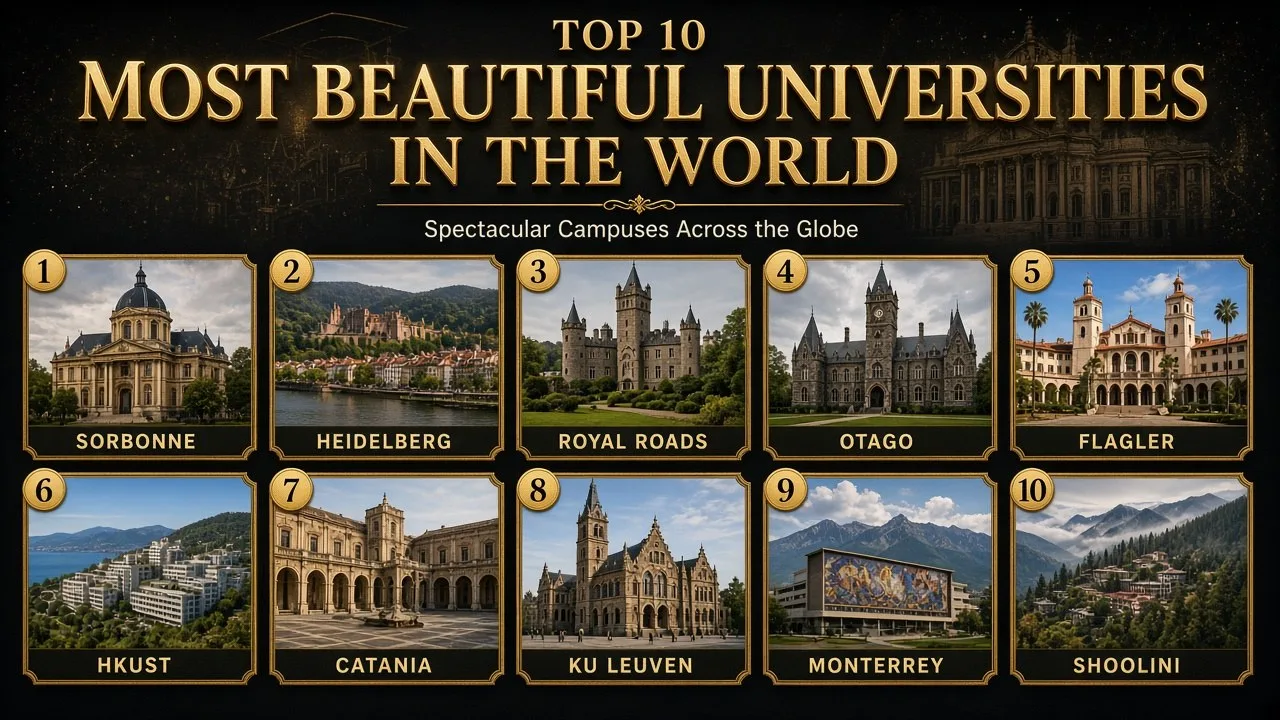
The most beautiful universities in the world pair centuries of learning with striking settings, from the Sorbonne in Paris to a castle campus in Canada.
A university campus is more than a place to attend lectures. For many students it is home for three to six years, and the buildings, courtyards and gardens around them shape how that time feels. Some campuses grew out of medieval colleges, others moved into old monasteries and grand hotels, and a few were built from scratch on hillsides above the sea.
This guide looks at ten universities whose architecture and surroundings make them stand out. For each one you will find a Quick Facts table, a short history, the features worth seeing, and a few interesting facts, all checked against university histories and encyclopaedic references.
How We Chose These Universities
This is an editorial list, not a ranking of academic quality. Beauty is subjective, so we looked for campuses that combine three things: architecture with a real story behind it, a memorable natural or urban setting, and buildings that are still in daily use for teaching and research.
The list spans eight countries and more than seven centuries of history. It includes famous old institutions, but also younger universities whose sites were chosen or designed with care. Rankings and student numbers change every year, so we mention them only where they help explain a campus.
Most Beautiful Universities at a Glance
| No. | University | Location | Founded | Standout feature |
|---|---|---|---|---|
| 1 | Sorbonne University | Paris, France | 2018 (roots in 1257) | The Sorbonne building and its domed chapel |
| 2 | Heidelberg University | Heidelberg, Germany | 1386 | Baroque Old University in a historic old town |
| 3 | Royal Roads University | Colwood, Canada | 1995 | Hatley Castle and its Edwardian gardens |
| 4 | University of Otago | Dunedin, New Zealand | 1869 | Gothic revival Clocktower complex |
| 5 | Flagler College | St. Augustine, United States | 1968 | The former Hotel Ponce de Leon |
| 6 | Hong Kong University of Science and Technology | Clear Water Bay, Hong Kong | 1991 | Seaside campus on a hillside |
| 7 | University of Catania | Catania, Italy | 1434 | The Monastery of San Nicolo l'Arena |
| 8 | KU Leuven | Leuven, Belgium | 1425 (first university) | The rebuilt University Library |
| 9 | Monterrey Institute of Technology | Monterrey, Mexico | 1943 | Jorge Gonzalez Camarena's mosaic mural |
| 10 | Shoolini University | Solan, India | 2009 | Hillside campus in the Himalayan foothills |
1. Sorbonne University
| Attribute | Details |
|---|---|
| Location | Latin Quarter, 5th arrondissement, Paris, France |
| Founded | 2018 merger; the College of Sorbonne dates from the 1250s |
| Type | Public research university |
| Famous building | The Sorbonne, rebuilt by Henri-Paul Nenot (1883 to 1901) |
| Heritage status | Chapel listed as a French historic monument in 1887 |
Origins and History
The name Sorbonne goes back to Robert de Sorbon, a chaplain to King Louis IX, who set up a college in the 1250s so that poor students could study theology without worrying about food and lodging. The king confirmed the foundation in 1257, and the college became one of the best known parts of the medieval University of Paris.
Today's Sorbonne University was formed on 1 January 2018 by merging Paris-Sorbonne University (Paris IV) and Pierre and Marie Curie University (Paris VI). It shares the historic Sorbonne building with other successors of the old University of Paris, including Paris 1 Pantheon-Sorbonne and Sorbonne Nouvelle.
Key Features
- The Sorbonne Chapel, built in 1622 under Cardinal Richelieu, then head of the college
- A main building rebuilt between 1883 and 1901 by architect Henri-Paul Nenot, giving the complex a unified look
- The Cour d'honneur, the peristyle and the Grand Amphitheatre, shared by all the successor universities
- The Sorbonne Library, which holds around 2.5 million books and was fully refurbished in 2013
Significance
Few campuses are as tied to the history of a city as the Sorbonne is to Paris. The building sits in the heart of the Latin Quarter, a short walk from the Pantheon and the Luxembourg Gardens, and its stone facades have become a symbol of French scholarship. Marie Curie studied and taught here and became the first woman to hold a professorship at the Sorbonne.
Interesting Facts
- The college library was among the first to arrange books alphabetically by title
- The whole building complex, including facades and roofs, was protected as a monument in 1975
- As of 2021, Sorbonne University said its alumni and professors had won 33 Nobel Prizes
2. Heidelberg University
| Attribute | Details |
|---|---|
| Location | Heidelberg, Baden-Wurttemberg, Germany |
| Founded | 1386 |
| Type | Public research university |
| Famous building | The baroque Old University on University Square |
| Claim to fame | Germany's oldest university |
Origins and History
Heidelberg University was founded in 1386 with the approval of Pope Urban VI, making it the oldest university in Germany and the third in the Holy Roman Empire after Prague and Vienna. It grew into a centre of humanist learning in the 16th century, but war brought hard times: its famous library, the Bibliotheca Palatina, was taken to Rome in 1622, and French troops almost completely destroyed the town in 1693.
The rebuilding that followed gave the old town much of its present look. Between 1712 and 1728 the Old University was constructed on University Square, and it remains the symbolic heart of the institution.
Key Features
- The Old University, a baroque building that houses the great hall, the university museum and the old student prison
- A setting in Heidelberg's old town below the castle ruins, one of the most visited spots in Germany
- The Faculty of Physics and Astronomy on the Philosophers' Walk, across the River Neckar
- A New Campus for the sciences and medicine, among the largest science campuses in Germany
Significance
Heidelberg is often called the cradle of German Romanticism, and the university is part of that image. Its lecture halls are spread through cobbled streets, so studying here means living inside one of Europe's best preserved historic towns. The university is also a leading research institution, with 33 Nobel Prize winners affiliated with it as of 2021.
Interesting Facts
- Students who broke the rules were once locked in the student prison, which visitors can still see
- The university library system holds roughly 6.2 million printed volumes
- It has admitted women since 1899
3. Royal Roads University
| Attribute | Details |
|---|---|
| Location | Colwood, near Victoria, British Columbia, Canada |
| Founded | 1995 (successor to Royal Roads Military College) |
| Type | Public university |
| Famous building | Hatley Castle, completed in 1908 |
| Heritage status | Hatley Park National Historic Site |
Origins and History
Royal Roads sits on the estate of James Dunsmuir, a coal magnate who served as Premier and later Lieutenant Governor of British Columbia. He and his wife Laura commissioned architect Samuel Maclure to build a 40-room mansion in the Scottish baronial style, completed in 1908, and surrounded it with formal gardens.
After the Dunsmuir family, the estate passed to the Canadian government and became a training college for naval officers in 1940, later Royal Roads Military College. When the college closed after the Cold War, the site reopened in 1995 as Royal Roads University.
Key Features
- Hatley Castle, now home to a small museum, with seasonal tours
- Japanese, Italian and rose gardens, the showcase areas of the grounds
- Trails through mature Douglas fir and western red cedar forest
- Views across the water to the Olympic Mountains in the United States
Significance
Royal Roads shows how a heritage estate can be kept alive by putting it to work. The campus covers about 260 hectares of parkland and woodland, and the university looks after the gardens and historic buildings itself. It is one of the few places where students can say their main building is a castle.
In Popular Culture
Hatley Castle has appeared in dozens of films and television shows. It played Professor Xavier's school in X-Men films starting with X2, as well as in Deadpool and Deadpool 2, and it doubled as the Luthor Mansion in Smallville and the Queen Mansion in Arrow.
Interesting Facts
- In 1940 the castle was considered as a wartime refuge for the British royal family
- The estate's contents were sold at a public auction of 927 lots in 1939
- The site became a National Historic Site of Canada in 1995
4. University of Otago
| Attribute | Details |
|---|---|
| Location | Dunedin, Otago, New Zealand |
| Founded | 1869, teaching from 1871 |
| Type | Public research collegiate university |
| Famous building | The Clocktower complex, designed by Maxwell Bury |
| Claim to fame | New Zealand's oldest university |
Origins and History
The University of Otago was created by an ordinance of the Otago Provincial Council in 1869 and opened for teaching on 5 July 1871. It first worked out of a former post office building before moving into Maxwell Bury's Clocktower and Geology buildings in 1878 and 1879.
Those buildings grew into the Clocktower complex, a group of Gothic revival buildings inspired by the main building of the University of Glasgow in Scotland. In 2024 the university also began using its Maori name, Otakou Whakaihu Waka.
Key Features
- The Clocktower complex, with its dark stone walls, pointed windows and central tower
- A compact campus at the edge of central Dunedin, a city with strong Scottish roots
- Lawns and gardens around the historic buildings
- Additional health sciences campuses in Christchurch and Wellington
Significance
Otago's Clocktower is one of the most photographed buildings in New Zealand and a symbol of the country's early commitment to higher education. The university also has a famous student culture, with students known as Scarfies because of the scarves they wear through Dunedin's cold winters.
Interesting Facts
- Students race around the Clocktower at noon, trying to finish before the chimes stop
- Graduates traditionally sing Gaudeamus igitur at graduation
- The university had a student headcount of 21,315 in 2024
5. Flagler College
| Attribute | Details |
|---|---|
| Location | St. Augustine, Florida, United States |
| Founded | 1968 |
| Type | Private liberal arts college |
| Famous building | Hotel Ponce de Leon, opened in January 1888 |
| Heritage status | U.S. National Historic Landmark since 2006 |
Origins and History
Flagler College's centrepiece was built as a luxury winter resort by Henry Flagler, the Standard Oil co-founder and railroad pioneer. The Hotel Ponce de Leon was built between 1885 and 1887 in the Spanish Colonial Revival style and opened in January 1888, the first major project of architects John Carrere and Thomas Hastings, who later designed the New York Public Library.
The college was founded in 1968 and turned the old hotel into its main hall. Today the campus covers about 49 acres in the historic centre of St. Augustine.
Key Features
- Stained glass windows by Louis Comfort Tiffany's company in the former dining room
- Ceiling paintings by Virgilio Tojetti and murals by George W. Maynard in the rotunda and dining room
- Walls of poured concrete made with local coquina shell stone
- Red tile roofs, towers and courtyards that echo Spanish architecture
Significance
The building was a technical marvel in its day. It was one of the first large buildings constructed entirely of poured concrete, and one of the first in the world wired for electricity from the start, with DC generators installed by Thomas Edison's company. Students now eat, study and live in rooms first designed for wealthy winter visitors.
Interesting Facts
- The original hotel had 540 rooms
- The building joined the US National Register of Historic Places in 1975
- Early guests were so wary of electric switches that staff were hired to turn the power on and off for them
6. Hong Kong University of Science and Technology
| Attribute | Details |
|---|---|
| Location | Clear Water Bay Peninsula, Sai Kung District, Hong Kong |
| Founded | 1991 |
| Type | Public research university |
| Campus size | About 60 hectares (150 acres) |
| Claim to fame | Hong Kong's first research university built from scratch |
Origins and History
Planning for what was then called the Third University began in 1986. The foundation stone was laid in November 1989 by the then Prince of Wales, now King Charles III, on the site of the former Kohima Barracks in Tai Po Tsai. The Royal Hong Kong Jockey Club funded much of the construction and managed the project.
The university was officially opened on 10 October 1991, and its first students arrived that same month. A second phase of building completed in 1992 added more laboratories, housing and sports facilities.
Key Features
- A seaside campus that steps down a hillside toward Clear Water Bay
- Academic buildings on the upper levels, with student halls and sports facilities closer to the water
- Wide views over the bay and the green hills of Sai Kung
- English as the main language of teaching since the start
Significance
HKUST proves that a beautiful campus does not need centuries of history. Its designers made the most of a dramatic coastal site, and the view of the sea from its terraces is one of the most memorable of any university in Asia. In a short time it has also become one of the region's leading research universities.
Interesting Facts
- It was the third institution in Hong Kong to receive university status
- The Jockey Club's pledge for the campus grew to about HK$1.9 billion
- By 1992 the campus could support about 7,000 students
7. University of Catania
| Attribute | Details |
|---|---|
| Location | Catania, Sicily, Italy |
| Founded | 19 October 1434 |
| Type | Public university |
| Famous building | The Monastery of San Nicolo l'Arena |
| Claim to fame | Sicily's oldest and largest university |
Origins and History
The University of Catania was founded by King Alfonso in 1434, with papal recognition following in 1444. Teaching began in 1445 with six professors and ten students, and the first degree was awarded in 1449. In the late 1690s the university moved to the Palazzo dell'Universita, which is still the rector's office.
Its most spectacular building came later. The Monastery of San Nicolo l'Arena, founded in 1558, was surrounded by lava in the Etna eruption of 1669 and almost destroyed in the earthquake of 1693. It was rebuilt from 1702 and donated to the university in 1977, which restored it with designs by architect Giancarlo De Carlo.
Key Features
- One of the largest Benedictine monasteries in Europe, now home to the Department of Humanities
- Cloisters and halls built on top of a bank of hardened lava
- Late baroque architecture that is part of the Val di Noto ensemble
- A historic university palace in the centre of Catania
Significance
Studying in a monastery rebuilt after a volcanic eruption and an earthquake is a rare experience. The university's buildings tell the story of a city that has been destroyed and rebuilt several times, and its restoration of San Nicolo l'Arena is a model of reusing heritage for modern teaching.
Interesting Facts
- The word Arena in the monastery's name refers to the volcanic sand of the area
- The 1669 lava flow pushed Catania's coastline out by more than a kilometre
- The university has more than 40,000 students
8. KU Leuven
| Attribute | Details |
|---|---|
| Location | Leuven, Flanders, Belgium |
| Founded | First university in Leuven founded in 1425 |
| Type | Catholic research university |
| Famous building | University Library on Ladeuzeplein (1921 to 1928) |
| Library architect | Whitney Warren |
Origins and History
The first university in Leuven was founded in 1425 by Duke John IV of Brabant and the city, which makes Leuven one of the oldest university towns in Europe. That university was abolished in 1797, and the modern Catholic University of Leuven dates from 1834. Since 1970 the French-speaking and Dutch-speaking parts have been separate institutions, with KU Leuven as the Dutch-speaking one.
The university's library has an especially dramatic history. German soldiers burned it at the start of the First World War, destroying about 230,000 books. A new library was built on Ladeuzeplein with donations from around the world, only to burn again in 1940, before being restored once more.
Key Features
- The University Library, a neo-Flemish Renaissance building designed by American architect Whitney Warren
- A tall library tower that dominates the square in front of it
- Historic colleges and university halls spread through the old town
- Cobbled streets, small squares and green spaces close to the teaching buildings
Significance
In Leuven, the university and the town are almost the same thing. Its library has become a symbol of cultural recovery after war, and its rebuilt walls are a reminder of how much international support went into replacing what was lost.
Interesting Facts
- The founding charter of 1425 was found in 1909 in a seminary in the Netherlands
- The 1914 fire destroyed about 950 manuscripts and 800 early printed books
- The restored library holds around four million books, shared between the two successor universities
9. Monterrey Institute of Technology
| Attribute | Details |
|---|---|
| Location | Monterrey, Nuevo Leon, Mexico (flagship campus) |
| Founded | 6 September 1943 |
| Type | Private research university |
| Famous artwork | Mosaic mural by Jorge Gonzalez Camarena, commissioned in 1954 |
| Network | About 35 campuses in 25 Mexican cities |
Origins and History
The Monterrey Institute of Technology and Higher Education, known as Tec de Monterrey, was founded in 1943 by a group of local business leaders led by Eugenio Garza Sada, an industrialist educated at MIT. The aim was to train engineers and managers for the city's fast-growing industries.
From the late 1960s it expanded across Mexico, and it now runs campuses in many cities. The Monterrey campus remains the flagship and the home of the system-wide administration.
Key Features
- The main administration building, decorated with an Italian mosaic mural on a relief by Jorge Gonzalez Camarena
- Green lawns and modern buildings on the flagship campus in Monterrey
- The Cervantes library, with one of the largest collections of early editions of Don Quixote
- A mountain backdrop formed by the ranges around Monterrey
Significance
Gonzalez Camarena's mural has become the visual symbol of the institution and even appears on class rings. Combined with the mountain views of Monterrey, it gives the campus a strong identity that sets it apart from the many modern campuses built in the 20th century.
Interesting Facts
- Garza Sada commissioned the mural for what is now the main administration building
- The university libraries hold more than 2.4 million books and publications
- The rare book collection includes an original edition of the French Encyclopedie
10. Shoolini University
| Attribute | Details |
|---|---|
| Location | Solan, Himachal Pradesh, India |
| Founded | 2009 |
| Type | Private university |
| Setting | Hills of the outer Himalayas, among pine forest |
| Focus | Biotechnology, management and applied sciences |
Origins and History
Shoolini University grew out of the Foundation for Life Sciences and Business Management, set up in 2004 by people from academia and industry. A first institute opened in Solan in 2005, affiliated with Himachal Pradesh University, and it became a full private university under a state act in 2009.
Solan itself takes its name from the Hindu goddess Shoolini Devi. Its campus sits on the forested hills near the town, with views over the surrounding valleys.
Key Features
- A hillside campus surrounded by pine forest in the Himalayan foothills
- Buildings arranged to follow the slopes of the site
- More than 100 laboratories and 11 centres of excellence
- Cool mountain air and views that are very different from India's big-city campuses
Significance
Shoolini shows that a young university can still have a memorable setting. In a short time it has also climbed international tables, and the Times Higher Education Impact Rankings 2025 placed it 21st in the world for affordable and clean energy.
Interesting Facts
- It holds an A+ grade from India's National Assessment and Accreditation Council
- The NIRF 2025 placed it 69th among universities in India
- Its research covers biotechnology, cancer research, nanotechnology and artificial intelligence
Comparison: Old and New Campuses
| Era | Universities on this list | What makes them beautiful |
|---|---|---|
| Medieval foundations | Sorbonne, Heidelberg, KU Leuven, Catania | Historic town settings and buildings rebuilt after war or disaster |
| 19th century | Otago | Gothic revival stone architecture |
| Reused estates and hotels | Royal Roads, Flagler College | Grand private buildings turned into teaching spaces |
| 20th and 21st century | HKUST, Tec de Monterrey, Shoolini | Dramatic natural sites, public art and modern design |
Tips for Visiting Beautiful Campuses
- Check opening times first, because many historic buildings are working university spaces with limited public access
- Look for official tours, such as those offered at Hatley Castle and Flagler College
- Visit during term breaks for quieter courtyards, but expect some buildings to be closed
- Respect lectures and exams; take photos from public areas and follow campus rules
- Combine your visit with the town around it, since the setting is often half the appeal
Frequently Asked Questions
What is the most beautiful university in the world?
There is no official answer, because beauty is subjective. Campuses that appear again and again in travel and architecture lists include the Sorbonne in Paris, Heidelberg University in Germany, KU Leuven in Belgium and Royal Roads University in Canada, thanks to their historic buildings and memorable settings.
Which university is in a real castle?
Royal Roads University in British Columbia, Canada, uses Hatley Castle as its main building. The 40-room mansion was built in the Scottish baronial style and completed in 1908 for James Dunsmuir. It has been used in many films, including several X-Men films and both Deadpool films.
What is the oldest university on this list?
The Sorbonne has the oldest roots, since its college dates from the 1250s, although today's Sorbonne University was formed in 2018. Heidelberg University, founded in 1386, is Germany's oldest university. Leuven's first university followed in 1425 and Catania's in 1434.
Can tourists visit these universities?
Most of them welcome visitors to public areas, and several offer guided tours, including Hatley Castle at Royal Roads and the historic hotel at Flagler College. Some buildings, such as the Sorbonne, restrict access to students and staff, so it is best to check official visitor information before going.
Which beautiful university was once a hotel?
Flagler College in St. Augustine, Florida, occupies the former Hotel Ponce de Leon, a luxury resort built by Henry Flagler that opened in 1888. It was one of the first buildings in the world wired for electricity from the start, and it has Tiffany stained glass windows.
Does a beautiful campus mean a better education?
Not necessarily. A campus can make student life more pleasant and inspiring, but students should also look at courses, teaching quality, costs, location and career support. The best choice is the university that fits a student's goals, with a beautiful setting as a welcome bonus.
Conclusion
The most beautiful universities in the world show that learning spaces can be works of art. Some, like the Sorbonne, Heidelberg and Leuven, carry centuries of history in their stones. Others, like Royal Roads, Flagler College and the University of Catania, found new life in castles, hotels and monasteries. Younger campuses in Hong Kong, Monterrey and the Himalayan foothills prove that thoughtful design and a striking site can be just as inspiring.
For more lists like this one, explore our Top 10 Facts collection on Finepedia, or browse more articles on architecture from around the world.
- Sorbonne University, official history and Sorbonne building heritage records
- Heidelberg University, university history and Old University information
- Royal Roads University and Hatley Park National Historic Site visitor information
- University of Otago, history of the university and the Clocktower complex
- Flagler College, history of the Hotel Ponce de Leon; US National Park Service, National Historic Landmark records
- Hong Kong University of Science and Technology, university history
- University of Catania, history of the university and the Monastery of San Nicolo l'Arena
- KU Leuven and University Library Leuven, history of the library
- Tecnologico de Monterrey, history of the institute
- Shoolini University; Times Higher Education Impact Rankings 2025; NIRF 2025
- Encyclopaedic overviews of each university, used to cross-check dates and figures



















Log in with