






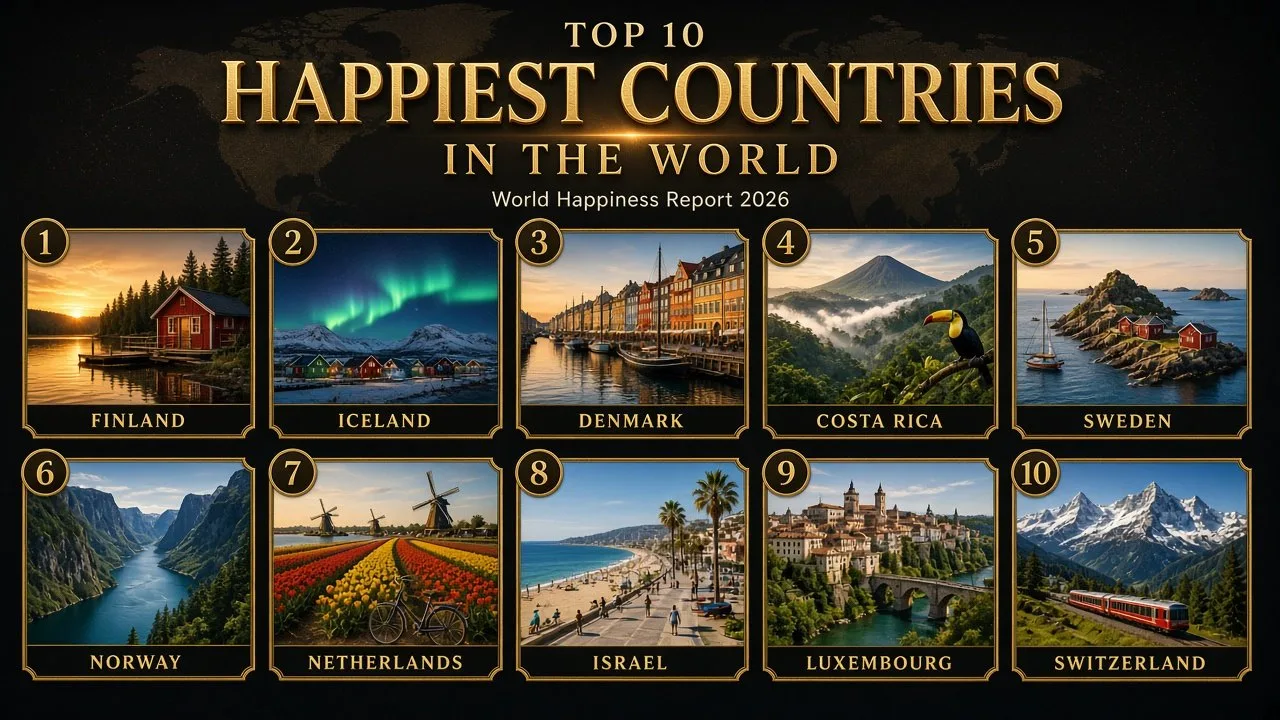
The happiest countries in the world in 2026 are led by Finland, Iceland, Denmark and Costa Rica, according to the latest World Happiness Report rankings.
Every March, the World Happiness Report asks a simple question of people in more than 140 countries: on a ladder from 0 to 10, where would you place your life right now? The answers, collected by Gallup and analysed by researchers at the University of Oxford's Wellbeing Research Centre and the UN Sustainable Development Solutions Network, produce the most widely quoted league table of national wellbeing on the planet.
The 2026 edition, published on 19 March 2026, ranks 147 countries. Finland takes first place for a record ninth year in a row, the Nordic countries again fill most of the top spots, and Costa Rica climbs to fourth, the highest position a Latin American country has ever reached. Switzerland returns to the top 10 after a year away, while Mexico slips out of it.
This guide walks through the 10 happiest countries in the world, what their scores mean, which strengths lift each one up, and what the rankings can and cannot tell us about a good life.
How the World Happiness Report Ranks Countries
The ranking is not based on a formula of wealth, health or crime statistics. It rests on what ordinary people say about their own lives. Gallup World Poll interviewers ask nationally representative samples of adults aged 15 and over to imagine a ladder, with the best possible life for them at the top (10) and the worst possible life at the bottom (0), and to say which step they stand on today. Researchers call this the Cantril Ladder.
To smooth out one-off swings, each country's score is a three-year average. The 2026 rankings use surveys from 2023, 2024 and 2025.
The report then estimates how much of each country's score can be explained by six factors that consistently go hand in hand with happiness:
- GDP per capita: average income, adjusted for living costs.
- Social support: whether people have relatives or friends they can count on in times of trouble.
- Healthy life expectancy: how many years people can expect to live in good health.
- Freedom to make life choices: whether people feel free to choose what to do with their lives.
- Generosity: how common it is to donate to charity, after allowing for income.
- Perceptions of corruption: how widespread people believe corruption is in government and business.
According to the report, these six variables together explain more than three-quarters of the differences in average life evaluations between countries. They are used to explain the rankings, not to calculate them. A country can score higher or lower than its six factors predict, and that unexplained part matters, as Costa Rica shows.
The 10 Happiest Countries in the World at a Glance
| Rank | Country | Life Evaluation (0–10) | Rank in 2025 Report | Movement |
|---|---|---|---|---|
| 1 | Finland | 7.764 | 1 | No change |
| 2 | Iceland | 7.540 | 3 | Up 1 |
| 3 | Denmark | 7.539 | 2 | Down 1 |
| 4 | Costa Rica | 7.439 | 6 | Up 2 |
| 5 | Sweden | 7.255 | 4 | Down 1 |
| 6 | Norway | 7.242 | 7 | Up 1 |
| 7 | Netherlands | 7.223 | 5 | Down 2 |
| 8 | Israel | 7.187 | 8 | No change |
| 9 | Luxembourg | 7.063 | 9 | No change |
| 10 | Switzerland | 7.018 | 13 | Up 3 |
Scores come from the World Happiness Report 2026 (survey years 2023–2025). The report itself warns that the gaps near the top are small: Iceland, Denmark and Costa Rica are statistically a group of three, and only Finland is clearly ahead of everyone else.
1. Finland
| Attribute | Details |
|---|---|
| 2026 rank | 1st of 147 |
| Life evaluation | 7.764 out of 10 |
| Years at number one | 9 in a row (2018–2026) |
| Strongest factors | Freedom, low perceived corruption, social support |
| Lead over second place | 0.224 points |
Why Finland Ranks First
Finland is the only country the report places in a group of its own at the top. Its average score of 7.764 is the highest recorded in the 2026 edition, and its lead over Iceland is more than twice the gap between second and fourth place.
Finland is not the richest country in the top 10. What sets it apart is trust. Its score for perceptions of corruption contributes more to its happiness than in any other top-10 country, and Finns also rate their freedom to make life choices and their social support networks very highly. In daily life that shows up as reliable public services, safe streets and a widespread belief that institutions, and other people, will treat you fairly.
Key Strengths
- Very low perceived corruption, the strongest result in the top 10 on this measure.
- Freedom to make life choices tied with Iceland for the highest score in the top 10.
- Strong social support and a high healthy life expectancy.
- Second place in the World Economic Forum's 2025 Global Gender Gap Index.
Interesting Facts
- Finland was 7th in the 2013 report before rising to the top in 2018 and staying there ever since.
- Finnish sauna culture was added to UNESCO's list of the Intangible Cultural Heritage of Humanity in December 2020.
- The country has around 188,000 lakes, and the everyman's right lets anyone walk, camp and pick berries in most forests.
- The 2026 score of 7.764 is slightly higher than Finland's 7.736 in the 2025 report.
2. Iceland
| Attribute | Details |
|---|---|
| 2026 rank | 2nd |
| Life evaluation | 7.540 out of 10 |
| Rank in 2025 report | 3rd |
| Strongest factors | Social support, freedom, generosity |
| Population | Fewer than 400,000 |
Why Iceland Ranks Second
Iceland moves up one place to second, equalling its best-ever ranking, which it first reached in the 2015 report. Its lead over Denmark is just 0.001 points, so the two are effectively tied.
No country in the top 10 gets more from social support than Iceland. In a small island nation where families and communities are tightly linked, almost everyone reports having someone to rely on when things go wrong. Iceland also records the highest generosity contribution in the top 10 and matches Finland on freedom to make life choices.
Key Strengths
- The strongest social support score in the top 10.
- The highest generosity contribution among the 10 happiest countries.
- A very high healthy life expectancy.
- Most peaceful country in the world on the Global Peace Index, a title it has held since 2008.
Interesting Facts
- Iceland has led the World Economic Forum's Global Gender Gap Index for 16 years in a row, closing 92.6% of its gender gap in the 2025 edition.
- It climbed from 9th in the 2013 report to 2nd in 2026, one of the biggest rises among long-standing top-10 countries.
- Iceland has no standing army of its own.
- Its perceived-corruption score is noticeably weaker than those of the other Nordic countries, yet it still ranks second overall.
3. Denmark
| Attribute | Details |
|---|---|
| 2026 rank | 3rd |
| Life evaluation | 7.539 out of 10 |
| Rank in 2025 report | 2nd |
| Times ranked first | 3 (2012, 2013 and 2016) |
| Strongest factors | Income, low perceived corruption, social support |
Why Denmark Ranks Third
Denmark slips one place to third, its first finish outside the top two since 2018, but its score of 7.539 is actually higher than last year's 7.521. It simply lost a photo finish with Iceland.
Danes combine high incomes with strong trust in each other and in public institutions. Denmark ranked first on Transparency International's Corruption Perceptions Index for 2024, and its perceived-corruption contribution in the happiness report is second only to Finland's among the top 10. A generous welfare state, free healthcare and education, and a culture that values work-life balance all feed into how Danes rate their lives.
Key Strengths
- High GDP per capita combined with low inequality.
- Very low perceived corruption.
- Strong social support and freedom to make life choices.
- A long record at the top: Denmark has never ranked lower than 3rd since the 2013 report.
Interesting Facts
- Denmark topped the first World Happiness Report in 2012.
- The Danish word hygge, a feeling of cosy, relaxed togetherness, became an international lifestyle trend in the 2010s.
- Copenhagen is famous for cycling, with dedicated bike lanes on most major streets.
- Denmark, Iceland and Costa Rica are statistically a group of three in 2026, all within 0.11 points of each other.
4. Costa Rica
| Attribute | Details |
|---|---|
| 2026 rank | 4th |
| Life evaluation | 7.439 out of 10 |
| Rank in 2025 report | 6th |
| Lowest recent rank | 23rd (2022 and 2023 reports) |
| Record | Highest rank ever for a Latin American country |
Why Costa Rica Ranks Fourth
Costa Rica is the standout story of 2026. After falling to 23rd in the 2022 and 2023 reports, it climbed to 12th in 2024, 6th in 2025 and now 4th, entering the top five for the first time. It is the first Latin American country ever to rank this high.
What makes Costa Rica remarkable is that its six measured factors do not explain its happiness. It has the lowest income contribution and the weakest perceived-corruption score in the top 10, yet Costa Ricans rate their lives higher than people in Sweden, Norway or Switzerland. The part of its score left unexplained by the six factors is the largest in the top 10, which researchers often link to strong family ties, close communities and a relaxed, outdoor way of life summed up in the national saying pura vida.
Key Strengths
- Freedom to make life choices almost level with Finland and Iceland.
- Strong social support, especially from family.
- Far happier than its income alone would predict.
- A steady four-year rise from 23rd to 4th.
Interesting Facts
- Costa Rica abolished its army in 1948, a decision written into its 1949 constitution, and redirected spending towards health and education.
- It generates almost all of its electricity from renewable sources such as hydropower, geothermal and wind.
- The Nicoya Peninsula is one of the world's Blue Zones, regions known for unusually long-lived residents.
- In the 2013 report, Costa Rica was already 12th, ahead of New Zealand and the United States.
5. Sweden
| Attribute | Details |
|---|---|
| 2026 rank | 5th |
| Life evaluation | 7.255 out of 10 |
| Rank in 2025 report | 4th |
| Best rank | 4th (2024 and 2025 reports) |
| Strongest factors | Healthy life expectancy, income, social support |
Why Sweden Ranks Fifth
Sweden drops one place to fifth after two years in fourth, and its score dipped from 7.345 to 7.255. It still sits comfortably in the top group, as it has in every edition since the three-year rankings began.
Sweden has the highest healthy life expectancy contribution of any country in the top 10, reflecting long, healthy lives backed by universal healthcare. High incomes, low perceived corruption and a dependable social safety net add to the picture, along with family policies that are among the most generous in the world.
Key Strengths
- The strongest healthy life expectancy result in the top 10.
- High income and low perceived corruption.
- Strong social support and freedom.
- Policies that support work-life balance, including a legal minimum of 25 days of paid annual leave.
Interesting Facts
- Swedish parents share 480 days of paid parental leave for each child.
- Allemansrätten, the right of public access, lets people roam, swim and camp on most land, including privately owned countryside.
- Sweden has ranked in the top 10 of the Global Gender Gap Index in every edition since 2006.
- It was 5th in the 2013 report, exactly where it stands in 2026.
6. Norway
| Attribute | Details |
|---|---|
| 2026 rank | 6th |
| Life evaluation | 7.242 out of 10 |
| Rank in 2025 report | 7th |
| Times ranked first | 1 (2017) |
| Strongest factors | Income, social support, freedom |
Why Norway Ranks Sixth
Norway climbs one place to sixth. It topped the whole ranking in 2017 and then drifted down to eighth by 2022, so this marks a modest recovery for one of the report's most consistent performers.
Norway has the second-highest income contribution in the top 10, backed by oil and gas wealth that has been carefully saved rather than spent. That money sits in the Government Pension Fund Global, one of the world's largest sovereign wealth funds, which helps keep public finances secure for future generations. Norwegians also report strong social support and plenty of freedom over their own lives.
Key Strengths
- Very high GDP per capita.
- Strong social support and freedom to make life choices.
- Low perceived corruption.
- High healthy life expectancy.
Interesting Facts
- Norway was 2nd in the 2013 report and 1st in 2017.
- The Norwegian idea of friluftsliv, spending time in the open air, is a central part of national life.
- Norway ranked 3rd in the 2025 Global Gender Gap Index.
- It has appeared in the top 10 of every World Happiness Report.
7. Netherlands
| Attribute | Details |
|---|---|
| 2026 rank | 7th |
| Life evaluation | 7.223 out of 10 |
| Rank in 2025 report | 5th |
| Best rank | 4th (2013 report) |
| Strongest factors | Income, social support, generosity |
Why the Netherlands Ranks Seventh
The Netherlands falls two places to seventh, with its score easing from 7.306 to 7.223. Even so, it has never ranked lower than seventh since the 2013 report, making it the most consistent non-Nordic country on the list.
The Dutch combine high incomes with strong social networks and a relatively high level of generosity. Its happiness is also widely shared. A flexible labour market lets many people choose how much they work: according to Eurostat, the Netherlands has the highest share of part-time workers in the European Union.
Key Strengths
- High GDP per capita and strong social support.
- One of the highest generosity contributions in the top 10.
- Low perceived corruption.
- Long-term stability, never below seventh place since 2013.
Interesting Facts
- Cycling is so common that the Netherlands is often said to have more bicycles than people.
- Its freedom score is a little lower than the Nordic countries' but still high by world standards.
- The Netherlands placed 14th on the 2025 Global Peace Index.
- It was 4th in 2013, its best result in the three-year rankings.
8. Israel
| Attribute | Details |
|---|---|
| 2026 rank | 8th |
| Life evaluation | 7.187 out of 10 |
| Rank in 2025 report | 8th |
| Best rank | 4th (2023 report) |
| Strongest factors | Social support, income, healthy life expectancy |
Why Israel Ranks Eighth
Israel holds eighth place for a second year running and has now been in the top 10 for five consecutive editions. Its score of 7.187 is a little below last year's 7.234.
Israel's results lean heavily on social support, which is almost as strong as in the Nordic countries, along with high incomes and a long healthy life expectancy. Like Costa Rica, it scores higher than its six factors predict. Its weakest measured factor is freedom to make life choices, which is the lowest in the top 10. Because the rankings use three-year averages and surveys taken at different times, the report cautions that the effects of major events on any single country's score can be muted or delayed.
Key Strengths
- Strong social support and close family networks.
- High healthy life expectancy.
- High income levels.
- A large positive gap between its actual score and what the six factors predict.
Interesting Facts
- Israel ranked 11th in the 2013 report and has been in the top 10 every year since 2022.
- It is one of only two countries in the 2026 top 10 from outside Europe, alongside Costa Rica.
- Its best result was 4th place in the 2023 report.
- The report notes that, in 2013, the top 10 was entirely made up of Western industrial countries; Israel and Costa Rica are the two exceptions in 2026.
9. Luxembourg
| Attribute | Details |
|---|---|
| 2026 rank | 9th |
| Life evaluation | 7.063 out of 10 |
| Rank in 2025 report | 9th |
| Best rank | 6th (2022 report) |
| Strongest factors | Income, healthy life expectancy, freedom |
Why Luxembourg Ranks Ninth
Luxembourg stays in ninth place and has now been in the top 10 for seven editions in a row, after ranking in the high teens through most of the 2010s.
No country in the top 10 gets a bigger boost from income than Luxembourg, one of the richest countries in the world per person. It also scores well on healthy life expectancy and freedom. Its score is, however, closer to what those factors predict than most of its neighbours on the list, suggesting money explains a larger share of Luxembourgers' wellbeing.
Key Strengths
- The highest GDP per capita contribution in the top 10.
- High healthy life expectancy.
- Strong freedom to make life choices.
- Low perceived corruption.
Interesting Facts
- On 1 March 2020, Luxembourg became the first country in the world to make all standard-class public transport free nationwide.
- The country has three administrative languages: Luxembourgish, French and German.
- Its population is under 700,000, and tens of thousands of workers cross the border from neighbouring countries every day.
- Luxembourg rose from 17th in 2015 to 9th in 2026.
10. Switzerland
| Attribute | Details |
|---|---|
| 2026 rank | 10th |
| Life evaluation | 7.018 out of 10 |
| Rank in 2025 report | 13th |
| Times ranked first | 1 (2015) |
| Strongest factors | Income, healthy life expectancy, low perceived corruption |
Why Switzerland Ranks Tenth
Switzerland returns to the top 10 after a one-year absence, climbing from 13th to 10th. It was the happiest country in the world in the 2015 report and spent most of the next decade in the top five before a gradual slide.
The Swiss benefit from high incomes, one of the longest healthy life expectancies anywhere and strong trust in public institutions. Its system of direct democracy, in which citizens vote on national issues on several fixed voting days each year, gives people an unusual degree of say over how the country is run.
Key Strengths
- The third-highest income contribution in the top 10, behind Luxembourg and Norway.
- Healthy life expectancy almost level with Sweden's.
- Low perceived corruption.
- Strong freedom to make life choices.
Interesting Facts
- Switzerland was 3rd in the 2013 report and 1st in 2015.
- It ranked 5th on the 2025 Global Peace Index.
- Its return to the top 10 pushed Mexico, last year's 10th, down to 12th.
- The report found that youth happiness in Switzerland has fallen sharply since 2006–2010, one of the largest youth declines among the 136 countries compared.
What the Six Factors Show
The table below shows the report's estimate of how much each factor adds to each country's score, compared with an imaginary worst-off country it calls Dystopia. Higher numbers mean a bigger contribution.
| Country | Income | Social Support | Healthy Life | Freedom | Generosity | Low Corruption |
|---|---|---|---|---|---|---|
| Finland | 1.915 | 1.638 | 0.939 | 1.105 | 0.093 | 0.491 |
| Iceland | 1.971 | 1.720 | 0.996 | 1.105 | 0.187 | 0.187 |
| Denmark | 1.986 | 1.633 | 0.930 | 1.081 | 0.125 | 0.474 |
| Costa Rica | 1.697 | 1.483 | 0.739 | 1.101 | 0.059 | 0.122 |
| Sweden | 1.950 | 1.570 | 1.027 | 1.070 | 0.149 | 0.447 |
| Norway | 2.057 | 1.626 | 0.983 | 1.092 | 0.157 | 0.413 |
| Netherlands | 1.983 | 1.539 | 0.922 | 1.000 | 0.175 | 0.349 |
| Israel | 1.867 | 1.606 | 0.925 | 0.863 | 0.139 | 0.196 |
| Luxembourg | 2.162 | 1.465 | 0.981 | 1.056 | 0.111 | 0.382 |
| Switzerland | 2.028 | 1.534 | 1.017 | 1.035 | 0.148 | 0.452 |
A few patterns stand out:
- Money matters, but not most. Luxembourg has the biggest income contribution yet ranks ninth, while Costa Rica has the smallest and ranks fourth.
- Social support is the great leveller. Every top-10 country scores strongly on having someone to count on, and Iceland leads them all.
- Trust separates the leaders. Finland and Denmark, two of the top three, have the strongest low-corruption scores.
- Freedom is high almost everywhere at the top, with Israel the only country noticeably below the rest.
Who Missed the Top 10
Several familiar names sit just outside. New Zealand is 11th (6.995), Mexico 12th (6.972), Ireland 13th, Belgium 14th and Australia 15th. The report notes that, for the second year in a row, none of the large English-speaking countries made the top 10: the United States is 23rd, Canada 25th and the United Kingdom 29th.
Central and Eastern Europe continues to rise. Kosovo (16th), Slovenia (18th) and Czechia (20th) are now in the top 20, part of a long-running convergence between happiness levels in Eastern and Western Europe.
India ranks 116th of 147 with a score of 4.536, up from 118th in the 2025 report. At the bottom, Afghanistan is 147th with an average of just 1.446, more than six points below Finland.
Why Nordic Countries Keep Winning
Five Nordic countries, Finland, Iceland, Denmark, Sweden and Norway, fill five of the top six places in 2026. The report notes that, as a group, their average rank has improved from 4.8 in 2013 to 3.4 in 2026.
Researchers point to a shared mix rather than any single secret:
- High trust in government and in fellow citizens.
- Welfare systems that protect people from the worst effects of illness, unemployment and old age.
- Low inequality, so prosperity is widely shared.
- A strong sense of personal freedom combined with community support.
Notably, Nordic happiness is not about constant cheerfulness. The ladder question measures how satisfied people are with their lives overall, not how often they smile, which is why famously reserved societies can top the chart.
Frequently Asked Questions
Which is the happiest country in the world in 2026?
Finland is the happiest country in the world in 2026, according to the World Happiness Report. It scored 7.764 out of 10 on average and has now ranked first for nine years in a row, from 2018 to 2026. Iceland and Denmark follow in second and third place, effectively tied.
How is the World Happiness Report calculated?
The ranking is based on Gallup World Poll surveys in which adults rate their own lives on a ladder from 0 to 10. Each country's score is a three-year average, with 2023 to 2025 used for the 2026 report. Six factors, including income and social support, are used to explain the scores, not to calculate them.
Where does India rank in the World Happiness Report 2026?
India ranks 116th out of 147 countries in the 2026 report, with an average life evaluation of 4.536 out of 10. That is a small improvement on the 2025 report, when India was 118th with a score of 4.389.
Why is Costa Rica so high in the happiness rankings?
Costa Rica ranks fourth even though it has the lowest income in the top 10. Its six measured factors explain less of its score than for any other top-10 country. Strong family and community ties, a high sense of freedom and the relaxed pura vida lifestyle are commonly cited reasons for this extra happiness.
Where does the United States rank in 2026?
The United States ranks 23rd in the World Happiness Report 2026, with a score of 6.816. It was 17th in the 2013 report. Gallup and the report's authors say much of the decline comes from lower life evaluations among young adults, a pattern also seen in Canada, Australia and New Zealand.
Which is the least happy country in the world?
Afghanistan is the least happy country in the 2026 report, ranked 147th with an average score of 1.446 out of 10. The report notes that life is especially hard for Afghan women, whose average life satisfaction is only 1.26. Most countries near the bottom are in or near zones of major conflict.
Does money make a country happy?
Money helps, but it is not the whole story. Income is one of six factors linked to happiness, alongside social support, health, freedom, generosity and trust. Luxembourg is the richest country in the top 10 but ranks ninth, while Costa Rica ranks fourth with far lower incomes.
Conclusion
The 10 happiest countries in the world in 2026 share more than high incomes. Finland, Iceland, Denmark and the rest of the list combine trust in institutions, strong social support, long healthy lives and a real sense of freedom, and Costa Rica proves that warm communities can outweigh a smaller pay packet.
The rankings move slowly at the top, but they do move. Costa Rica's rise, Switzerland's return and the steady climb of Central and Eastern European countries show that national wellbeing can improve, and the falling happiness of young people in some rich countries shows it can slip too. The next World Happiness Report is expected in March 2027.
- Helliwell, J. F., Layard, R., Sachs, J. D., De Neve, J.-E., Aknin, L. B. and Wang, S. (Eds.), World Happiness Report 2026, University of Oxford Wellbeing Research Centre, Chapter 2 and Data for Figure 2.1.
- Gallup, "Happiness Rankings Show Stability and Change", 2026.
- University of Oxford, "World Happiness Report 2026 shows a complex global picture of social media and happiness", 19 March 2026.
- Institute for Economics and Peace, Global Peace Index 2025.
- World Economic Forum, Global Gender Gap Report 2025.
- Government of Luxembourg, Transports.lu, "Free mobility from 1 March 2020".
- UNESCO, Memory of the World: Abolition of the Army in Costa Rica.
- Topic reference: 10mosttoday.com, 10 Happiest Countries in the World.












Log in with