






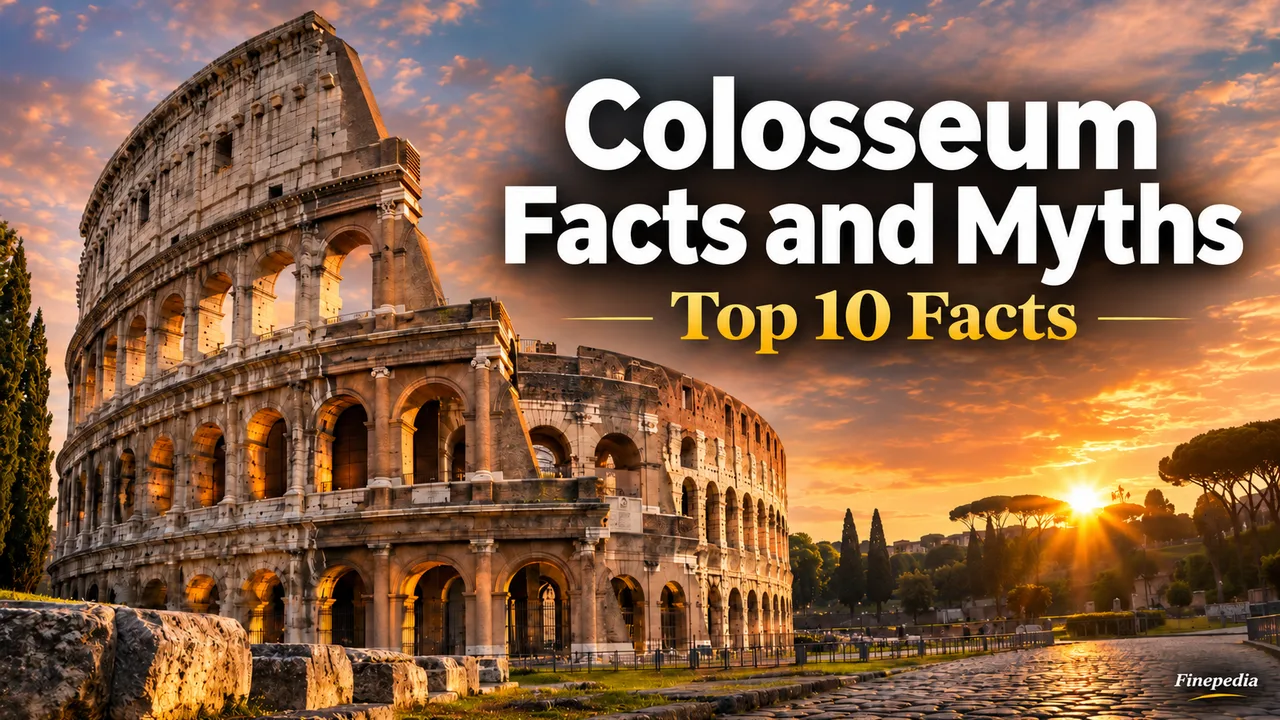
The Colosseum is one of the most recognisable buildings on Earth. Nearly two thousand years after it opened, the great ruined amphitheatre in the centre of Rome still draws millions of visitors every year. Yet much of what people believe about it comes from later legends, paintings and Hollywood films rather than from the stones themselves or the ancient writers who saw it in use.
This Finepedia list brings together the top 10 Colosseum facts and myths. Each entry explains a feature of the building or a popular belief about it, from its original name and the sailors who worked its awning to the famous thumbs-down gesture and the story of Christian martyrs in the arena.
The entries draw on the surviving architecture, ancient Roman authors and modern archaeological research. Together they show that the real Colosseum was a sophisticated public venue and a working machine for spectacle, with a long and surprising life after the games ended.
Key Facts
The table below sums up all 10 entries on this list, with whether each is a fact or a myth and the evidence behind it.
The 10 Colosseum Facts and Myths at a Glance
| No. | Entry | Type | What the evidence shows |
|---|---|---|---|
| 1 | Its ancient name was the Flavian Amphitheatre | Fact | "Colosseum" came later, probably from a nearby statue |
| 2 | It opened in 80 AD | Fact | Begun under Vespasian, finished under Titus |
| 3 | Seating followed Roman rank | Fact | Senators sat closest, women and the poor highest up |
| 4 | Sailors worked the awning | Fact | Crews from the fleet at Misenum rigged the velarium |
| 5 | The underground was a stage machine | Fact | Tunnels, lifts and trapdoors fed the arena |
| 6 | Women never fought in the arena | Myth | Female fighters were rare but recorded |
| 7 | Thumbs down meant death | Myth | The real gesture is uncertain |
| 8 | A vomitorium was a room for vomiting | Myth | It was an exit passage |
| 9 | Every gladiator fight ended in death | Myth | Many bouts ended with the loser spared |
| 10 | The Colosseum was simply abandoned | Myth | It became housing, a fortress, a quarry and a shrine |
1. Its Ancient Name Was the Flavian Amphitheatre
The Romans did not call the building the Colosseum. Its original name was the Amphitheatrum Flavium, or Flavian Amphitheatre, after the Flavian dynasty of emperors who built it: Vespasian and his sons Titus and Domitian.[1]
The name Colosseum is believed to come from a colossal bronze statue of Nero that stood nearby. By around the year 1000, the Latin name Colosseum had come into use for the amphitheatre itself.[1] The name stuck so firmly that it is now used for the building in almost every language.
The site itself carried a political message. The amphitheatre was built on land that had been part of Nero's vast private palace, the Domus Aurea, where an artificial lake was drained and filled in.[1] By turning a tyrant's private grounds into a public entertainment venue, the Flavians presented themselves as rulers who gave Rome back to its people.
2. The Amphitheatre Opened in 80 AD
Construction began under Vespasian around 70 to 72 AD, funded in part by spoils from the Jewish Temple taken after the siege of Jerusalem in 70 AD.[1] Vespasian died in 79 AD before the building was complete.
His son Titus opened the amphitheatre in 80 AD with lavish inaugural games that, according to ancient writers, lasted 100 days and included gladiator fights and animal hunts.[1] Titus's brother Domitian later added further features, including the underground structures beneath the arena floor.
The Colosseum was built of travertine limestone, tuff and Roman concrete, with brick-faced walls and wooden structures. It is the largest amphitheatre ever built, measuring about 189 by 156 metres, and it remains the largest standing amphitheatre in the world.[1]
3. The Seating Plan Reflected Roman Rank
The Colosseum could hold an estimated 50,000 to 80,000 spectators at different points in its history.[1] Entry was free, but where people sat was strictly controlled by law and custom.
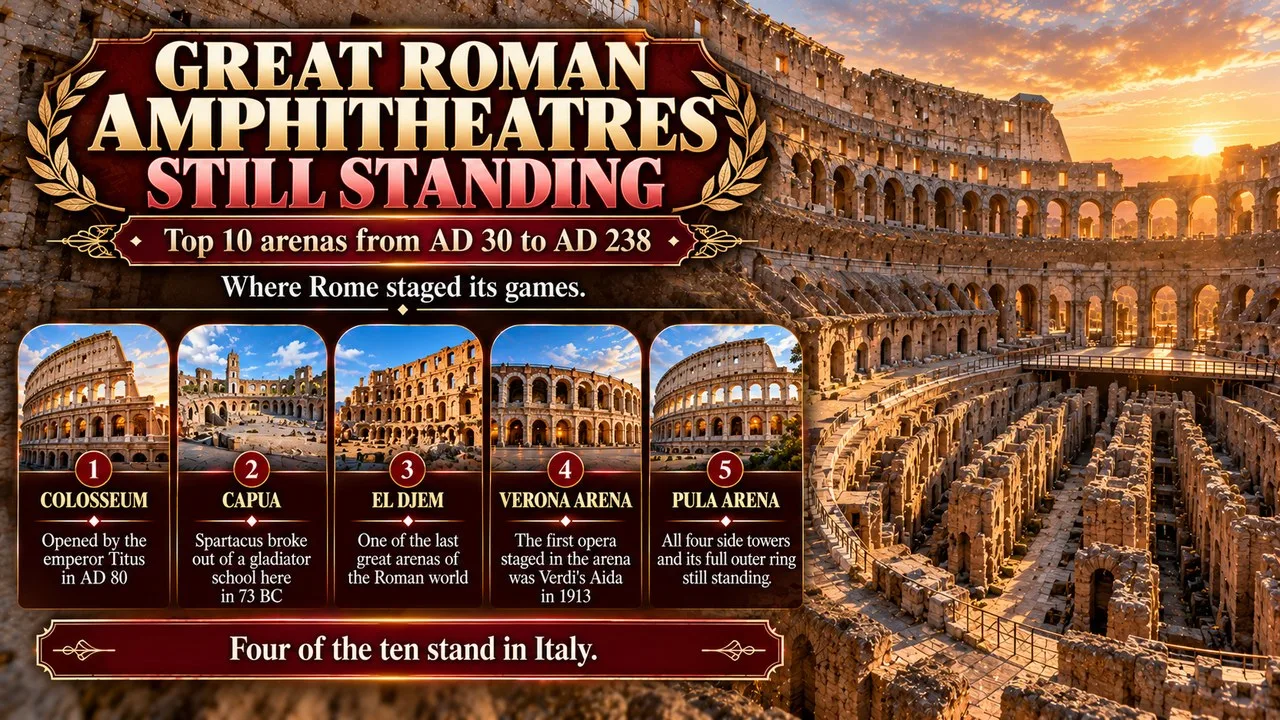
Related: Top 10 Great Roman Amphitheatres Still Standing
The emperor and senators had the best places on a broad terrace close to the arena, called the podium. Above them sat members of the equestrian order, then ordinary male citizens, with poorer citizens, slaves and women placed in the highest tiers.[1] Some sections were reserved for particular groups, such as soldiers, priests or foreign dignitaries.
A system of numbered entrances and staircases helped move these crowds efficiently. Spectators carried tokens that pointed them to the right entrance and section, so that tens of thousands of people could find their seats in a short time.[1] The building was as much a model of Roman social order as a place of entertainment.
4. Sailors Helped Operate the Awning
To protect spectators from the sun and rain, the Colosseum had a huge retractable awning called the velarium. It was a canvas-covered, net-like structure of ropes with a hole in the centre, supported by 240 masts fitted around the top of the outer wall.[1]
Ancient awnings of this kind were used in many Roman theatres and amphitheatres. At the Colosseum it covered a large part of the seating and sloped toward the centre to catch the wind and create a cooling breeze.[2] Rigging such a vast system required skilled crews, so sailors were specially enlisted from the Roman naval headquarters at Misenum and from a detachment based in Rome.[1]
The use of naval expertise shows how much practical engineering went into running the building. Handling ropes, sails and pulleys was everyday work for sailors, and their skills turned the amphitheatre into a more comfortable venue on hot Roman afternoons. Announcements of games sometimes promised spectators that the awnings would be in use, a sign of how much the comfort mattered.[2]
5. The Underground Was a Working Stage
Beneath the arena floor lay the hypogeum, a two-level network of tunnels and chambers where animals, gladiators and scenery waited before shows.[1] It was added under Domitian and is clearly visible to visitors today because the original wooden floor has gone.
Lifts and pulleys, operated by teams of workers, raised animals and stage sets through trapdoors into the arena, allowing sudden appearances that surprised the crowd.[1] Some scenes were elaborate, with artificial landscapes of trees and hills appearing from below.
Related: Top 10 Ancient Rome Myths and What the Evidence Shows
Ancient writers say that the arena was flooded for mock naval battles in the early years, before the hypogeum was built. Historians still debate how often this happened and how it worked, but the later underground system would have made flooding impossible.[1]
6. Myth: Women Never Fought in the Arena
Most gladiators were men, but female fighters did appear in Roman games. Ancient writers mention them, and a few inscriptions and a relief from Halicarnassus show women fighting as gladiators.[3]
Female gladiators were always rare and were treated as an exotic novelty. They were officially banned as unseemly from 200 AD onwards, during the reign of Septimius Severus.[3] Women were also present as spectators, though usually in the upper seats.
Modern scholars use the term gladiatrix for these fighters, though the Romans did not commonly use the word. The limited evidence makes it hard to know how often women fought in the Colosseum itself, as opposed to other venues.[3]
7. Myth: Thumbs Down Always Meant Death
Films often show the crowd or emperor turning thumbs down to order a defeated gladiator's death. Roman writers do mention a gesture called pollice verso, meaning "with a turned thumb", but they never describe exactly what it looked like.[4]
The modern thumbs-down image owes much to the French painter Jean-Léon Gérôme, whose painting Pollice Verso of 1872 showed Vestal Virgins signalling death with their thumbs pointed down.[4] The painting was hugely popular and shaped later films, including the 2000 movie Gladiator.
Historians have suggested other possibilities, such as a thumb pointed toward the chest, a thumb raised, or a closed fist with the thumb hidden for mercy. The true gestures remain uncertain, and they may have varied over time and place.[4]
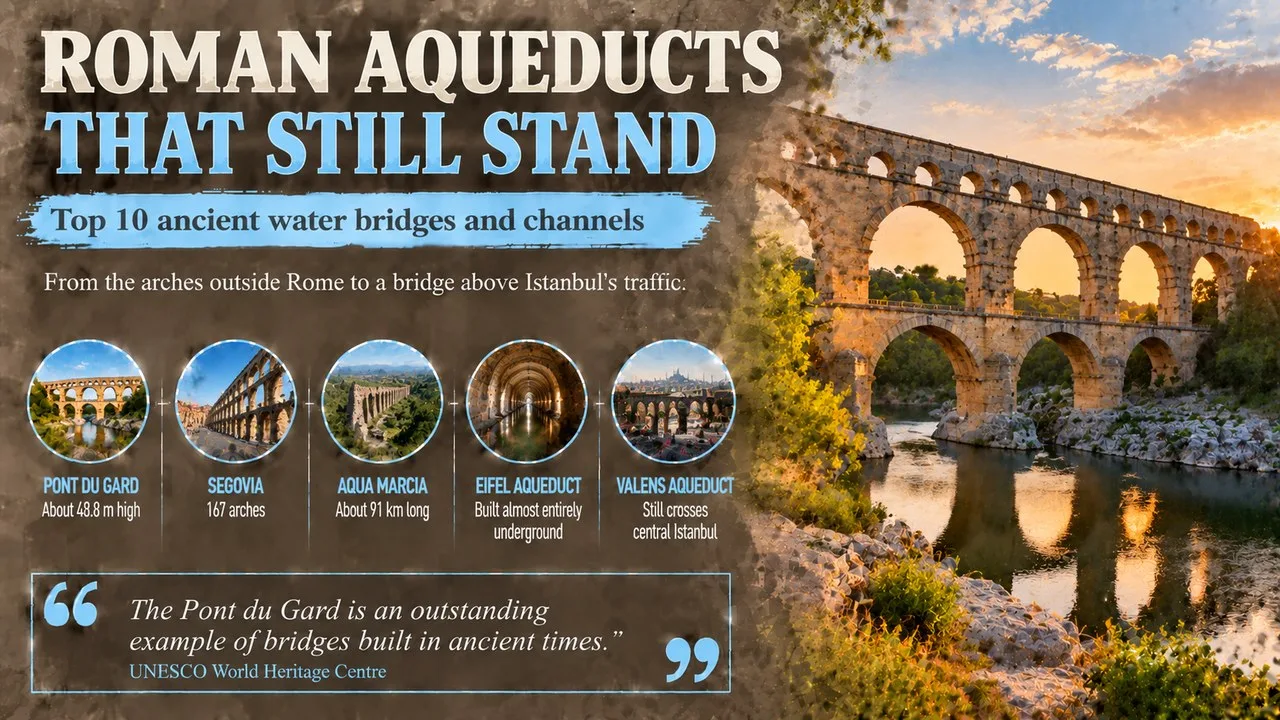
Related: Top 10 Roman Aqueducts That Still Stand
8. Myth: A Vomitorium Was a Room for Vomiting
A popular myth claims that Romans used rooms called vomitoria to throw up during feasts so they could keep eating. In fact, a vomitorium was a passageway that allowed crowds to exit a theatre or amphitheatre quickly.[5]
The word comes from the Latin verb vomere, "to spew forth", describing the way the passages poured spectators out of the building at the end of a show.[5] The Colosseum had many such exits, which helped it empty in minutes.
The misunderstanding seems to date from the 19th and 20th centuries, when writers mixed the word with stories of Roman excess.[5] There is no evidence that Romans had special rooms for vomiting at banquets.
9. Myth: Every Gladiator Fight Ended in Death
Gladiators were valuable. They were trained at schools, fed and given medical care, and their owners or sponsors had invested heavily in them. Many fights ended with the loser asking for mercy and being spared, a release known as missio.[6]
Fights could be brutal, and deaths certainly happened, but studies of epitaphs and records suggest that many gladiators survived several bouts. Some became celebrities and could eventually win their freedom, receiving a wooden sword called a rudis.[6]
The popular image of the Colosseum as the site of mass Christian martyrdom is also doubtful. Christians were persecuted and executed in Rome, but there is no reliable evidence that any Christians were martyred in the Colosseum itself.[1]
Related: Cleopatra's Tomb: History, Theories and the Search at Taposiris Magna
10. Myth: The Colosseum Was Simply Abandoned
The games declined in late antiquity, and the last recorded gladiator fights and animal hunts took place in the 5th and 6th centuries.[1] But the building did not stand empty.
Its vaulted spaces were turned into housing and workshops, still rented out in the 12th century. Around 1200 the powerful Frangipani family fortified the amphitheatre, and a great earthquake in 1349 brought down the outer south side.[1] For centuries the fallen stone was quarried for other buildings in Rome.
In 1749 Pope Benedict XIV declared the Colosseum a sacred site in memory of Christian martyrs and installed the Stations of the Cross, though the martyrdom claim has no historical support.[1] Today the pope still leads a Good Friday procession there, and the building is a UNESCO World Heritage Site and one of the New Seven Wonders of the World.
Conclusion
The top 10 Colosseum facts and myths show that the real amphitheatre was more ingenious and more complicated than its legend. It was built to celebrate a new dynasty, organised to reflect Roman society, and equipped with engineering that let it stage elaborate spectacles for tens of thousands of people.
Many of the most famous images, from thumbs-down verdicts to vomiting rooms and mass martyrdoms, come from later art and storytelling. Looking at the stones and the ancient sources reveals a building whose long life, from arena to fortress, quarry and shrine, is a story worth knowing on its own.





















Discussion
Log in with