




Top 10 Bioluminescent Sea Animals That Use Light to Survive
 By Dhiraj Sharma · Published
Share Post
Loading…
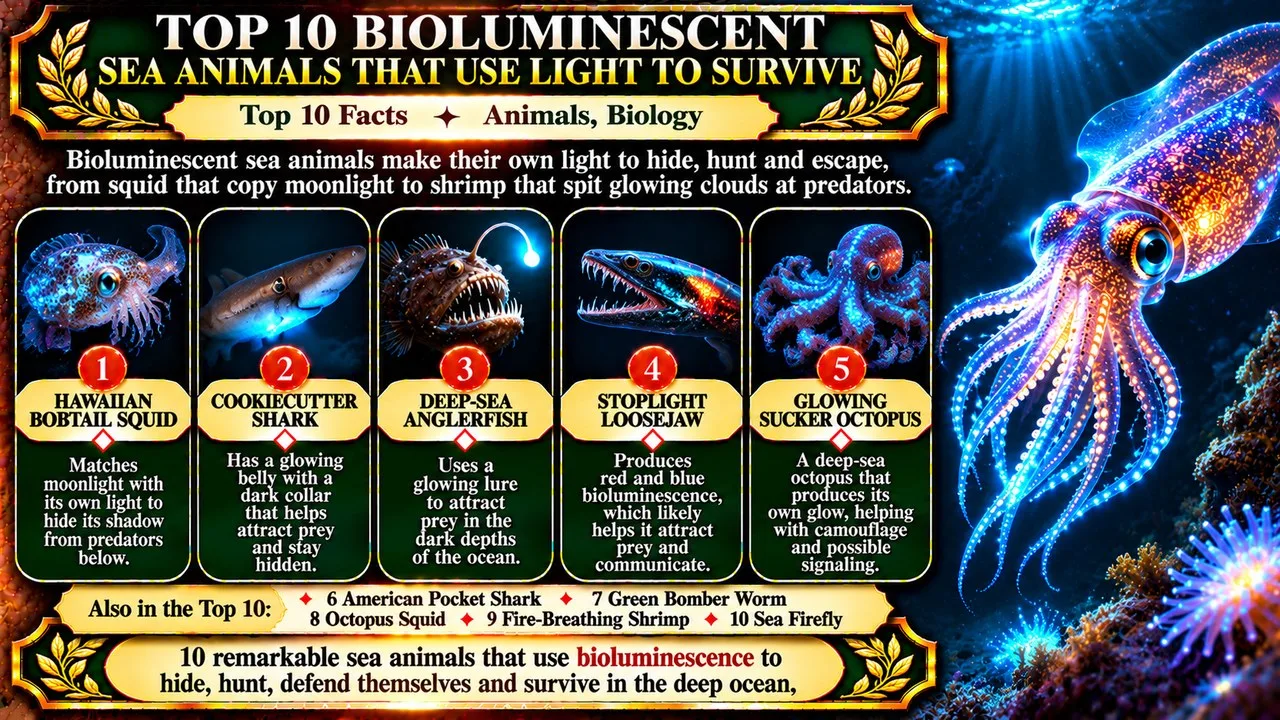
Bioluminescent sea animals make their own light to hide, hunt and escape, from squid that copy moonlight to shrimp that spit glowing clouds at predators.
Bioluminescence is light produced by a chemical reaction inside a living thing, usually when a compound called luciferin is oxidised with the help of an enzyme called luciferase [1]. On land it is fairly rare, but in the open ocean it is the rule. A study by the Monterey Bay Aquarium Research Institute (MBARI), based on more than 350,000 robot observations off California, found that about 76 percent of the animals seen in the water column could produce light [2].
Most of that light is blue or green, the colours that travel furthest through seawater. Animals use it to vanish, to lure dinner, or to distract an attacker for the second or two they need to escape [1].
This Finepedia guide, written in November 2026, takes its topic from a Listverse list on glowing animals that defend and deceive [24], but the selection, order and wording are our own. Each animal's light trick is documented by encyclopaedias, museums, ocean research institutes or peer-reviewed studies, and we corrected one common mix-up along the way. The list moves from animals that use light as camouflage, through hunters with glowing lures, to animals that throw light away as a decoy.
Key Facts
This table sums up all ten animals and how each uses its light.
Bioluminescent Sea Animals at a Glance
| Rank | Name | Where it lives | Key figure | How it uses light |
|---|---|---|---|---|
| 1 | Hawaiian Bobtail Squid | Shallow waters of Hawaii | Mantle up to 30 mm | Glowing bacteria hide its shadow |
| 2 | Cookiecutter Shark | Warm oceans worldwide | 42 to 56 cm long | Glowing belly with a dark collar |
| 3 | Deep-Sea Anglerfish | Deep open ocean | Largest females about 1.2 m | Bacterial lamp on a fishing rod |
| 4 | Stoplight Loosejaw | Oceans worldwide, 500 to 2,500 m | Red light near 710 nm | Red beam that most prey cannot see |
| 5 | Glowing Sucker Octopus | North Atlantic, 500 to 4,000 m | About 40 glowing suckers | Twinkling arms that may lure prey |
| 6 | American Pocket Shark | Gulf of Mexico | One 14 cm specimen | Pockets that release glowing fluid |
| 7 | Green Bomber Worm | Pacific, 1,800 to 3,700 m | Eight glowing "bombs" | Releases glowing sacs as decoys |
| 8 | Octopus Squid | Northeast Pacific, 400 to 800 m | First squid known to shed arms | Leaves glowing arm tips behind |
| 9 | Fire-Breathing Shrimp | Deep ocean waters | Described in 1881 | Spews a cloud of blue light |
| 10 | Sea Firefly | Coasts of southern Japan | About 3 mm long | Glows when attacked or swallowed |
1. Hawaiian Bobtail Squid
The Hawaiian bobtail squid, Euprymna scolopes, is a tiny cephalopod of the shallow coastal waters around the Hawaiian Islands. Its mantle grows to only about 30 millimetres [3]. It hides in the sand by day and hunts shrimp at night, when moonlight could reveal its outline to predators below.
To solve that problem the squid farms light. A two-lobed light organ inside its mantle is colonised by the glowing bacterium Aliivibrio fischeri, which the newly hatched squid gathers from seawater using a sticky mucus. Within a day the young squid can counter-illuminate, matching the glow on its underside to the light from above so that its shadow disappears [3]. Experiments published in Marine Biology in 2004 confirmed that the squid adjusts this glow to changing light levels [4].
The squid feeds the bacteria, and every dawn it vents up to 95 percent of them back into the sea [3]. It takes the top spot as one of biology's best-studied animal and microbe partnerships; in 2021 baby bobtail squid even flew to the International Space Station [3].
2. Cookiecutter Shark
The cookiecutter shark, Isistius brasiliensis, is a small, cigar-shaped shark of warm oceans worldwide. Males reach about 42 centimetres and females about 56 centimetres [5][6]. Its genus name honours Isis, the Egyptian goddess of light, fitting for an animal whose underside is covered in tiny light organs called photophores that give off an even green glow [5][6].
The glow blends the shark into the faint light from above, but it has one gap. A dark band around the throat carries no photophores at all [5][6]. Seen from below, this collar may look like the silhouette of a small fish. If so, the cookiecutter would be the only known animal that uses the absence of light as bait [5]. Its targets include tuna, dolphins and whales [6].
Related: Top 10 Most Dangerous Sea Creatures
When a large animal comes close, the shark clamps on with its sucking lips and twists, so its saw-like lower teeth carve out a round plug of flesh about 5 centimetres across [5]. Such bites turn up on whales, seals, large fish and even submarine sonar domes [5][6]. The shark spends the day as deep as 1,000 metres or more and rises towards the surface at night to feed [6].
3. Deep-Sea Anglerfish
The deep-sea anglerfishes, the suborder Ceratioidei, are the classic glowing hunters of the dark. Like all anglerfish they carry a fishing rod, a modified fin ray called the illicium, tipped with a lure called the esca, and in the deep-sea groups that lure glows [7].
The light comes from bioluminescent bacteria living inside the bulb of the lure. A 2019 Cornell-led study in eLife found that, although these bacteria have lost many genes, the fish pick them up from seawater rather than inheriting them. Bacteria from fish caught as far apart as the Gulf of Mexico and the Cape Verde islands were 99 percent identical, and the researchers also detected the bacteria floating freely in seawater [8].
Only the females carry the lamp, and the sexes differ hugely in size: a female warty seadevil can reach about 120 centimetres, while males are far smaller, and in some species the male fuses permanently to the female's body [7].
4. Stoplight Loosejaw
Several popular lists credit the black dragonfish with a red searchlight, but the fish best known for this trick is the stoplight loosejaw, Malacosteus niger, a member of the same dragonfish family. It lives in oceans around the world at depths of about 500 to 2,500 metres and grows to about 25.6 centimetres [9].
Most deep-sea animals cannot see red light at all. The loosejaw has a tear-shaped light organ below each eye that produces far-red light peaking at about 710 nanometres, and a second organ behind the eye that gives off ordinary blue light [9]. A 1998 paper in Nature showed that the fish sees its own beam with the help of a chlorophyll-derived pigment in its retina [10]. That pigment probably comes from the copepods it eats [9].
The result is a private spotlight for finding prey unnoticed. Its name comes from its jaws: the lower jaw is about a quarter of its body length, and its mouth has no floor of skin [9].
5. Glowing Sucker Octopus
The glowing sucker octopus, Stauroteuthis syrtensis, is a gelatinous, umbrella-shaped octopus of the deep North Atlantic. It has been recorded from about 500 to 4,000 metres below the surface, most often between 1,500 and 2,500 metres, and its longest arms reach about 35 centimetres [11].
Related: Top 10 Longest-Living Animals on Earth
It is one of only two octopus genera known to produce light. In 1999, scientists Sönke Johnsen, Elisabeth Balser and Edith Widder reported in Nature that the animal's suckers have been turned into light organs [12]. About 40 of them along the arms give off a blue-green glow; some shine steadily while others blink on and off, creating a twinkling effect that can last for about five minutes after the octopus is disturbed [11].
The light organs share features of both suckers and simple photophores, which suggests that they evolved from suckers [12]. The glow may lure the small crustaceans that make up its diet or startle predators [11].
6. American Pocket Shark
The American pocket shark, Mollisquama mississippiensis, is one of the rarest sharks ever recorded. The only known specimen, a male about 14 centimetres long, was collected in February 2010 in the eastern Gulf of Mexico by the NOAA ship Pisces during a survey of sperm whale feeding [13][14]. NOAA scientist Mark Grace spotted it in 2013, and it was named as a new species in 2019 [14].
Its bulbous head resembles a miniature sperm whale's, but its most remarkable feature is a pair of small pockets, one on each side near the gills, that release a glowing fluid. Unlike the only other pocket shark specimen, caught in the eastern Pacific in 1979, it also has photophores across much of its body [13][14].
Nobody has watched a living pocket shark use its fluid, but it may help the shark attract prey [13]. As Tulane's Henry Bart put it, finding a new species from a single Gulf specimen "underscores how little we know about the Gulf" [14].
7. Green Bomber Worm
The green bomber worm, Swima bombiviridis, is a see-through, free-swimming worm of the deep Pacific. It was introduced to science on 21 August 2009 in the journal Science, in a paper led by Karen Osborn of Scripps Institution of Oceanography that described seven new species of swimming worms found by remotely operated vehicles at depths between 1,800 and 3,700 metres [15][16].
Related: Top 10 Most Dangerous Fish in the World
Just behind its head the worm carries eight small sacs of fluid. When it is disturbed, it releases one or more of them, and each sac bursts into a bright green glow that lasts several seconds before slowly fading [16][17]. While a predator is distracted, the worm paddles away on fans of bristles. MBARI notes that the worm can later regrow the sacs it has used [17].
Related seafloor worms have easily shed gills in the same places, which suggests the glowing "bombs" evolved from gills [16]. Since 2011 a second species, the shining bomber, has joined the genus [15].
8. Octopus Squid
The octopus squid, Octopoteuthis deletron, is a midwater squid of the northeast Pacific, living at about 400 to 800 metres [18]. Each of its arms ends in a light organ, and when threatened it can carry out one of the boldest tricks in the ocean: it grabs an attacker with the hooks on its arms, then jets away and leaves the arm tips behind [18][19].
Stephanie Bush filmed this with MBARI's underwater robots: when she prodded a squid with a bottlebrush, it lit up, seized the brush and left two arms on it [19]. Her 2012 study in Marine Ecology Progress Series reported that the released arm usually thrashes while its tip glows or flashes, a likely way to keep a predator busy while the squid escapes [20].
Bush found that the arm breaks just above the point of contact, minimising tissue loss, and the arms grow back [19][20]. When she tested seven other squid species in the same way, none gave up their arms [19]. The octopus squid was the first squid reported to shed its arms, which makes it a clear choice for a list about defensive light [20].
9. Fire-Breathing Shrimp
Acanthephyra purpurea, nicknamed the fire-breathing shrimp, is a deep-sea shrimp first described in 1881 [21]. When it is attacked or upset it expels a large cloud of luminous fluid from around its mouth, a display that looks like a puff of blue fire in the dark water [21][22].
It is sometimes called the "vomiting shrimp", but that is misleading. MBARI biologist Steven Haddock told National Geographic that the fluid probably comes from the hepatopancreas, an organ that does the work of a liver and pancreas, rather than from the stomach [22]. Once the fluid meets seawater, its luciferin reacts with oxygen and gives off light [21].
Related: Exploring the Great Barrier Reef: Ecosystem and Biodiversity
The glowing cloud is thought to confuse or distract a predator while the shrimp escapes. It is not alone in this tactic, since species of Heterocarpus, Systellaspis and Oplophorus also release glowing clouds [21][22], but it is the best-known example of this smoke-screen strategy.
10. Sea Firefly
The sea firefly, Vargula hilgendorfii, is an ostracod, a tiny crustacean only about 3 millimetres long enclosed in a two-part carapace. It lives in sandy shallows off the southern coasts of Japan, where it is known as umi-hotaru [23]. When it is disturbed, it squirts luciferin and luciferase from a gland near its mouth into the water, producing a burst of blue light [23].
Related ostracods use the flash as a defence. In 2014 a BBC crew, working with Kansas biologist Trevor Rivers, filmed cardinalfish failing to eat glowing ostracods and spitting them out [25]. The light may also draw bigger predators to the attacker, an idea called the "burglar alarm" effect [1][25].
During the Second World War the Japanese army is reported to have used dried sea fireflies, moistened when needed, as a dim light for reading maps [23][26]. In 1957 the chemist Osamu Shimomura became the first to crystallise its luciferin, and he later shared the 2008 Nobel Prize in Chemistry for work on green fluorescent protein [1].
Conclusion
From the bobtail squid that hides its shadow with borrowed bacteria to the sea firefly that makes fish spit it out, these ten animals show how many different jobs a little light can do in the sea. Some use glow as camouflage, some as bait, and some as a decoy they will throw away, from a worm's green sacs to a squid's own arms.
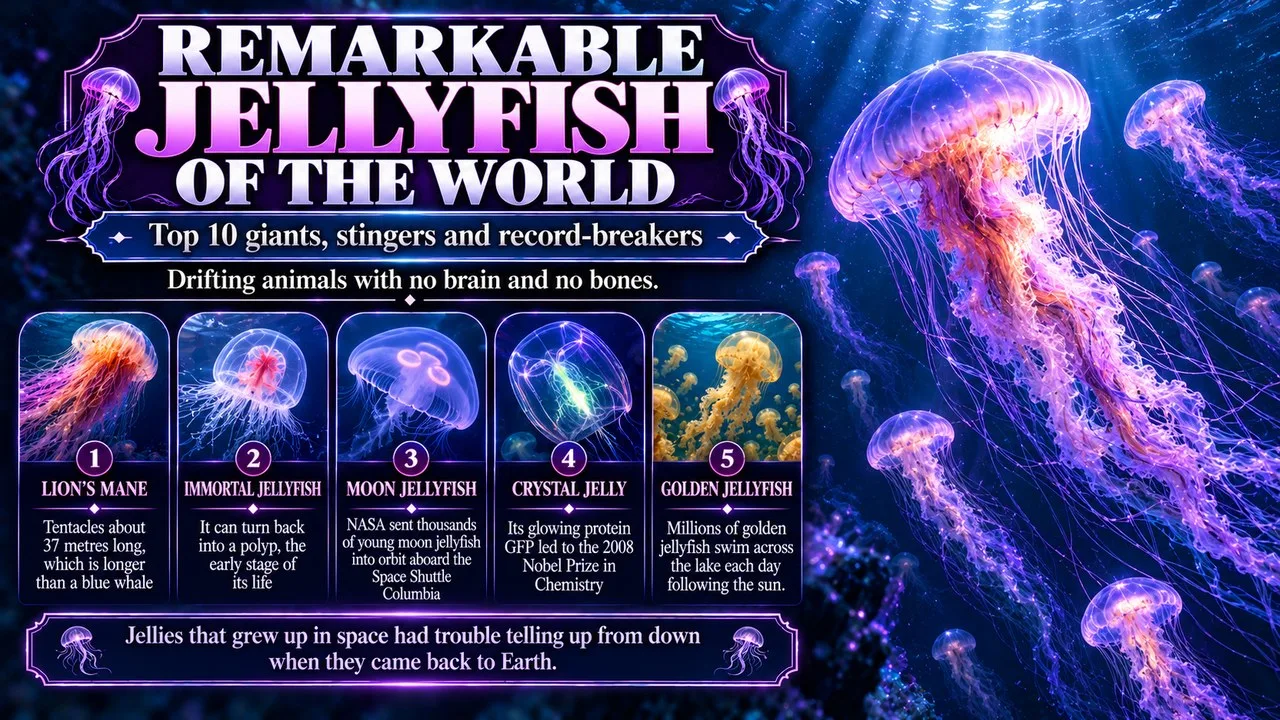
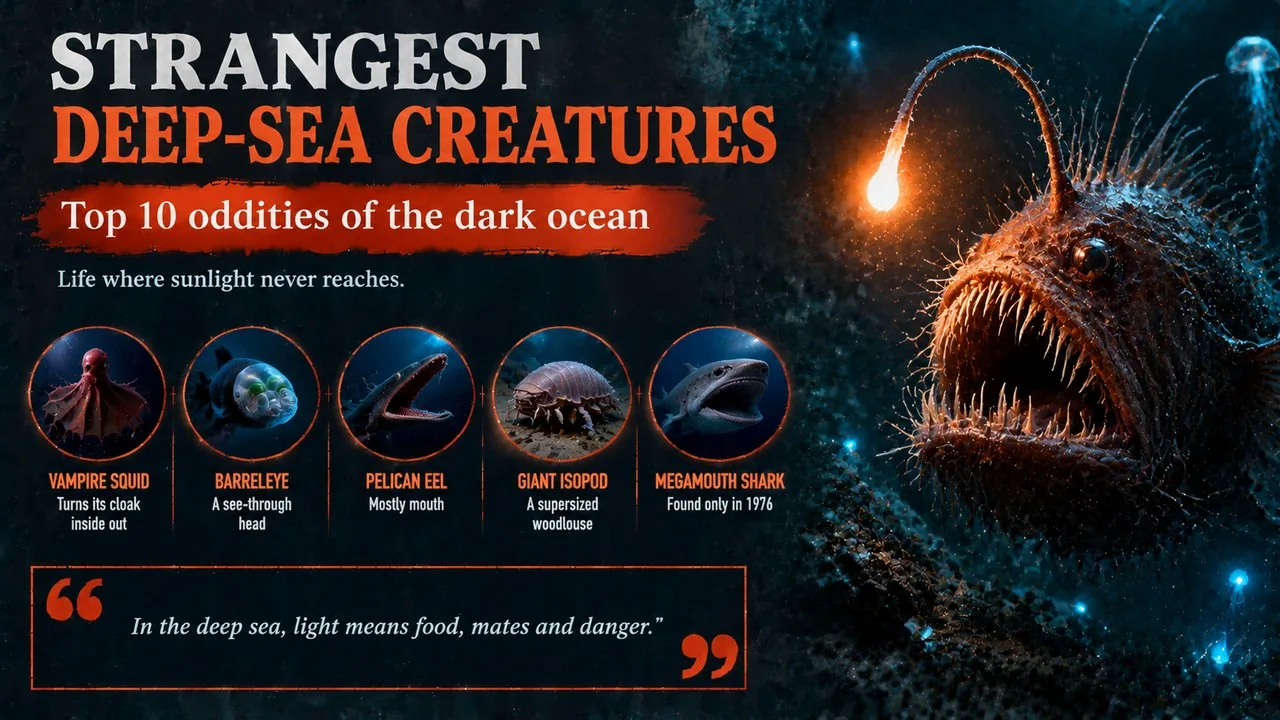
The pocket shark and the green bomber worm were unknown until the 21st century, and with about three quarters of deep-sea animals able to make light, the ocean almost certainly holds many more glowing tricks still to be found [2]. For more ocean life, see Top 10 Strangest Deep-Sea Creatures and Top 10 Remarkable Jellyfish of the World.
- ^ [1] "Bioluminescence". Wikipedia. Wikipedia
- ^ [2] "Three quarters of deep-sea animals make their own light". MBARI. MBARI news
- ^ [3] "Hawaiian bobtail squid". Wikipedia. Wikipedia
- ^ [4] "Counterillumination in the Hawaiian bobtail squid, Euprymna scolopes". Marine Biology. Marine Biology article
- ^ [5] "Cookiecutter shark". Wikipedia. Wikipedia
- ^ [6] "Cookiecutter Shark". Florida Museum of Natural History. Florida Museum
- ^ [7] "Ceratioidei". Wikipedia. Wikipedia
- ^ [8] "Study illuminates link between anglerfish, bacteria". Cornell Chronicle. Cornell Chronicle
- ^ [9] "Malacosteus niger". Wikipedia. Wikipedia
- ^ [10] "Dragon fish see using chlorophyll". Nature. Nature
- ^ [11] "Stauroteuthis syrtensis". Wikipedia. Wikipedia
- ^ [12] "Light-emitting suckers in an octopus". Nature. Nature
- ^ [13] "American pocket shark". Wikipedia. Wikipedia
- ^ [14] "Researchers identify new species of pocket shark". Tulane University. Tulane News
- ^ [15] "Swima". Wikipedia. Wikipedia
- ^ [16] "Scientists Discover Bioluminescent Green Bombers from the Deep Sea". Scripps Institution of Oceanography. Scripps news
- ^ [17] "Bomber worm". MBARI. MBARI animal profile
- ^ [18] "Octopoteuthis deletron". Wikipedia. Wikipedia
- ^ [19] "Deep-sea squid can jettison its arms". University of Rhode Island. URI news
- ^ [20] "Economy of arm autotomy in the mesopelagic squid Octopoteuthis deletron". Marine Ecology Progress Series. MEPS abstract
- ^ [21] "Acanthephyra purpurea". Wikipedia. Wikipedia
- ^ [22] "Glow, Little Spewing Shrimp, Glow". National Geographic. National Geographic
- ^ [23] "Vargula hilgendorfii". Wikipedia. Wikipedia
- ^ [24] "10 Cases Of Bioluminescence Used For Defense And Deception". Listverse. Topic reference on Listverse
- ^ [25] "KU researcher and BBC filmed little fish fireworks". University of Kansas. KU News
- ^ [26] "The Secret History of Bioluminescence". Hakai Magazine. Hakai Magazine




















Discussion
Log in with