






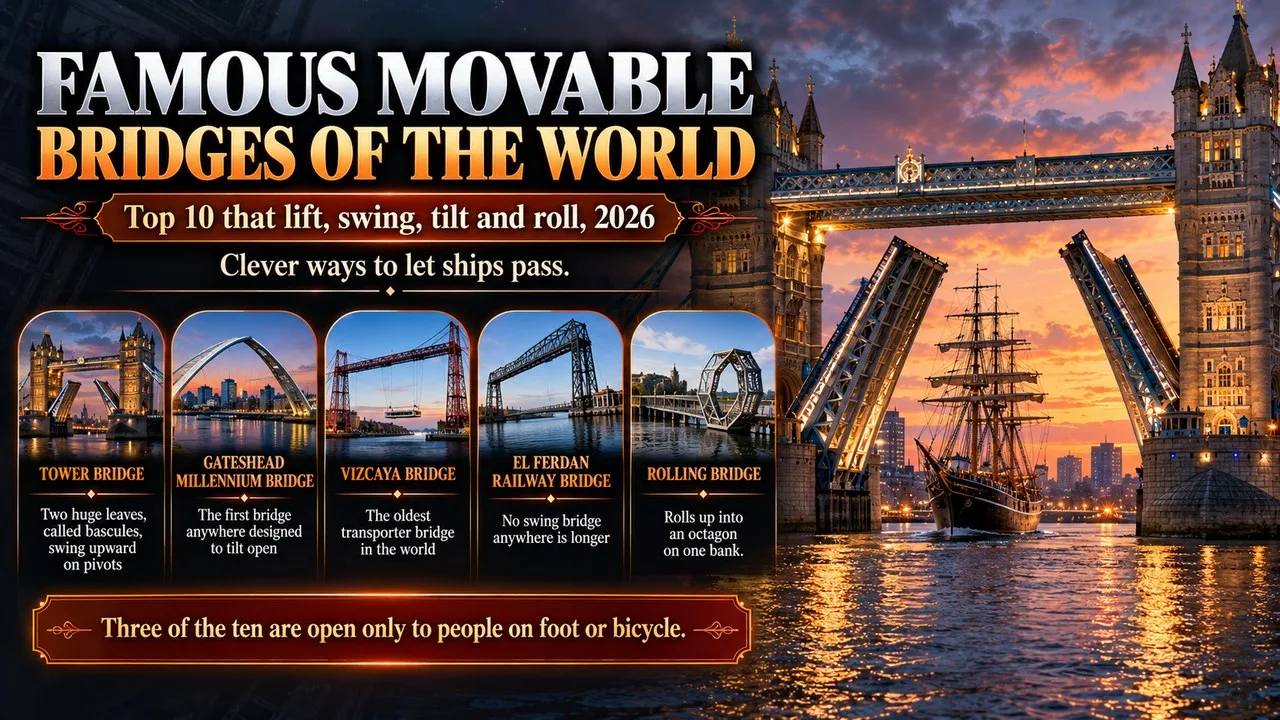
Famous movable bridges of the world lift, swing, tilt or even roll up to let boats pass, from London's Tower Bridge to a tilting footbridge on the Tyne.
This Finepedia guide, written in October 2026, looks at ten bridges that move, each using a different trick to clear the way for ships. Each entry explains how the bridge opens, when it was built and one story that makes it stand out. Figures come from bridge owners, UNESCO, engineering journals and encyclopaedias. For more record-breaking crossings, see the Finepedia guides Top 10 Highest Bridges in the World and Top 10 Longest Suspension Bridge Spans in the World.
How We Chose These
We looked for bridges that are famous for the way they move, not just for their size, and we wanted every main type: bascule, tilt, swing, vertical lift, transporter and one that rolls itself into a ball. Some hold world records, such as the longest swing span and the longest lift span, while others are loved for their looks. The list mixes Victorian engineering with 21st-century design, and three of the ten are open only to people on foot or bicycle.
The 10 Famous Movable Bridges at a Glance
| No. | Bridge | City | Opened | How it moves |
|---|---|---|---|---|
| 1 | Tower Bridge | London, UK | 1894 | bascule |
| 2 | Gateshead Millennium Bridge | Gateshead, UK | 2001 | tilt |
| 3 | Erasmus Bridge | Rotterdam, Netherlands | 1996 | bascule |
| 4 | Vizcaya Bridge | Portugalete and Getxo, Spain | 1893 | transporter |
| 5 | Puente de la Mujer | Puerto Madero, Buenos Aires | 2001 | swing |
| 6 | El Ferdan Railway Bridge | Ismailia, Egypt | 2001 | swing |
| 7 | Arthur Kill Vertical Lift Bridge | New Jersey and New York, US | 1959 | vertical lift |
| 8 | Pont Jacques Chaban-Delmas | Bordeaux | 2013 | vertical lift |
| 9 | Samuel Beckett Bridge | Dublin, Ireland | 2009 | swing |
| 10 | Rolling Bridge | London, UK | 2004 | rolling |
1. Tower Bridge Still Opens for Ships on the Thames
Tower Bridge crosses the River Thames beside the Tower of London.[1] The architect Horace Jones and the engineer John Wolfe Barry planned it, and it was built from 1886 to 1894 and opened on 30 June 1894. Two huge leaves, called bascules, swing upward like a seesaw on pivots, so that tall ships can reach the Pool of London.
Key Facts
- Length: about 290 m, including the abutments
- Towers: two, each about 65 m tall
- Openings: roughly a thousand a year
- Traffic: about 40,000 people cross it every day
Did You Know?
In December 1952 the bascules began to rise while a double-decker bus was on the bridge. The driver, Albert Gunter, sped up and jumped a gap of about 1 m onto the far leaf, and the bus landed safely on the other side. The high walkways, closed in 1910, reopened in 1982 and gained glass floors in 2014.
2. The Gateshead Millennium Bridge Tilts Like a Blinking Eye
The Gateshead Millennium Bridge carries people on foot and bicycle across the River Tyne, linking Gateshead's arts quarter with Newcastle's Quayside. Opened in 2001, it was the first bridge anywhere designed to tilt open. Its curved deck and supporting arch rotate together, and locals call it the Blinking Eye Bridge because of the way it moves.
Key Facts
- Weight: about 850 tonnes, tilted as one piece
- Clearance when open: 25 m
- Opening time: about four minutes to turn through 40 degrees
- Designers: WilkinsonEyre with the engineers Gifford
Why It Matters
In November 2000 the floating crane Asian Hercules II set the complete bridge on its bearings in a single lift. It won the 2002 RIBA Stirling Prize, one of Britain's top awards for architecture, and was the first opening bridge built on the Tyne for more than a century.
3. Rotterdam's Erasmus Bridge Hides a Giant Lifting Span
The Erasmus Bridge spans the Nieuwe Maas river in central Rotterdam.[2] Its tall, pale blue pylon, bent like a neck, earned it the nickname The Swan. Most people notice only its cable-stayed main span, but at its southern end is a bascule section that lifts for ships too tall to pass beneath.
Key Facts
- Total length: 802 m
- Pylon height: 139 m
- Bascule span: 89 m long, the biggest in Western Europe
- Opened: 6 September 1996 by Queen Beatrix
Did You Know?
The bridge is named after Erasmus, the Renaissance scholar born in Rotterdam. Soon after it opened in 1996, engineers found that it swayed in very strong winds, so stronger dampers were added. It cost more than 165 million euros to build.
4. The Vizcaya Bridge Carries Cars on a Hanging Gondola
The Vizcaya Bridge spans the Nervión estuary near Bilbao, linking Portugalete with Las Arenas in Getxo.[3] Designed by Alberto Palacio and finished in 1893, it is the oldest transporter bridge in the world. A gondola hangs from a high crossbeam and glides from bank to bank, so ships can pass beneath at any time.
Related: Top 10 Longest Suspension Bridges in the World
Key Facts
- Length: about 160 m
- Height: about 45 m above the water
- Gondola: carries six cars and dozens of passengers in about 90 seconds
- UNESCO: World Heritage Site since 13 July 2006
Why It Matters
Palacio needed a crossing that would not block the busy port of Bilbao or need long, steep ramps. His idea, built with the French engineer Ferdinand Arnodin, was copied at river mouths around the world. Service stopped only once, for four years after the bridge was blown up during the Spanish Civil War.
5. Puente de la Mujer Turns Like a Tango Dancer
Puente de la Mujer, whose name means Woman's Bridge, is a footbridge over Dock 3 in the Puerto Madero district of Buenos Aires.[4] Designed by Santiago Calatrava, it opened on 20 December 2001. Its middle section, held by cables from a leaning steel mast, rotates 90 degrees on a white pylon to let boats pass in under two minutes.
Key Facts
- Length: 170 m
- Weight: about 800 tonnes
- Rotating span: 102.5 m
- Mast: about 34 m high, leaning at 39 degrees
Did You Know?
Calatrava said the design shows a couple dancing the tango, with the mast as the man and the curved deck as the woman. The name comes from the streets of Puerto Madero, many of which are named after notable Argentine women.
6. The El Ferdan Railway Bridge Swings Across the Suez Canal
Near Ismailia in Egypt, the El Ferdan Railway Bridge spans the Suez Canal, and no swing bridge anywhere is longer.[5] Each half turns on its pier to lie along the bank, opening a wide channel for the giant ships that use the canal. The present bridge was completed in 2001 after earlier crossings here were lost to war.
Related: Top 10 Highest Bridges in the World
Key Facts
- Total span: about 340 m
- First bridge on the site: 1918
- Contract: led by the German firm Krupp
- Purpose: carrying trains between mainland Egypt and Sinai
Why It Matters
When a new parallel channel of the canal opened in 2015, trains could no longer reach Sinai over the old bridge alone. Egypt decided in 2017 to keep it and build a second swing bridge of similar design across the new eastern channel, restoring the rail link.
7. The Arthur Kill Bridge Lifts a Record Span
This rail bridge, officially named Arthur Kill Vertical Lift Bridge, runs between Elizabethport in New Jersey and Staten Island in New York. Built in 1959 to replace an older swing bridge, it raises its whole truss span straight up between two towers, like a lift. No other vertical-lift bridge has a longer moving span.
Key Facts
- Lift span: about 170 m
- Towers: two, about 66 m tall
- Clearance: 9.45 m when closed, 41 m when raised
- Channel: about 152 m wide
Did You Know?
Freight traffic faded as factories on Staten Island closed, and no freight train crossed between 1990 and 2006. After a restoration costing about 72 million dollars, a train crossed again in October 2006, and container trains from the Howland Hook terminal followed in 2007.
8. The Pont Jacques Chaban-Delmas Raises Its Road for Cruise Ships
The Pont Jacques Chaban-Delmas crosses the Garonne in Bordeaux and opened on 16 March 2013.[6] Its central road deck rises between four tall pylons to let cruise ships and tall sailing ships reach the city's historic quays. When it opened, no lift bridge in Europe had a longer moving deck.
Key Facts
- Main bridge: 433 m long
- Lifting span: 117 m long, weighing about 2,500 tonnes
- Pylons: 77 m above high water
- Clearance when raised: 53 m
Why It Matters
The bridge takes about 11 minutes to raise or lower and opens around 60 times a year. Pedestrians and cyclists cross on curved walkways outside the pylons, and at night the pylons are lit in colours that change with the tide, an idea of the artist Yann Kersalé.
Related: Top 10 Famous Stone Bridges of the World
9. Dublin's Samuel Beckett Bridge Swings Like a Harp
The Samuel Beckett Bridge crosses the River Liffey in Dublin's Docklands and was opened in December 2009. Designed by Santiago Calatrava, it is a cable-stayed bridge that can turn through 90 degrees to let ships pass. Its curved mast and fan of cables look like a harp lying on its side, a fitting shape for Ireland.
Key Facts
- Named after: the writer Samuel Beckett
- Cost: about 60 million euros
- Cables: 31 stays from a single curved mast
- Award: Engineers Ireland Engineering Project of the Year, 2010
Did You Know?
The steel span was built in the Netherlands and shipped to Dublin in 2009. The harp has been a symbol of Ireland for centuries, and it is the second Calatrava bridge on the Liffey, after the James Joyce Bridge upriver.
10. The Rolling Bridge Rolls Into an Octagon
The Rolling Bridge spans a small canal inlet at Paddington Basin in London. Designed by Heatherwick Studio and completed in 2004, it is a footbridge of steel and timber made of eight hinged sections. Instead of lifting or swinging, it rolls up until its two ends meet, forming an octagon that sits on one bank.
Key Facts
- Length: about 12.9 m when flat
- Sections: eight, moved by hydraulic rams in the handrails
- Opening time: designed to open in about three minutes
- Record: listed by Guinness World Records as the first bridge of its kind
Why It Matters
Thomas Heatherwick said his studio wanted a bridge that gets out of the way instead of breaking apart. The idea came partly from the coiling tails of animated dinosaurs. The bridge usually rolls up on set days, and the display has become a small tourist event.
Related: Top 10 Most Bizarre Phobias: Strange Fears That Exist
Frequently Asked Questions
What is the difference between a drawbridge and a bascule bridge?
A drawbridge is any bridge that can be raised, like the old castle bridges pulled up by chains. A bascule bridge is a modern type of drawbridge in which each leaf pivots and is balanced by a heavy counterweight, so it can be lifted with little power.
Which is the longest movable bridge in the world?
On the Suez Canal, El Ferdan has the record swing span, at about 340 m. For bridges that lift straight up, the record belongs to Arthur Kill in the US, with a span of about 170 m.
Conclusion
From the Victorian bascules of Tower Bridge to a footbridge that rolls into a ball, these ten bridges prove that a crossing does not have to stay still. They keep roads, railways and footpaths open while ships still pass. For more record-breaking crossings, read the Finepedia guides Top 10 Highest Bridges in the World and Top 10 Longest Suspension Bridge Spans in the World.
- ^ [1] "Tower Bridge, London". Architecture of England, Scotland, and Wales. DOI
- ^ [2] "Erasmus University Rotterdam". Wikipedia. Wikipedia
- ^ [3] "Vizcaya Bridge". Wikipedia. Wikipedia
- ^ [4] "Puente de la Mujer". Wikipedia. Wikipedia
- ^ [5] "El Ferdan Railway Bridge". Wikipedia. Wikipedia
- ^ [6] "Gateshead Millennium Bridge". Wolfram Demonstrations Project. DOI






















Discussion
Log in with