




Top 10 Famous Bridges That Cross International Borders
 By Dhiraj Sharma · Published
Share Post
Loading…
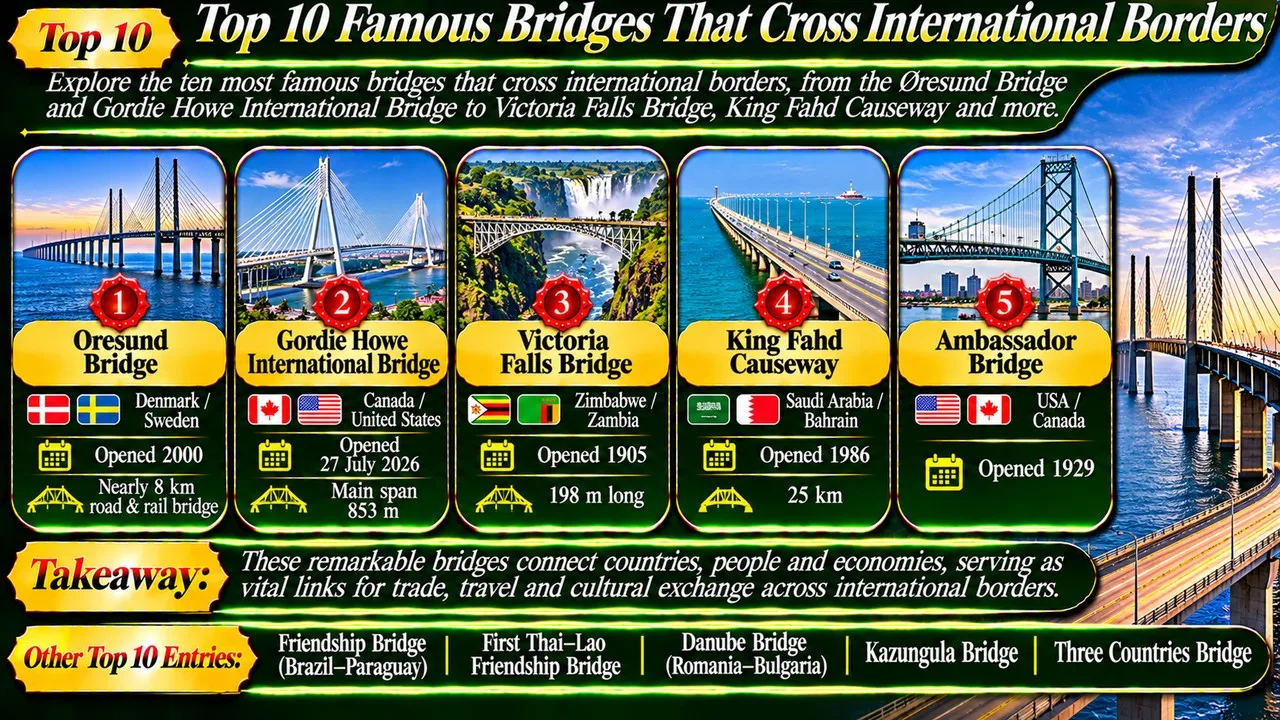
Famous bridges that cross international borders join nations over straits, gorges and great rivers, carrying trade, trains and travellers between countries.
Rivers and narrow seas have often served as natural frontiers, so many of the world's borders run along water. Bridges across them are more than feats of engineering. They are economic lifelines, symbols of cooperation and sometimes the only fixed link between two neighbours. Many are named after friendship between the countries they join [1].
This Finepedia list picks ten famous border bridges for their engineering, history, economic importance and fame. They range from a record-breaking new crossing between Canada and the United States to a century-old railway arch beside Victoria Falls. Lengths, opening dates and traffic figures come from published sources and are given as of November 2026. Other well-known crossings, such as the Rainbow Bridge at Niagara Falls, opened in 1941, narrowly missed the list [2].
Key Facts
Here is a quick overview of the ten bridges, with the countries they link, their opening year and one standout figure for each.
Border Bridges at a Glance
| Rank | Name | Countries linked | Opened | Key figure |
|---|---|---|---|---|
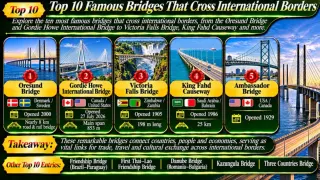
| 1 | Oresund Bridge | Denmark and Sweden | 2000 | Nearly 8 km of road and rail bridge |
| 2 | Gordie Howe International Bridge | Canada and United States | 2026 | 853 m main span |
| 3 | Victoria Falls Bridge | Zambia and Zimbabwe | 1905 | 128 m above the river |
| 4 | King Fahd Causeway | Saudi Arabia and Bahrain | 1986 | 25 km of bridges and causeways |
| 5 | Ambassador Bridge | US (Michigan) and Canada (Ontario) | 1929 | Once the world's longest suspended span |
| 6 | Friendship Bridge | Brazil and Paraguay | 1960s | 290 m concrete arch |
| 7 | First Thai-Lao Friendship Bridge | Thailand and Laos | 1994 | First bridge on the lower Mekong |
| 8 | Danube Bridge | Romania and Bulgaria | 1954 | About 2.2 km long, road and rail |
| 9 | Kazungula Bridge | Zambia and Botswana | 2021 | Curved to avoid two other countries |
| 10 | Three Countries Bridge | Germany and France, beside Switzerland | 2007 | Longest single-span footbridge |
1. Oresund Bridge
The Oresund Bridge links Denmark and Sweden across the Oresund strait. It is a combined road and railway bridge that runs for nearly 8 kilometres from the Swedish coast near Malmo to Peberholm, an artificial island in the middle of the strait [3].
From Peberholm, the link continues through the 4-kilometre Oresund Tunnel to the Danish island of Amager, near Copenhagen. Engineers chose a tunnel for this section to avoid interfering with flights at nearby Copenhagen Airport, to keep a clear channel for ships and to stop ice from blocking the strait [3].
Construction began in 1995, and the link opened to traffic on 1 July 2000. Its central section is a cable-stayed bridge carrying a motorway on the upper deck and a railway below. Together with Denmark's Great Belt link, it gives Scandinavia a direct road and rail connection to mainland Europe, and it has helped turn Copenhagen and Malmo into a single regional economy [3].
2. Gordie Howe International Bridge
The Gordie Howe International Bridge is the newest major border bridge in the world. It crosses the Detroit River between Windsor, Ontario, and Detroit, Michigan, and opened to traffic on 27 July 2026 [4][5].
The six-lane cable-stayed bridge has a main span of 853 metres, the longest of its kind in North America, and extends about 2.5 kilometres in total. Its two towers rise about 220 metres. Unlike the older crossings nearby, it links directly to motorways on both sides, so trucks no longer have to pass through city streets [4][5].
Related: Top 10 Famous Stone Bridges of the World
The CA$3.8 billion construction cost was funded by the Canadian government and is to be repaid by tolls, and the bridge is owned jointly by Canada and the state of Michigan [4]. It is named after Gordie Howe, the famous ice hockey player who was born in Canada and starred for Detroit. The new crossing is expected to ease pressure on one of the busiest trade routes in North America.
3. Victoria Falls Bridge
Spanning the gorge of the Zambezi a short distance downstream of Victoria Falls, this bridge links Zambia and Zimbabwe. It carries a road, a railway and a footpath, and has border posts at each end in the towns of Livingstone and Victoria Falls [6].
The bridge was part of the British plan for a Cape to Cairo railway. The colonial politician who promoted it reportedly asked for a bridge placed so that passing trains would catch the spray from the falls. It was built from steel prefabricated in England, shipped to Mozambique and carried to the site by rail, and opened on 12 September 1905 [6].
The bridge is 198 metres long, with a main arch spanning 156.5 metres, and stands 128 metres above the river at low water. Today it is also a famous adventure destination, with a 111-metre bungee jump, a bridge swing and a zip line, and it remains the only rail link between Zambia and Zimbabwe [6].
4. King Fahd Causeway
The King Fahd Causeway is a 25-kilometre chain of bridges and embankments linking Khobar in Saudi Arabia with Bahrain across the Gulf of Bahrain. Before it opened in 1986, the island kingdom could be reached from the mainland only by sea or air [7].
Its five bridges rest on 536 concrete pylons, and seven embankments cross the shallower parts of the gulf. Halfway across, an artificial island known as Passport Island holds customs and immigration offices, mosques and gardens, plus two restaurant towers about 65 metres tall. The causeway was officially inaugurated on 26 November 1986 in the presence of the Saudi king and the ruler of Bahrain, and it was named after King Fahd [7].
The project cost about US$800 million. In 2010 an estimated 25,000 vehicles used the causeway every day, and it has become a vital link for commuters, tourists and trade between the two countries [7].
5. Ambassador Bridge
The Ambassador Bridge is a suspension bridge across the Detroit River between Detroit, Michigan, and Windsor, Ontario. When it opened in 1929, its main span of 1,850 feet, about 560 metres, was the longest suspended central span in the world [8].
Related: Top 10 Greatest Engineering Achievements
The bridge is about 2,286 metres long including its approaches. For decades no other North American frontier crossing handled more trade by value, and it carried over a quarter of the goods traded between the two countries [8].
Unusually for a major international crossing, the Ambassador Bridge is privately owned. Its owners long opposed the construction of a competing public bridge nearby, which eventually opened as the Gordie Howe International Bridge in 2026 [4][8].
6. Friendship Bridge
The Friendship Bridge, known as Puente de la Amistad in Spanish and Ponte da Amizade in Portuguese, crosses the Parana River between Foz do Iguacu in Brazil and Ciudad del Este in Paraguay [9].
A treaty to build the bridge was signed by the two governments in 1956. When it was constructed in the early 1960s, its 290-metre reinforced concrete arch was the longest of its type in the world [9].
Today it is one of the busiest border crossings in South America, with more than 40,000 vehicles crossing each day [9]. Ciudad del Este is a major shopping destination, and the bridge sits close to the Triple Frontier where Brazil, Paraguay and Argentina meet, near Iguazu Falls.
7. First Thai-Lao Friendship Bridge
The First Thai-Lao Friendship Bridge crosses the Mekong River between Nong Khai in Thailand and an area about 20 kilometres from Vientiane, the capital of Laos. It opened on 8 April 1994 and was the first bridge across the lower Mekong [10].
Related: Top 10 Tallest TV and Observation Towers
The bridge is 1,170 metres long and was built with about A$42 million of Australian development aid. It has two road lanes, two footpaths and a metre-gauge railway line running down the middle. Road traffic stops whenever a train crosses [10].
Because Thailand drives on the left and Laos on the right, traffic lights near the Lao end of the bridge control the switch between sides. Train services across the bridge to a station near Vientiane began in 2009, giving Laos its first railway link [10].
8. Danube Bridge
The Danube Bridge, also called the Giurgiu-Ruse Friendship Bridge, crosses the Danube between Giurgiu in Romania and Ruse in Bulgaria. Opened on 20 June 1954, it was designed by Soviet engineers and was for decades the only bridge shared by the two countries [11].
The steel truss bridge is about 2,224 metres long and has two decks: a two-lane road above and a railway below. Its central section includes a lifting rail deck that can be raised to let tall vessels pass [11].
The bridge remains an important link on the route between northern and southern Europe, carrying traffic between Bucharest and the Balkans. Only in 2013 did a second bridge between the two countries open, the New Europe Bridge between Vidin and Calafat, far upstream near the Serbian border [11].
9. Kazungula Bridge
The Kazungula Bridge crosses the Zambezi River between Zambia and Botswana. It opened to traffic in May 2021, replacing the ferry that had previously been the only direct link between the two countries [12].
What makes the bridge unusual is its location. Zambia and Botswana share a border on the river only about 135 metres long, close to the point where Zimbabwe and Namibia also meet. The 923-metre bridge is curved to stay within Zambian and Botswanan territory and avoid the borders of the other two countries [12].
Related: Top 10 Largest Dams in the World
The bridge carries two road lanes, footpaths and a single railway line that will eventually form part of a planned railway. It also includes one-stop border posts that speed up trade along the North-South Corridor in southern Africa [12].
10. Three Countries Bridge
The Three Countries Bridge is a footbridge over the Rhine between Huningue in France and Weil am Rhein in Germany, within the Basel metropolitan area. Its name comes from its location close to the point where France, Germany and Switzerland meet [13].
Opened in 2007, the steel arch bridge carries only pedestrians and cyclists. It is 248 metres long with a main span of about 229 metres, making it the world's longest single-span bridge for walkers and cyclists. It was designed by the architect Dietmar Feichtinger [13].
The bridge stands near the site of earlier crossings, including a pontoon bridge destroyed in 1944. Today it symbolises open borders in Europe, letting residents stroll or cycle between countries without passport checks [13].
Conclusion
Bridges that cross international borders do far more than carry traffic. They join economies, families and cultures, and many were built as gestures of friendship between neighbours. From the Oresund link and the brand-new Gordie Howe bridge to the historic Victoria Falls Bridge, each tells a story about how nations connect.
As trade grows and new infrastructure is built, more border bridges are being planned around the world. To learn about the frontiers themselves, read about the longest land borders in the world. For more remarkable structures, see the longest suspension bridge spans in the world, the highest bridges in the world and the famous movable bridges of the world on Finepedia.
- ^ [1] "List of international bridges". Wikipedia. Wikipedia: List of international bridges
- ^ [2] "Rainbow Bridge (Niagara Falls)". Wikipedia. Wikipedia: Rainbow Bridge
- ^ [3] "Oresund Bridge". Wikipedia. Wikipedia: Oresund Bridge
- ^ [4] "Gordie Howe International Bridge". Wikipedia. Wikipedia: Gordie Howe International Bridge
- ^ [5] "Gordie Howe International Bridge opened to traffic". SICE. SICE: Gordie Howe bridge opened
- ^ [6] "Victoria Falls Bridge". Wikipedia. Wikipedia: Victoria Falls Bridge
- ^ [7] "King Fahd Causeway". Wikipedia. Wikipedia: King Fahd Causeway
- ^ [8] "Ambassador Bridge". Wikipedia. Wikipedia: Ambassador Bridge
- ^ [9] "Friendship Bridge (Brazil-Paraguay)". Wikipedia. Wikipedia: Friendship Bridge
- ^ [10] "First Thai-Lao Friendship Bridge". Wikipedia. Wikipedia: First Thai-Lao Friendship Bridge
- ^ [11] "Giurgiu-Ruse Friendship Bridge". Wikipedia. Wikipedia: Danube Bridge
- ^ [12] "Kazungula Bridge". Wikipedia. Wikipedia: Kazungula Bridge
- ^ [13] "Three Countries Bridge". Wikipedia. Wikipedia: Three Countries Bridge





















Discussion
Log in with