






 By
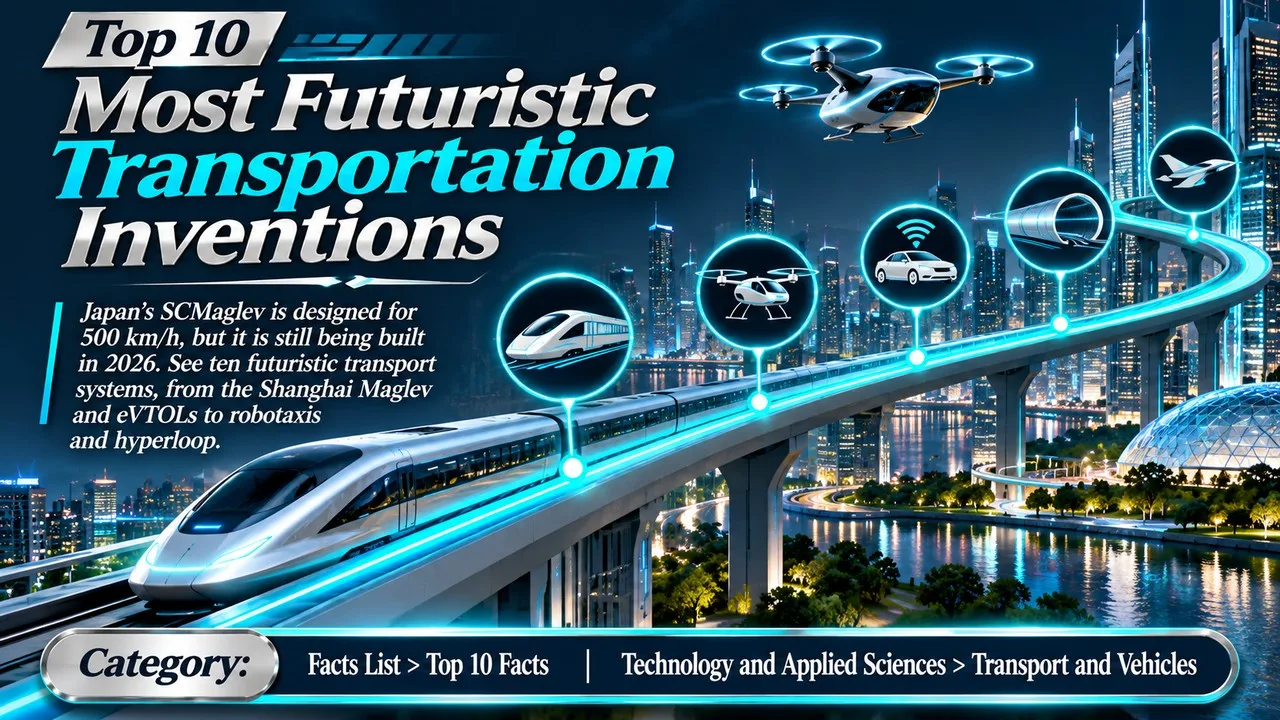
Japan's superconducting maglev is designed to run at 500 kilometres per hour, but the Chuo Shinkansen is still under construction in 2026. Central Japan Railway has already abandoned the original 2027 opening target for the Shinagawa-Nagoya section, and work on the new Nagoya station is not expected to finish before 2033 [1][2].
This list looks at transport systems that still feel ahead of everyday travel: magnetic levitation, electric vertical-takeoff aircraft, driverless taxis, hydrogen trains, electric ferries, vacuum-tube proposals, personal rapid transit and battery-electric regional aircraft. It is not a catalogue of concept vehicles from the 2010s. Several of those earlier gadgets never reached service, and the honest test in 2026 is whether a technology is already carrying people, is in certified trials, or is still only a prototype [3][4].
A related Finepedia list covers the most common modes of transportation. The items below are the ones that may change how those common modes work. Figures are as of November 2026.
Key Facts
The table gives each system's top speed or role, where it stands in 2026, and why it is on the list.
Futuristic Transportation at a Glance
| Rank | System | Type | 2026 status | Notable fact |
|---|---|---|---|---|
| 1 | Chuo Shinkansen SCMaglev | Superconducting maglev | Under construction, opening delayed | Designed operating speed of 500 km/h |
| 2 | Shanghai Maglev | Transrapid maglev | In commercial service since 2004 | Still the fastest scheduled train service, at 431 km/h |
| 3 | China 600 km/h maglev prototype | High-speed maglev prototype | Tested, no commercial line yet | Designed for 600 km/h, faster than any service train |
| 4 | eVTOL air taxis | Electric vertical take-off aircraft | Limited passenger operations and trials | China's EH216-S has been cleared for passenger sightseeing flights |
| 5 | Driverless robotaxis | Autonomous passenger cars | Paid service in multiple US cities | Waymo has been the leading large-scale operator |
| 6 | Hydrogen passenger trains | Fuel-cell multiple units | In service on some non-electrified lines | Alstom's Coradia iLint was the first such train in passenger use |
| 7 | Electric and autonomous ferries | Battery and automated ships | In service and in trials, especially in Norway | Short-sea routes have proved easier to electrify than long flights |
| 8 | Hyperloop | Low-pressure tube transport | Pre-commercial; no passenger service | Leading private developers have shut down or become insolvent |
| 9 | Personal rapid transit pods | Small automated guideway vehicles | In service at London Heathrow | A rare working example of the old "personal rapid transit" idea |
| 10 | Battery-electric regional aircraft | Short-haul electric aeroplanes | In development, not in airline service | Aimed at short routes that today's batteries can more realistically serve |
1. Chuo Shinkansen SCMaglev
The Chuo Shinkansen is Japan's planned superconducting maglev line between Tokyo, Nagoya and later Osaka, with a designed operating speed of 500 kilometres per hour [1]. The Ministry of Land, Infrastructure, Transport and Tourism has already judged that the technologies needed for a commercial line have been developed, and test runs at the Yamanashi test track have demonstrated high-speed travel with a magnetically levitated train that cannot derail in the ordinary sense [1].
Construction of the first section, from Shinagawa to Nagoya, has been slowed by geology, tunnelling in the Southern Alps and rising costs. JR Central has said it cannot set a new opening date while there is no prospect of starting tunnel work in the Shizuoka section, and in November 2026 it told local residents that the new Nagoya station itself will not be finished until at least 2033 [1][2]. Cost estimates for the first section have also been revised sharply upwards, to around 11 trillion yen [1].
Even with those delays, the project remains the most serious attempt to put 500 km/h maglev into daily inter-city service. If it opens, it will cut the Tokyo-Nagoya journey well below the time of the Tokaido Shinkansen, whose operating speed is 285 kilometres per hour [1].
2. Shanghai Maglev
The Shanghai Maglev, opened in 2004, is still the best proof that high-speed magnetic levitation can work as a scheduled public service. The 30-kilometre Transrapid line between Pudong International Airport and Longyang Road in the city reaches a peak operating speed of 431 kilometres per hour, which remains the highest speed used in regular passenger service anywhere [5].
The line is a demonstration as well as a utility. It does not form part of a national maglev network, and its commercial lesson has been mixed: the technology works, but the cost of extending it across a country has kept China focused mainly on conventional high-speed rail for long-distance travel [5]. For visitors, it is one of the few places in the world where a passenger can simply buy a ticket and ride a high-speed maglev.
Related: Top 10 Fastest Trains in the World
Its place on this list is therefore different from the Chuo Shinkansen's. Shanghai is not the future tense. It is the present-day benchmark that later, faster prototypes are trying to beat [5].
3. China 600 km/h maglev prototype
China has developed a high-speed maglev prototype designed for 600 kilometres per hour, a figure above both the Shanghai service speed and the planned Japanese operating speed [6]. Rolling-stock manufacturer CRRC and related research institutes have conducted tests of the train, and the project has been presented as a possible next step beyond conventional high-speed rail on selected corridors [6].
A prototype is not a timetable. As of 2026 there is no confirmed commercial route operating at that speed, and any future line would still have to solve the usual problems of cost, alignment, noise and how to connect a new guideway to existing stations [6]. In that sense the Chinese prototype sits between Shanghai's working line and Japan's still unfinished SCMaglev.
If a 600 km/h service were ever opened, it would change the distance at which a train can compete with a short-haul flight. Until then, the claim that matters is narrower: the hardware has been built and tested, but passengers cannot yet buy a seat [6].
4. eVTOL air taxis
Electric vertical-take-off and landing aircraft, often marketed as air taxis, are the most visible new aircraft type of the mid-2020s. In China, EHang's pilotless EH216-S received type certification and air operator certificates, and the company said ticketed sightseeing flights would begin in Guangzhou and Hefei in 2026, with a cautious rollout rather than a full urban transport network [4][7]. Elsewhere, Joby, Archer and other firms have been working through certification and pilot programmes, including planned trial operations in the United States and the Gulf [4].
The honest picture in November 2026 is that limited passenger flying has started in a few places, while everyday city-to-city or suburb-to-airport eVTOL service is still in the trial stage. Most operations outside China, if and when they start, are expected to be piloted at first rather than autonomous [4].
Noise, landing sites, batteries and regulation will decide whether these aircraft become a transport mode or remain a tourist experience. They belong on this list because certified passenger eVTOLs now exist, which was not true a few years earlier [4][7].
5. Driverless robotaxis
Paid, driverless taxi service is no longer a demonstration confined to one campus. Waymo has been the leading operator, expanding robotaxi rides across a growing list of US cities during 2025 and 2026, with other firms such as Amazon's Zoox also moving into public testing and limited service [3]. The vehicles are ordinary-looking electric cars fitted with sensors and a remote-assistance system, not a new kind of guideway.
Related: Top 10 Longest Rail Tunnels in the World
The technology is uneven. It works best in mapped urban areas with good weather and a dense support network, and serious incidents, when they occur, receive close regulatory attention. Even so, the step from "safety driver in the seat" to cars that pick up paying passengers with no one behind the wheel is one of the largest changes in urban transport this decade [3].
Robotaxis matter because they could alter how cities use taxi and ride-hail fleets, and because they are already part of daily life in a few metropolitan areas, rather than only a trade-show film [3].
6. Hydrogen passenger trains
Hydrogen fuel-cell trains are designed for lines that have not been electrified with overhead wires. Alstom's Coradia iLint, which entered passenger service in Germany, was the first hydrogen-powered passenger train in regular use, producing water vapour at the stack and using batteries to smooth power demand [8]. Other manufacturers have since developed competing or successor units, and several European regions have tested or ordered similar trains [8].
Hydrogen rail is not a universal solution. Where a line can be electrified, wires are usually more efficient. The case for fuel cells is strongest on quieter routes where full electrification would be expensive, and where a diesel replacement is the realistic alternative [8]. Fuel supply and the carbon intensity of the hydrogen itself remain practical limits.
The iLint still deserves a place here because it took a "future fuel" and put it into ordinary timetabled service, which is a rarer achievement than a prototype unveiling [8].
7. Electric and autonomous ferries
Short-sea ferries have become one of the most successful places to introduce batteries and automation. Norway, in particular, has put electric car and passenger ferries into daily service on fjord crossings, and has also trialled vessels with high levels of automated navigation, often with crews still aboard [9]. On a short, repeatable route, a ship can return to a charger often enough that today's batteries already work.
Related: Top 10 Most Bizarre Phobias: Strange Fears That Exist
Autonomy at sea is arriving more slowly than electrification. Regulatory caution, collision rules and the need for a human backup have kept most projects in a supervised mode. Even so, the combination of electric propulsion and automated ship-handling is further along than the equivalent story in long-haul aviation [9].
For anyone used to thinking of "futuristic transport" only as flying cars or vacuum tubes, ferries are an unglamorous lesson: the first large vehicles to change may be the ones that travel a few kilometres and come home every hour [9].
8. Hyperloop
The hyperloop idea, popularised in the 2010s, is a passenger or freight pod travelling at very high speed through a low-pressure tube, usually with magnetic levitation and electric propulsion [10]. As of 2026, no hyperloop system has entered commercial passenger or freight service anywhere in the world [10][11].
The corporate history has been difficult. Virgin Hyperloop ceased operations in 2023 after raising large sums of private capital. In 2026, two of Europe's best-known developers, Hardt Hyperloop in the Netherlands and Zeleros in Spain, collapsed or were declared insolvent, even though Hardt had demonstrated levitation and a lane-switch at a 420-metre test facility in Veendam [10][11]. Remaining work has tended to shift toward publicly backed test tracks and feasibility studies, including efforts in India, rather than near-term passenger lines [11].
Hyperloop stays on this list because it is still the most ambitious high-speed concept in public debate, and because an honest 2026 account has to say that it remains pre-commercial. A test-track success is not the same thing as a service [10][11].
9. Personal rapid transit pods
Personal rapid transit (PRT) is an old idea: small automatic vehicles, more like a taxi than a train, running on a dedicated guideway and taking passengers from one stop to another without a fixed timetable. One of the few systems actually in daily use is the ULTra pod service that links a business-car park with Terminal 5 at London Heathrow, opened in 2011 [12].
The Heathrow pods travel on a segregated, elevated track at modest speed, carrying a handful of passengers at a time. They are not a city-wide network, and the idea has been tried and dropped in other places. Masdar City in Abu Dhabi also built a small PRT system, but the wider dream of replacing urban buses with pods has not arrived [12].
Related: Top 10 Oldest Buildings in the World
The reason the pods belong here is modest and important. They show that a "futuristic" automated people-mover can work in a controlled setting, even if it has not scaled into ordinary streets. They are a useful contrast to both robotaxis, which share the road, and hyperloop, which has not reached service [12].
10. Battery-electric regional aircraft
Battery-electric passenger aircraft are being designed for short regional routes, typically with tens of seats rather than a narrow-body jet's load, because today's batteries are heavy and the physics of flight punish excess mass [13]. Several firms have been developing such aircraft through the mid-2020s, but scheduled airline service with a true battery-electric regional airliner had not begun as of November 2026 [13].
The contrast with eVTOL air taxis is useful. eVTOLs aim at very short hops and vertical take-off. Regional electric aircraft aim at the short-haul routes that are now flown by small turboprops, where a conventional runway already exists. If they reach service, they could cut local emissions and noise on those hops; they will not, on current battery technology, replace long-haul jets [13].
This item is therefore a progress report, not a success story. It closes the list because it is one of the most consequential transport inventions still waiting for a ticketed timetable [13].
Conclusion
In 2026 the most futuristic transport systems already in regular use are the Shanghai Maglev, a growing number of driverless taxis, hydrogen trains on a few lines, electric ferries, and a small PRT network at Heathrow. The most important projects still in the future tense are Japan's SCMaglev, China's faster maglev prototype, wider eVTOL networks, any commercial hyperloop, and battery-electric regional airliners.
The pattern is consistent: technologies that can be inserted into a known route, such as a fjord crossing or a mapped city, have moved faster than those that need an entirely new kind of infrastructure. For a survey of the ordinary modes these inventions may eventually change, see the most common modes of transportation and Finepedia's lists of inventions that changed the world and extreme airports.
- ^ [1] "Fact Sheets 2026 (The Chuo Shinkansen Project Using the Superconducting Maglev)". Central Japan Railway Company. JR Central: Chuo Shinkansen fact sheet, 2026
- ^ [2] "Maglev construction at Nagoya Station won't be completed until at least 2033". The Japan Times. Japan Times: Nagoya Station and maglev delay, 10 November 2026
- ^ [3] "Waymo and Zoox expand into more U.S. markets as robotaxi race heats up". CNBC. CNBC: robotaxi expansion, September 2026
- ^ [4] "Demystifying the eVTOL industry". The Jerusalem Post. Jerusalem Post: eVTOL industry overview
- ^ [5] "Shanghai maglev train". Wikipedia. Wikipedia: Shanghai maglev train
- ^ [6] "Maglev Technologies Worldwide Compared". Maglev Hub. Maglev Hub: high-speed maglev technologies
- ^ [7] "EHang's EH216-S eVTOL Operators Obtain Air Operator Certificates". EHang. EHang: operator certificates
- ^ [8] "Alstom Coradia iLint, the world's first hydrogen-powered passenger train". Alstom. Alstom: Coradia iLint
- ^ [9] "Electric boat". Wikipedia. Wikipedia: Electric boat
- ^ [10] "European hyperloop sector suffers second major collapse in 2026". The Rail Agenda. The Rail Agenda: Hardt and Zeleros, 2026
- ^ [11] "Hyperloop". Wikipedia. Wikipedia: Hyperloop
- ^ [12] "Personal rapid transit". Wikipedia. Wikipedia: Personal rapid transit
- ^ [13] "Electric aircraft". Wikipedia. Wikipedia: Electric aircraft





















Discussion
Log in with