





Top 10 Most Interesting Safari Experiences in the World
 By Dhiraj Sharma · Published
Share Post
Loading…
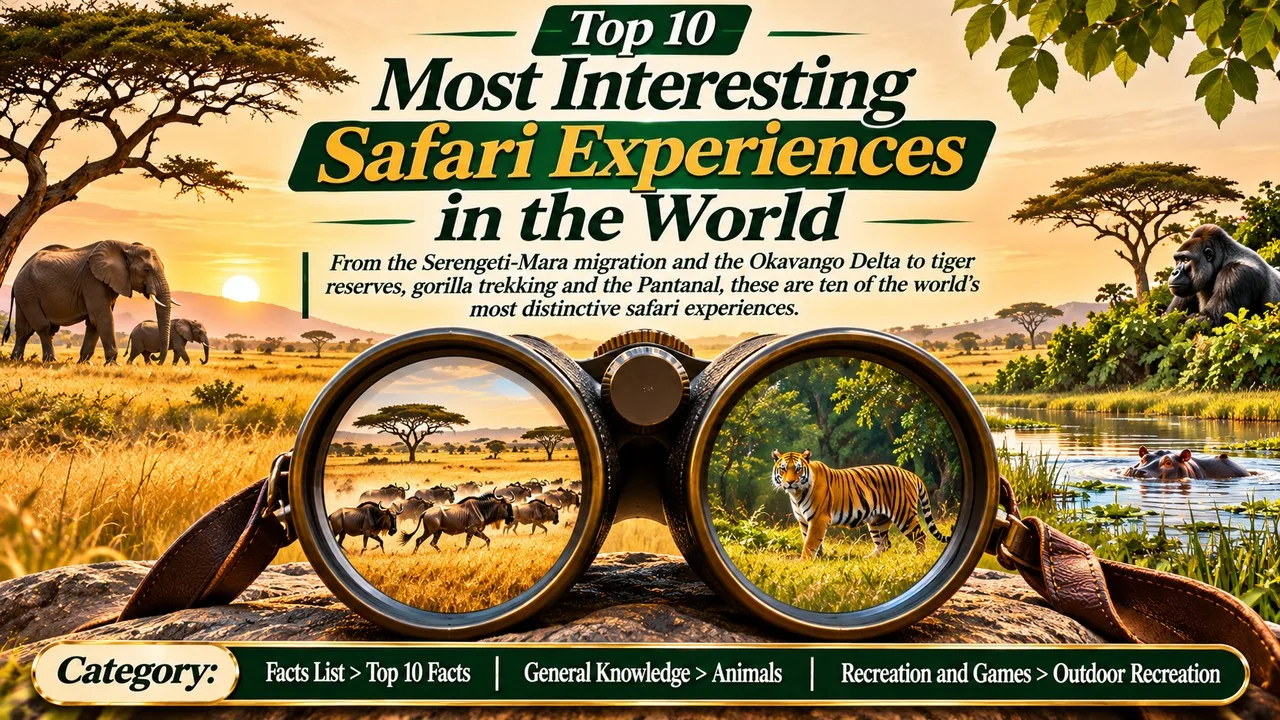
The Serengeti-Mara migration, Botswana's Okavango Delta and India's tiger reserves anchor this list of the world's most distinctive safari experiences. "Safari" here means a guided trip to see large wild animals in a protected landscape, not a zoo visit and not a generic beach holiday with a side excursion [1].
The list is weighted towards places that are famous for a particular sighting or landscape: the wildebeest migration, a flooded inland delta, a volcanic crater floor, tigers, mountain gorillas, walking safaris, jaguars in wetland, or desert-adapted wildlife. It is not a ranking of luxury camps, and it is not limited to East Africa, even though Kenya and Tanzania still define the word for many travellers [1][2].
Wildlife populations and park rules change. Gorilla-trekking permits, for example, are deliberately limited. Figures and protection status below are as of November 2026.
Key Facts
The table gives each destination's country, the signature wildlife experience, and a notable conservation or landscape fact.
Safari Experiences at a Glance
| Rank | Destination | Country | Signature experience | Notable fact |
|---|---|---|---|---|
| 1 | Serengeti National Park | Tanzania | Great wildebeest and zebra migration | UNESCO World Heritage site and the classic East African safari park |
| 2 | Maasai Mara National Reserve | Kenya | Migration river crossings and big-cat viewing | The Kenyan continuation of the same Serengeti ecosystem |
| 3 | Okavango Delta | Botswana | Water-based safari in a vast inland delta | UNESCO World Heritage site; often explored by mokoro and boat as well as by vehicle |
| 4 | Kruger National Park | South Africa | Mixed-habitat big-game viewing, including on self-drive trips | One of Africa's largest and most accessible parks, with private reserves on its borders |
| 5 | Ngorongoro Crater | Tanzania | Wildlife concentrated on a crater floor | A volcanic caldera within a UNESCO conservation area |
| 6 | Indian tiger reserves | India | Bengal tiger tracking in dry or sal forest | Project Tiger reserves such as Ranthambore, Kanha and Bandhavgarh |
| 7 | Mountain gorilla trekking | Rwanda and Uganda | Guided hikes to habituated gorilla groups | Strict, limited permits in Volcanoes National Park and Bwindi |
| 8 | South Luangwa National Park | Zambia | Walking safari and Luangwa river wildlife | A pioneer area for walking safaris |
| 9 | Pantanal | Brazil | Jaguar and wetland wildlife viewing | The world's largest tropical wetland |
| 10 | Etosha and Namibian safari | Namibia | Desert-adapted wildlife and huge salt pan | Etosha's waterholes and the country's desert landscapes |
1. Serengeti National Park
Serengeti National Park, in northern Tanzania, is the model of a classic East African safari. It is a UNESCO World Heritage site, and it forms the larger part of an ecosystem in which more than a million wildebeest, together with zebra and gazelle, move with the rains in the migration often called the largest of its kind [1][2]. Lion, leopard, cheetah, elephant and buffalo are all present, which is why the park is also a standard place to look for the so-called big five.
The migration is a circuit, not a single event, and the best month depends on whether a visitor wants calving on the southern plains or river crossings further north. That seasonal logic is part of what makes a Serengeti trip different from a static reserve visit [1]. The park can be explored from tented camps and lodges, or as part of a longer northern-Tanzania circuit.
The Serengeti's fame has a cost: some central areas are busy in high season. The landscape is still the reference point against which other safari destinations are judged [1][2].
2. Maasai Mara National Reserve
The Maasai Mara, in south-western Kenya, is the northern extension of the same grassland ecosystem as the Serengeti, separated only by a national border [3]. When the migration moves into Kenya, usually in the middle of the year, the Mara River crossings become one of the most watched wildlife events on Earth. For the rest of the year the reserve and the surrounding conservancies remain one of the most reliable places in Africa to see large predators, especially lions, cheetahs and leopards [3].
The Mara is smaller and, in places, more crowded than the Serengeti, which is why many travellers now spend time in the adjacent conservancies, where vehicle numbers and night-drive rules can be different. The reserve is also closely associated with Maasai pastoral land use, a relationship that is part of the area's conservation politics as well as its visitor image [3].
Related: Top 10 Famous Natural Landmarks of Africa
Together, the Mara and the Serengeti are one safari experience in two countries. A serious migration trip has to think about the border, the season and the river, not only about a single park name [3].
3. Okavango Delta
The Okavango Delta in Botswana is a huge inland delta, where the Okavango River spreads into the Kalahari instead of reaching the sea. UNESCO listed it as a World Heritage site in 2014, recognising a wetland that floods and recedes with a seasonal pulse and supports elephant, buffalo, hippo, crocodile, wild dog and a dense bird fauna [4].
Safari here is often amphibious. Visitors may travel by mokoro (dugout canoe), by motorboat and by 4x4, depending on the water level and the concession. That mix, and the feeling of being in a maze of channels and islands, is what sets the Okavango apart from an open-plain park [4]. Botswana's tourism model has generally favoured higher-cost, lower-volume camps in the private concessions, which keeps vehicle density down but also makes a trip expensive.
The delta is not a single reserve. Moremi Game Reserve sits in the eastern part of the system, and private concessions surround it. The experience depends heavily on which of those areas a traveller reaches [4].
4. Kruger National Park
Kruger National Park, in north-eastern South Africa, is one of the continent's largest and most practical safari parks. It has a long north-south extent, a dense road network, rest camps that allow self-drive visits, and a full range of large African mammals, including lion, leopard, elephant, rhino and buffalo [5]. Along its western boundary, private reserves in the Greater Kruger area offer guided drives, night drives and a more exclusive style of stay, often without fences between the private land and the national park [5].
Kruger's interest for this list is accessibility as much as wildlife. A first-time visitor can fly to an airstrip, or drive from Johannesburg, and still have a realistic chance of seeing a wide range of species. That is a different kind of safari from a fly-in camp in the Okavango, and it is why Kruger remains a foundational destination [5].
Poaching, especially of rhino, has been a serious problem in recent decades, and the park's management story is part of any current visit. The wildlife spectacle is still there, but it is not an unchanging backdrop [5].
5. Ngorongoro Crater
The Ngorongoro Crater is a vast, unbroken caldera in northern Tanzania, inside the wider Ngorongoro Conservation Area, itself a UNESCO World Heritage site [6]. The crater floor holds a permanent concentration of large animals, including lion, elephant, black rhino, buffalo and huge herds of herbivores, around a central soda lake used by flamingos [6]. Because the walls are steep and the floor is a defined bowl, a day's game drive here has a theatrical quality that open savannah does not.
Related: Top 25 Interesting Facts About the Solar System
The conservation area is also a multiple-use landscape, in which Maasai pastoralists live and graze livestock outside the crater itself. That arrangement is unusual among the most famous African parks and is part of Ngorongoro's complicated conservation history [6].
Visitor numbers on the crater floor are managed because the space is finite and demand is high. A trip is often paired with the Serengeti, but the crater is not a smaller version of the same place; it is a closed volcanic world with its own rules and rhythm [6].
6. Indian tiger reserves
India's tiger reserves offer a safari experience built around one animal, the Bengal tiger, in forests that also hold leopard, sloth bear, gaur, deer and a rich bird life [7]. Reserves such as Ranthambore in Rajasthan, Kanha and Bandhavgarh in Madhya Pradesh, and Corbett in Uttarakhand became the international face of this kind of trip, especially after Project Tiger and later camera-trap censuses made the species' recovery a public story [7].
Tiger watching is not like watching a lion on an open plain. The forest is denser, drives start early, and a sighting is never guaranteed. That uncertainty is part of the experience. Vehicle access is usually limited to booked safari slots, which is both a conservation measure and a visitor-management system [7].
India belongs on a global safari list because it is the main place to see tigers in the wild in a structured, park-based way. It also shows that "safari" as a travel form is not only African, even if the word itself travelled from Swahili and earlier hunting journeys [7].
7. Mountain gorilla trekking
Tracking mountain gorillas on foot in the Virunga mountains of Rwanda, and in Bwindi Impenetrable National Park and related forests in Uganda, is one of the world's most tightly controlled wildlife experiences [8]. Visitors hike with guides to a habituated family group, spend a strictly limited time with the animals, and then walk out again. Permits are limited and expensive, by design, so that each group of gorillas is not surrounded all day [8].
Related: Top 10 Mythical Creatures in World Mythology - That Inspired Myths Across Civilizations (unchanged)
The trekking is physically harder than a vehicle safari, and the reward is proximity to a great ape that exists only in this small range of central-African forest. Conservation here has been closely tied to tourism revenue and to the politics of parks that sit on international borders [8]. The Democratic Republic of the Congo also holds gorilla habitat in Virunga National Park, but most international tourist circuits are built around Rwanda and Uganda.
This is not a big-five game drive, and it should not be sold as one. It is a short, intense, permit-based encounter, and that is exactly why it belongs on a list of distinctive safari experiences [8].
8. South Luangwa National Park
South Luangwa National Park, in eastern Zambia, is famous less for a single headline species than for a style of safari. The Luangwa Valley, a branch of the Great Rift, has a high density of leopard, elephant, giraffe, hippo and specialist animals such as the Thornicroft's giraffe, and it was one of the cradles of the walking safari [9]. Guided walks, often at first light, are still a reason people come, alongside night drives that are more widely offered here than in some East African national parks [9].
The park has a marked wet and dry season, and the dry months concentrate animals along the river. Camps are often small and seasonal. South Luangwa is less famous than the Mara or Kruger, which is part of its appeal for travellers who want a classic African safari without the busiest circuits [9].
Zambia's wider valley system, including North Luangwa and other parks, offers related trips, but South Luangwa remains the name most often attached to walking as a central, not optional, part of the experience [9].
9. Pantanal
The Pantanal, mostly in Brazil but extending into Bolivia and Paraguay, is the world's largest tropical wetland and one of the best places on Earth to look for jaguars, along with caiman, capybara, giant otter, tapir and huge numbers of birds [10]. In the dry season, animals concentrate along rivers and remaining water, and boat safaris on the Transpantaneira and the rivers of the northern Pantanal have become a specialised form of wildlife watching [10].
This is a safari in a South American sense: cattle ranches, river lodges and long, flat horizons rather than acacia savannah. The wildlife, however, is as charismatic as anything in East Africa, and jaguar tourism has become an economic argument for keeping the wetland intact [10]. Related Finepedia coverage of South American landscapes includes famous natural landmarks of South America.
Related: Top 25 Interesting Facts About the Universe
Floods, cattle and fire all shape the Pantanal, and the landscape is not a sealed national park in the Serengeti mould. A good trip depends on the season and on a ranch or lodge that understands the river system [10].
10. Etosha and Namibian safari
Namibia offers a desert-edge safari that looks unlike the East African plains. Etosha National Park is built around a vast salt pan, with animals coming to permanent and managed waterholes, which makes sitting and watching as important as driving [11]. Elephant, lion, giraffe, rhino and large antelope are all present, often seen in pale, open light that is part of the park's identity [11].
Beyond Etosha, Namibia's appeal includes desert-adapted elephant and lion in the northwest, cheetah conservation landscapes, and the dune and desert scenery of the Namib, which is not a classic game drive but often forms part of the same journey [11]. The country is sparsely populated and well set up for self-drive travel, a different rhythm from a guided camp in Botswana.
Namibia closes this list because it shows how wide the idea of a safari has become: not only migration crossings and jungle walks, but also waterholes on a salt pan and wildlife that lives in genuine desert [11].
Conclusion
A global safari list still begins in the Serengeti-Mara and in Botswana's Okavango, then branches to Kruger, Ngorongoro, India's tiger forests, the gorilla mountains, Zambia's walking trails, Brazil's wetland, and Namibia's salt pan and desert. Each of those places is built around a different encounter, which is a better reason to travel than a search for a single "best" park.
Other strong options, including Malawi's restored parks, Sri Lanka's leopards, and Madagascar's unique mammals, could have been added in a longer list. Whatever the destination, the quality of a safari now depends as much on park rules, season and ethical distance from the animals as on the landscape itself. Related Finepedia wildlife lists include the best whale-watching destinations and the best aquariums in the world.
- ^ [1] "Serengeti National Park". UNESCO World Heritage Centre. UNESCO: Serengeti National Park
- ^ [2] "Serengeti National Park". Wikipedia. Wikipedia: Serengeti National Park
- ^ [3] "Maasai Mara". Wikipedia. Wikipedia: Maasai Mara
- ^ [4] "Okavango Delta". UNESCO World Heritage Centre. UNESCO: Okavango Delta
- ^ [5] "Kruger National Park". Wikipedia. Wikipedia: Kruger National Park
- ^ [6] "Ngorongoro Conservation Area". UNESCO World Heritage Centre. UNESCO: Ngorongoro Conservation Area
- ^ [7] "Project Tiger". Wikipedia. Wikipedia: Project Tiger
- ^ [8] "Mountain gorilla". Wikipedia. Wikipedia: Mountain gorilla
- ^ [9] "South Luangwa National Park". Wikipedia. Wikipedia: South Luangwa National Park
- ^ [10] "Pantanal". Wikipedia. Wikipedia: Pantanal
- ^ [11] "Etosha National Park". Wikipedia. Wikipedia: Etosha National Park





















Discussion
Log in with