






 By
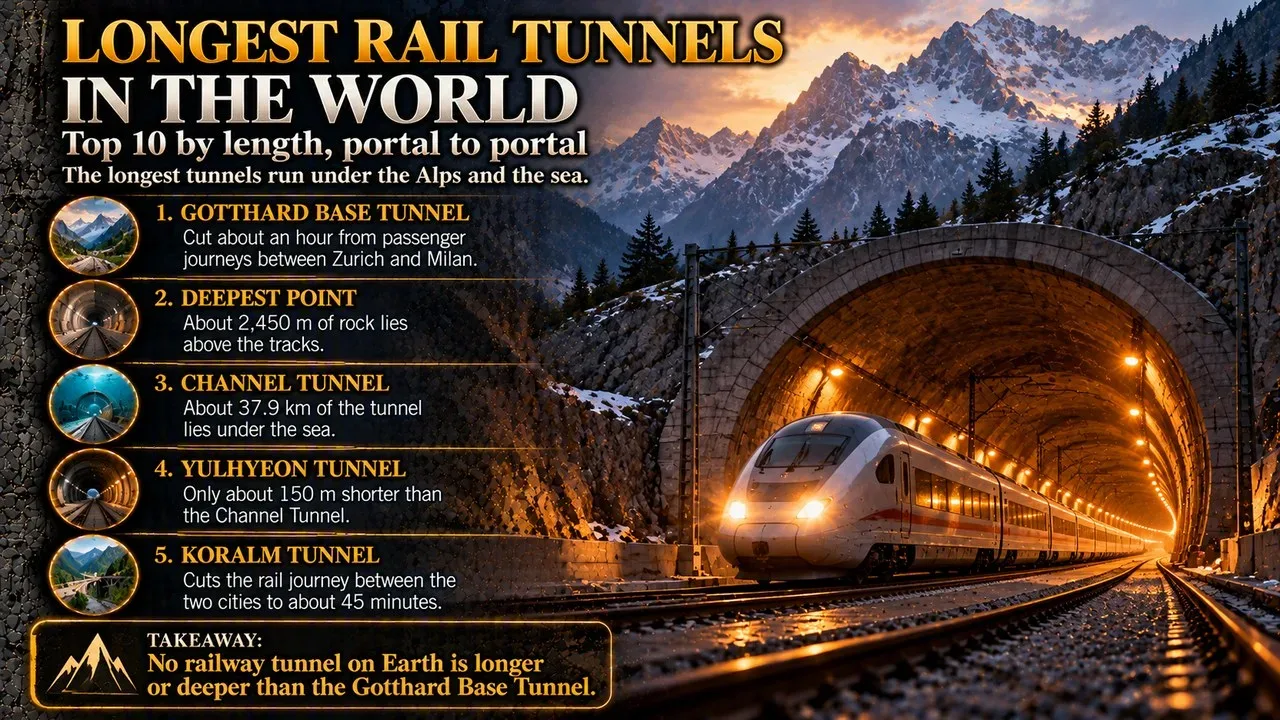
The longest rail tunnels in the world carry trains for tens of kilometres through mountain ranges and under the sea. Switzerland's Gotthard Base Tunnel heads the list with a route length of 57.09 kilometres, which also makes it the deepest traffic tunnel on Earth.[2] Japan's Seikan Tunnel and the Channel Tunnel between Britain and France come next, and both run for long stretches beneath the seabed.[3][4]
Introduction
For most of railway history, trains climbed over mountains on steep, winding lines and crossed straits on ferries. Long tunnels changed that. A tunnel bored deep under a mountain range lets trains run on almost flat track at high speed, and a tunnel under the sea removes the weather and the ferry from the journey altogether. Seven of the ten longest railway tunnels now in use were completed in 2016 or later, and several of the newest are in China, where high-speed and intercity networks have grown very quickly.[1]
This Finepedia list, updated in November 2026, ranks the ten longest railway tunnels that are in use today. Subway tunnel sections are left out. For each tunnel you will find its length, location and opening year, the line it serves, and the engineering stories that make it remarkable.
Key Facts
The table below sums up the ten tunnels on this list, with the country, length and completion year of each.
The 10 Tunnels at a Glance
| Rank | Tunnel | Country | Length | Completed |
|---|---|---|---|---|
| 1 | Gotthard Base Tunnel | Switzerland | 57.1 km | 2016 |
| 2 | Seikan Tunnel | Japan | 53.85 km | 1988 |
| 3 | Channel Tunnel | France and United Kingdom | 50.45 km | 1994 |
| 4 | Yulhyeon Tunnel | South Korea | 50.3 km | 2016 |
| 5 | Shanghai Airport Tunnel | China | 40.188 km | 2024 |
| 6 | Songshan Lake Tunnel | China | 38.813 km | 2016 |
| 7 | Pearl River Tunnel | China | 36.043 km | 2025 |
| 8 | Shenzhen–Hong Kong Tunnel | China and Hong Kong | 35.655 km | 2018 |
| 9 | Lötschberg Base Tunnel | Switzerland | 34.576 km | 2007 |
| 10 | Koralm Tunnel | Austria | 32.9 km | 2025 |
Source: list of the world's longest railway tunnels in use, excluding subway tunnel sections.[1]
How the Ranking Works
Tunnels are ranked by the length of their longest tube, and only tunnels that are open to traffic are counted.[1] Many long tunnels are built as two parallel single-track tubes rather than one large bore. The Gotthard Base Tunnel, for example, has two tubes of 57.104 and 57.017 kilometres, while the Channel Tunnel has three tubes, two for trains and one for service and safety.[1]
Length also depends on how it is measured. The Gotthard Base Tunnel has a route length of 57.09 kilometres, but the straight-line distance between its two portals is 55.782 kilometres, and the whole system of tubes, shafts and passages adds up to 151.84 kilometres of tunnel.[2] Where sources differ by a few metres, this list uses the figure given for the longest tube.
1. The Gotthard Base Tunnel Is the Longest and Deepest
The Gotthard Base Tunnel runs under the Swiss Alps between Erstfeld in the canton of Uri and Giornico in Ticino, passing deep beneath Sedrun in Graubünden. It opened in June 2016 and full timetable service began that December.[2] With a route length of 57.09 kilometres it is the longest railway tunnel in the world, and it is also the first flat, low-level route through the Alps.[2]
It is called a base tunnel because it runs near the foot of the mountains instead of high up. It bypasses most of the old Gotthard railway, a winding mountain line opened in 1882 that was running at full capacity. The aim was to carry far more traffic, especially freight on the Rotterdam–Basel–Genoa corridor, and to move goods from lorries to trains to reduce pollution and road accidents.[2] Together with the Ceneri Base Tunnel, opened in September 2020, and the Lötschberg Base Tunnel, it forms the New Railway Link through the Alps.[2]
The numbers are extraordinary. At its deepest point the tunnel lies 2,450 metres below the surface, comparable with the deepest mines on Earth. Work began in November 1999, the final breakthrough in the east tube came on 15 October 2010, and the two tubes are linked by 178 cross passages. The final cost was reported as 12.2 billion Swiss francs. Nine workers died during construction and were remembered at a ceremony at the north portal the day before the opening.[2]
2. Japan's Seikan Tunnel Runs Under the Tsugaru Strait
The Seikan Tunnel is a 53.85-kilometre railway tunnel linking Honshu with the northern island of Hokkaido. About 23.3 kilometres of it run under the seabed of the Tsugaru Strait, with the track roughly 100 metres below the seabed and 240 metres below sea level.[3] It opened on 13 March 1988 and today carries both the Hokkaido Shinkansen and the narrow-gauge Kaikyō Line.[3]
Related: Top 10 Longest Road Tunnels in the World
The tunnel was born from disaster. In 1954 five ferries, including the Tōya Maru, sank in the strait during a typhoon and 1,430 people died. The Japan Railway Construction Public Corporation was set up in 1964, excavation began that year, and the decision to dig the main tunnel was made in September 1971.[3] Its name joins the first characters of Aomori and Hakodate, the main cities on either side.
By total length it is the longest undersea tunnel in the world, even though the Channel Tunnel has the longer section under the sea. It is also the deepest railway tunnel below sea level. Two stations, Tappi-Kaitei and Yoshioka-Kaitei, once operated inside it as the first railway stations ever built under the sea. Building it cost the lives of 34 workers.[3]
3. The Channel Tunnel Links Britain and France
The Channel Tunnel, often called the Chunnel, runs for about 50.46 kilometres under the English Channel between Folkestone in England and Coquelles in northern France. It opened in 1994 and remains the only fixed link between Great Britain and mainland Europe.[4] Its undersea section of 37.9 kilometres is the longest of any tunnel in the world, reaching 75 metres below sea level and running an average of 45 metres below the seabed.[4]
The idea is surprisingly old. In 1802 the French mining engineer Albert Mathieu-Favier proposed a tunnel lit by oil lamps for horse-drawn coaches. The modern project was started by Eurotunnel in 1988 and finished in 1994 at a final cost of 4.65 billion pounds.[4]
The tunnel is operated by Getlink and carries Eurostar passenger trains, LeShuttle trains for cars and lorries, and freight trains. In 2017 Eurostar carried 10.3 million passengers, and LeShuttle moved 2.6 million cars and 1.6 million heavy goods vehicles. The tunnel was designed for 200 km/h, but trains are limited to 160 km/h for safety.[4]
4. South Korea's Yulhyeon Tunnel Serves High-Speed Trains
The Yulhyeon Tunnel opened on 9 December 2016 and, at 50.3 kilometres, is the fourth-longest railway tunnel in the world.[5] Unlike most of the long tunnels on this list it is a single double-track tube. It forms part of the 61.1-kilometre Suseo–Pyeongtaek high-speed railway, which links Suseo station in south-eastern Seoul with the Gyeongbu high-speed line, and it makes up about 82 percent of that new line.[5]
The tunnel was built using the New Austrian tunnelling method and designed for 300 km/h, although an intermediate stop at Dongtan station keeps average running speeds nearer 240 km/h.[5] Much of it lies over a seismic fault known as the Singal Fault, which led to an inquiry into its stability.
In 2021 an audit found design and construction flaws that had caused the trackbed to deform. In some sections the top operating speed had to be cut sharply, at times to as low as 90 km/h, showing that long tunnels need careful maintenance long after they open.[5]
5. The Shanghai Airport Tunnel Links Two Airports
The Shanghai Airport Tunnel is 40.188 kilometres long and was completed in 2024 on the Shanghai Airports Connection Rail Line.[1] This express line, also called the Airport Link Line, is 68.6 kilometres long and joins Hongqiao and Pudong, the city's two main airports.[6]
Related: Top 10 Fastest Trains in the World
Before the line opened, travellers changing airports usually took Metro Line 2, a trip of about 90 minutes. The new link cuts that to under 40 minutes. Construction began in June 2019, and the section from Hongqiao Airport Terminal 2 to Pudong Airport opened on 27 December 2024 with seven stations.[6]
The tunnel was dug with a large tunnel boring machine developed by Shanghai Tunnel Engineering Co. Building such a long tunnel through the soft, water-rich ground of the Yangtze delta is very different from cutting through Alpine rock, and it shows how far tunnelling technology has spread.[6]
6. The Songshan Lake Tunnel Serves the Pearl River Delta
The Songshan Lake Tunnel in Dongguan is a twin-tube tunnel 38.813 kilometres long, completed in 2016 on the Dongguan–Huizhou intercity railway.[1] It takes its name from the Songshan Lake district of Dongguan, one of several districts the line passes through.[7]
The railway, also called the Guanghui intercity railway, runs for 139.8 kilometres between Guangzhou and Huizhou and was designed for speeds of 200 km/h. Its first section opened on 30 March 2016.[7] It is one part of a dense intercity network built to tie together the cities of the Pearl River Delta, one of the most crowded urban regions in the world.
Putting so much of the route underground lets the trains run straight and fast beneath built-up areas, without demolishing homes and factories on the surface. That logic explains why so many of the newest long tunnels are in southern China.
7. The Pearl River Tunnel Is One of the Newest
The Pearl River Tunnel in Guangdong is a twin-tube tunnel 36.043 kilometres long, completed in 2025 on the Guangzhou–Foshan circular intercity railway.[1] It is one of the newest entries on any list of long railway tunnels.
The railway, also known as the Guangfo ring intercity railway, is planned to form a ring around Guangzhou as part of the Pearl River Delta's intercity network.[8] Its section from Huadu to Baiyun Airport North opened on 30 November 2020, and the line was extended to Panyu on 29 September 2025.[8]
Like the Songshan Lake Tunnel, it shows how China has used long urban tunnels to build fast regional rail through crowded cities, and further long tunnels in the region are still being planned.
Related: Top 10 Most Expensive Megaprojects in History
8. The Shenzhen–Hong Kong Tunnel Carries High-Speed Trains Across a Border
The Shenzhen–Hong Kong Tunnel is 35.655 kilometres long and was completed in 2018 on the Guangzhou–Shenzhen–Hong Kong Express Rail Link.[1] The final phase of that line, from Shenzhen Futian to Hong Kong West Kowloon, opened on 22 September 2018.[9]
The tunnel lets high-speed trains run from the heart of Hong Kong straight into mainland China. The fastest journey from West Kowloon to Futian takes 14 minutes, and the fastest to Guangzhou South takes 46 minutes.[9]
Planners wanted to cut the trip from Guangzhou to Hong Kong from about 100 minutes to under an hour, and trains running at up to 350 km/h on the mainland section made that possible.[9]
9. The Lötschberg Base Tunnel Was the Alps' First Great Base Tunnel
The Lötschberg Base Tunnel is 34.57 kilometres long and cuts through the Bernese Alps about 400 metres below the older Lötschberg Tunnel, between Frutigen in Bern and Raron in Valais.[10] Construction began in 1999, the tunnel broke through in 2005, and trains began running in December 2007, almost nine years before the Gotthard Base Tunnel opened.[10]
It was a victim of its own success. Because about 21 kilometres were built with only a single track, the tunnel was full within a few years. In early 2024 the Swiss parliament decided to complete the second bore, with work expected to start in 2028.[10] Passenger trains run through it at 200 km/h and freight trains at about 100 km/h, and lorries and trailers can be loaded onto trains in Germany and unloaded in Italy.
Warm water flowing out of the mountain is put to an unusual use. It heats the Tropenhaus Frutigen, a tropical greenhouse that grows exotic fruit and raises sturgeon for meat and caviar.[10]
10. Austria's Koralm Tunnel Opened in December 2025
The Koralm Tunnel runs under the Koralpe mountains in southern Austria and forms part of the 130-kilometre Koralm Railway between Graz and Klagenfurt.[11] At 32.9 kilometres it is Austria's longest railway tunnel, lying up to 1,250 metres below the surface, with two parallel single-track tubes linked every 500 metres.[11]
It was officially opened on 12 December 2025 and regular service began two days later. The railway is designed for up to 250 km/h and cuts journey times between Vienna and Klagenfurt via Graz by more than an hour, to about two hours and 40 minutes.[11]
Related: Top 25 Interesting Facts About the Solar System
Boring began in 2013 with more than 800 workers and three tunnel boring machines. Using a boring machine continuously through hard rock for more than 17 kilometres was reported as a world first.[11]
Tunnels Just Outside the Top 10 and Under Construction
China's New Guanjiao Tunnel on the Qinghai–Tibet Railway is 32.645 kilometres long and lies more than 3,300 metres above sea level. It opened on 28 December 2014.[14] Spain's Guadarrama Tunnel, with tubes of just over 28.4 kilometres, crosses the Sierra de Guadarrama on the Madrid high-speed line to the north-west and opened in December 2007.[15]
Two Alpine giants are being built. The Brenner Base Tunnel, about 55 kilometres long between Innsbruck in Austria and Fortezza in Italy, is due in 2032 and, joined with the Inntal Tunnel, will form a 64-kilometre underground rail link.[12] The 57.5-kilometre Mont d'Ambin Base Tunnel between France and Italy will be slightly longer than the Gotthard when it is finished, expected in the early 2030s.[13]
Frequently Asked Questions
What is the longest rail tunnel in the world?
The Gotthard Base Tunnel in Switzerland, with a route length of 57.09 kilometres. It opened in 2016.[2]
What is the longest undersea tunnel?
By total length it is Japan's Seikan Tunnel. The Channel Tunnel has the longest section under the sea, at 37.9 kilometres.[3][4]
Which tunnel will become the longest?
The Mont d'Ambin Base Tunnel between France and Italy, at 57.5 kilometres, will be slightly longer than the Gotthard Base Tunnel.[13]
Conclusion
The world's longest rail tunnels show how railways solved two old problems, mountains and seas. The Gotthard and Lötschberg tunnels flattened the route through the Alps, the Seikan and Channel tunnels removed the ferry, and the new tunnels of China and South Korea carry high-speed and intercity trains beneath crowded cities. With the Brenner and Mont d'Ambin tunnels under way, this list will change again within a decade.
See also
- Top 10 Longest Suspension Bridges in the World
- Top 10 Tallest Buildings in the World
- Top 10 Highest Mountains in the World
- ^ [1] "List of longest railway tunnels". Wikipedia. Wikipedia
- ^ [2] "Gotthard Base Tunnel". Wikipedia. Wikipedia
- ^ [3] "Seikan Tunnel". Wikipedia. Wikipedia
- ^ [4] "Channel Tunnel". Wikipedia. Wikipedia
- ^ [5] "Yulhyeon Tunnel". Wikipedia. Wikipedia
- ^ [6] "Shanghai Airport Connection Rail". Wikipedia. Wikipedia
- ^ [7] "Dongguan–Huizhou intercity railway". Wikipedia. Wikipedia
- ^ [8] "Guangzhou–Foshan circular intercity railway". Wikipedia. Wikipedia
- ^ [9] "Guangzhou–Shenzhen–Hong Kong Express Rail Link". Wikipedia. Wikipedia
- ^ [10] "Lötschberg Base Tunnel". Wikipedia. Wikipedia
- ^ [11] "Koralm Tunnel". Wikipedia. Wikipedia
- ^ [12] "Brenner Base Tunnel". Wikipedia. Wikipedia
- ^ [13] "Mont d'Ambin Base Tunnel". Wikipedia. Wikipedia
- ^ [14] "New Guanjiao Tunnel". Wikipedia. Wikipedia
- ^ [15] "Guadarrama Tunnel". Wikipedia. Wikipedia























Discussion
Log in with