










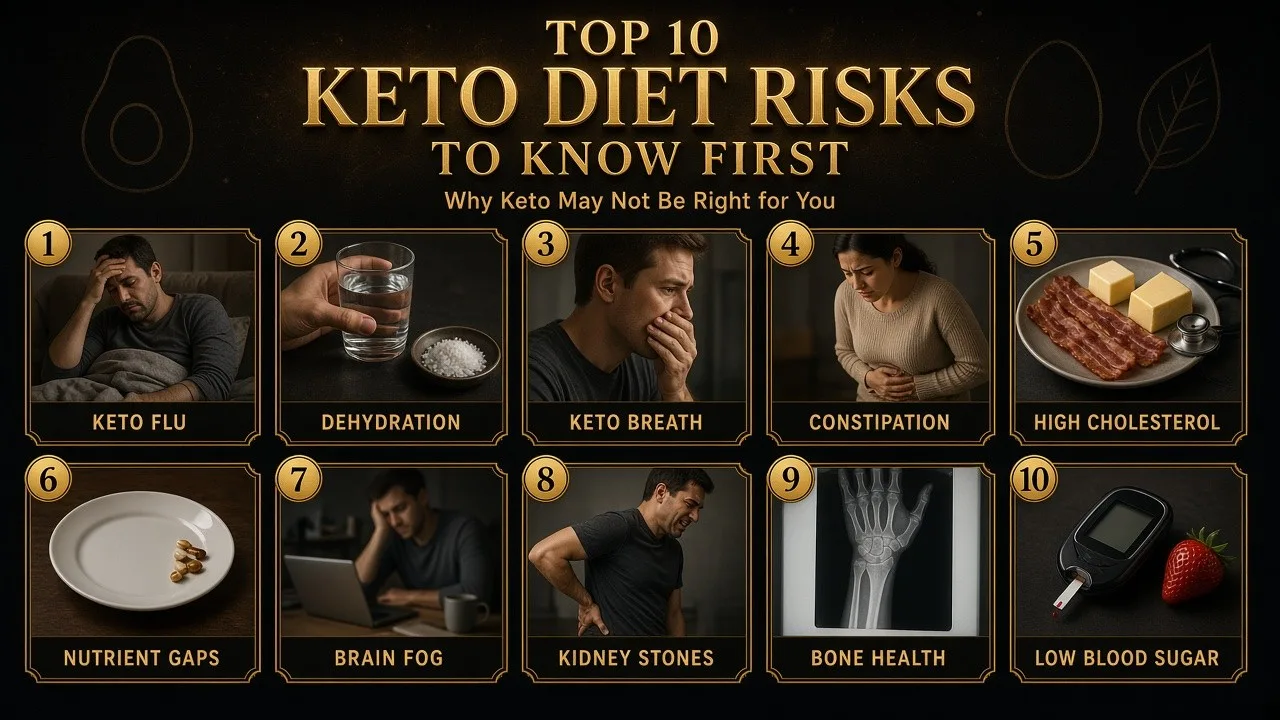
Keto diet risks include keto flu, dehydration, bad breath, constipation, higher LDL cholesterol, nutrient gaps, kidney stones and weaker bones.
The ketogenic, or keto, diet cuts carbohydrates so far that the body switches to burning fat and making ketones for fuel. It can produce quick weight loss, and it has a long record as a medical treatment for epilepsy that does not respond to drugs. But it is also one of the most restrictive eating plans in popular use, and it does not suit everyone.
This guide sets out ten common reasons the keto diet may not be right for you, from the short-lived side effects most people notice in the first weeks to the long-term concerns doctors watch for. It also lists the people who should not start keto without medical supervision, and the situations where the diet genuinely helps.
How the Keto Diet Works
On a typical diet, carbohydrates from grains, fruit, starchy vegetables and sugar are broken down into glucose, the body's main fuel. The brain alone uses about 120 g of glucose a day, according to the Harvard T.H. Chan School of Public Health. When carbohydrate intake drops very low, the body first uses up the glucose stored in the liver and muscles. After a few days, insulin levels fall and the liver starts turning fat into three compounds called ketone bodies: beta-hydroxybutyrate, acetoacetate and acetone. A raised level of ketones in the blood is called ketosis.
There is no single standard keto plan, but most popular versions share the same broad pattern.
- Carbohydrates: usually under 50 g a day and sometimes as low as 20 g, which is less than a medium banana (about 27 g) or a medium plain bagel.
- Fat: about 70 to 80% of daily calories, eaten at every meal and snack.
- Protein: moderate, about 10 to 20% of calories, because too much protein can be turned into glucose and stop ketosis.
- On a 2,000-calorie day, Harvard estimates this works out to roughly 165 g of fat, 40 g of carbohydrate and 75 g of protein.
To stay this low in carbohydrate, keto plans remove bread, rice, pasta, cereals, potatoes, corn, beans, lentils, most fruit, fruit juice, sugar and most alcohol. Meals centre on meat, fish, eggs, cheese, butter, oils, nuts, seeds, avocado and non-starchy vegetables such as leafy greens, broccoli and cauliflower. That sharp shift in what people eat is the root of most of the risks below.
How We Chose These 10 Risks
This is an editorial list, not a medical ranking. Each reason was included because at least one major health body or a body of clinical research links it to the ketogenic diet, and because it affects a meaningful number of people who try it. The list runs roughly from the side effects most people meet early on to the less common but more serious concerns.
It is general information, not personal medical advice. Anyone with a health condition, anyone taking regular medication, and anyone who is pregnant or breastfeeding should speak to a doctor or registered dietitian before changing their diet this much.
Keto Diet Risks at a Glance
| No. | Risk | When It Usually Appears | Who Is Most Affected | How Common |
|---|---|---|---|---|
| 1 | Keto flu | First days to weeks | Almost anyone starting the diet | Common |
| 2 | Fluid and electrolyte loss | First weeks | People who sweat a lot, older adults, people on blood pressure pills | Common |
| 3 | Keto breath | While in ketosis | Anyone in deep ketosis | Common |
| 4 | Constipation | Early and ongoing | People who eat few vegetables | Common |
| 5 | Higher LDL cholesterol | Weeks to months | People eating lots of saturated fat | Varies widely |
| 6 | Nutrient gaps | Months | Anyone on a narrow food list | Common without planning |
| 7 | Brain fog, mood and sleep changes | First weeks | New starters, athletes in heavy training | Fairly common |
| 8 | Kidney stones | Months to years | Long-term followers, people with past stones | Less common |
| 9 | Bone and hormone effects | Long term | Children, teenagers, women | Less common |
| 10 | Low blood sugar and ketoacidosis | Any time | People with diabetes, people on certain medicines, breastfeeding women | Rare but serious |
1. Keto Flu
| Attribute | Details |
|---|---|
| What it is | A cluster of flu-like symptoms as the body adapts to burning fat |
| Main symptoms | Headache, tiredness, dizziness, nausea, poor sleep, low exercise tolerance |
| When it happens | Usually in the first days and weeks after cutting carbohydrates |
| Cause | The switch from glucose to fat as the main fuel, plus fluid and salt losses |
| Seriousness | Usually mild and temporary, but enough to make many people quit |
What Happens
Keto flu is the informal name for the rough patch many people go through when they first slash carbohydrates. It is not an infection and it is not contagious. It is the body adjusting to a very different fuel supply while glucose stores run down and the liver ramps up ketone production.
Medical reviews of ketosis list headache, fatigue, dizziness, insomnia, difficulty exercising, constipation and nausea as typical early effects. Some people feel only mildly flat for a few days; others feel unwell enough to stop the diet before the symptoms pass.
Signs to Watch For
- A dull headache that starts within the first few days
- Unusual tiredness, weakness or heavy legs during exercise
- Light-headedness when standing up quickly
- Nausea, irritability and difficulty concentrating
- Trouble falling or staying asleep
How to Reduce the Risk
Cutting carbohydrates gradually over a week or two, rather than overnight, gives the body more time to adapt. Drinking enough fluid and replacing lost salt, as described under the next risk, often eases headaches and dizziness. Symptoms that are severe, or that last more than a couple of weeks, are a reason to see a doctor rather than push on.
Interesting Facts
- Keto flu is a popular nickname, not a formal medical diagnosis.
- Very similar early symptoms are described for other very low-carbohydrate diets, not only keto.
- Medical keto programmes for epilepsy often start the diet gradually and no longer begin with a fast, partly because fasting increases the risk of low blood sugar and acidosis.
2. Fluid and Electrolyte Loss
| Attribute | Details |
|---|---|
| What it is | Loss of water and minerals such as sodium, potassium and magnesium |
| Main symptoms | Thirst, dizziness, headaches, muscle cramps, palpitations |
| When it happens | Mostly in the first weeks |
| Cause | Glycogen stores run down and ketones are excreted in urine along with water |
| Seriousness | Usually manageable, but riskier for older adults and people on some medicines |
What Happens
Much of the weight people lose in the first week or two of keto is water rather than fat. The body stores carbohydrate as glycogen, which is held with water, and as those stores are used up the water goes too. Harvard's Nutrition Source also notes that when ketones build up, the kidneys excrete them along with body water, adding to the early fluid loss.
Minerals leave with the water. Lower insulin levels encourage the kidneys to release more sodium, and potassium and magnesium can fall as well. Researchers studying very low-calorie keto diets have raised concerns about blood sodium levels and suggested such diets be used only in selected people.
Signs to Watch For
- Strong thirst and dark urine
- Dizziness or feeling faint, especially on standing
- Muscle cramps, often in the calves at night
- A racing or fluttering heartbeat
- Headaches that ease after drinking fluid with salt
How to Reduce the Risk
Drinking regularly through the day and including salty broth or lightly salted food can help most healthy adults. People who take diuretics or other blood pressure medicines, or who have heart or kidney disease, should not add extra salt or mineral supplements without medical advice, because their medicines may already change how the body handles sodium and potassium.
Interesting Facts
- The rapid early drop on the scales is one reason keto feels so effective at first.
- That water usually returns quickly when carbohydrates are eaten again, which can look like sudden weight regain.
- Epilepsy clinics once restricted fluids for children on keto to 80% of normal needs; that practice is no longer encouraged because it raises kidney stone risk.
3. Keto Breath
| Attribute | Details |
|---|---|
| What it is | A distinctive breath odour linked to ketosis |
| Main symptoms | Fruity, sweet or nail-polish-like smell; sometimes a metallic taste |
| When it happens | While ketone levels are raised |
| Cause | Acetone, one of the three ketone bodies, is breathed out through the lungs |
| Seriousness | Harmless in itself, but socially awkward for many people |
What Happens
Acetone is the simplest of the three ketone bodies, and because it evaporates easily, some of it leaves the body in the breath. The result is a smell that many people describe as fruity, sweet or similar to nail-polish remover. Brushing teeth does not remove it, because it comes from the lungs rather than the mouth.
The same breath smell is one of the warning signs doctors look for in ketoacidosis, a dangerous condition covered under risk 10. In a healthy person on keto, however, it usually just reflects normal dietary ketosis.
Signs to Watch For
- A sweet or fruity smell that others notice
- A dry mouth or a lingering metallic taste
- Breath odour that persists after brushing and mouthwash
How to Reduce the Risk
Drinking plenty of water, chewing sugar-free gum and keeping up good dental hygiene can mask the smell. For many people it fades after the first few weeks. A fruity breath smell together with nausea, vomiting, stomach pain or rapid breathing is different and needs urgent medical attention.
Interesting Facts
- Breath meters that measure acetone are sold as a way to check whether someone is in ketosis.
- Ketone levels can be tested in urine, blood or breath, though each method measures a different ketone body.
- Acetone is the same compound used in many nail-polish removers.
4. Constipation and Gut Changes
| Attribute | Details |
|---|---|
| What it is | Hard, infrequent stools, or sometimes loose stools |
| Main symptoms | Straining, bloating, stomach discomfort |
| When it happens | Often early, and can continue long term |
| Cause | Little fibre from grains, beans and fruit, plus fluid loss |
| Seriousness | Usually mild but very common |
What Happens
Constipation is one of the most frequently reported side effects of the ketogenic diet in children and adults alike. Harvard Health Publishing points out that keto removes many of the foods that normally supply fibre, such as whole grains, beans and lentils, and most fruit. Combined with the early loss of body water, that slows the gut down for many people.
Some people have the opposite problem. A sudden jump in fat intake can cause loose stools or diarrhoea while the digestive system adjusts, and sugar alcohols used in many keto snacks are known to have a laxative effect in larger amounts.
Signs to Watch For
- Fewer bowel movements than usual
- Hard stools, straining or a feeling of incomplete emptying
- Bloating and wind
- Loose stools after very high-fat meals or keto snack bars
How to Reduce the Risk
Filling half the plate with non-starchy vegetables such as leafy greens, broccoli, cauliflower, courgette and peppers adds fibre without many carbohydrates. Seeds such as chia and flaxseed and nuts also help, as does drinking enough water. Persistent constipation, or constipation with pain or blood, should be checked by a doctor.
Interesting Facts
- Most adults in Western countries already eat less fibre than recommended before starting any diet.
- Constipation is listed among the common, easily treated side effects in medical keto programmes for epilepsy.
- Fibre is a carbohydrate, which is why some keto plans count net carbs and exclude it from the total.
5. Higher LDL Cholesterol
| Attribute | Details |
|---|---|
| What it is | A rise in low-density lipoprotein, the "bad" cholesterol, in some people |
| Main symptoms | None; it only shows up on a blood test |
| When it happens | Over weeks to months |
| Cause | High intake of saturated fat from butter, fatty meat, cheese, coconut and palm oil |
| Seriousness | A long-term heart disease risk factor |
What Happens
Harvard Health Publishing names saturated fat as the top concern with keto. Many plans encourage butter, lard, cream, fatty cuts of meat, bacon and coconut or palm oil in large amounts, and the diet is associated with a rise in LDL cholesterol, which is linked to heart disease. Harvard's experts suggest keeping saturated fat to no more than 7% of daily calories, a limit that is hard to meet on a typical keto menu.
The response varies a great deal between people. Some see their triglycerides fall and their HDL cholesterol rise, while others see a large jump in LDL. In children treated with keto for epilepsy, raised blood lipids affect up to 60%, and cholesterol can rise by about 30%. Reviews of low-carbohydrate diets also report that long-term use tends to raise total and LDL cholesterol.
Signs to Watch For
There are no symptoms of high cholesterol, so the only way to know is a blood test. People with a family history of early heart disease, existing heart disease or a known inherited cholesterol disorder should be especially cautious.
How to Reduce the Risk
Choosing mostly unsaturated fats, such as olive oil, avocado, nuts, seeds and oily fish, rather than butter, cream and processed meat, can limit the rise. Medical keto teams lower the share of saturated fat, or loosen the diet, when lipid levels climb. Anyone following keto for more than a few weeks should ask their doctor about a lipid test before and during the diet.
Interesting Facts
- Harvard notes that keto, unlike most low-carb diets, is built around fat rather than protein, with fat supplying up to 90% of calories in some versions.
- Short-term studies often show improvements in triglycerides and blood pressure alongside weight loss.
- Following a low-carbohydrate diet for less than two years has not been found to worsen heart markers on average, but long-term data are less reassuring.
6. Nutrient Gaps
| Attribute | Details |
|---|---|
| What it is | Shortfalls in vitamins, minerals and fibre from a narrow food list |
| Nutrients at risk | Selenium, magnesium, phosphorus, B vitamins, vitamin C, fibre |
| When it happens | Over months |
| Cause | Cutting out whole grains, beans, most fruit and many vegetables |
| Seriousness | Can be significant if the diet is followed long term without planning |
What Happens
Removing whole food groups removes the nutrients they supply. Harvard Health Publishing warns that people who are not eating a wide variety of vegetables, fruits and grains may be at risk of deficiencies in selenium, magnesium, phosphorus, and vitamins B and C. Clinical keto programmes for epilepsy routinely prescribe supplements because the diet alone does not cover many micronutrients.
Low-carbohydrate diets in general can also make it difficult to get enough fibre, and research on carbohydrate quality suggests that high-fibre, slowly digested carbohydrates are linked with better long-term health than refined starches and sugars.
Signs to Watch For
- Ongoing tiredness or weakness
- Muscle cramps or twitching, which can point to low magnesium
- Bleeding gums or slow-healing cuts, rare signs of very low vitamin C
- Frequent constipation linked to low fibre
How to Reduce the Risk
Eating a wide range of non-starchy vegetables, berries in small portions, nuts, seeds, eggs and oily fish covers more nutrients than a menu built on meat, cheese and butter. A registered dietitian can check the plan, and a doctor can advise whether a multivitamin or specific supplements are needed.
Interesting Facts
- One cup of chopped broccoli has about 6 g of carbohydrate, according to Harvard Health, making it one of the most keto-friendly vegetables.
- Medical keto diets are calculated individually by dietitians, food by food.
- Bananas, potatoes, peas and corn are typically excluded because of their starch or sugar content.
7. Brain Fog, Mood and Sleep Changes
| Attribute | Details |
|---|---|
| What it is | Difficulty thinking clearly, irritability and disturbed sleep |
| Main symptoms | Poor focus, confusion, mood swings, insomnia |
| When it happens | Mostly in the first weeks |
| Cause | The brain adapting from glucose to ketones; lower energy for intense effort |
| Seriousness | Usually temporary, but a problem for people with demanding jobs or training |
What Happens
Harvard Health Publishing notes that the brain normally runs best on glucose from carbohydrates, and that low-carbohydrate diets may cause confusion and irritability. Insomnia is also listed among the common early effects of switching to fat metabolism. For many people these effects ease as the body adapts, but they can make the first weeks hard at work, at school or behind the wheel.
Athletes who rely on short bursts of high-intensity effort may also notice that they tire sooner, because those efforts depend heavily on glucose stored in the muscles.
Signs to Watch For
- Losing track of tasks or struggling to concentrate
- Feeling short-tempered or low in mood
- Waking during the night or sleeping poorly
- Reduced performance in sprints, interval training or heavy lifting
How to Reduce the Risk
Starting keto during a quieter period, rather than before exams, a big project or a competition, gives time to adapt. Steady fluid and salt intake, regular meals and a consistent sleep routine help. People with a history of depression, anxiety or eating disorders should talk to a professional before starting a highly restrictive diet.
Interesting Facts
- Ketones can supply a large share of the brain's energy during long periods of very low carbohydrate intake.
- Some people report sharper focus once adapted; the evidence for this is mostly personal accounts.
- Harvard Health describes keto as a diet that is not the type to try as an experiment.
8. Kidney Stones and Kidney Strain
| Attribute | Details |
|---|---|
| What it is | Mineral stones forming in the kidneys or urinary tract |
| Main symptoms | Severe pain in the side or back, blood in urine, nausea |
| When it happens | Usually after months or years on the diet |
| Cause | Acidic urine, low citrate, extra calcium in urine and dehydration |
| Seriousness | Painful and sometimes needs treatment, but treatable |
What Happens
Kidney stones are one of the best-documented long-term risks of the ketogenic diet. In children treated for epilepsy, about one in 20 develop stones, compared with one in several thousand in the general population. Researchers point to four contributing factors: extra calcium in the urine as acid draws minerals from bone, low levels of citrate (which normally helps keep calcium dissolved), acidic urine that lets uric acid crystals form, and too little fluid.
Harvard Health Publishing adds that the kidneys help process protein and the diet may overload them, while existing liver conditions could be made worse by the large amount of fat to metabolise. People who already have kidney disease are generally advised not to try keto without close medical supervision.
Signs to Watch For
- Sudden, severe pain in the side, back or lower abdomen, often coming in waves
- Pink, red or brown urine
- Pain when passing urine, or needing to go often
- Nausea, vomiting or fever with any of the above, which needs urgent care
How to Reduce the Risk
Drinking plenty of water is the simplest protection. Around half of epilepsy clinics give potassium citrate supplements to all patients on keto, and there is some evidence this lowers stone formation, though it has not been proven in a controlled trial. Anyone who has had kidney stones before should speak to their doctor before starting.
Interesting Facts
- Stones linked to keto are treatable and, in medical programmes, do not usually mean the diet has to stop.
- Some epilepsy medicines also raise kidney stone risk, but combining them with keto does not appear to raise it further.
- Medical teams now encourage normal fluid intake for children on keto, reversing older advice to restrict fluids.
9. Bone and Hormone Effects
| Attribute | Details |
|---|---|
| What it is | Weaker bones over time and changes to growth and periods |
| Main concerns | Bone loss, fractures, slowed growth in children, menstrual changes |
| When it happens | Usually with long-term use |
| Cause | Mild acidosis, lower growth factors and reduced energy intake |
| Seriousness | Most important for children, teenagers and women |
What Happens
Long-term use of the ketogenic diet in children increases the risk of slowed or stunted growth, bone fractures and kidney stones. The diet lowers insulin-like growth factor 1, a hormone that matters for childhood growth, and mild acidosis can draw calcium out of the bones. Like several epilepsy drugs, keto has an adverse effect on bone health, which is why children on medical keto diets are monitored closely.
In adolescents and adults, painful periods (dysmenorrhoea) are among the side effects reported in studies, alongside weight loss, constipation and raised blood lipids. Any very restrictive diet that leads to rapid weight loss or too little energy can also disrupt periods.
Signs to Watch For
- Irregular, painful or missed periods
- A child falling off their usual growth curve
- Fractures after minor falls
- Unexplained bone or joint pain
How to Reduce the Risk
Children and teenagers should only follow a ketogenic diet under medical supervision. Adults can protect their bones by eating enough calories, calcium and vitamin D, staying active with weight-bearing exercise and avoiding very long stretches on the diet without check-ups. Missed periods for three months or more are a reason to see a doctor.
Interesting Facts
- Bones are made mainly of calcium phosphate, which acid can gradually break down.
- Medical keto teams usually prescribe calcium and vitamin D supplements.
- Children on keto for epilepsy commonly stay on the diet for around two years before it is gradually withdrawn.
10. Low Blood Sugar and Ketoacidosis
| Attribute | Details |
|---|---|
| What it is | Dangerously low blood glucose, or a harmful build-up of acid in the blood |
| Main symptoms | Shakiness, sweating and confusion (low sugar); vomiting, stomach pain, rapid breathing (ketoacidosis) |
| When it happens | Any time, especially when starting or changing medicines |
| Who is most at risk | People with diabetes on insulin or other glucose-lowering drugs, people on SGLT2 inhibitors, breastfeeding women |
| Seriousness | Rare in healthy people, but potentially life-threatening |
What Happens
For people with diabetes who take insulin or other glucose-lowering medicines, cutting carbohydrates sharply without adjusting the dose can push blood sugar dangerously low. This is called hypoglycaemia, and it can cause shakiness, sweating, hunger, confusion and, in severe cases, seizures or loss of consciousness.
Ketoacidosis is a different and more dangerous problem. Normal dietary ketosis keeps the blood's acid balance stable, but in ketoacidosis ketones build up uncontrollably and the blood becomes acidic. It most often affects people with type 1 diabetes, who cannot make insulin. SGLT2 inhibitor medicines for diabetes can cause a form that occurs even with normal blood sugar, and Harvard notes that ketoacidosis has been reported in rare cases in people without diabetes on prolonged very low-carbohydrate diets, including a breastfeeding woman described in a 2015 case report.
Signs to Watch For
- Shakiness, sweating, sudden hunger and confusion, which suggest low blood sugar
- Nausea, vomiting and stomach pain
- Deep, rapid breathing and a strong fruity breath smell
- Extreme tiredness or drowsiness
How to Reduce the Risk
Anyone with diabetes, and anyone taking insulin, sulfonylureas or SGLT2 inhibitors, must talk to their doctor before cutting carbohydrates, because doses may need to change. Breastfeeding women should also get advice first. Symptoms of ketoacidosis need emergency medical care.
Interesting Facts
- Healthy people go into mild ketosis naturally overnight and during very strenuous exercise.
- Ketoacidosis from fasting alone is rare and usually happens with another stress such as pregnancy, breastfeeding or illness.
- In the 19th century, low-carbohydrate, high-fat diets were used to help control diabetes before insulin was discovered.
Who Should Not Try the Keto Diet
Some people should avoid the ketogenic diet altogether, and others should only try it under medical supervision. The list below draws on Harvard guidance, clinical keto protocols and published case reports.
| Group | Main Concern | Advice |
|---|---|---|
| People with type 1 diabetes | Risk of ketoacidosis and low blood sugar | Only with a specialist diabetes team |
| People on insulin, sulfonylureas or SGLT2 inhibitors | Low blood sugar; ketoacidosis with SGLT2 inhibitors | Talk to a doctor before cutting carbohydrates |
| Pregnant or breastfeeding women | Higher needs for nutrients; reported ketoacidosis while breastfeeding | Not recommended without medical advice |
| People with kidney disease or past kidney stones | Stone risk and extra load on the kidneys | Medical supervision only |
| People with liver, pancreas or gallbladder conditions | Difficulty processing a very high fat intake | Get medical advice first |
| People with disorders of fat metabolism, pyruvate carboxylase deficiency or porphyria | The diet is medically contraindicated | Avoid |
| People with heart disease or very high cholesterol | LDL cholesterol may rise | Only with lipid monitoring |
| Children and teenagers | Growth, bone health and nutrient needs | Only as a supervised medical diet |
| People with a history of eating disorders | Strict rules can trigger relapse | Speak to a professional first |
When the Keto Diet Can Help
The keto diet is not only a weight-loss trend. It began as a medical treatment and is still used in hospitals today, which is part of why doctors stress that it should be taken seriously.
- Epilepsy: the ketogenic diet reduces seizure frequency by more than half in about half of patients who try it, and by more than 90% in about a third. It is recommended for children with drug-resistant epilepsy in national guidelines in England, Wales and Scotland.
- Rare metabolic disorders: it is a first-line treatment for glucose transporter 1 deficiency syndrome and pyruvate dehydrogenase deficiency, where the brain cannot use glucose properly.
- Weight loss and blood sugar: short-term studies show weight loss and improvements in insulin resistance, blood pressure and triglycerides. Long-term results are less clear, and the diet is hard to sustain.
A Short History of the Ketogenic Diet
| Year | Milestone |
|---|---|
| 19th century | Low-carbohydrate, high-fat diets are used to help control diabetes |
| 1921 | Rollin Woodyatt describes the ketone bodies produced on starvation or very low-carbohydrate, high-fat diets; Russell Wilder of the Mayo Clinic proposes a ketogenic diet for epilepsy |
| 1920s | Mynie Peterman sets out the classic ketogenic diet for children with epilepsy |
| 1970s | The Atkins diet popularises low-carbohydrate eating for weight loss |
| 1998 | A Johns Hopkins study of 150 children renews medical interest in keto for epilepsy |
| 2010s | Keto becomes one of the most popular weight-loss diets worldwide |
| 2018 | A Cochrane review of 11 randomised trials examines keto for drug-resistant epilepsy |
Safer Alternatives to Strict Keto
People who want the benefits of eating fewer refined carbohydrates do not have to go fully ketogenic. Several less extreme options carry fewer of the risks above.
- A moderate low-carbohydrate diet that cuts sugar and refined starches but keeps vegetables, beans and some whole grains.
- A Mediterranean-style diet built on vegetables, olive oil, fish, nuts and whole grains; in one study Harvard reviews, people who moved from keto to a Mediterranean diet kept their weight off at one year.
- Harvard's Healthy Eating Plate model, which Harvard's Nutrition Source suggests can bring health benefits and weight loss for most people.
- For epilepsy, less restrictive medical diets such as the modified Atkins diet and the low glycaemic index treatment, which are often better tolerated by teenagers and adults.
Frequently Asked Questions
What are the main risks of the keto diet?
The most common short-term risks are keto flu, dehydration and electrolyte loss, bad breath and constipation. Longer-term concerns include higher LDL cholesterol, nutrient deficiencies, kidney stones and effects on bone health. People with diabetes or on certain medicines also face a risk of low blood sugar or, rarely, ketoacidosis.
How long does keto flu last?
Keto flu usually appears within the first few days of cutting carbohydrates and tends to ease over the following days to weeks as the body adapts to burning fat. Drinking enough fluid and replacing salt often helps. Symptoms that are severe or last longer than a couple of weeks should be checked by a doctor.
Is the keto diet bad for your heart?
It depends on the person and the foods chosen. Harvard Health Publishing warns that keto is high in saturated fat and is associated with higher LDL cholesterol, a heart disease risk factor. Some people see little change, while others see large rises. Choosing unsaturated fats and checking cholesterol with a blood test is sensible.
Can the keto diet damage your kidneys?
The diet raises the risk of kidney stones, especially over the long term. In children on medical keto diets, about one in 20 develop stones. Harvard also warns it may overload the kidneys. People with kidney disease or a history of stones should only try keto under medical supervision, and everyone should drink plenty of water.
Is keto safe for people with diabetes?
Some people with type 2 diabetes use low-carbohydrate diets under medical guidance, but cutting carbohydrates sharply while taking insulin or other glucose-lowering drugs can cause dangerous low blood sugar. SGLT2 inhibitors can trigger ketoacidosis. People with type 1 diabetes face a higher ketoacidosis risk. Anyone with diabetes should talk to their doctor first.
How long can you safely stay on keto?
There is no agreed safe limit for weight loss. Harvard Health suggests treating keto as a short-term change rather than a permanent way of eating, because long-term data on heart, kidney and bone health are limited and the diet is hard to sustain. Medical keto diets for epilepsy often last around two years under close supervision.
Do you regain weight after stopping keto?
Often, yes. Part of the early loss is water, which returns quickly when carbohydrates are eaten again. Harvard notes that restrictive diets of any kind are difficult to sustain and that weight is likely to return once a normal diet resumes, so a gradual move to a balanced pattern helps keep weight steady.
Conclusion
The keto diet can deliver fast early weight loss and remains a valuable medical treatment for drug-resistant epilepsy, but it is far from risk-free. Most people meet at least some of the early side effects, such as keto flu, fluid loss, keto breath and constipation, while rising LDL cholesterol, nutrient gaps, kidney stones and bone effects become more important the longer the diet continues.
For people with diabetes, kidney or liver disease, heart disease, a history of eating disorders, and for children, pregnant and breastfeeding women, keto should only be considered with medical support. For everyone else, a short trial planned with a doctor or dietitian, or a less extreme low-carbohydrate or Mediterranean-style diet, is usually the safer path.
- Harvard T.H. Chan School of Public Health, The Nutrition Source: Diet Review: Ketogenic Diet for Weight Loss
- Harvard Health Publishing, Should you try the keto diet?
- Martin-McGill KJ et al., Ketogenic diets for drug-resistant epilepsy, Cochrane Database of Systematic Reviews, 2018
- Sampath A, Kossoff EH et al., Kidney stones and the ketogenic diet: risk factors and prevention, Journal of Child Neurology, 2007
- von Geijer L, Ekelund M, Ketoacidosis associated with low-carbohydrate diet in a non-diabetic lactating woman: a case report, Journal of Medical Case Reports, 2015
- Encyclopaedic overviews of the ketogenic diet, ketosis, ketoacidosis and low-carbohydrate diets, used to cross-check clinical figures
















Log in with