






Top 10 Psychological Facts About Human Behavior
 By Dhiraj Sharma · Published
· Updated
Share Post
Loading…
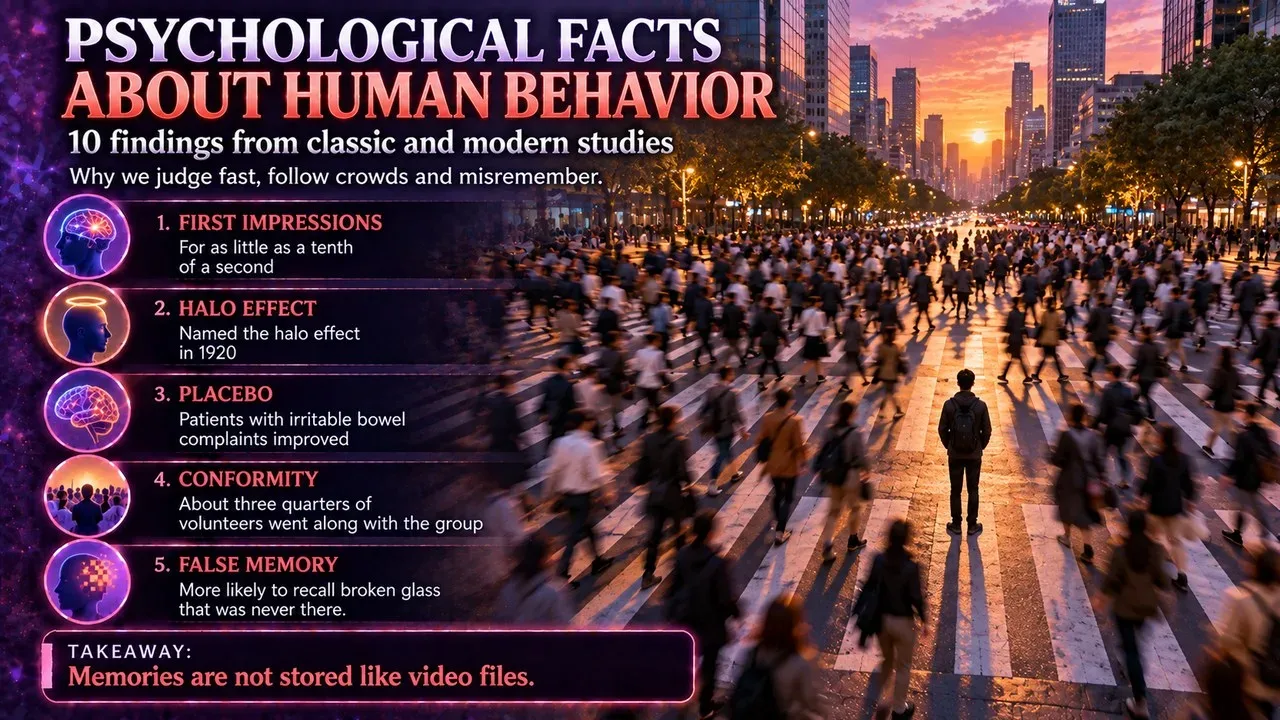
Psychological facts about human behavior are findings from controlled research that explain how people judge one another, give way to groups, remember events and weigh gains against losses. Many of them began as single laboratory experiments in the 20th century and have since been tested again, sometimes many times. This Finepedia guide, revised in October 2026, lists ten findings with strong research behind them, names the original studies, and notes where later work has narrowed or challenged a famous claim.
The ten facts move from how we size up strangers, to how other people sway what we say and do, to how our own minds store memories and keep score. Each one is tied to a published paper or a reference summary, and claims that failed large replication attempts are kept out of the main list and covered in a separate section.
Key Facts
| Fact | Key study |
|---|---|
| First impressions form within about 100 milliseconds | Willis and Todorov, 2006[1] |
| One good trait colours the rest (halo effect) | Thorndike, 1920; Nisbett and Wilson, 1977[2][3] |
| We adjust beliefs to fit what we have done | Festinger and Carlsmith, 1959[4][5] |
| Expecting relief can bring real relief (placebo) | Levine and colleagues, 1978; Kaptchuk and colleagues, 2010[7][8] |
| Many people go along with a plainly wrong group | Asch, 1951 onward[9] |
| Crowds can slow help, but someone usually steps in | Darley and Latané, 1968; Philpot and colleagues, 2019[10][11] |
| Memory is rebuilt each time we recall it | Loftus and Palmer, 1974[13] |
| Familiar things tend to feel more likeable | Zajonc, 1960s[16] |
| Losses weigh more than equal gains | Kahneman and Tversky, 1979[17][18] |
| Favourite music releases dopamine | Salimpoor and colleagues, 2011[20] |
How the Facts Were Chosen
Each finding had to come from a published study and be supported by later research or a standard reference account. That rule matters because psychology has been through what is often called the replication crisis. In August 2015 the Reproducibility Project: Psychology, coordinated by Brian Nosek, repeated 100 studies from three leading journals. Of 97 original studies with significant effects, only 36% replicated successfully.[25] The list below therefore favours results that have been repeated, re-analysed or confirmed in real-world settings.
The Top 10 Psychological Facts
1. First Impressions Form in a Fraction of a Second
In a 2006 study at Princeton University, Janine Willis and Alexander Todorov showed volunteers photographs of unfamiliar faces for different lengths of time across five experiments.[1] Judgements made after a 100-millisecond glimpse correlated highly with judgements made with no time limit. This held for attractiveness, likeability, trustworthiness, competence and aggressiveness.[1]
When the viewing time rose from 100 to 500 milliseconds, the judgements became more negative, responses got faster and confidence grew. Going from 500 to 1,000 milliseconds mostly left the judgements unchanged but raised confidence for some traits, which the authors read as extra time simply boosting confidence.[1] Longer viewing did, however, produce more detailed impressions of each person.[1]
Why it matters: first impressions shape how people are treated in many everyday settings.[26] They rest on appearance, though, and a quick judgement can feel certain without being accurate.
2. One Good Trait Colours How We See the Rest
The halo effect is the tendency for a positive impression in one area to shape opinions in other areas.[2] The psychologist Edward Thorndike named it in his 1920 article "A Constant Error in Psychological Ratings". He had asked commanding officers to rate their soldiers on physical qualities, intellect, leadership and personal qualities, and found the ratings were far too closely correlated with one another.[2]
In 1977 Richard Nisbett and Timothy Wilson at the University of Michigan staged two videotaped interviews with the same college instructor, who spoke English with a European accent. In one he was warm and friendly, in the other cold and distant.[3] Students who saw the warm version rated his appearance, mannerisms and accent as appealing, while those who saw the cold version rated the same features as irritating.[3]
The students were unaware of this influence. Those who saw the cold instructor believed the effect ran the other way: that disliking his features had lowered their opinion of him.[3] When the judgement is negative, such as an unattractive person being more readily blamed for a crime, the pattern is sometimes called the horn effect.[2]
3. We Change Beliefs to Match What We Have Done
Leon Festinger set out the theory of cognitive dissonance in his 1957 book A Theory of Cognitive Dissonance. It holds that people strive for internal consistency and feel psychological stress when their behaviour, attitudes or beliefs conflict.[4]
Related: Top 10 Cases Where the Placebo Effect Misled Science
In 1959 Festinger and James Carlsmith ran an experiment titled "Cognitive Consequences of Forced Compliance".[5] Students did tedious tasks and were then paid either $1 or $20 to tell the next participant that the experiment was fun.[5] When later asked to rate the tasks, the students paid only $1 rated them more positively than those paid $20.[4]
The usual explanation is that $20 gave a ready reason for the lie, while $1 did not, so the poorly paid group eased the tension by deciding the task had not been so bad. The finding helps explain why people often defend choices they have already made.[4]
4. Expecting Relief Can Bring Real Relief
A placebo is a treatment with no active ingredient. Modern studies find placebos can affect some outcomes such as pain and nausea, but otherwise do not generally have important clinical effects.[6] Since 1978 it has been known that placebo pain relief depends on the release of the brain's own opioids.[6]
That 1978 result came from Jon Levine, Newton Gordon and Howard Fields, who studied patients after wisdom-tooth surgery.[7] They gave naloxone, a drug that blocks opioids, or a placebo under double-blind conditions. Naloxone raised pain only in people who had responded to the placebo, which fitted the idea that endorphin release drives placebo pain relief.[7]
A 2010 trial led by Ted Kaptchuk at Beth Israel Deaconess Medical Center and Harvard Medical School went further. Eighty patients with irritable bowel syndrome were either given pills openly described as placebos or no treatment. Over three weeks, the open-label placebo group reported significantly greater global improvement and relief.[8] Reviews of such trials note that they were small and should be read with caution.[6] The negative version of the effect, where expecting harm produces symptoms, is called the nocebo effect.[6]
5. Many People Go Along With an Obviously Wrong Group
In 1951 Solomon Asch began his conformity experiments at Swarthmore College.[9] Volunteers judged which of several lines matched a reference line. All but one person in the room were actors who, on certain critical trials, gave the same wrong answer.[9]
Across all critical trials, about one third of the real participants' responses were wrong, compared with an error rate of less than 1% in a control group with no pressure.[9] There were clear individual differences: 26% of participants consistently defied the majority, 12% followed the group in nearly all tests, and the rest conformed on some trials.[9] That means about three quarters went along with the group at least once.
Two variations stand out. Conformity fell when a "true partner" in the room gave the correct answer, and it decreased significantly when the real participant could write the answer instead of saying it aloud.[9]
Related: Top 10 Most Bizarre Phobias: Strange Fears That Exist
6. Crowds Can Slow Help, but People Usually Do Step In
The bystander effect is the theory that people are less likely to help a victim when others are present.[10] John Darley and Bibb Latané proposed it in 1968 after becoming interested in the 1964 murder of Kitty Genovese in New York.[10] In a related 1969 study by Latané and Judith Rodin, 70% of people who were alone helped a woman they believed had fallen, but only 40% did so when paired with a stranger.[10]
The Genovese case itself was badly reported. A newspaper story claimed that 38 witnesses watched and did nothing, but a 2007 article in American Psychologist found "no evidence for the presence of 38 witnesses, or that witnesses observed the murder, or that witnesses remained inactive".[12]
Later research also changed the picture. Richard Philpot and colleagues studied 219 real public conflicts filmed by surveillance cameras in the United Kingdom, the Netherlands and South Africa. In nine of ten conflicts, at least one bystander, and typically several, did something to help.[11] The likelihood was similar in all three countries, and more bystanders meant a greater chance that someone intervened.[11]
7. Memory Is Rebuilt Each Time We Recall It
In 1974 Elizabeth Loftus and John Palmer showed students films of car accidents and asked how fast the cars were going when they "smashed", "collided", "hit" or otherwise made contact.[13] Average speed estimates were 41 mph for "smashed", 34 mph for "hit" and 32 mph for "collided".[14]
In a second experiment with 150 students, those asked the "smashed" question were retested a week later. When asked "Did you see any broken glass?", 16 of 50 in the smashed group said yes, against 7 of 50 in the hit group and 6 of 50 controls. There was no broken glass in the film.[13] The authors concluded that questions asked after an event can cause a reconstruction of the memory itself.[13]
A 1978 follow-up showed people a car at a stop sign, then gave some of them a description that mentioned a yield sign, and many later reported the wrong sign.[15] This misinformation effect is a major reason eyewitness evidence is treated with care.[15]
8. Familiar Things Tend to Feel More Likeable
The mere-exposure effect is the finding that simply being exposed to something makes people rate it more positively.[16] Robert Zajonc is the scholar best known for developing it, through a series of laboratory experiments in the 1960s.[16]
The effect has been shown with words, Chinese characters, paintings, pictures of faces, geometric figures and sounds.[16] It even appears with subliminal exposure, though such effects are unlikely outside controlled laboratory conditions.[16] There is a limit: with enough repetitions, the curve for liking turns down in an inverted-U shape.[16]
Related: Top 10 Reasons People Fail to Reach Their Goals
9. Losses Hurt More Than Equal Gains Please
In 1979 Daniel Kahneman and Amos Tversky proposed prospect theory and coined the term "loss aversion".[17] The idea is that losing something weighs more heavily than gaining the same thing. Empirically, losses tend to be treated as if they were about twice as large as equivalent gains.[17]
Prospect theory was cited when Kahneman received the 2002 Nobel Memorial Prize in Economic Sciences.[18] Tversky had died in 1996, six years earlier, and Kahneman described it as "a joint prize".[19] The idea is not settled in every detail. David Gal argued in 2006, and with Derek Rucker in 2018, that many effects credited to loss aversion are better explained by psychological inertia.[17]
10. Favourite Music Triggers Dopamine Release
In a 2011 study at the Montreal Neurological Institute, McGill University, Valorie Salimpoor and colleagues scanned people while they listened to music that gave them intense pleasure.[20] Using PET scanning, they found dopamine release in the striatum at moments of peak emotional arousal.[20]
Functional MRI with the same listeners showed a split in timing: the caudate was more involved during the build-up before a peak, and the nucleus accumbens during the peak itself.[20] The authors said the results help explain why music is so highly valued across human societies.[20]
Key Figures
- 100 milliseconds: viewing time enough for a first impression of a face.[1]
- 36%: share of 97 significant psychology studies that replicated in the 2015 Reproducibility Project.[25]
- $1 versus $20: the payments in Festinger and Carlsmith's 1959 experiment.[5]
- 80: patients in the 2010 open-label placebo trial.[8]
- 26%: Asch participants who consistently defied the majority.[9]
- 9 in 10: public conflicts where at least one bystander helped, from 219 CCTV recordings.[11]
- 41 mph versus 34 mph: speed estimates for "smashed" versus "hit".[14]
- 32% versus 14%: false reports of broken glass in the "smashed" and "hit" groups.[13]
- About 2 to 1: how much more heavily losses tend to weigh than equal gains.[17]
- 2002: year Kahneman received the Nobel Memorial Prize in Economic Sciences.[18]
Findings That Did Not Hold Up as Well
Ego Depletion
Ego depletion is the idea that self-control draws on a limited resource that runs down with use.[21] In 2016 a pre-registered replication run across 23 laboratories used a single protocol and found no evidence for the effect.[21][22] The leaders of that project, Martin Hagger and Nikos Chatzisarantis, had earlier published a 2010 meta-analysis that seemed to support it.[21]
The Stanford Prison Experiment
The Stanford prison experiment was carried out in August 1971 under Philip Zimbardo. Twenty-four volunteers were randomly assigned to be prisoners or guards, and Zimbardo ended the study on the sixth day.[23] It has since drawn strong criticism. Thibault Le Texier argued that Zimbardo asked guards to behave in certain ways to confirm conclusions written largely in advance, and some critics have called the study unscientific.[23] Zimbardo disputed these accounts.[23]
Mirror Neurons and Empathy
Mirror neurons were identified by researchers at the University of Parma who recorded from the brains of macaque monkeys in the 1980s and 1990s.[24] Some scientists have argued that mirror neurons underlie human empathy, but the function of the mirror system in humans is the subject of much speculation and intense debate.[24]
Related: Top 10 Bad Reasons to Stay Friends With Your Ex
Why These Findings Matter
Taken together, the ten facts describe a mind that is fast, social and often less rational than it feels from the inside. Quick judgements of faces, the halo effect and mere exposure show how much is decided before careful thought begins.[1][2][16] Asch's experiments and bystander research show how strongly other people shape what we say and do, while also showing that a single ally or a single helper can change the outcome.[9][11]
Research on memory and loss aversion has practical uses. Findings on misleading questions inform how eyewitness evidence is handled.[15] Prospect theory has shaped the study of economic decisions.[18] Knowing about these patterns will not remove them, but it can help people pause before acting on a first impression or a fear of losing out.
Frequently Asked Questions
What is the halo effect?
It is the tendency for one positive impression, such as warmth or good looks, to shape judgements of a person's other qualities. Thorndike named it in 1920.[2]
Is the placebo effect real?
Yes, for some symptoms. Placebos can affect pain and nausea, partly through the brain's own opioids, but they do not generally have important effects on other clinical outcomes.[6][7]
Why do people conform to groups?
Asch's studies showed that many people give a wrong answer to match a unanimous group, but that conformity falls when one other person disagrees or when answers are private.[9]
Are eyewitness memories reliable?
They can be accurate, but questions and later information can change them, as the Loftus and Palmer studies and later misinformation research showed.[13][15]
Is the bystander effect true?
People in groups can be slower to help, but real-world CCTV research found that at least one bystander helped in nine of ten public conflicts.[10][11]
See also
- Top 10 Most Hated Personality Traits
- Top 10 Most Common Reasons Why Couples Argue
- History of Human Civilization
- ^ [1] "First impressions: making up your mind after a 100-ms exposure to a face". Psychological Science, Willis and Todorov, 2006. DOI
- ^ [2] "Halo effect". Wikipedia. Wikipedia
- ^ [3] "The halo effect: Evidence for unconscious alteration of judgments". Journal of Personality and Social Psychology, Nisbett and Wilson, 1977. DOI
- ^ [4] "Cognitive dissonance". Wikipedia. Wikipedia
- ^ [5] "Forced compliance theory". Wikipedia. Wikipedia
- ^ [6] "Placebo". Wikipedia. Wikipedia
- ^ [7] "The mechanism of placebo analgesia". The Lancet, Levine, Gordon and Fields, 1978. DOI
- ^ [8] "Placebos without deception: a randomized controlled trial in irritable bowel syndrome". PLoS ONE, Kaptchuk and colleagues, 2010. DOI
- ^ [9] "Asch conformity experiments". Wikipedia. Wikipedia
- ^ [10] "Bystander effect". Wikipedia. Wikipedia
- ^ [11] "Would I be helped? Cross-national CCTV footage shows that intervention is the norm in public conflicts". American Psychologist, Philpot and colleagues, 2019. DOI
- ^ [12] "Murder of Kitty Genovese". Wikipedia. Wikipedia
- ^ [13] "Reconstruction of automobile destruction: An example of the interaction between language and memory". Journal of Verbal Learning and Verbal Behavior, Loftus and Palmer, 1974. Stanford PDF
- ^ [14] "Elizabeth Loftus". Wikipedia. Wikipedia
- ^ [15] "Misinformation effect". Wikipedia. Wikipedia
- ^ [16] "Mere-exposure effect". Wikipedia. Wikipedia
- ^ [17] "Loss aversion". Wikipedia. Wikipedia
- ^ [18] "Prospect theory". Wikipedia. Wikipedia
- ^ [19] "Amos Tversky". Wikipedia. Wikipedia
- ^ [20] "Anatomically distinct dopamine release during anticipation and experience of peak emotion to music". Nature Neuroscience, Salimpoor and colleagues, 2011. DOI
- ^ [21] "Ego depletion". Wikipedia. Wikipedia
- ^ [22] "A Multilab Preregistered Replication of the Ego-Depletion Effect". Perspectives on Psychological Science, Hagger and colleagues, 2016. DOI
- ^ [23] "Stanford prison experiment". Wikipedia. Wikipedia
- ^ [24] "Mirror neuron". Wikipedia. Wikipedia
- ^ [25] "Replication crisis". Wikipedia. Wikipedia
- ^ [26] "First impression (psychology)". Wikipedia. Wikipedia





















Discussion
Log in with