




 By
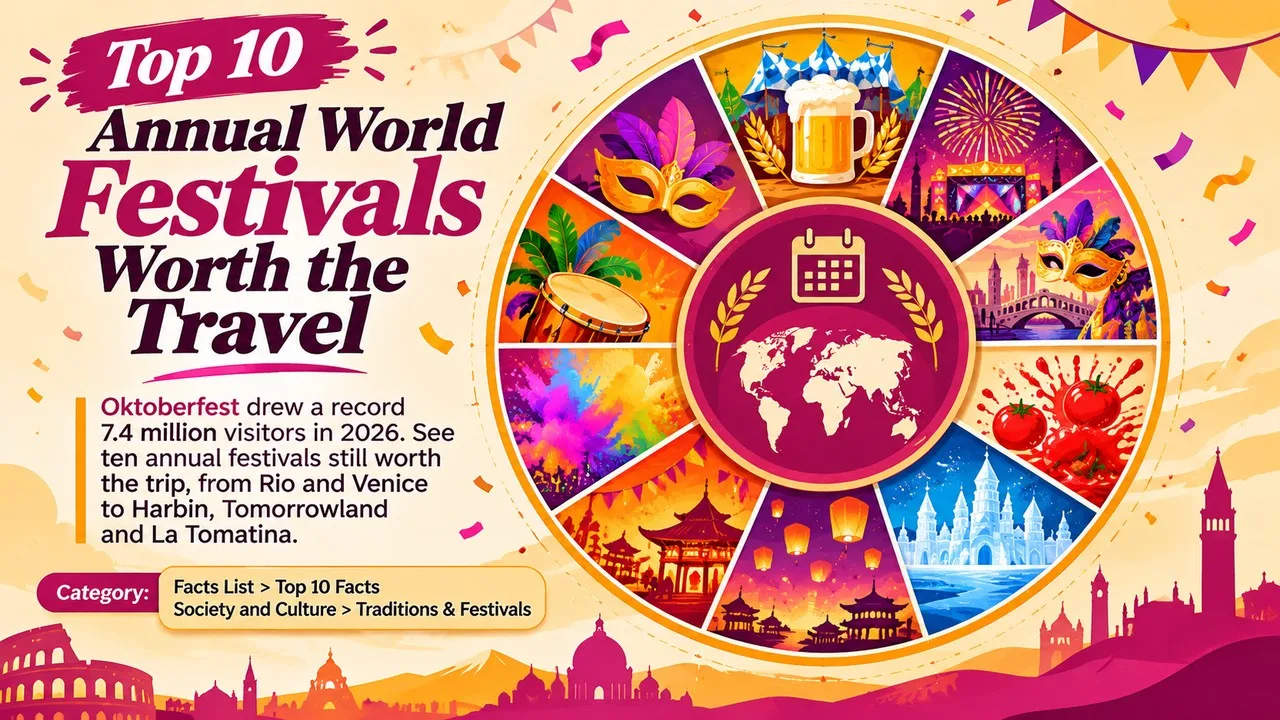
Oktoberfest drew a record 7.4 million visitors in 2026, one reason the world's great annual festivals still shape travel calendars. Official figures from the City of Munich put the 16-day fair on the Theresienwiese ahead of the 6.5 million guests recorded in 2025 [1].
This list covers ten festivals that are held every year (or on a fixed seasonal cycle), are famous enough to draw large numbers of visitors from outside the host city, and have a clear historical or cultural identity. Attendance is not the only test. A smaller event such as La Tomatina or the desert gathering at Black Rock City can still be a defining travel experience if it is distinctive and tightly organised [2][3].
Dates move with calendars and religious seasons. Carnival in Rio and Venice, and Mardi Gras in New Orleans, fall before Lent and therefore shift between February and March. Figures below are as of November 2026.
Key Facts
The table summarises each festival's usual timing, location and a headline fact. Crowd estimates vary by method and should be read as orders of magnitude except where an official count is given.
Annual World Festivals at a Glance
| Rank | Festival | Location | Usual timing | Notable fact |
|---|---|---|---|---|
| 1 | Rio Carnival | Brazil | February or March, before Lent | Street parties and the official samba-school parade in the Sambadrome |
| 2 | Venice Carnival | Italy | February or March, before Lent | Famous for elaborate masks; the modern festival was revived in 1979 |
| 3 | Oktoberfest | Munich, Germany | 16 days ending in early October | 7.4 million visitors in 2026, the highest official total to date |
| 4 | Harbin Ice and Snow Festival | Harbin, China | Late December to early March | Monumental ice and snow sculpture park in a sub-zero climate |
| 5 | Mardi Gras | New Orleans, United States | The season ends on Shrove Tuesday | Parade krewes, throws and a legally recognised holiday in Louisiana |
| 6 | Burning Man | Nevada, United States | Late August to Labor Day | A temporary city on the playa, built around art, self-reliance and the burning of a wooden effigy |
| 7 | Tomorrowland | Boom, Belgium | Usually two or three weekends in July | One of the world's largest electronic dance music festivals |
| 8 | Taiwan Lantern Festival | Rotating host cities in Taiwan | Around the first full moon of the lunar new year | National lantern displays; Pingxi's sky-lantern release is a related but separate tradition |
| 9 | San Fermin | Pamplona, Spain | 6-14 July | The running of the bulls, made widely known by Ernest Hemingway |
| 10 | La Tomatina | Bunol, Spain | Last Wednesday in August | A ticketed tomato fight, limited in size after earlier overcrowding |
1. Rio Carnival
Carnival in Brazil's famous coastal city is the best-known event of its kind. The official parade of samba schools takes place in the purpose-built Sambadrome Marques de Sapucai, designed by Oscar Niemeyer and first used in 1984, while blocos (street parties) fill neighbourhoods across the city [4]. The festival is tied to the Christian calendar and is held in the days before Lent, usually in February or March.
Carnival in Rio grew out of Portuguese entrudo traditions and Afro-Brazilian music and dance. By the twentieth century the competitive samba-school parade had become the centrepiece, with groups such as Mangueira, Portela and Beija-Flor building a year of rehearsal into a single night of music, costume and floats [4]. Tickets for the reserved Sambadrome seats are sold in advance; the free street parties are harder to measure and are often described, in official and tourism writing, as drawing crowds in the millions over the festival period.
The event is now a major export of Brazilian popular culture as well as a local holiday. Travellers need to plan for heat, dense crowds and a wide gap in price between official parade tickets and informal street festivities. For a different Italian take on the same pre-Lent season, see the carnival in Venice, below, and Finepedia's list of car-free destinations for the city in ordinary weeks [4].
2. Carnival of Venice
The Carnival of Venice is older as an idea than as a continuous modern event. Masked celebration in the lagoon city is documented from the late Middle Ages, was restricted under later governments, and was revived as an organised public festival in 1979 [5]. It now runs in the period before Lent, with official opening ceremonies, masked balls and daily costume displays in St Mark's Square and along the canals.
The bauta, moretta and other historic mask types are the festival's visual signature. Unlike Rio, Venice is not built around a single stadium parade. The attraction is the city itself: visitors in costume moving through a dense historic centre that is already one of Europe's most visited places. That combination makes accommodation scarce and expensive during carnival weeks, and it puts pressure on a fragile urban fabric that the city is also trying to manage at other times of year [5].
Related: Top 10 Christmas Lights Displays in the United States
The revival succeeded because it offered something Rio does not: a slower, theatrical, highly photogenic carnival rooted in commedia dell'arte and Venetian civic history. It is worth treating as a cultural festival first and a party second. The masks are not a generic costume; many are still made by specialist workshops in the city [5].
3. Oktoberfest
Oktoberfest is the world's largest Volksfest, held on Munich's Theresienwiese. It began in 1810 as a public celebration of the wedding of Crown Prince Ludwig and Princess Therese of Saxony-Hildburghausen, and it has been repeated, with interruptions for wars and pandemics, ever since [6]. The modern fair usually lasts 16 days and ends on the first Sunday in October, or slightly later when the calendar requires it.
In 2026 the festival recorded about 7.4 million guests, according to the official preliminary report, compared with 6.5 million in 2025. That made it the most visited Oktoberfest to date. Breweries reported about 6.7 million litres of festival beer, and the city emphasised weekday visitor management after several busy weekends [1]. The majority of guests still come from Munich and the surrounding region, with the largest groups of international visitors from the United States, Italy and Austria [1].
The event is more than beer. It includes a costume and riflemen's parade, a funfair, and the Oide Wiesn, a historic section of the grounds. Tents are run by established Munich landlords and the six main Munich breweries. For travellers, the practical lesson from 2026 is that weekdays are now actively promoted, and that official crowd figures are one of the few festival totals that are published in a consistent way [1][6].
4. Harbin Ice and Snow Festival
Harbin's midwinter ice-and-snow festival, in Heilongjiang province in north-east China, is the leading winter spectacle of its kind. Harbin's climate, with long stretches well below freezing, allows builders to cut blocks of ice from the Songhua River and raise them into coloured, illuminated palaces, towers and figurative sculptures [7]. The main public sites usually open in late December and run into February or early March.
The festival grew from local ice-lantern traditions and, from the 1980s and 1990s, into an international sculpture competition and a large ticketed park known as Ice and Snow World. Competing events in Sapporo and Quebec City are important, but Harbin's structures are on a larger architectural scale, which is why the city has become a midwinter travel destination rather than only a regional fair [7].
Visitors should plan for extreme cold as much as for the displays. The festival is a reminder that "annual travel festivals" are not confined to warm carnival climates. Attendance is reported in the millions in recent seasons, though methods are not always comparable with Munich's official count, so the ranking here rests on the event's scale and uniqueness rather than on a single audited ticket number [7].
5. Mardi Gras
Mardi Gras in New Orleans is the best-known carnival in the United States. The season, which follows Twelfth Night and ends on Shrove Tuesday, is organised around krewes that stage parades on announced routes, throw beads and other trinkets, and hold private balls [8]. Fat Tuesday itself is a legal holiday in Louisiana. The city's French and Spanish colonial history, and later Afro-Creole traditions, including the Mardi Gras Indians, give the festival a character that is distinct from Rio or Venice [8].
Related: Top 10 Most Bizarre Phobias: Strange Fears That Exist
Parade culture is highly local. Families claim the same spots on St Charles Avenue year after year, while the French Quarter attracts a denser, later-night crowd. The festival has repeatedly recovered from interruptions, including after Hurricane Katrina in 2005, which is part of why it remains a symbol of the city as well as a tourist event [8].
Travellers who want the parades should study krewe schedules and the city's rules on public drinking and street closures. Mardi Gras is easier to attend than a ticketed music festival, but it is not informal in the sense of being unorganised: the calendar, routes and krewes are public and long established [8].
6. Burning Man
Burning Man is a week-long gathering in Nevada's Black Rock Desert, timed to end on the American Labor Day weekend. It began in 1986 as a small effigy burning on San Francisco's Baker Beach and moved to the playa, where participants build a temporary city, install large-scale art and, on the Saturday night, burn a wooden figure that gives the event its name [2]. Entry is ticketed, and the event is built around stated principles such as self-reliance, gifting and leaving no trace.
The population of Black Rock City has been in the tens of thousands in recent years, with the 2025 census reporting 72,181 participants [2][9]. That is far smaller than Oktoberfest or Rio, but the setting is more extreme: a dry lake bed, harsh weather, and a requirement that people bring their own shelter, water and food. The 2023 rains, which trapped many campers in mud, showed how quickly the site can become difficult [2].
Burning Man is not a spectator festival in the usual sense. There is no paid main-stage bill in the manner of Tomorrowland. People go to build, perform or camp, which is why it belongs on a list of travel festivals even though it rejects some of the commercial habits of the others [2].
7. Tomorrowland
Tomorrowland, held in the town of Boom in Flanders, is one of the world's largest electronic dance music festivals. It was first staged in 2005 and now usually occupies two or three consecutive weekends in July, with a detailed stage design that is rebuilt each year [10]. Organisers have reported weekend crowds on the order of 400,000 people in recent editions, a figure that includes visitors who come from a very wide range of countries [10].
Related: Top 10 Oldest Buildings in the World
The festival is a study in modern event logistics: timed entry, a nearby camping and lodging system, and a global ticket lottery that often sells out quickly. Unlike carnival or Oktoberfest, it is a commercial music event rather than a civic or religious holiday, which is why dates can be adjusted and why a winter offshoot has also been held at other sites [10].
For this list, Tomorrowland represents the music-festival end of annual travel. People book international flights specifically for it, in the same way they do for carnival in Rio. Those who want a still larger, older German fair should look at Oktoberfest; those who want a participatory desert event should look at Burning Man [10].
8. Taiwan Lantern Festival
The Taiwan Lantern Festival is a national event held around the first full moon of the lunar new year, historically associated with the Yuanxiao or Lantern Festival. Since the 1990s the main official festival has rotated among host cities and counties, with large thematic lantern installations, a main lantern, and night-time displays that are designed as much for visitors as for local families [11].
It should not be confused with the Pingxi Sky Lantern Festival in New Taipei City, where people write wishes on paper lanterns and release them into the valley. Pingxi is an older local custom that became a major tourist draw in its own right. Both are worth considering, but they are different events in different places, and travel writing sometimes blurs them [11].
The official festival's rotating venue is part of its appeal: the 2010s and 2020s have taken the main display to cities well beyond Taipei, spreading hotel demand and showing regional crafts and food. For visitors, the practical requirement is to check which county is hosting the official festival in a given lunar new year, and whether a trip to Pingxi is a separate excursion [11].
9. San Fermin
The Festival of San Fermin in Pamplona, in Navarre, runs from 6 to 14 July. It honours the city's co-patron saint and is internationally known for the encierro, the morning running of the bulls from the corrals to the bullring along a fenced course through the old town [12]. Ernest Hemingway's novel The Sun Also Rises (1926) did more than any other single work to fix the festival in the English-speaking imagination [12].
The programme also includes processions, fireworks, music and afternoon bullfights. Animal-welfare groups have long criticised the bull runs and fights, and that debate is now part of any honest account of the festival. Injuries to runners occur every year; deaths are rarer but have happened, which is why the town hall issues strict rules on age, clothing and conduct on the course [12].
Related: Top 10 Tallest Buildings in the World
Travellers who attend should treat the encierro as a dangerous traditional event, not as a casual photo opportunity. The rest of the festival, including the opening chupinazo and the religious procession, can be experienced without entering the run. Fireworks during the week also sit in a wider European tradition covered in Finepedia's list of spectacular fireworks displays [12].
10. La Tomatina
La Tomatina is a one-hour tomato fight held in the town of Bunol, near Valencia, on the last Wednesday in August. Participants throw overripe tomatoes at one another in the main streets after a signal is given; fire crews then wash down the town [3]. The event is usually traced to a street brawl in 1945 that the town later turned into an annual festivity, suspended during some official bans and then re-established [3].
Because the fight became too crowded in the early 2010s, the town introduced tickets and a cap on participants. That makes La Tomatina smaller and more controlled than the open street carnivals earlier in this list, and it is the reason a visitor cannot simply arrive and join in. The tomatoes are typically cheap, overripe fruit brought in for the purpose, not the local market crop [3].
The festival is short, messy and specific: it does not have the religious calendar of carnival or the civic scale of Oktoberfest. It earns a place here because it is a clearly defined annual event that people still travel to Spain to join, and because it shows how a local custom can be managed once it becomes an international attraction [3].
Conclusion
These ten events range from civic holidays with official headcounts, such as Oktoberfest, to ticketed gatherings such as Tomorrowland, Burning Man and La Tomatina. Rio, Venice and New Orleans represent different branches of pre-Lent carnival. Harbin and Taiwan show how winter ice and lunar-new-year lanterns can be as important a travel reason as a summer fair.
No single attendance table can rank them fairly, because some publish official counts and others do not. The safer approach is to match the trip to the season and to the kind of festival it is: a parade, a music weekend, a desert city or a one-hour street fight. Check the current year's dates, because several of these events move with Easter, Labor Day or the lunar calendar.
- ^ [1] "The Preliminary Final Report on Oktoberfest 2026". City of Munich / Oktoberfest.de. Official 2026 preliminary report
- ^ [2] "Burning Man". Wikipedia. Wikipedia: Burning Man
- ^ [3] "La Tomatina". Wikipedia. Wikipedia: La Tomatina
- ^ [4] "Rio Carnival". Wikipedia. Wikipedia: Rio Carnival
- ^ [5] "Carnival of Venice". Wikipedia. Wikipedia: Carnival of Venice
- ^ [6] "Oktoberfest". Wikipedia. Wikipedia: Oktoberfest
- ^ [7] "Harbin International Ice and Snow Sculpture Festival". Wikipedia. Wikipedia: Harbin Ice and Snow Festival
- ^ [8] "Mardi Gras in New Orleans". Wikipedia. Wikipedia: Mardi Gras in New Orleans
- ^ [9] "Burning Man Statistics 2025: Attendance, Spending & Demographics". CamperChamp. CamperChamp: Burning Man 2025 statistics
- ^ [10] "Tomorrowland (festival)". Wikipedia. Wikipedia: Tomorrowland
- ^ [11] "Taiwan Lantern Festival". Wikipedia. Wikipedia: Taiwan Lantern Festival
- ^ [12] "San Fermin". Wikipedia. Wikipedia: San Fermin



















Discussion
Log in with