
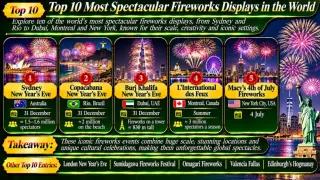

Top 10 Most Spectacular Fireworks Displays in the World
 By Dhiraj Sharma · Published
Share Post
Loading…
The world's most spectacular fireworks displays light up harbours, beaches, rivers and skyscrapers, drawing crowds of a million or more and huge TV audiences.
Fireworks were invented in China more than a thousand years ago and have been used to celebrate festivals, victories and new beginnings ever since. Modern shows combine traditional shells with computer firing systems, music, lasers and lighting, so a single display can involve tens of thousands of separate effects launched with split-second timing [1].
This Finepedia list picks ten displays for their scale, setting, history and worldwide fame. New Year's Eve dominates, but summer festivals and competitions also earn a place. Other famous shows, such as the New Year fireworks fired from the Taipei 101 skyscraper in Taiwan, narrowly missed the list. Crowd sizes and quantities come from organisers and published reports, change from year to year and are given as of November 2026.
Key Facts
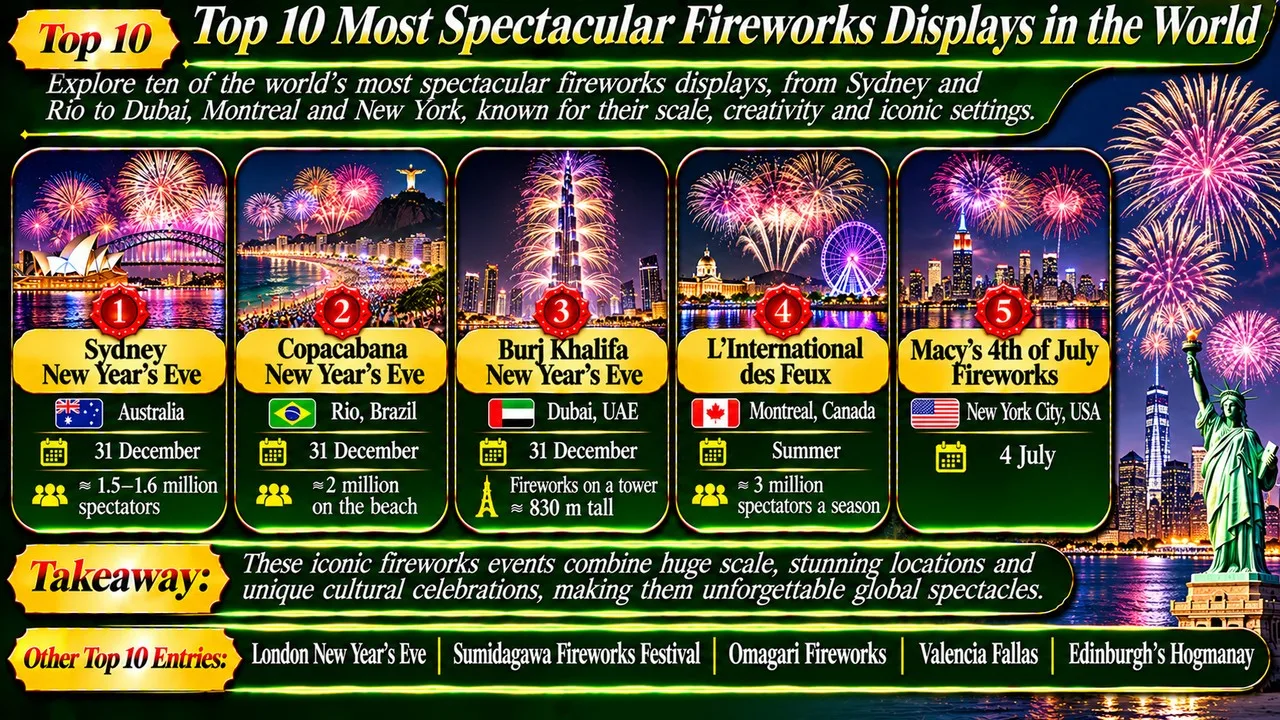
Here is a quick overview of the ten displays, with their location, timing and one standout figure or feature for each.
Fireworks Displays at a Glance
| Rank | Name | Location/Country | When | Key figure |
|---|---|---|---|---|
| 1 | Sydney New Year's Eve | Sydney, Australia | 31 December | About 1.5 to 1.6 million spectators |
| 2 | Copacabana New Year's Eve | Rio de Janeiro, Brazil | 31 December | About 2 million on the beach |
| 3 | Burj Khalifa New Year's Eve | Dubai, UAE | 31 December | Fireworks on a tower about 830 m tall |
| 4 | L'International des Feux | Montreal, Canada | Summer | About 3 million spectators a season |
| 5 | Macy's 4th of July Fireworks | New York City, USA | 4 July | More than 56,000 effects in 2016 |
| 6 | London New Year's Eve | London, UK | 31 December | Launched from the London Eye and barges |
| 7 | Sumidagawa Fireworks Festival | Tokyo, Japan | Last Saturday of July | Close to a million viewers |
| 8 | Omagari Fireworks | Daisen, Akita, Japan | Last Saturday of August | Japan's national competition since 1910 |
| 9 | Valencia Fallas | Valencia, Spain | 1 to 19 March | UNESCO intangible heritage since 2016 |
| 10 | Edinburgh's Hogmanay | Edinburgh, Scotland | 31 December | Fireworks from Edinburgh Castle |
1. Sydney New Year's Eve
Sydney is one of the first major cities in the world to welcome each new year, and its harbour show is often called the New Year's Eve capital of the world. Fireworks are fired from barges across Port Jackson and from landmarks including the Sydney Opera House, while the Sydney Harbour Bridge acts as the centrepiece with lighting and cascading effects [2].
Organisers estimate that around 1.5 to 1.6 million people watch from the foreshore, parks, boats and rooftops, with tourists making up a large share of the crowd [2]. Many arrive early in the morning to claim a spot. Hundreds of millions more around the world watch the broadcast.
The night has two main shows: an earlier display at 9 pm, now linked with Indigenous culture, and the main midnight fireworks. Since 2000, the shows have been designed and produced by the Foti family company, and recent displays have used several tonnes of pyrotechnics [2]. The famous waterfall effect, in which sparks pour from the bridge deck into the harbour, is a regular highlight.
2. Copacabana New Year's Eve
Rio de Janeiro's Copacabana beach hosts one of the largest New Year parties on the planet, attracting around two million people [3]. Crowds fill the four-kilometre beach for concerts on several stages before the countdown.
At midnight, fireworks are launched from barges anchored offshore, a practice adopted after an accident on the beach. Published figures describe about 24 tons of fireworks fired from 11 barges in a show lasting roughly 12 to 16 minutes, filling the whole curve of the bay with light [3].
Related: Top 25 Interesting Facts About the Solar System
The event is closely tied to Afro-Brazilian traditions. Many people dress in white and offer flowers and gifts to the sea in honour of Iemanja, the goddess of the ocean. Others jump seven waves for good luck. The celebration brings hundreds of millions of dollars into the city every year [3].
3. Burj Khalifa New Year's Eve
Dubai's Burj Khalifa, the world's tallest building at about 830 metres, becomes the centrepiece of a huge New Year's Eve show each year. The tower opened in January 2010, and its fireworks have since become one of the most watched countdowns in the world [4].
Fireworks erupt from many levels of the tower at once, synchronised with music, fountains and lighting. Guinness World Records recognised the show at the end of 2015 for the highest fireworks ever launched from a building. On 1 January 2019, a light show on its LED facade, covering nearly 45,000 square metres, set the record for the largest LED-illuminated facade [5].
Huge crowds gather in Downtown Dubai and around the Dubai Fountain to watch, and some areas require tickets. In recent years the show has combined fireworks with laser displays and messages projected across the tower's full height.
4. L'International des Feux
L'International des Feux Loto-Quebec is the world's best-known fireworks competition. It has been held every summer since 1985 at La Ronde amusement park in Montreal, with shows fired over a lake inside the park [6].
Teams from different countries take turns presenting pyromusical shows, in which fireworks are carefully synchronised to a soundtrack. Each display uses around 6,000 fireworks, and the season draws an estimated 3 million spectators [6]. Winners receive Jupiter awards, and the top prize is the Gold Jupiter.
Seats can be bought inside the park, but thousands of people watch for free from bridges, riverbanks and streets around Montreal. The Jacques Cartier Bridge, which closes to traffic on show nights, is a famous free viewing spot.
5. Macy's 4th of July Fireworks
The Macy's 4th of July Fireworks in New York City is the largest Independence Day display in the United States. The department store first staged a fireworks show in 1958, and the 4th of July display has been held every year since 1976, when it marked the American bicentennial [7].
Related: Top 10 Mythical Creatures in World Mythology - That Inspired Myths Across Civilizations (unchanged)
The display moves between New York's rivers and harbour, and has been launched from barges on the East River, the Hudson River and near the Brooklyn Bridge. The Hudson allows larger shells, some as wide as about 25 centimetres. For the show's 40th anniversary in 2016, more than 56,000 effects were fired [7].
The event has been televised since 1983 and has aired on NBC since 2000. Millions watch the broadcast at home, while huge crowds pack the waterfronts of Manhattan, Brooklyn, Queens and New Jersey [7].
6. London New Year's Eve
London's New Year's Eve fireworks centre on the River Thames. At midnight, the chimes of Big Ben ring in the year and fireworks erupt from the London Eye observation wheel and barges along the river [8].
The city first organised an official display for the millennium celebrations of 1999 to 2000, when around three million people were estimated to have watched in person. After a break, the show became a regular event from New Year's Eve 2004 onwards [8]. Displays now combine fireworks with lights, lasers, drones and music celebrating the city.
In recent years the main viewing areas along the river have been ticketed to control crowding. Millions more watch on television across the United Kingdom.
7. Sumidagawa Fireworks Festival
The Sumidagawa Fireworks Festival is held on the Sumida River in Tokyo on the last Saturday of July. It continues a tradition from the Edo period, when fireworks were launched over the river during summer festivals, and it attracts close to a million spectators each year [9].
Related: Top 25 Interesting Facts About the Universe
The custom is usually traced to 1732, a year of famine, when fireworks were set off at festivals held to honour the dead. Rival fireworks makers called Tamaya and Kagiya competed to impress the crowd, and Japanese spectators still shout their names when a firework bursts [9].
After a long break caused by traffic, safety and environmental concerns, the festival was revived in 1978 [9]. Today the shells are fired from two separate launch sites along the river, and many viewers watch from bridges, riverbanks, rooftops and traditional boats.
8. Omagari Fireworks
The Omagari National Fireworks Competition takes place each year on the last Saturday of August in the city of Daisen, Akita Prefecture, often called the city of fireworks. Established in 1910 as part of a local shrine festival, it is one of Japan's most prestigious fireworks events [10][11].
Pyrotechnicians from across Japan compete with their best work, and the top winner has received the Prime Minister's Prize since 2000 [11]. It is the only event in Japan that includes a daytime fireworks competition, which uses coloured smoke rather than light [11].
Japan's national tourism organisation reports crowds of more than 700,000 spectators [12]. After the daytime contest, evening shows feature perfectly round chrysanthemum shells and wide-screen displays that fill the sky above the Omono River.
9. Valencia Fallas
The Fallas festival in Valencia, Spain, celebrates Saint Joseph's Day on 19 March and is one of the noisiest and most explosive festivals in the world. In 2016 UNESCO added it to its list of intangible cultural heritage [13].
From 1 to 19 March, a daytime pyrotechnic show called the Mascleta takes place at 2 pm, with the main event in the city hall square. Rather than colour, it is about sound and rhythm: thousands of firecrackers explode in carefully planned sequences that shake the ground [13].
Related: Top 25 Weird Facts About Left-Handed People
The night-time fireworks reach a climax with the Nit del Foc, the Night of Fire, shortly before the end of the festival. On the final night, huge satirical monuments made of wood and papier-mache, called falles, are set on fire across the city in a ceremony known as the Crema [13].
10. Edinburgh's Hogmanay
Hogmanay is the Scottish celebration of the new year, and Edinburgh's festival is one of the most famous New Year events in Europe. It has been officially organised since 1993, with the main street party held along Princes Street [14].
At midnight, a cannon is fired at Edinburgh Castle, followed by a fireworks display launched from the castle ramparts high above the city. The silhouette of the castle on its volcanic rock makes the display especially dramatic [14].
The street party became so popular that in 1996 more than 300,000 people attended, which led organisers to sell tickets with a limit of 100,000 places [14]. The celebrations run over several days and include a torchlight procession, concerts and the Loony Dook, when people plunge into the cold sea on New Year's Day.
Conclusion
The world's most spectacular fireworks displays turn famous landmarks into giant stages. From Sydney Harbour and Copacabana beach to Montreal's lake and Tokyo's river, each combines skill, tradition and enormous crowds.
Behind every show are months of planning, careful safety rules and skilled pyrotechnicians. Whether celebrating a new year, a national holiday or a centuries-old festival, these displays remain among the most memorable public events on the calendar. For more celebrations, see the most fascinating New Year's Eve traditions.
- ^ [1] "Fireworks". Wikipedia. Wikipedia: Fireworks
- ^ [2] "Sydney New Year's Eve". Wikipedia. Wikipedia: Sydney New Year's Eve
- ^ [3] "New Year's Eve in Copacabana". Wikipedia. Wikipedia: New Year's Eve in Copacabana
- ^ [4] "Burj Khalifa". Wikipedia. Wikipedia: Burj Khalifa
- ^ [5] "Largest LED-illuminated facade". Guinness World Records. Guinness World Records: Largest LED-illuminated facade
- ^ [6] "L'International des Feux Loto-Quebec". Wikipedia. Wikipedia: L'International des Feux Loto-Quebec
- ^ [7] "Macy's 4th of July Fireworks". Wikipedia. Wikipedia: Macy's 4th of July Fireworks
- ^ [8] "New Year's Eve in London". Wikipedia. Wikipedia: New Year's Eve in London
- ^ [9] "Sumidagawa Fireworks Festival". Wikipedia. Wikipedia: Sumidagawa Fireworks Festival
- ^ [10] "Daisen, Akita". Wikipedia. Wikipedia: Daisen, Akita
- ^ [11] "About Omagari Hanabi". Omagari Hanabi Official Website. Omagari Hanabi: About
- ^ [12] "Omagari Fireworks Festival". Japan National Tourism Organization. JNTO: Omagari Fireworks Festival
- ^ [13] "Falles". Wikipedia. Wikipedia: Falles
- ^ [14] "Edinburgh's Hogmanay". Wikipedia. Wikipedia: Edinburgh's Hogmanay






















Discussion
Log in with