




 By
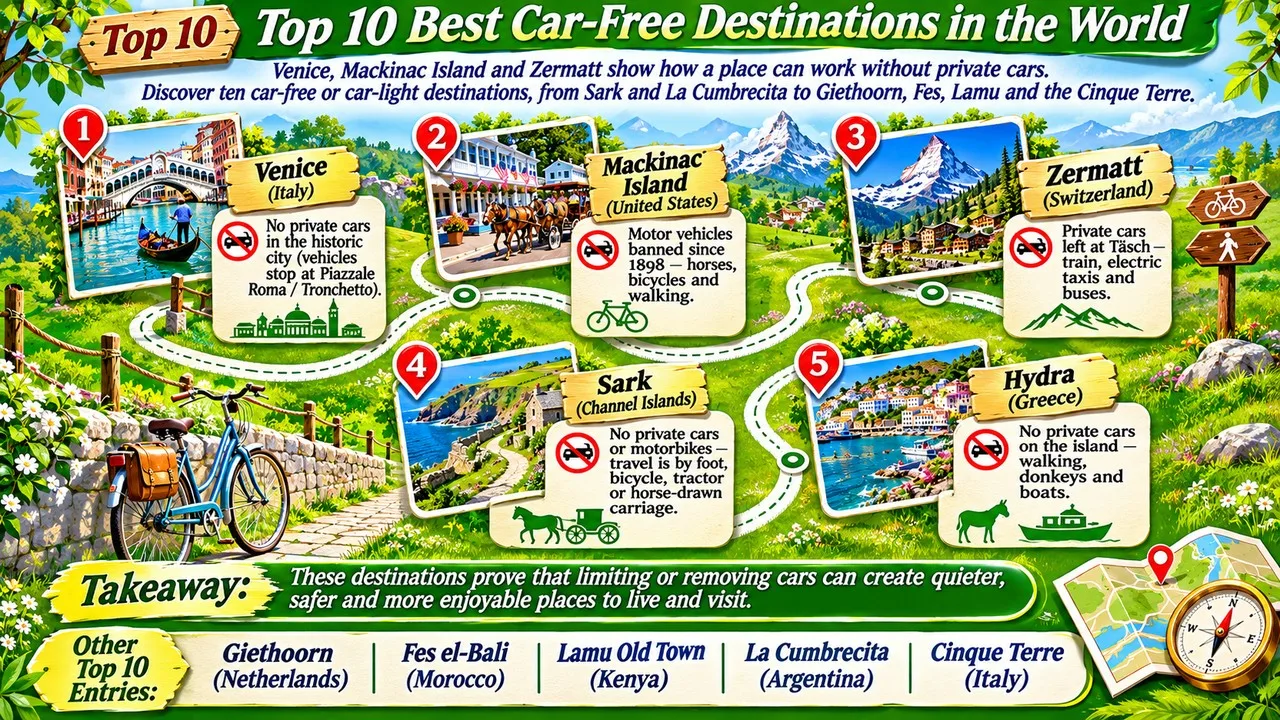
Historic centres such as Venice, Mackinac Island and Zermatt show how a town can work without private cars, using boats, horses, trains and walking streets. This list ranks ten well-known destinations where private automobiles are banned or tightly restricted in the places visitors actually walk, stay and eat [1][2].
"Car-free" is rarely absolute. Venice has traffic at Piazzale Roma and on the causeway. Zermatt allows electric taxis and service vehicles. Giethoorn and the Cinque Terre have roads and parking at the edges of the historic cores. The ranking favours places whose main streets, harbours or island interiors are genuinely used on foot, by bicycle, by boat or by horse, and it is honest about those exceptions [1][3].
The list is about destinations people travel to, not about entire car-free city centres in large capitals. Related Finepedia reading includes the most popular Greek islands, which include Hydra, and the most bicycle-friendly cities.
Key Facts
The table summarises each destination's country, the form of the restriction and how people move around instead.
Best Car-Free Destinations at a Glance
| Rank | Destination | Country | Restriction | How people move |
|---|---|---|---|---|
| 1 | Venice | Italy | No private cars in the historic city | On foot, vaporetti, water taxis and gondolas |
| 2 | Mackinac Island | United States | Motor vehicles banned since 1898 | Horses, bicycles and walking |
| 3 | Zermatt | Switzerland | Private cars left at Täsch | Train, electric taxis and buses, on foot |
| 4 | Sark | Channel Islands | No private cars or motorbikes | Walking, bicycles, tractors and horse-drawn carriages |
| 5 | Hydra | Greece | No private cars on the island | Walking, donkeys and boats |
| 6 | Giethoorn | Netherlands | Historic village is largely without cars | Canals, boats, bicycles and footpaths |
| 7 | Fes el-Bali | Morocco | The medina is largely closed to cars | Walking and pack animals |
| 8 | Lamu Old Town | Kenya | No cars in the old town | Walking, donkeys and dhows |
| 9 | La Cumbrecita | Argentina | Visitors leave cars at the entrance | Walking and pedestrian streets |
| 10 | Cinque Terre | Italy | Cars restricted in the village cores | Walking, trains and boats; some edge parking |
1. Venice
Venice is the most famous car-free city in the world. The historic islands are a maze of canals, bridges and narrow streets, and ordinary private cars do not enter that fabric [1][4]. People move on foot, on public water buses called vaporetti, on water taxis and, for a shorter and more expensive trip, by gondola. Goods are still moved by special barges and trolleys.
The exception is at the landward edge. The Ponte della Liberta causeway carries road traffic to Piazzale Roma and the Tronchetto car parks, where visitors leave vehicles before walking or taking a boat into the city [4]. That does not make the historic centre a driving city; it is how a car-free island group is reached from the mainland.
Venice belongs at the top of any such list because the whole urban form, not just a pedestrian street, was built around water and walking. The result is unique, crowded and still the standard against which other car-free destinations are compared [1][4].
2. Mackinac Island
Mackinac Island, in Lake Huron between Michigan's Upper and Lower Peninsulas, has banned motor vehicles since 1898 [2]. The rule is one of the oldest automobile bans still in force, and it is a central part of the island's identity. Residents and visitors get around on foot, by bicycle or in horse-drawn carriages. The main town, the harbour and the state park all work without private cars [2].
A few emergency and service vehicles are allowed, but they are the exception, not the everyday street scene. In summer the island is busy with day visitors who arrive by ferry; year-round residents number only in the hundreds [2]. The clip of hooves on the road is as much a part of a visit as the views of the straits and the porch of the Grand Hotel.
Related: Top 10 Most Beautiful Highways in the World
Mackinac is the clearest North American example of a tourist destination that chose, early and firmly, not to let the automobile take over [2].
3. Zermatt
Zermatt, at the foot of the Matterhorn in Switzerland, does not allow ordinary private cars into the village [3]. Drivers leave their vehicles in the nearby village of Täsch and continue by train. Inside Zermatt, electric taxis and buses, horse-drawn carriages and walking are the normal ways to move between hotels, the station and the cable-car valley stations [3].
The policy is often described as a car-free village rule, and it is one of the best-known in the Alps, but it is not a total ban on motor vehicles. Electric service and guest transport is part of how the resort works, especially for luggage and for people who cannot walk every steep street [3]. The payoff is quieter lanes and clearer views toward the Matterhorn, which is why Zermatt is so often cited in discussions of Alpine tourism without cars.
It ranks high here because the combination of a famous mountain, a rail approach and a genuinely car-light village is hard to match [3].
4. Sark
Sark, in the Channel Islands, does not allow private cars or motorbikes [5]. The island is small, with a high plateau and steep harbours, and everyday transport is on foot, by bicycle, by tractor or by horse-drawn carriage. Tractors are used as working vehicles and as unofficial buses, which is a local quirk that surprises some first-time visitors [5].
There is no airport and no large marina town. Reaching Sark usually means a ferry from Guernsey or, in season, from other islands, followed by a tractor ride or a walk up from the harbour. The absence of cars is part of a wider sense of small-island quiet, and it has been a tourist selling point for many years [5].
Sark is less famous than Venice or Zermatt, but the restriction is among the strictest on this list, which is why it belongs near the top of any serious car-free ranking [5].
5. Hydra
Hydra, in the Saronic Islands of Greece, is famous for having no private cars on the island [6]. The harbour town rises in a tight amphitheatre of stone houses, and people and goods move on foot, by boat and by donkey or mule. The rule is one of the reasons Hydra has kept a compact, photogenic waterfront that has attracted artists and visitors for decades [6].
Related: Top 10 Longest Cable Cars in the World
As on other small islands, the ban is about daily life as well as tourism. Without a road network for private cars, the steep lanes stay narrow, and the harbour remains the main public space. Visitors arrive by ferry and usually stay within walking distance of the water [6].
Hydra is also covered, in a wider island context, in Finepedia's list of the most popular Greek islands. It is included here specifically for the car-free character that sets it apart from busier, more road-built islands nearby [6].
6. Giethoorn
Giethoorn, in the Dutch province of Overijssel, is a village of canals, wooden bridges and thatched houses, often nicknamed the "Dutch Venice" [7]. In the old village, cars are out of place on the narrow canalside paths, and the usual way to get around is by boat, bicycle or on foot. That is the scene that made Giethoorn a famous day trip from Amsterdam and other Dutch cities [7].
The honest caveat is that Giethoorn is not an island cut off from roads. There are streets and parking areas at the edges of the tourist core, and residents in newer parts of the village can use cars. What visitors come to see, though, is still a canalside settlement that works without traffic in its historic heart [7].
It is on this list as a classic European village example: not a whole city like Venice, but a small, water-shaped place whose prettiest streets are genuinely quiet [7].
7. Fes el-Bali
Fes el-Bali, the old medina of Fez in Morocco, is one of the largest historic urban areas in the world where cars cannot follow the main network of lanes [8]. The medina is listed by UNESCO as World Heritage, a dense maze of souks, houses, workshops and mosques, and ordinary motor traffic is kept out of that fabric. People walk; goods often move by hand cart or by pack animal [8].
Related: Top 10 Giant Sinkholes and Blue Holes
Unlike a small island, Fez is a large living city, and modern traffic exists outside the walls and in newer districts. The car-free claim applies to the old town, which is the destination most travellers mean when they visit Fez. Getting lost in the lanes is part of the experience, and it is possible only because those lanes were never rebuilt for automobiles [8].
Fes el-Bali shows that a car-free destination can be a major historic city, not only a resort village, provided the street pattern is fine enough to keep engines out [8].
8. Lamu Old Town
Lamu Old Town, on Lamu Island off the Kenyan coast, is listed by UNESCO as World Heritage and is among the oldest Swahili towns still inhabited [9]. There are no cars in the old town. People move on foot, by donkey and by boat, including the traditional dhows of the archipelago. The narrow coral-stone streets were not built for motor traffic, and they have not been widened to accept it [9].
Lamu is less visited than Venice or Zermatt, but it is one of the most complete examples of a working historic town without automobiles in Africa. The waterfront, the squares and the donkey traffic are part of daily life, not only a heritage display [9].
It is included both for that authenticity and to widen a list that would otherwise lean too heavily on Europe and North America [9].
9. La Cumbrecita
La Cumbrecita is a small pedestrian village in the mountains of Córdoba Province, Argentina [10]. Visitors leave their cars at a car park at the entrance and enter on foot. Inside the village, the streets are for walking, and the wooden houses, forest paths and mountain air are the point of the trip [10].
The destination is a planned tourist village rather than a medieval city, and it is much quieter than the European names on this list. That is also its appeal. It shows a simple South American version of the same idea used in Zermatt or Mackinac: park at the edge, then walk [10].
Related: Top 10 Most Beautiful Crater Lakes in the World
La Cumbrecita earns a place as a clear, deliberately car-free village in the Southern Hemisphere, and as a reminder that the idea is not limited to famous Old World centres [10].
10. Cinque Terre
The Cinque Terre, five coastal villages in Liguria, Italy, are listed by UNESCO as World Heritage and are among Europe's most popular walking destinations [11]. Vernazza, Manarola, Corniglia, Riomaggiore and Monterosso have tight historic cores that are largely pedestrian, linked by trains, boats and cliff paths rather than by a seafront highway through each village centre [11].
This entry needs a caveat. The Cinque Terre are not a single car-free island. Roads and parking exist at the edges of some villages, especially Monterosso and Riomaggiore, and service vehicles use restricted routes. What visitors experience in the harbour streets and on the path between villages is still a largely car-light landscape, which is why the area is so often recommended to travellers who want to leave the car behind [11].
It closes the list as a famous, slightly imperfect example, and as a warning not to treat every pretty Italian village as a total automobile ban [11].
Conclusion
These ten destinations range from a whole canal city to Alpine and Great Lakes resorts, a Channel Island, a Greek island, a Dutch village, a Moroccan medina, a Swahili town and a small Argentinian mountain village. In each case, the interest is not only the absence of cars, but the older ways of moving that remain in use: boats, horses, donkeys, trains and walking.
Anyone planning a trip should check the local rules, because electric taxis, tractors, ferries and edge parking all change how "car-free" feels in practice. Used carefully, the phrase still points to some of the most distinctive places a traveller can go.
- ^ [1] "Carfree city". Wikipedia. Wikipedia: Carfree city
- ^ [2] "Celebrating 125 Years of Mackinac Island's Automobile Ban". Mackinac State Historic Parks. 2023. Mackinac Parks: 125 years of the automobile ban
- ^ [3] "Zermatt". Wikipedia. Wikipedia: Zermatt
- ^ [4] "Venice". Wikipedia. Wikipedia: Venice
- ^ [5] "Sark". Wikipedia. Wikipedia: Sark
- ^ [6] "Hydra (island)". Wikipedia. Wikipedia: Hydra
- ^ [7] "Giethoorn". Wikipedia. Wikipedia: Giethoorn
- ^ [8] "Fez, Morocco". Wikipedia. Wikipedia: Fez, Morocco
- ^ [9] "Lamu". Wikipedia. Wikipedia: Lamu
- ^ [10] "La Cumbrecita". Wikipedia. Wikipedia: La Cumbrecita
- ^ [11] "Cinque Terre". Wikipedia. Wikipedia: Cinque Terre





















Discussion
Log in with