






 By
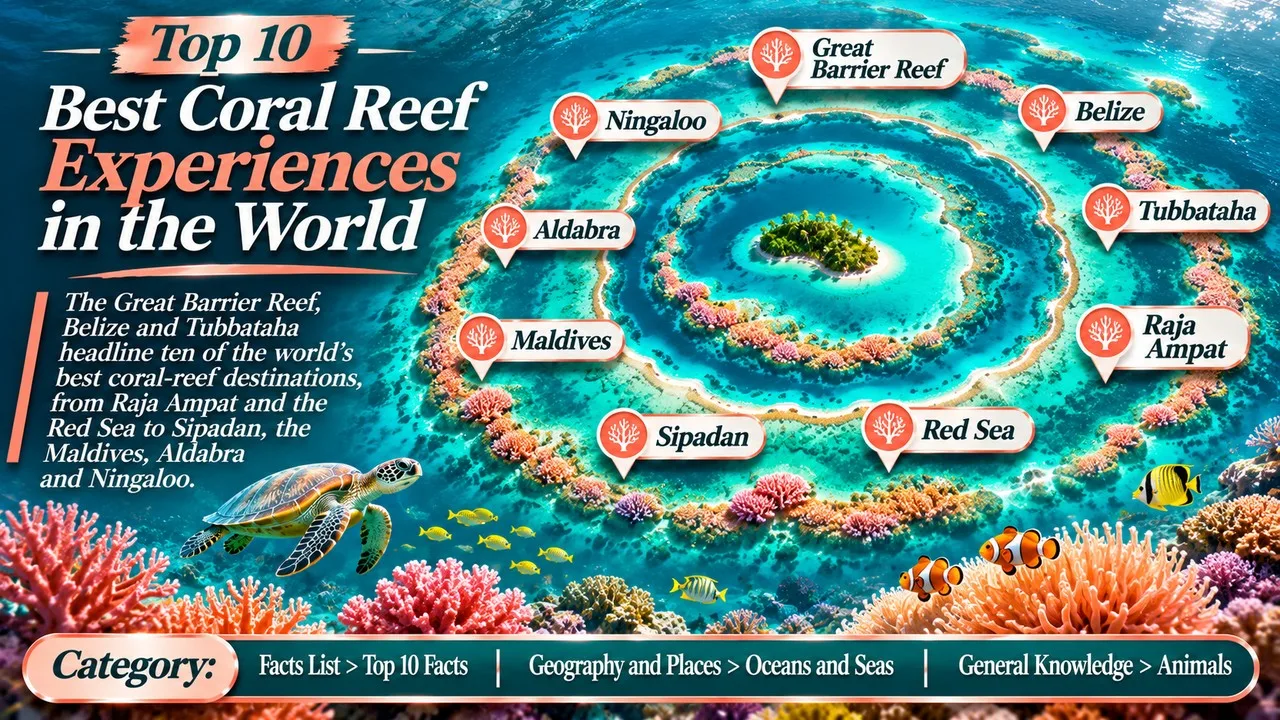
The Great Barrier Reef, the Belize Barrier Reef and Tubbataha are among the world's most celebrated coral-reef destinations for divers and snorkellers. Several of them are UNESCO World Heritage sites, which is a useful, if incomplete, guide to reefs that have been formally recognised for their scale or biodiversity [1][2].
This list is a travel list, not a scientific ranking of every reef by species counts. It favours places that are both biologically important and realistically visitable, with a spread across the Pacific, Indian Ocean, Caribbean and Red Sea. An older popular list that leaned on little-known single drop-off names, or treated a whole Hawaiian island as if it were one famous reef, is not copied here [1].
Coral reefs worldwide have been damaged by marine heatwaves. A good experience in 2026 is not a guarantee that the same site will look the same after the next bleaching year, a point also made in Finepedia's article on places to visit before they disappear [3]. Status notes below are as of November 2026.
Key Facts
The table gives each reef or reef system, its country, a signature attraction, and a protection or access note.
Coral Reef Experiences at a Glance
| Rank | Reef or site | Country or region | Signature experience | Notable fact |
|---|---|---|---|---|
| 1 | Great Barrier Reef | Australia | Snorkelling and diving on the world's largest reef system | UNESCO World Heritage site; condition varies by region and year |
| 2 | Belize Barrier Reef | Belize | Snorkelling on the hemisphere's longest barrier reef | UNESCO World Heritage site; includes the Blue Hole and many cays |
| 3 | Tubbataha Reefs | Philippines | Live-aboard diving on a remote atoll park | UNESCO World Heritage site in the Sulu Sea |
| 4 | Raja Ampat | Indonesia | Some of the richest coral biodiversity on Earth | Heart of the Coral Triangle, usually reached by live-aboard or island stay |
| 5 | Red Sea coral reefs | Egypt, Sudan and neighbours | Clear-water wall and reef diving | Easy access from the Sinai and Egyptian Red Sea coast, plus more remote southern sites |
| 6 | Sipadan | Malaysia | Oceanic-island drift dives with big pelagic life | A small island in the Celebes Sea, with tightly limited daily divers |
| 7 | Palancar Reef | Mexico | Drift dives on the Mesoamerican Reef at Cozumel | One of the Caribbean's most famous wall reefs |
| 8 | Maldives reefs | Maldives | House-reef snorkelling and atoll diving, including with manta rays | Low-lying atolls whose reefs are also a climate-vulnerable landscape |
| 9 | Aldabra Atoll | Seychelles | A huge, lightly visited raised atoll | UNESCO World Heritage site, second-largest coral atoll, more expedition than resort |
| 10 | Ningaloo Reef | Australia | Shore-accessible reef and seasonal whale sharks | UNESCO-listed Ningaloo Coast, on the opposite side of Australia from the Great Barrier Reef |
1. Great Barrier Reef
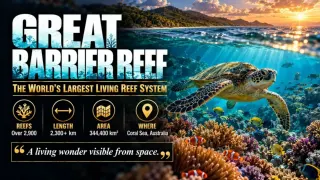
The Great Barrier Reef stretches for more than 2,000 kilometres off Queensland and is the largest coral-reef system on the planet [2]. Visitors usually reach it from Cairns, Port Douglas, Airlie Beach or the southern islands, on day boats or longer live-aboards, and the experience ranges from shallow snorkelling on inshore reefs to serious diving further out [2]. Because the system is so large, one trip only ever samples a small part of it.
Condition is not uniform. Marine heatwaves have caused mass bleaching in several recent summers, and official monitoring in 2025-26 described limited bleaching in that season, recovery of coral cover in some areas, and continuing risks from heat, cyclones and crown-of-thorns starfish [3]. A traveller should therefore choose an operator that is honest about recent local conditions, not one that still uses photographs from a better year.
The reef remains the essential starting point for a global list: the most famous, the largest, and still, in many sites, a fulfilling place to get in the water [2][3].
2. Belize Barrier Reef
The Belize Barrier Reef Reserve System is a UNESCO World Heritage site and the largest barrier-reef tract in the Northern Hemisphere, running much of the length of the Belizean coast and including cays, atolls and the famous Great Blue Hole [4]. For snorkellers it is often more approachable than a long crossing to an outer Australian reef: many sites are close to Ambergris Caye, Caye Caulker or mainland departure points [4].
The reef is part of the wider Mesoamerican Reef, which continues into Mexico, Guatemala and Honduras. Palancar, later on this list, belongs to the same system. Belize is listed separately because the barrier, the Blue Hole and the atolls form a complete destination in their own right, with a strong tradition of small-boat snorkelling as well as scuba [4].
Related: Top 10 Longest Coral Reefs in the World
Protection has been an issue, and UNESCO has previously scrutinised the site over development and extraction. A current visit should still be planned around licensed operators and no-take rules, which are part of what keeps the experience worth having [4].
3. Tubbataha Reefs
Tubbataha Reefs Natural Park, in the Sulu Sea in the Philippines, is a remote pair of atolls protected as a UNESCO World Heritage site and as a national marine park [5]. There is no resort on the reefs. Almost all visitors come on live-aboard dive boats during a limited season, which keeps numbers down and makes the trip more of an expedition than a casual snorkel stop [5].
The reward is reputedly some of the most intact coral and some of the most reliable big-animal encounters in South-East Asia, including sharks, turtles and schooling pelagic fish. Because the park is far from shore, the water is often very clear, and the walls drop away quickly [5].
Tubbataha is a useful contrast to the Great Barrier Reef's day-trip industry. It is harder to reach, more seasonal, and closer to the idea of a reef as a protected wilderness than as a backdrop to a beach hotel [5].
4. Raja Ampat
Raja Ampat, off the western end of New Guinea in Indonesia, sits at the heart of the Coral Triangle and is widely described as one of the most biodiverse coral regions on Earth, with a staggering number of fish and coral species recorded in surveys [6]. The destination is a scatter of islands, passages and limestone karsts, usually visited from a live-aboard boat or from small island stay-houses around the Dampier Strait [6].
The experience is not only walls and drift dives. Mangroves, shallow passages and manta cleaning stations are part of the same trip, which is why snorkellers as well as divers travel there. The area is more remote than Bali or even Komodo, and the logistics are part of the price [6].
Raja Ampat is not a UNESCO marine World Heritage site in the same way as Tubbataha or Belize, but on a travel list that cares about the richness of the reef itself, it belongs near the top [6].
5. Red Sea coral reefs
The Red Sea has some of the most accessible high-quality coral diving in the world, especially along Egypt's Sinai and mainland coasts, around sites such as Ras Mohammed, and on the offshore reefs and wrecks reached from Sharm el-Sheikh, Hurghada and Marsa Alam [7]. Further south, Sudanese reefs are more of a live-aboard destination. Clear water, colourful walls and a long dive-tourism infrastructure are the region's strengths [7].
Related: Top 10 Most Bizarre Phobias: Strange Fears That Exist
The Red Sea is a young, almost enclosed sea with a distinctive fauna, including many species found nowhere else. That biological identity, together with the ease of a beach-and-reef holiday, is why it has been a staple of European dive travel for decades [7]. Political and security conditions have sometimes shifted visitor patterns from one resort to another, so current travel advice matters.
This entry is a coastline rather than a single named reef, because that is how people actually experience it: a week based in one port, with daily boats to a string of sites [7].
6. Sipadan
Sipadan is a small oceanic island in the Celebes Sea off Sabah, Malaysia, rising from deep water and famous for drift dives, turtles, reef sharks and huge schools of barracuda and jacks [8]. It is often mentioned in the same breath as the world's great "small island, big water" dive sites. Daily visitor numbers are limited by permit, and overnight stays on the island itself were ended years ago in order to protect the habitat [8].
Divers now base themselves on nearby Mabul or in Semporna and cross in the morning. That system is less romantic than an island camp, and it is the reason Sipadan is still worth diving: the reef is not buried under a hotel [8].
Sipadan is a specialist trip rather than a first snorkel holiday. For people who already dive, it remains one of South-East Asia's essential oceanic-island experiences [8].
7. Palancar Reef
Palancar Reef, off the island of Cozumel in Mexico, is one of the most famous sections of the Mesoamerican Reef, the same barrier system that includes Belize [9]. The typical dive is a drift along a wall or through coral ridges, in generally clear water, with boats following the current. Snorkellers can also see parts of the shallower reef, though the classic Palancar experience is a scuba drift [9].
Related: Top 10 Oldest Buildings in the World
Cozumel's dive industry is large and well organised, which makes Palancar much easier to visit than Tubbataha or Raja Ampat. Ease is not a weakness on a travel list, provided the reef is still in good enough condition to justify the trip. As in the rest of the Caribbean, coral health has been under pressure from disease, heat and coastal development, so local, recent advice from operators matters [9].
Palancar stands here for the wider Cozumel Marine Park as well as for one named wall. It is the Caribbean counterpart to the big Pacific and Australian names earlier in the list [9].
8. Maldives reefs
The Maldives is a nation of atolls, and almost every inhabited or resort island has a house reef that can be snorkelled from the beach, as well as channels (kandu) and outer reefs for diving [10]. South Ari Atoll is well known for whale sharks; Baa Atoll, a UNESCO Biosphere Reserve, is famous for seasonal manta-ray gatherings at sites such as Hanifaru Bay [10]. The experience is therefore both casual, in the best sense, and capable of producing unforgettable large-animal encounters.
The same low islands are threatened by sea-level rise, which is why the Maldives also appears in Finepedia's list of places to visit before they disappear [10]. Reef condition has varied with bleaching events, including recent heat warnings, so a visitor should not assume that every house reef is in textbook health [10].
Even with that caveat, few countries make coral so central to an ordinary holiday. For many travellers this will be their first, and sometimes their most memorable, reef experience [10].
9. Aldabra Atoll
Aldabra, in the Seychelles, is one of the world's largest coral atolls and a UNESCO World Heritage site, famous as much for giant tortoises and a largely uninhabited landscape as for the reef itself [11]. It is often described as the second-largest coral atoll, and it has been protected by its remoteness as well as by formal conservation [11]. Visiting usually means an expedition cruise or a specialised permit-based trip, not a standard resort week.
The reef and lagoon experiences are therefore rarer, and more expensive, than almost anything else on this list. That is also why Aldabra still feels like a wild atoll rather than a developed dive destination [11].
Related: The Science Behind Auroras: How Solar Winds Create Colorful Skies
Including it is a way of keeping the list honest about the difference between a famous reef that is easy to reach and a famous reef that almost no one gets to see. Both kinds belong here [11].
10. Ningaloo Reef
Ningaloo Reef, on the Ningaloo Coast of Western Australia, is a UNESCO World Heritage site and one of the world's longest fringing reefs close to shore [12]. In places a visitor can swim off the beach and be over coral within a short distance, which is unusual for a reef of this quality. The coast is also one of the most reliable places to snorkel with whale sharks in season, as well as with other migrating marine life [12].
Ningaloo is a deliberate counterpart to the Great Barrier Reef at the top of the list: the same country, a very different ocean, a much smaller tourism machine, and a reef that does not require a long boat ride in every case [12]. Towns such as Exmouth and Coral Bay are the usual bases.
It is a fitting tenth entry because it shows that Australia's reef story is not only Pacific and not only offshore. For a related Finepedia wildlife-travel list, see the best whale-watching destinations [12].
Conclusion
These ten reef experiences run from the vast, variable Great Barrier Reef to remote parks such as Tubbataha and Aldabra, biodiverse corners of the Coral Triangle, the clear walls of the Red Sea, a permit-only oceanic island, Caribbean drift dives, Maldivian house reefs, and a shore-accessible reef in Western Australia. Together they cover the main ways people actually meet a coral reef: a day boat, a live-aboard, a house reef and, more rarely, an expedition.
Reefs change with the water temperature, and no list should pretend otherwise. The best current advice is to go with operators who follow local protection rules, to ask about recent bleaching, and to treat the encounter as a look at a living system, not as a guaranteed postcard. Related Finepedia coverage includes the best aquariums in the world and places to visit before they disappear.
- ^ [1] "World Heritage Marine Sites with coral reefs". International Coral Reef Initiative. ICRI: World Heritage marine sites with coral reefs
- ^ [2] "Great Barrier Reef". UNESCO World Heritage Centre. UNESCO: Great Barrier Reef
- ^ [3] "Annual Summary Report of Coral Reef Condition 2025/26". Australian Institute of Marine Science. AIMS: GBR condition summary 2025-26
- ^ [4] "Belize Barrier Reef Reserve System". UNESCO World Heritage Centre. UNESCO: Belize Barrier Reef
- ^ [5] "Tubbataha Reefs Natural Park". UNESCO World Heritage Centre. UNESCO: Tubbataha Reefs
- ^ [6] "Raja Ampat". Wikipedia. Wikipedia: Raja Ampat Islands
- ^ [7] "Red Sea". Wikipedia. Wikipedia: Red Sea
- ^ [8] "Sipadan". Wikipedia. Wikipedia: Sipadan
- ^ [9] "Cozumel". Wikipedia. Wikipedia: Cozumel
- ^ [10] "Maldives". Wikipedia. Wikipedia: Maldives
- ^ [11] "Aldabra". UNESCO World Heritage Centre. UNESCO: Aldabra Atoll
- ^ [12] "Ningaloo Coast". UNESCO World Heritage Centre. UNESCO: Ningaloo Coast



















Discussion
Log in with