




Top 10 Best Whale Watching Destinations in the World
 By Dhiraj Sharma · Published
Share Post
Loading…
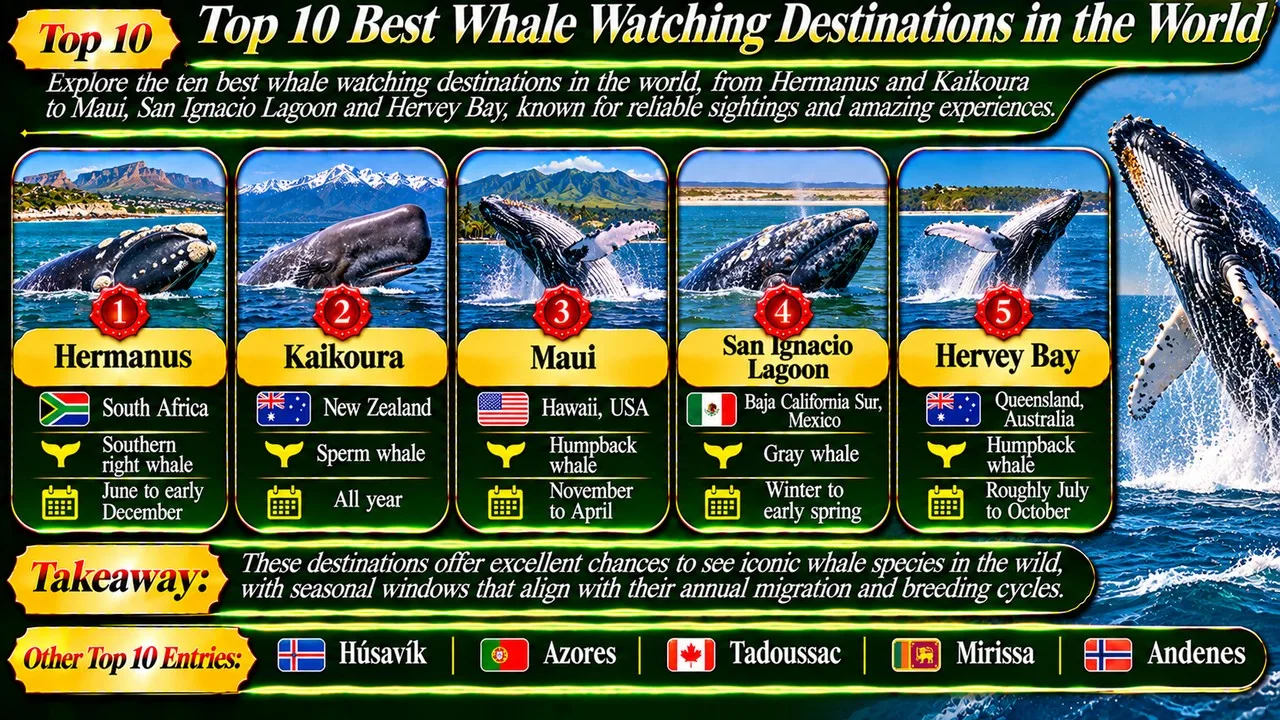
The best whale watching destinations in the world offer reliable sightings of humpbacks, blue whales, sperm whales and belugas, often from shore or near land.
Whale watching began as an organised activity in 1950, when crowds gathered at a lookout in San Diego to watch gray whales migrate along the California coast. Today it is a global industry. A 2009 study estimated that about 13 million people went whale watching in 2008, spending around 2.1 billion US dollars a year [1].
This Finepedia list picks ten places for the reliability of their sightings, the variety of species, the quality of their regulations and how close the whales come to land. Seasons and figures are given as of November 2026 and vary from year to year. Responsible operators keep a safe distance from whales, and many destinations now have strict rules to protect the animals from disturbance.
Key Facts
Here is a quick overview of the ten destinations, with their main species and the best season for each.
Whale Watching Destinations at a Glance
| Rank | Name | Location/Country | Main species | Best season |
|---|---|---|---|---|
| 1 | Hermanus | Western Cape, South Africa | Southern right whale | June to early December |
| 2 | Kaikoura | New Zealand | Sperm whale | All year |
| 3 | Maui | Hawaii, USA | Humpback whale | November to April |
| 4 | San Ignacio Lagoon | Baja California Sur, Mexico | Gray whale | Winter to early spring |
| 5 | Hervey Bay | Queensland, Australia | Humpback whale | Roughly July to October |
| 6 | Husavik | Iceland | Humpback and minke whales | Summer |
| 7 | Azores | Portugal | Sperm whale and many others | Spring to autumn |
| 8 | Tadoussac | Quebec, Canada | Beluga and other whales | Summer to autumn |
| 9 | Mirissa | Sri Lanka | Blue whale | December to March |
| 10 | Andenes | Norway | Sperm whale | Summer, with winter orca trips |
1. Hermanus
Hermanus is a seaside town on Walker Bay in South Africa's Western Cape, about a two-hour drive from Cape Town. It is famous as one of the best places in the world for land-based whale watching, because southern right whales come right into the bay to mate and give birth [2].
The whales arrive from about June and usually leave by early December, and they can be seen from cliffs along the coast. A walking path along the cliffs gives views of whales close to shore, sometimes only metres from the rocks. Southern right whales are easy to recognise by their broad backs with no dorsal fin and the pale callosities on their heads [2][3].
Since August 1992 Hermanus has employed a whale crier, who walks through town and blows a horn made of kelp to announce where whales have been spotted. The town also holds an annual whale festival at the end of September, and boat tours from the harbour run from June to mid December [2][1].
2. Kaikoura
Kaikoura is a small town on the northeast coast of New Zealand's South Island, set between snow-capped mountains and the Pacific Ocean. Its main attraction is the sperm whale, the largest toothed predator on Earth, which can be seen close to the coast throughout the year [4].
The secret is the Kaikoura Canyon, an undersea gorge about 60 kilometres long. Its head lies very close to shore, and the water drops from about 30 metres to roughly 2,000 metres deep. In some places the deep water of the canyon is only about a kilometre from the shoreline, and studies have found 10 to 100 times more marine life there than in other deep-sea habitats [5].
Related: Top 10 Longest-Living Animals on Earth
The town was once a whaling station, but whale watching took over as the main industry, with operators that include a company owned by the local Maori community. Visitors can also see dusky dolphins, fur seals and albatrosses. The town recovered after the major 2016 Kaikoura earthquake damaged roads and lifted parts of the seabed [4].
3. Maui
Maui is the leading whale watching centre in the Hawaiian Islands. Each winter, North Pacific humpback whales gather in the sheltered Auau Channel between Maui and the islands of Lanai and Molokai [6].
The humpbacks migrate about 5,600 kilometres from feeding grounds in Alaska each autumn and spend roughly November to April in the warm Hawaiian waters, where they mate and give birth. An estimated 21,000 to 26,000 humpbacks live in the North Pacific [6].
Humpbacks are known for their acrobatic behaviour, including breaching, slapping their tails and fins on the water and long, complex songs sung by males during the breeding season [7]. Visitors can watch from boats out of Lahaina and Maalaea, from coastal lookouts, or even hear whale songs by putting their heads under water while snorkelling.
4. San Ignacio Lagoon
San Ignacio Lagoon on the Pacific coast of Baja California Sur in Mexico is one of the main winter sanctuaries of the eastern Pacific gray whale. Each winter, gray whales travel from feeding grounds in the Arctic to the warm, shallow lagoons of Baja California to give birth and raise their calves [8].
In the nineteenth century, whalers discovered the lagoon and nearly wiped out the Pacific gray whale population. Today the species has recovered, with about 27,000 individuals in the eastern Pacific, and the lagoon is protected as part of the El Vizcaino Biosphere Reserve, created in 1988, and the Whale Sanctuary of El Vizcaino World Heritage Site [8][9][10].
San Ignacio is famous for curious gray whales that often approach small boats, and some mothers even bring their calves close enough for visitors to touch. Strict rules limit the number of boats in the lagoon, and the small local community relies on fishing and whale watching for its income [8].
5. Hervey Bay
Hervey Bay is a coastal city in Queensland, Australia, sheltered by K'gari, the world's largest sand island. It calls itself the whale watching capital of Australia, as humpback whales pass along the coast between April and October each year [11].
Related: Top 10 Most Dangerous Fish in the World
Many humpbacks stop to rest in the calm waters of Platypus Bay on their way south to Antarctica after giving birth in the warm waters further north. Mothers and calves often spend time in the bay, and the whales are known for approaching boats with curiosity [11].
In October 2019 Hervey Bay became the first place in the world to be named a Whale Heritage Site by the World Cetacean Alliance, in recognition of its commitment to responsible whale and dolphin watching [11]. The peak season for viewing in the bay itself runs from about July to October.
6. Husavik
Husavik is a small town on Skjalfandi Bay in northern Iceland and has become the country's best-known whale watching centre. The bay is known for the many kinds of whales, dolphins and seabirds that feed in its waters [12][13].
Humpback whales and minke whales are the most common sightings, and white-beaked dolphins and harbour porpoises are also frequently seen. Blue whales, the largest animals that have ever lived, are occasionally reported too. Tours run mainly in the summer months, when long daylight hours allow trips late into the evening [12].
The town is also home to the Husavik Whale Museum, located by the harbour, which explains the biology of whales and the history of whaling in Iceland. Across the bay rise the Viknafjoll and Kinnarfjoll mountains, which give whale watching trips a dramatic backdrop [13].
7. Azores
The Azores are a group of volcanic islands in the middle of the Atlantic Ocean, about 1,360 kilometres west of mainland Portugal. They are one of the best places in the world to see sperm whales, which live around the islands all year, and around 28 species of whales and dolphins have been recorded in their waters [14].
Related: Exploring the Great Barrier Reef: Ecosystem and Biodiversity
The islands have a long whaling history. From 1867, the village of Lajes on Pico island ran a shore-based sperm whale hunt using open boats and hand-thrown harpoons. Lookouts in stone towers on the cliffs spotted whales and signalled the whalers. The hunt ended in the 1980s, after Portugal backed the international ban on commercial whaling [14].
Whale watching tours began from Lajes in 1989, and the old lookout towers are used again, this time to guide tour boats to the whales. Regulations require a marine biologist or trained guide on board and limit how many boats can stay with a group of whales [14].
8. Tadoussac
Tadoussac is a historic village in Quebec, Canada, at the point where the Saguenay Fjord meets the St. Lawrence River. It is one of the oldest European settlements in Canada and a major whale watching centre [15].
The meeting of fresh water from the fjord and cold salt water from the river stirs up nutrients that attract large numbers of whales. The area is protected by the Saguenay-St. Lawrence Marine Park, the first park in Canada created to protect a purely marine environment, covering about 1,245 square kilometres [16].
The park is home to the St. Lawrence beluga, a small white whale found in this population only in Canada and listed as a species at risk. Minke, fin and humpback whales are also common in summer, and even the blue whale sometimes appears. Visitors can join boat tours or watch from the shore and cliffs [16].
9. Mirissa
Mirissa is a fishing town and beach resort on the south coast of Sri Lanka. It is one of the best places in the world to see blue whales, the largest animals ever known to have existed [17].
The continental shelf is narrow off southern Sri Lanka, so deep water lies close to the coast. Blue whales of the northern Indian Ocean population feed in these waters, and the peak season for sightings off Mirissa runs from about December to March, during the northeast monsoon [18].
Related: Top 10 Remarkable Jellyfish of the World
Sperm whales, Bryde's whales and spinner dolphins are also seen on some trips. Sri Lanka has regulations requiring boats to keep at least 100 metres from whales, but researchers have warned that crowding by boats can disturb the whales, so choosing a responsible operator is important [18].
10. Andenes
Andenes is a fishing village at the northern tip of Andoya island in the Vesteralen archipelago of northern Norway. Its location beside a narrow section of the continental shelf has made it a major whale watching centre [19].
The edge of the shelf, where the sea floor drops into deep water, lies only about 7 kilometres from the harbour at Andenes. Male sperm whales gather there to feed on squid and fish, making sightings very reliable. Summer trips run from about May to September [1].
In winter, from about October to April, operators in northern Norway also offer trips to see orcas and humpback whales, which follow herring into the fjords. Under the dark sky of the polar night, some visitors combine whale watching with the northern lights [1][19].
Conclusion
The world's best whale watching destinations combine rich feeding or breeding grounds with places where whales come close to land. From the right whales of Hermanus and the gray whale nurseries of Baja California to the sperm whales of Kaikoura and the Azores, each offers a different window into the lives of the largest animals on Earth.
Many of these places were once whaling centres. Their shift to whale watching shows how protecting whales can benefit both the animals and local communities. For more about marine life, see the most dangerous sea creatures and the strangest deep sea creatures on Finepedia.
- ^ [1] "Whale watching". Wikipedia. Wikipedia: Whale watching
- ^ [2] "Hermanus". Wikipedia. Wikipedia: Hermanus
- ^ [3] "Southern right whale". Wikipedia. Wikipedia: Southern right whale
- ^ [4] "Kaikoura". Wikipedia. Wikipedia: Kaikoura
- ^ [5] "Kaikoura Canyon". Wikipedia. Wikipedia: Kaikoura Canyon
- ^ [6] "Maui". Wikipedia. Wikipedia: Maui
- ^ [7] "Humpback whale". Wikipedia. Wikipedia: Humpback whale
- ^ [8] "San Ignacio Lagoon". Wikipedia. Wikipedia: San Ignacio Lagoon
- ^ [9] "Gray whale". Wikipedia. Wikipedia: Gray whale
- ^ [10] "Whale Sanctuary of El Vizcaino". UNESCO World Heritage Centre. UNESCO: Whale Sanctuary of El Vizcaino
- ^ [11] "Hervey Bay". Wikipedia. Wikipedia: Hervey Bay
- ^ [12] "Husavik". Wikipedia. Wikipedia: Husavik
- ^ [13] "Skjalfandi". Wikipedia. Wikipedia: Skjalfandi
- ^ [14] "Portugal: The Azores". IWC Whale Watching Handbook. IWC: The Azores
- ^ [15] "Tadoussac". Wikipedia. Wikipedia: Tadoussac
- ^ [16] "Saguenay-St. Lawrence Marine Park". Wikipedia. Wikipedia: Saguenay-St. Lawrence Marine Park
- ^ [17] "Mirissa". Wikipedia. Wikipedia: Mirissa
- ^ [18] "Sri Lanka". IWC Whale Watching Handbook. IWC: Sri Lanka
- ^ [19] "Andenes". Wikipedia. Wikipedia: Andenes




















Discussion
Log in with