




 By
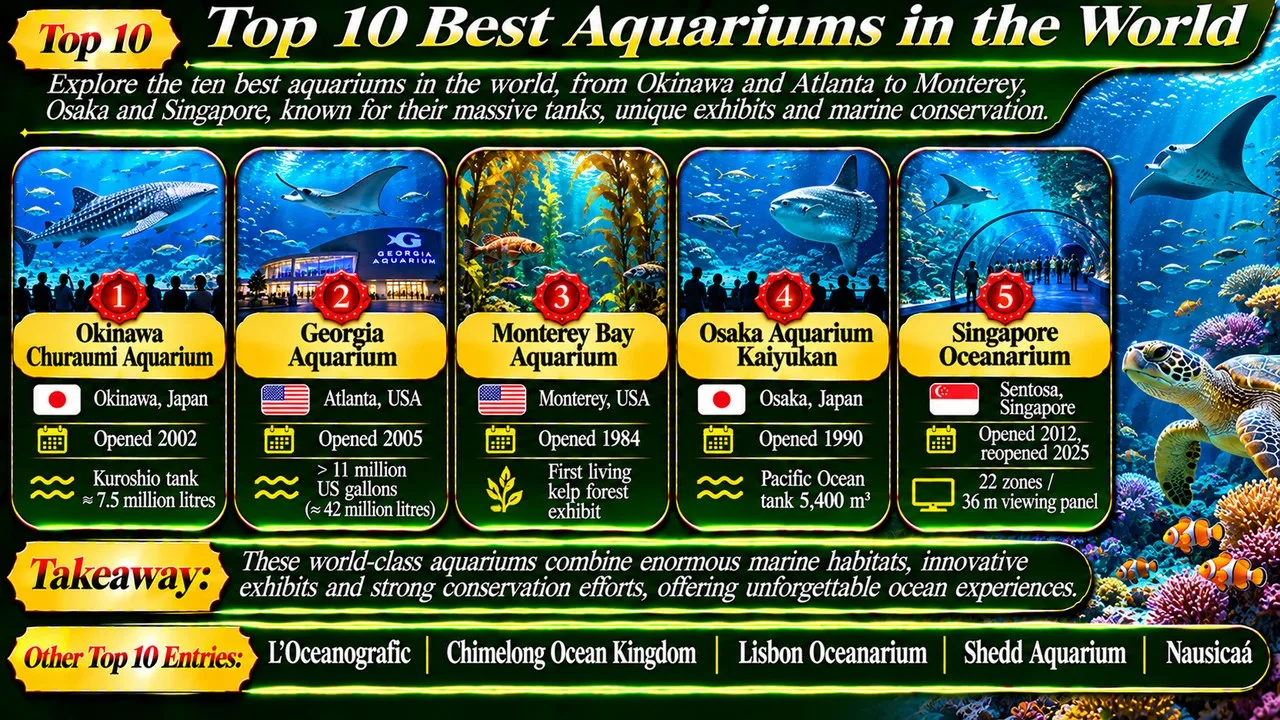
The best aquariums in the world let visitors meet whale sharks, manta rays, belugas and kelp forests up close, through giant windows and walk-through tunnels.
Public aquariums began in the nineteenth century as small rooms of glass tanks. Today the largest hold tens of millions of litres of water and recreate whole ocean ecosystems, from coral reefs and polar seas to the open ocean. Many also run research, breeding and rescue programmes that support conservation in the wild [1].
This Finepedia list ranks ten aquariums by a mix of size, the quality of their exhibits, their scientific work and their reputation with visitors. Water volumes, animal numbers and visitor figures come from the aquariums and published sources and are given as of November 2026. Because aquariums keep expanding, rankings by size change over time, and claims such as "largest in Europe" depend on how each facility counts its water.
Key Facts
Here is a quick overview of the ten aquariums, with their location, opening year and one standout figure for each.
World's Best Aquariums at a Glance
| Rank | Name | Location/Country | Opened | Key figure |
|---|---|---|---|---|
| 1 | Okinawa Churaumi Aquarium | Okinawa, Japan | 2002 | Kuroshio Sea tank of 7.5 million litres |
| 2 | Georgia Aquarium | Atlanta, USA | 2005 | More than 11 million US gallons of water |
| 3 | Monterey Bay Aquarium | Monterey, USA | 1984 | First living kelp forest exhibit |
| 4 | Osaka Aquarium Kaiyukan | Osaka, Japan | 1990 | Pacific Ocean tank of 5,400 cubic m |
| 5 | Singapore Oceanarium | Sentosa, Singapore | 2012, reopened 2025 | 22 zones and a 36 m viewing panel |
| 6 | L'Oceanografic | Valencia, Spain | 2003 | 45,000 animals of 500 species |
| 7 | Chimelong Ocean Kingdom | Hengqin, China | 2014 | 48.75 million litres of water |
| 8 | Lisbon Oceanarium | Lisbon, Portugal | 1998 | Central tank of 5 million litres |
| 9 | Shedd Aquarium | Chicago, USA | 1930 | About 32,000 animals |
| 10 | Nausicaa | Boulogne-sur-Mer, France | 1991 | 17 million litres after 2018 expansion |
1. Okinawa Churaumi Aquarium
Okinawa Churaumi Aquarium stands in Ocean Expo Park on the northern coast of Okinawa Island in Japan. It opened on 1 November 2002, replacing an older aquarium on the same site, and annual visitor numbers jumped from about 430,000 to 2.75 million in its first year [2].
Its centrepiece is the Kuroshio Sea tank, named after the warm current that flows past Okinawa. The tank is 35 metres long, 27 metres wide and 10 metres deep, holds about 7.5 million litres of water and has a viewing panel 8.2 metres tall and 22.5 metres wide, made of acrylic 60 centimetres thick [2]. Whale sharks and manta rays glide past the window, creating one of the most famous views in any aquarium.
Churaumi is also known for its research. Its earlier aquarium was among the first in the world to keep whale sharks and manta rays for long periods, and it has achieved important breeding successes with these species. The site welcomed its 50 millionth visitor in 2019 [2].
2. Georgia Aquarium
The Georgia Aquarium in Atlanta held the global size record when it opened in November 2005 and remains the largest in the United States. Its exhibits hold more than 11 million US gallons, or about 42 million litres, of fresh and salt water [3].
The centrepiece is the Ocean Voyager exhibit, a huge habitat of about 6.3 million US gallons that is home to whale sharks, the largest fish in the sea, along with manta rays and thousands of other fish. A long underwater tunnel and a giant window let visitors watch these animals from below and alongside [3].
Related: Top 10 Longest-Living Animals on Earth
Other galleries feature beluga whales, bottlenose dolphins, sea otters, California sea lions and tiger sharks. The aquarium also runs research and rescue programmes, including work on whale sharks and right whales in the wild [3].
3. Monterey Bay Aquarium
The Monterey Bay Aquarium opened in October 1984 on Cannery Row in Monterey, California, in a building that reused parts of an old sardine cannery. At the time it was the largest public aquarium in the United States, and it still draws around two million visitors a year [4].
Rather than displaying exotic fish from around the world, Monterey focused on the habitats of its own bay. It was the first aquarium to show a living kelp forest, with tall seaweed swaying in a tank open to sunlight and fed by seawater pumped from the bay [4].
The aquarium is a leader in marine research and conservation. Its sea otter programme rescues stranded pups and raises them for release, and it has worked on tuna and seabird studies. Its Seafood Watch programme helps shoppers and restaurants choose sustainably caught fish [4].
4. Osaka Aquarium Kaiyukan
Osaka Aquarium Kaiyukan opened in 1990 beside Osaka Bay as the largest public aquarium in the world at the time. It was an instant hit, welcoming 5.6 million visitors in its first year, and it has since become the most visited aquarium in Japan [5].
The aquarium follows a single theme: the Pacific Ring of Fire. Visitors take an escalator to the top floor and walk down a spiral ramp past habitats from different parts of the Pacific, including the Aleutian Islands, Monterey Bay, Antarctica and the Great Barrier Reef [5].
At the heart of the building is the Pacific Ocean tank, which is about 34 metres long and 9 metres deep and holds 5,400 cubic metres of water. It houses whale sharks, hammerhead sharks, bluefin tuna and manta rays, and because the ramp spirals around it, visitors see the tank from many levels [5].
5. Singapore Oceanarium
The Singapore Oceanarium at Resorts World Sentosa is the expanded successor of the S.E.A. Aquarium, which opened in 2012. The original aquarium held nearly 45 million litres of water and housed upwards of 100,000 creatures from some 800 species, and for a time it was the world's largest aquarium by water volume [6].
Related: Top 10 Largest Islands in the World
The S.E.A. Aquarium closed on 30 April 2025 for rebranding and expansion and reopened as the Singapore Oceanarium on 24 July 2025 [6]. The new attraction takes visitors through 22 themed zones, from mangroves and Singapore's own coast to prehistoric seas and the open ocean [7].
Its Open Ocean habitat keeps the famous 36-metre-wide viewing panel, where reef manta rays, zebra sharks and thousands of fish swim past [7]. The oceanarium also features one of the world's largest jellyfish habitats and gives a strong focus to marine research and conservation.
6. L'Oceanografic
L'Oceanografic in Valencia, Spain, opened on 14 February 2003 as part of the City of Arts and Sciences, a striking complex of futuristic buildings. Its shell-like roofs were designed by the architect Felix Candela [8].
It is one of the largest aquarium complexes in Europe, covering about 110,000 square metres and holding around 42 million litres of water. This includes a 26 million litre dolphinarium and an ocean tank of 7 million litres with sharks and rays. About 45,000 animals of 500 species live there [8].
Visitors move between nine underwater towers that represent major marine environments, including the Mediterranean, the Arctic, Antarctica, temperate and tropical seas and the Red Sea. A long tunnel lets visitors walk beneath sharks, and the complex also includes mangrove and wetland areas and a garden [8].
7. Chimelong Ocean Kingdom
Chimelong Ocean Kingdom is a marine theme park on Hengqin island in Zhuhai, southern China, near Macau. It opened in January 2014, and Guinness World Records confirmed it as the world's largest aquarium, with 48.75 million litres of salt and fresh water [9][10].
Related: Top 10 Most Dangerous Sea Creatures
The park set five world records at its opening, including the largest aquarium window, a single acrylic panel 39.6 metres wide and 8.3 metres tall that looks into a whale shark tank. It is also one of the most visited theme parks in the world, with about 12.6 million visitors in 2024 [9].
Animal areas include beluga whales, polar bears, penguins, dolphins and a freshwater Amazon zone, alongside rides and shows. In 2023 Guinness recognised a newer park by the same company in Zhuhai, Chimelong Spaceship, as the holder of the largest aquarium record, with more than 75 million litres [10].
8. Lisbon Oceanarium
The Lisbon Oceanarium was built for Expo '98, the world exhibition held in Lisbon to mark the international year of the oceans. It sits on the waterfront in the Parque das Nacoes and attracts about one million visitors a year [11].
Designed by Peter Chermayeff, who also planned the Osaka Kaiyukan, the building is centred on a single large tank of about 5 million litres with a surface area of about 1,000 square metres. Sharks, rays, barracudas, groupers and moray eels swim through it, and four large windows give views from every side [11].
Around the main tank are four habitats representing the North Atlantic coast, the Antarctic coast, Pacific kelp forests and Indian Ocean coral reefs. They are separated from the central tank only by acrylic panels, giving the impression of a single ocean. Its sea otters are among the most popular residents [11].
9. Shedd Aquarium
The Shedd Aquarium in Chicago opened on 30 May 1930 on the shore of Lake Michigan and was once the largest indoor aquarium in the world. It holds about 5 million US gallons of water and around 32,000 animals of some 1,500 species [12].
When it opened, the aquarium was far from the sea, so railway tank cars made repeated round trips to Key West in Florida to bring about one million gallons of seawater for its saltwater exhibits [12]. Its grand classical building is now a city landmark.
Related: Top 10 Most Dangerous Fish in the World
Highlights include the Caribbean Reef, a circular habitat added in 1971, the Wild Reef shark exhibit and the Abbott Oceanarium, which shows belugas, Pacific white-sided dolphins and sea otters against a view of Lake Michigan. It recorded about two million visitors in 2015 [12].
10. Nausicaa
Nausicaa, the French National Sea Centre, is in Boulogne-sur-Mer on the English Channel coast. It opened on 18 May 1991 and takes its name from a princess in Greek mythology [13].
A major expansion in 2018 added a gallery called The High Seas, built around a tank of 10 million litres for open-ocean fish such as sharks and rays. The work raised the total water volume from 4.5 million to around 17 million litres. Nausicaa describes itself as the largest aquarium in Europe and attracts more than 800,000 visitors a year [13].
Its exhibits explore the relationship between people and the sea, from fishing and coastal life to climate change. Visitors can see sea lions, penguins, jellyfish and coral reefs, and the centre works to raise awareness about protecting the oceans [13].
Conclusion
The world's best aquariums combine vast tanks, careful design and serious science. From Okinawa's whale sharks and Atlanta's giant ocean habitat to Monterey's living kelp forest and Lisbon's single-ocean design, each offers a different window into life underwater.
Modern aquariums also face debate about keeping large marine mammals in captivity, and the most respected now put strong emphasis on research, rescue and education. For more about marine life, see the strangest deep sea creatures, the remarkable jellyfish of the world and the bioluminescent sea animals on Finepedia.
- ^ [1] "Public aquarium". Wikipedia. Wikipedia: Public aquarium
- ^ [2] "Okinawa Churaumi Aquarium". Wikipedia. Wikipedia: Okinawa Churaumi Aquarium
- ^ [3] "Georgia Aquarium". Wikipedia. Wikipedia: Georgia Aquarium
- ^ [4] "Monterey Bay Aquarium". Wikipedia. Wikipedia: Monterey Bay Aquarium
- ^ [5] "Osaka Aquarium Kaiyukan". Wikipedia. Wikipedia: Osaka Aquarium Kaiyukan
- ^ [6] "S.E.A. Aquarium". Wikipedia. Wikipedia: S.E.A. Aquarium
- ^ [7] "Resorts World Sentosa unveils Singapore Oceanarium". Resorts World Sentosa. Resorts World Sentosa: press release
- ^ [8] "L'Oceanografic". Wikipedia. Wikipedia: L'Oceanografic
- ^ [9] "Chimelong Ocean Kingdom". Wikipedia. Wikipedia: Chimelong Ocean Kingdom
- ^ [10] "Largest aquarium". Guinness World Records. Guinness World Records: Largest aquarium
- ^ [11] "Lisbon Oceanarium". Wikipedia. Wikipedia: Lisbon Oceanarium
- ^ [12] "Shedd Aquarium". Wikipedia. Wikipedia: Shedd Aquarium
- ^ [13] "Nausicaa Centre National de la Mer". Wikipedia. Wikipedia: Nausicaa




















Discussion
Log in with