





 By
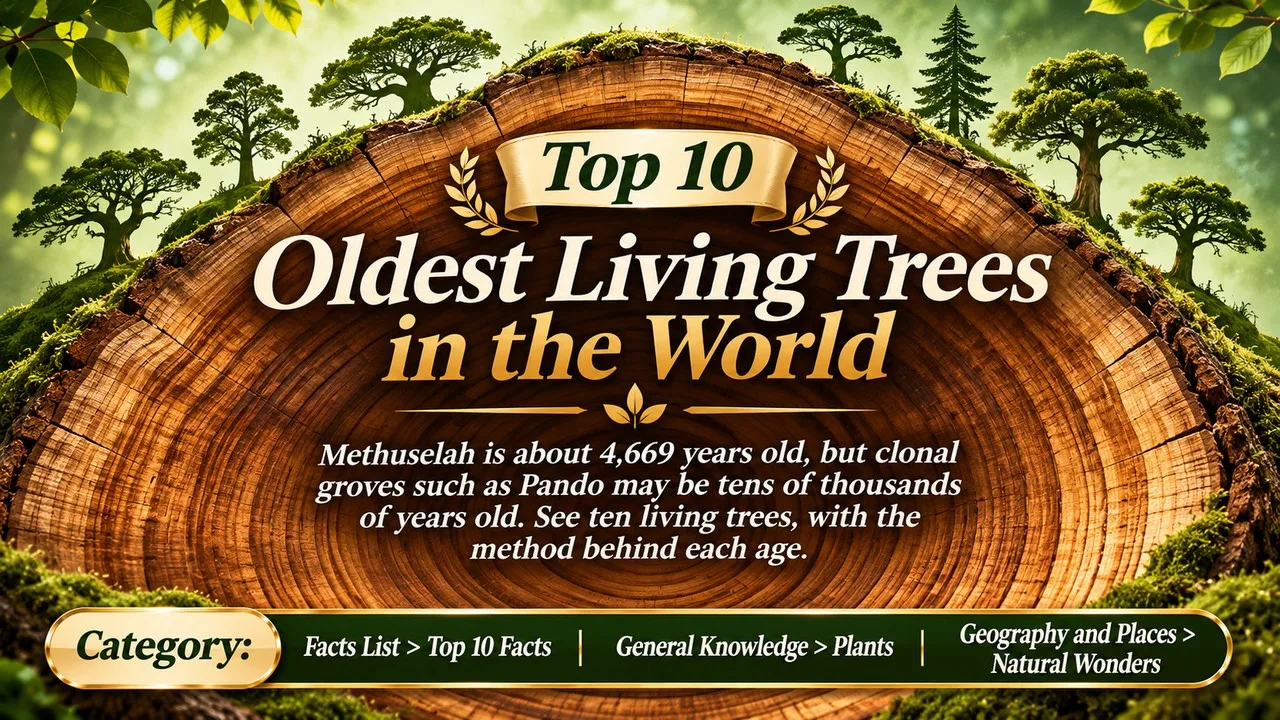
Methuselah, a bristlecone pine in California's White Mountains, is the oldest living non-clonal tree with a verified age of about 4,669 years. That figure comes from tree-ring cross-dating and is reported on Wikipedia's list of oldest trees as a germination around 2644 BCE [1][2].
Age in trees is not a single number. Scientists distinguish a living trunk whose rings can be counted or cross-dated, a trunk whose centre has rotted so that only a minimum or an estimate is possible, and a clonal colony in which individual stems are relatively young but the root system or genotype is ancient. A list that mixed those categories without labels would be misleading, which is why each entry below states how the age was obtained [1].
This article covers ten living trees or tree organisms that are still standing as of November 2026. Dead specimens such as Prometheus, a bristlecone cut down in 1964 and later dated to about 4,961 years, are mentioned only for context. Finepedia's separate list of the most famous trees in the world ranks recognition and visitor fame, not verified age, so the two lists overlap at Methuselah but otherwise diverge [1][2].
Key Facts
The table summarises how each age was measured or estimated. Cross-dated figures are the most precise; estimated and clonal ages should be read as ranges or scientific judgements, not as exact birth years.
Oldest Living Trees at a Glance
| Rank | Tree or organism | Location | Type of age | Age (as of 2026) |
|---|---|---|---|---|
| 1 | Pando | Fishlake National Forest, Utah, United States | Clonal colony (genetic and landscape evidence) | About 16,000 to 37,000 years (2024 estimate) |
| 2 | Old Tjikko | Fulufjallet National Park, Sweden | Clonal spruce; dated root system | About 9,550 years |
| 3 | Methuselah | White Mountains, California, United States | Cross-dated non-clonal trunk | About 4,669 years |
| 4 | Alerce Milenario | Alerce Costero National Park, Chile | Incomplete ring count; one higher model is unconfirmed | At least 3,655 years; 5,484 claimed but not confirmed |
| 5 | Llangernyw Yew | Llangernyw, Wales, United Kingdom | Estimate from girth and growth | Often given as 4,000 to 5,000 years |
| 6 | Sarv-e Abarkuh | Abarkuh, Yazd, Iran | Traditional and size-based estimate | Often given as about 4,500 years |
| 7 | Oliveira do Mouchao | Mouriscas, Abrantes, Portugal | Dendrometric estimate | About 3,350 years |
| 8 | The President | Sierra Nevada, California, United States | Estimate for a living giant sequoia | About 3,200 years |
| 9 | Jaya Sri Maha Bodhi | Anuradhapura, Sri Lanka | Documented planting date | Planted around 288 BCE (about 2,314 years) |
| 10 | CB-90-11 | Central Colorado, United States | Cross-dated Rocky Mountain bristlecone | About 2,469 years |
1. Pando
Pando is a single quaking aspen genotype in Utah's Fishlake National Forest. It covers about 43 hectares and sends up tens of thousands of stems, each of which may live only about a century, while the root system keeps resprouting [1][3]. In that sense it is better described as one of the oldest and heaviest known organisms than as a single trunk.
A 2024 study of somatic mutations, reported via a preprint later cited on the Wikipedia list of oldest trees, estimated the colony's age at roughly 16,000 to 37,000 years [1][3]. Earlier popular figures of 80,000 years or more are no longer the central scientific range. Because the method is not a ring count of one bole, the age remains an estimate, and it should not be compared directly with Methuselah's cross-dated total [1].
The stand is also a conservation problem. Heavy browsing by mule deer and other animals has reduced regeneration in parts of the grove, which is why forest managers have tested fencing and other controls [3]. Visitors can see the trembling leaves from public roads near Fish Lake, but the spectacle is a forest, not a single labelled tree.
2. Old Tjikko
Old Tjikko is a Norway spruce on Fulufjallet in Dalarna, Sweden. The visible stem is not thousands of years old; spruce trunks on the site live only a few centuries. What was dated, by radiocarbon and genetic matching, is the root system that has kept putting up new trunks since the early Holocene, about 9,550 years ago [1][4].
The tree was identified by a team led by Leif Kullman and announced in 2008. Other very old spruces have since been reported in the same mountain area, including trees with root ages of more than 8,000 years, so Old Tjikko is the best-known example of a regional pattern rather than a unique freak [1][4].
Related: General Knowledge Facts About the Banyan Tree: Botany, Records and Culture
For travellers, the point is modest: a small, slightly leaning spruce on a high plateau, not a giant. Its importance is scientific. It shows how a species can persist at a treeline by cloning itself through climate swings that would have killed a single stem [4].
3. Methuselah
Methuselah is the oldest living non-clonal tree whose age is securely known from cross-dating. It is a Great Basin bristlecone pine (Pinus longaeva) in the White Mountains of California, in the Ancient Bristlecone Pine Forest. Wikipedia, following the Rocky Mountain Tree-Ring Research old-list, gives an age of 4,669 years and a germination around 2644 BCE [1][2].
The United States Forest Service does not mark the exact tree on the trail, a precaution taken after vandalism risks became obvious. Visitors walk among many other bristlecones, some nearly as old, in a dry, high-elevation woodland where slow growth and durable wood allow rings to be preserved for millennia [2]. An even older living bristlecone was once reported from a core that later went missing; that claim is treated as unconfirmed [1].
Prometheus, sometimes called WPN-114, was a still older bristlecone on Wheeler Peak in Nevada. It was cut down in 1964 during research and later dated to about 4,961 years. It is not on this list because it is no longer alive, but it explains why Methuselah is described as the oldest known living example rather than the oldest specimen ever dated [1][2].
4. Alerce Milenario
Alerce Milenario, also called Gran Abuelo, is a Patagonian cypress (Fitzroya cupressoides) in Chile's Alerce Costero National Park. A published ring-based minimum age of 3,655 years already places it among the oldest living non-clonal trees outside the bristlecone pines [1][5].
In 2022 a researcher argued, from a partial core and a growth model, that the tree could be about 5,484 years old, which would overtake Methuselah. That higher figure has not been confirmed by a complete cross-dated record, and reference lists still present 3,655 as the securely demonstrated minimum [1][5]. Until a full series is published and reproduced, the honest ranking is: definitely more than 3,600 years, possibly much older, not proven to be the world's oldest single stem.
The species itself is long-lived and was heavily logged in the past. The park protects a ravine habitat that is wetter and more temperate than the White Mountains, which is a reminder that extreme age is not confined to desert highlands [5].
5. Llangernyw Yew
The yew in the churchyard of St Digain's at Llangernyw, in Conwy, Wales, is one of the most frequently cited old trees in Britain. Its girth is about 10.75 metres, and popular and some specialist accounts estimate its age at 4,000 to 5,000 years [1]. Those figures are not the product of a complete ring count. Yews hollow with age, which destroys the evidence that bristlecone researchers rely on.
Related: Top 10 Rarest Rock Formations in the World
The tree is still alive and is listed among the 50 Great British Trees. Estimates of this kind can be too high or too low by centuries, so the entry is here as a major living veteran with a widely reported millennial age, not as a precision record [1]. Churchyard yews across Britain and Ireland raise the same problem: great age is plausible, but the numbers are ranges.
Visitors see a vast, fragmented trunk around a quiet church, a very different experience from a labelled national-park specimen. The uncertainty is part of the story, not a reason to ignore the tree.
6. Sarv-e Abarkuh
Sarv-e Abarkuh, sometimes called the Zoroastrian cypress, is a Mediterranean cypress (Cupressus sempervirens) in the city of Abarkuh, in Iran's Yazd province. Traditional and popular accounts assign it an age of about 4,000 to 4,500 years, and it is often described as one of Iran's natural monuments [1][6]. As with the Welsh yew, this is not a published cross-dated ring count.
The tree is a civic and cultural landmark as much as a botanical one, standing in a planted setting rather than a remote forest. Cypresses can be extremely long-lived in dry climates, so a multi-millennial age is not impossible, but scientific lists treat the figure as an estimate [1][6].
It is included here because it is living, famous, and consistently reported as several thousand years old, and because a global list that used only North American ring records would hide how much old-tree evidence elsewhere still depends on girth, tradition and local scholarship [6].
7. Oliveira do Mouchao
Oliveira do Mouchao is a European olive at Mouriscas, in the municipality of Abrantes, Portugal. In 2016 Jose Luis Lousada of the University of Tras-os-Montes and Alto Douro estimated its age at about 3,350 years by dendrometry, with a stated precision of around 2 percent, and Portuguese authorities have treated it as the country's oldest tree [1][7].
Related: Top 10 Breathtaking Natural Arches of the World
Dendrometry infers age from size and growth, which is less exact than counting rings to the pith. The figure is nonetheless a documented scientific estimate, not folklore alone, and the tree is alive and protected [7]. Ancient olives elsewhere, including the Olive Tree of Vouves on Crete and S'Ozzastru in Sardinia, have similar or broader estimated ranges and face the same methodological limits [1].
Olives are among the oldest cultivated trees, so a Portuguese veteran of this scale also sits at the edge of agricultural history. It is a working kind of monument: a fruit tree that has outlasted kingdoms.
8. The President
The President is a giant sequoia in the Sierra Nevada of California, estimated at about 3,200 years old and still alive [1]. Unlike General Sherman, which Finepedia's famous-trees article discusses as the largest living single-stem tree by volume, The President is listed here for longevity. Sequoia ages for many named trees are estimates, because cores to the centre of the largest boles are often incomplete [1][2].
Several still older sequoia specimens in the same range were cross-dated at more than 3,000 years but are dead, so they do not belong on a list of living trees [1]. The President's combination of great size, an age estimate over three millennia, and a public location in a protected grove makes it the best-known living sequoia in the age discussion after the volume record-holders.
Giant sequoias grow in a wetter climate than bristlecones and reach their ages with huge annual wood production rather than with extreme suppression of growth. That contrast is one reason a single "oldest tree" headline is never enough [2].
9. Jaya Sri Maha Bodhi
Jaya Sri Maha Bodhi, in the Mahamevnawa Gardens at Anuradhapura, Sri Lanka, is a sacred fig (Ficus religiosa) planted around 288 BCE. Tradition, recorded in early chronicles and accepted by Guinness World Records, holds that it was grown from a cutting of the Bodhi tree at Bodh Gaya and brought to the island by Sanghamitta, daughter of the emperor Ashoka [1][8]. That makes it the oldest living tree with a known human planting date, a different kind of record from a wild ring count.
The tree is a major Buddhist pilgrimage site and a carefully tended monument, with terraces, railings and attendant monks. Its fame is also why it appears on Finepedia's list of famous trees; it is on this list for the documentary date, not for estimated wild age [8].
Related: Top 10 Most Incredible Sea Cliffs in the World
A planting date can be more trustworthy than a girth estimate, even when it is slightly younger than the oldest bristlecones. At about 2,314 years in 2026, it remains an extraordinary span for a tree whose history is a matter of public record rather than a laboratory core [1][8].
10. CB-90-11
CB-90-11 is a Rocky Mountain bristlecone pine (Pinus aristata) in central Colorado, cross-dated at about 2,469 years (germination around 444 BCE) [1]. It is less famous than Methuselah because it has no popular name and is not a tourism icon, but it is one of the oldest living trees with a fully documented ring series outside the Great Basin species.
Including an unnamed, carefully dated tree is deliberate. A list of only celebrated specimens would favour folklore and visitor centres over the scientific record. CB-90-11 stands for a larger set of dated pines, junipers and bald cypresses whose ages are known to the year but whose locations are often withheld or unmarked to protect them [1].
Rocky Mountain bristlecones are a different species from the Great Basin trees of the White Mountains. Their presence on this list shows that extreme longevity has evolved more than once in high, dry North American ranges [1].
Conclusion
The oldest living trees are not a single league table. Pando and Old Tjikko are ancient as organisms; Methuselah is ancient as a dated trunk; several yews, cypresses and olives are almost certainly millennial but cannot yet be cross-dated to the same standard. As of November 2026, no published, reproduced ring record has unseated Methuselah among living non-clonal trees, and the higher model for Chile's Alerce Milenario remains unconfirmed [1][5].
Anyone using these figures should keep the method in view, and should not treat a tourist nickname as a laboratory result. For trees people travel to see because of story and shape rather than a ring count, see Finepedia's list of famous trees.
- ^ [1] "List of oldest trees". Wikipedia. Wikipedia: List of oldest trees
- ^ [2] "Methuselah (tree)". Wikipedia. Wikipedia: Methuselah (tree)
- ^ [3] "Pando (tree)". Wikipedia. Wikipedia: Pando
- ^ [4] "Old Tjikko". Wikipedia. Wikipedia: Old Tjikko
- ^ [5] "Alerce Milenario". Wikipedia. Wikipedia: Alerce Milenario
- ^ [6] "Sarv-e Abarkuh". Wikipedia. Wikipedia: Cypress of Abarkuh
- ^ [7] "Oliveira do Mouchao". Wikipedia / University of Tras-os-Montes and Alto Douro estimate as summarised on the list of oldest trees. Wikipedia: List of oldest trees (Oliveira do Mouchao)
- ^ [8] "Jaya Sri Maha Bodhi". Wikipedia. Wikipedia: Jaya Sri Maha Bodhi





















Discussion
Log in with