





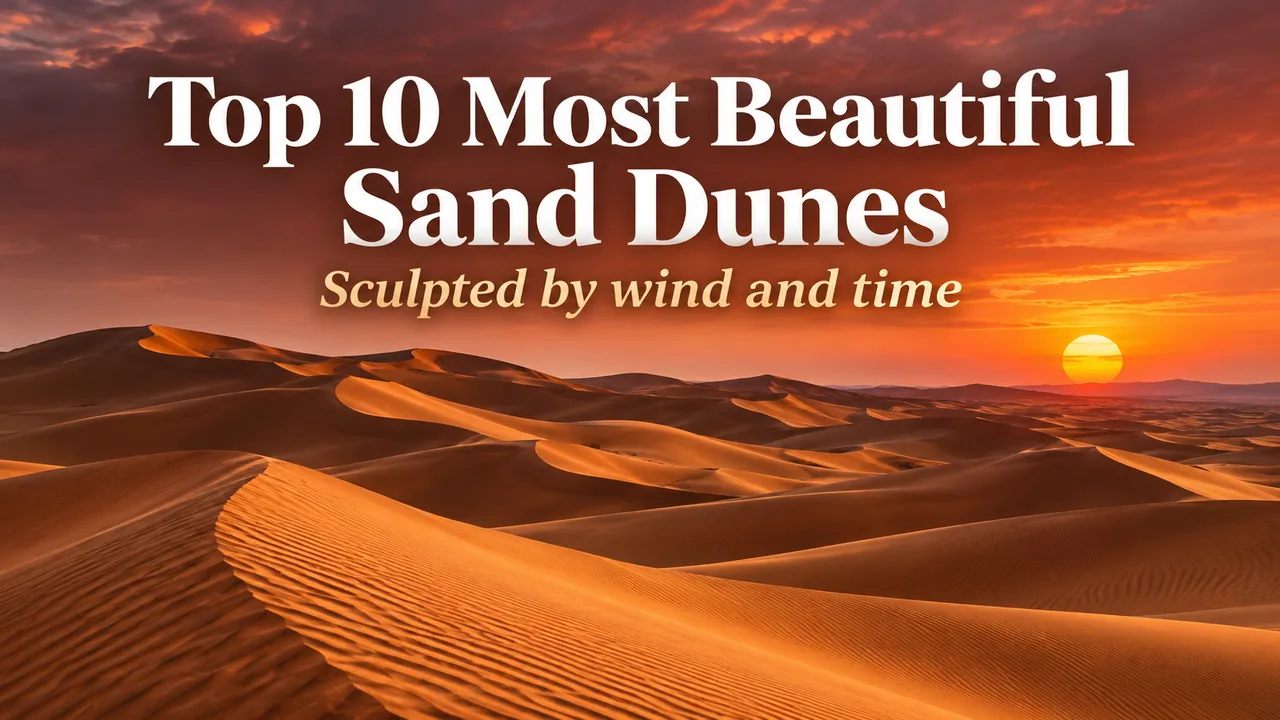
The most beautiful sand dunes in the world are landscapes that never stand still. Built and reshaped by wind, they form crests, ridges and stars of sand that shift colour from pale gold to deep red as the sun moves across the sky [1].
Dunes form where there is a plentiful supply of loose sand, steady wind and few plants to hold the ground in place. Depending on wind direction and sand supply, they take shapes such as crescent barchans, long linear ridges and towering star dunes that grow upward as winds blow from several directions [1].
This Finepedia list features ten dune landscapes chosen for their beauty, height and uniqueness. They include desert giants in Africa, Asia and South America, as well as coastal dunes beside the Atlantic and dunes that hide lakes, rivers and singing sands. Heights are approximate, because dunes grow, shrink and migrate over time.
Key Facts
The table below lists the ten dune fields and dunes in this article, with their country, an approximate height and one notable fact.
Beautiful Sand Dunes at a Glance
| Rank | Name | Location/Country | Key figure | Notable fact |
|---|---|---|---|---|
| 1 | Sossusvlei | Namib Desert, Namibia | Dunes over 300 m | Red dunes beside the white clay pan of Deadvlei |
| 2 | Badain Jaran Desert | Inner Mongolia, China | Dunes about 500 m | More than 100 lakes among the dunes |
| 3 | Rub al Khali | Arabian Peninsula | About 650,000 km2 | Largest continuous sand desert in the world |
| 4 | Dune du Pilat | Gironde, France | About 100-110 m | Tallest sand dune in Europe |
| 5 | Great Sand Dunes | Colorado, USA | Star Dune about 230 m | Tallest dunes in North America |
| 6 | Erg Chebbi | Merzouga, Morocco | Dunes up to about 150 m | Classic Sahara scenery |
| 7 | Lencois Maranhenses | Maranhao, Brazil | About 1,500 km2 | Rainwater lagoons between white dunes |
| 8 | Cerro Blanco | Nazca, Peru | About 1,176 m from base | Among the tallest dunes in the world |
| 9 | Mingsha Shan | Dunhuang, China | Peaks about 250 m | Crescent Lake oasis and singing sands |
| 10 | Wahiba Sands | Oman | About 12,500 km2 | Long north-south dune ridges |
1. Sossusvlei
Sossusvlei is a salt and clay pan in the Namib Desert of Namibia, surrounded by some of the highest dunes on Earth. Many of the dunes rise more than 300 metres, and their deep red colour comes from iron oxide coating the sand grains [2].
The Namib is often called one of the oldest deserts in the world, having been dry for tens of millions of years. Nearby Deadvlei is a white clay pan dotted with dead camel thorn trees around 600 to 900 years old, blackened by the sun but too dry to decay.
Popular dunes include Big Daddy and Dune 45, which visitors climb at sunrise to watch shadows race across the sand. The area is part of the Namib-Naukluft National Park and the Namib Sand Sea UNESCO World Heritage Site, one of the few coastal deserts in the world shaped by fog as well as wind.
2. Badain Jaran Desert
The Badain Jaran Desert in Inner Mongolia, China, contains some of the tallest stationary dunes on Earth, reaching about 500 metres in height [3].
Among the giant dunes lie more than 100 lakes, many of them salty and some fed by groundwater. Their blue and green waters create a striking contrast with the golden sand, and small Buddhist temples stand on the shores.
Some dunes here produce a booming sound when sand slides down their slopes, a phenomenon known as singing sand. The desert became part of a UNESCO World Heritage Site in 2024, recognising its unique dune and lake landscape.
The lakes and giant dunes exist together because groundwater seeps up through the sand in hollows, and scientists continue to study how it supplies water in such a dry place. Travel into the desert usually requires four-wheel-drive vehicles and local guides, which keeps the landscape quiet and largely unspoiled.
Related: Top 10 Most Bizarre Phobias: Strange Fears That Exist
3. Rub al Khali
The Rub al Khali, or Empty Quarter, covers much of the southern Arabian Peninsula, spreading across Saudi Arabia, Oman, the United Arab Emirates and Yemen. It covers around 650,000 square kilometres and is the largest continuous sand desert in the world [4].
Dunes in parts of the Empty Quarter rise to about 250 metres, separated by flat gravel and gypsum plains. Summer temperatures can exceed 50 degrees Celsius, and rainfall is extremely rare.
Explorers such as Bertram Thomas and Wilfred Thesiger crossed the desert in the twentieth century and wrote about Bedouin life there. Today areas such as the Liwa Oasis in the UAE offer access to its sweeping orange dunes.
The desert's emptiness hides surprising life, including desert foxes, beetles and hardy plants that survive on rare rains. Beneath the sand, the region also sits above some of the largest oil reserves in the world.
4. Dune du Pilat
The Dune du Pilat lies on the Atlantic coast near Arcachon Bay in southwest France. At about 100 to 110 metres high and nearly 3 kilometres long, it is the tallest sand dune in Europe [5].
The dune is moving inland by a few metres each year, slowly burying the pine forest behind it. Wooden staircases are installed in season to help visitors climb its steep face.
From the top, views stretch across the ocean, the sandbanks of Arcachon Bay and the forests of the Landes. It attracts around two million visitors a year and is a popular launch site for paragliders.
Archaeologists have found remains of ancient forests and wartime bunkers within and around the dune, revealed as the sand shifts. The coastline nearby is also famous for oysters, adding to the region's appeal.
5. Great Sand Dunes
Great Sand Dunes National Park and Preserve in southern Colorado contains the tallest dunes in North America. Star Dune rises roughly 230 metres above the valley floor [6].
Related: The Science Behind Auroras: How Solar Winds Create Colorful Skies
The dunes formed from sand carried by wind across the San Luis Valley and trapped against the Sangre de Cristo Mountains. Medano Creek flows along the base of the dunes in spring, creating a seasonal beach.
Visitors can sandboard and sled down the slopes, and the park is an International Dark Sky Park, making it a superb place for stargazing. The contrast of dunes with snowy peaks makes it one of the most unusual dune landscapes on Earth.
6. Erg Chebbi
Erg Chebbi is a sea of dunes near the village of Merzouga in eastern Morocco. Its dunes rise up to about 150 metres and cover roughly 28 kilometres from north to south [7].
The orange-red sand is a classic picture of the Sahara, and it is one of the most accessible large dune fields in the desert. Camel treks lead to tented camps where visitors sleep under the stars.
Erg Chebbi has appeared in films and is a popular location for sunrise photography. Its accessibility from Marrakech and Fes has made it a centre of desert tourism in Morocco.
Nearby villages of Berber and Gnawa communities offer music, food and traditional hospitality. Fossil-rich rock in the area also provides polished stones sold in local markets.
7. Lencois Maranhenses
Lencois Maranhenses National Park in northeastern Brazil covers about 1,500 square kilometres of white dunes along the Atlantic coast [8].
Between January and June heavy rains fill the hollows between dunes, creating thousands of clear blue and green lagoons. Some lagoons even hold fish, whose eggs survive the dry season buried in the sand or arrive with birds.
Related: Top 10 Facts About Dogs
The park's name means "bedsheets of Maranhao", describing the white dunes stretching to the horizon. In 2024 it was added to UNESCO's World Heritage List.
The dunes are shaped by strong winds that push sand inland from the coast, while the lagoons quickly dry again as the dry season returns. Visitors reach the park by four-wheel-drive vehicles from the town of Barreirinhas.
8. Cerro Blanco
Cerro Blanco is a huge sand dune near Nazca in southern Peru. Measured from its base, it rises about 1,176 metres, and its summit stands more than 2,000 metres above sea level [9].
The dune is a popular site for sandboarding, attracting adventurers who climb for hours before speeding down its steep slopes. Its height makes it one of the tallest dunes in the world.
In pre-Columbian times, the dune was considered sacred by the Nazca people, who believed it was linked to water from the mountains. It lies near the famous Nazca Lines.
Climbing Cerro Blanco usually takes three to four hours from the base, and the reward is wide views over the desert and the Andean foothills. Sunrise climbs are common to avoid the heat of the day.
9. Mingsha Shan
Mingsha Shan, meaning Echoing Sand Mountains, lies near Dunhuang in Gansu Province, China. Its dunes reach about 250 metres and produce a humming sound when the wind blows or people slide down [10].
At the foot of the dunes lies Crescent Lake, a small oasis that has survived for thousands of years. Pavilions and a pagoda beside the lake create a famous view.
Related: Top 10 Tallest Buildings in the World
Dunhuang was an important stop on the Silk Road, and the nearby Mogao Caves hold Buddhist art dating back more than 1,000 years. Visitors ride camels or slide down dunes in this historic setting.
The sound of the sand has fascinated travellers for centuries and is mentioned in old Chinese records. The combination of dunes, oasis and history makes it one of the most memorable desert sites in Asia.
10. Wahiba Sands
The Wahiba Sands, also called Sharqiya Sands, cover about 12,500 square kilometres in eastern Oman [11].
The desert is known for its long north-south dune ridges that reach about 100 metres high, shaped by monsoon winds. The sand changes colour from amber to orange through the day.
Bedouin communities still live in the area, and desert camps offer dune bashing, camel riding and stargazing. Scientists have studied the Wahiba Sands as a model for understanding sand seas.
The desert sits only a few hours by road from Muscat, making it easy to combine with visits to wadis and mountain villages. Its cool winter nights make the season from October to March the best time to visit.
Conclusion
The world's most beautiful sand dunes show how wind and time shape remarkable landscapes. Each dune field has its own colour, form and story, from the red giants of Namibia to the lagoon-filled dunes of Brazil.
These landscapes are fragile and can be damaged by overuse. Visitors should follow park rules, stay hydrated and protect these unique environments so that future generations can enjoy them.
- ^ [1] "Dune". Wikipedia. Wikipedia: Dune
- ^ [2] "Namib Sand Sea". UNESCO World Heritage Centre. UNESCO: Namib Sand Sea
- ^ [3] "Badain Jaran Desert". Wikipedia. Wikipedia: Badain Jaran Desert
- ^ [4] "Rub' al Khali". Wikipedia. Wikipedia: Rub al Khali
- ^ [5] "Dune of Pilat". Wikipedia. Wikipedia: Dune of Pilat
- ^ [6] "Great Sand Dunes National Park and Preserve". U.S. National Park Service. NPS: Great Sand Dunes
- ^ [7] "Erg Chebbi". Wikipedia. Wikipedia: Erg Chebbi
- ^ [8] "Lencois Maranhenses National Park". Wikipedia. Wikipedia: Lencois Maranhenses
- ^ [9] "Cerro Blanco (Peru)". Wikipedia. Wikipedia: Cerro Blanco
- ^ [10] "Mingsha Shan". Wikipedia. Wikipedia: Mingsha Shan
- ^ [11] "Wahiba Sands". Wikipedia. Wikipedia: Wahiba Sands




















Discussion
Log in with