





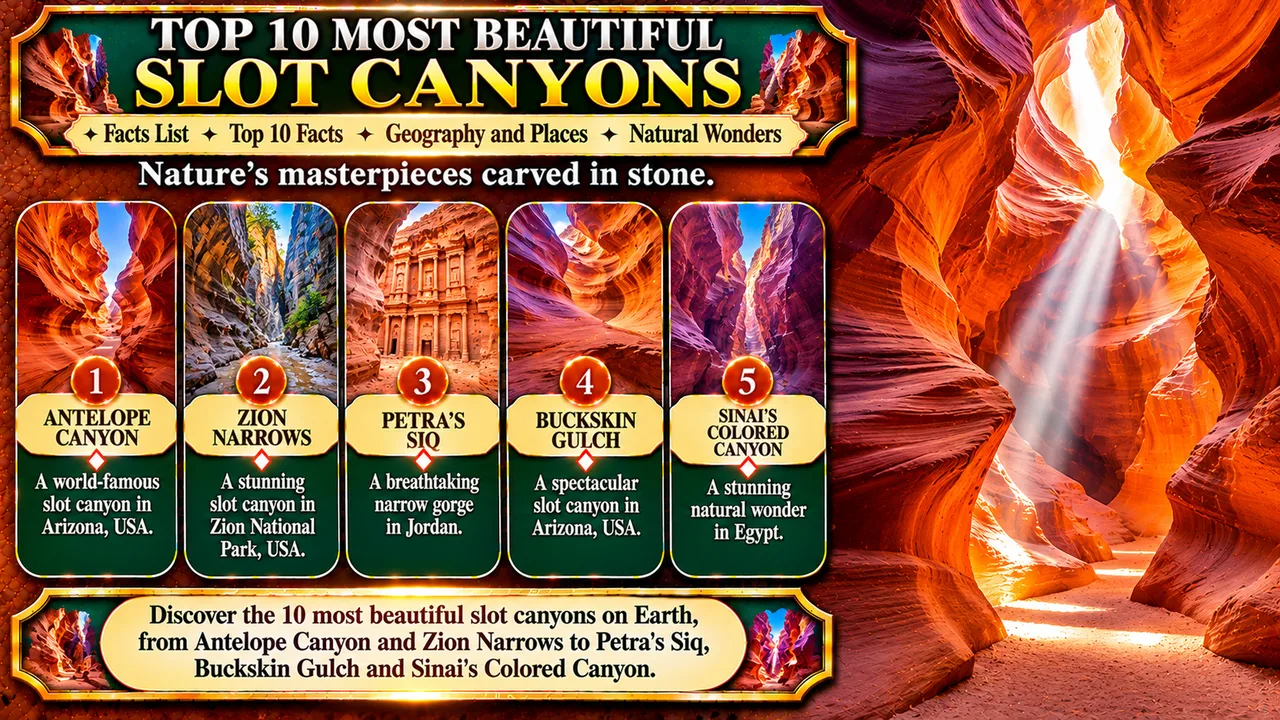
The most beautiful slot canyons in the world are narrow rock corridors carved so deeply that sunlight often reaches the floor only as a soft glow or a brief midday beam. A slot canyon is a naturally formed gorge that is much deeper than it is wide, frequently only a few metres across at the bottom, with walls that rise tens or hundreds of metres above a dry wash or a shallow stream [1].
Most true slots form where intermittent floods cut into soft rock such as sandstone, polishing walls into flowing curves. A few corridors, such as the Siq at Petra, began as tectonic faults and were only later smoothed by water [2]. Slot canyons are common on the Colorado Plateau, with further examples in Australia, the Middle East and North Africa.
This Finepedia list ranks ten slot canyons for colour, form, scale and cultural fame. The Wave in Arizona is a celebrated sandstone formation but not a classic slot, so Peek-a-Boo and Spooky Gulches near Escalante, Utah, take its place. Figures come from park services and encyclopaedia sources and are approximate where references disagree.
Key Facts
The table below summarises the ten slot canyons in this list, with location and one stand-out figure or feature for each.
Slot Canyons at a Glance
| Rank | Name | Location | Key figure | Notable fact |
|---|---|---|---|---|
| 1 | Antelope Canyon | Near Page, Arizona, USA | Walls about 37 m deep | Most photographed Navajo sandstone slot; guided tours only |
| 2 | The Siq | Petra, Jordan | About 1.2 km long | Main entrance corridor to ancient Nabataean Petra |
| 3 | The Subway | Zion National Park, Utah, USA | Tube-like undercut section | Permit-required Left Fork slot with reflective pools |
| 4 | The Narrows | Zion National Park, Utah, USA | Walls up to about 300 m | Virgin River hike through Zion Canyon's narrowest gorge |
| 5 | Peek-a-Boo and Spooky Gulches | Near Escalante, Utah, USA | Spooky as narrow as about 25 cm | Twin Dry Fork slots famous for arches and squeezes |
| 6 | Buckskin Gulch | Kane County, Utah, USA | About 16 miles / 26 km | Among the longest continuous slot canyons in the Southwest |
| 7 | Cathedral Gorge | Purnululu National Park, Australia | Amphitheatre inside banded beehives | UNESCO World Heritage Bungle Bungle Range |
| 8 | Witches Gulch | Wisconsin Dells, Wisconsin, USA | Boardwalk through narrow sandstone | Upper Dells boat-tour stop with mossy walls |
| 9 | Weano Gorge | Karijini National Park, Australia | Handrail Pool at the lower end | Banded iron-formation gorge in the Pilbara |
| 10 | Colored Canyon | South Sinai, Egypt | Walls up to about 40 m | Multicoloured sandstone labyrinth near Nuweiba |
1. Antelope Canyon
Antelope Canyon, on Navajo Nation land near Page in northern Arizona, is the most visited and most photographed slot canyon in the American Southwest. It is cut into Navajo Sandstone by flash floods that still reshape the corridors today. Upper Antelope Canyon runs roughly 200 metres and is about 37 metres deep; Lower Antelope Canyon is longer, about 407 metres, and more spiral in form [3].
The Navajo name for Upper Antelope Canyon, Tse Bighanilini, means roughly "the place where water runs through rocks." Rain far upstream can funnel into the slots with little warning, so visits are guided tours only through Lake Powell Navajo Tribal Park. Midday sunbeams create the orange-and-purple light shafts seen on postcards worldwide.
In August 1997 a flash flood killed eleven people in Lower Antelope Canyon, prompting bolted ladders, weather radios and stricter tour rules [3]. Carefully managed visits still make it the clearest introduction to slot-canyon beauty for most travellers.
2. The Siq
The Siq is the main entrance gorge into the ancient Nabataean city of Petra in southern Jordan. It winds for about 1.2 kilometres and in places narrows to roughly three metres, while the enclosing walls rise between about 91 and 182 metres [2]. Unlike most slots on this list, the Siq began as a geological fault pulled apart by tectonic forces; water later smoothed the rock and carved chambers into the walls.
Nabataean engineers built dams to divert floodwater from Wadi Musa, and a monumental arch once stood near the entrance before an 1896 earthquake left only abutments. At the far end, the gorge opens onto Al-Khazneh, the rock-cut Treasury. As part of UNESCO-listed Petra, the Siq mixes geology and archaeology in one of the world's most memorable slot-like corridors.
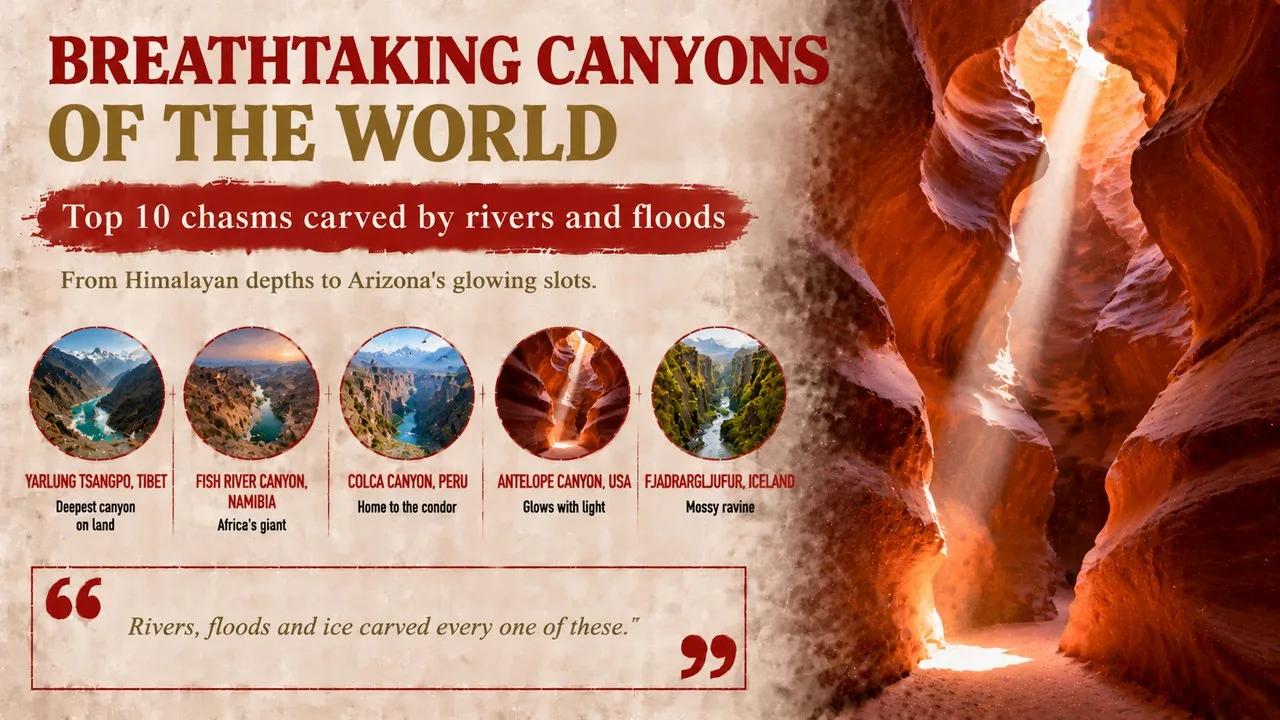
Related: Top 10 Breathtaking Canyons of the World
3. The Subway
The Subway is a short, tube-like section of the Left Fork of North Creek inside Zion National Park, Utah. Hikers give it that name because the undercut sandstone walls curve overhead like a transit tunnel, while cold pools fill potholes on the floor and reflect the green and orange rock [4]. The famous tube itself spans less than about 0.4 kilometres, but reaching it requires a long approach hike.
The bottom-up hike from the Left Fork Trailhead is demanding but non-technical; the top-down route from Wildcat Canyon involves rappels and cold swims for experienced groups. Both need a wilderness permit, which is limited in peak months [4]. The Subway shows that a short slot can still feel otherworldly.
4. The Narrows
The Narrows is the tightest section of Zion Canyon, where the North Fork of the Virgin River runs between walls that rise as high as about 1,000 feet (roughly 300 metres) while the river channel may shrink to only 20 to 30 feet across [5]. For much of the hike the river is the trail, so walkers spend most of their time wading on slippery stones.
Day hikers often start at the Temple of Sinawava and walk upstream as far as Big Spring, up to about 4.7 miles one way without a permit. The full top-down trip from Chamberlain's Ranch is about 16 miles and needs a wilderness permit [5]. Flash floods and hypothermia are the main hazards, yet The Narrows remains one of America's signature canyon walks.
5. Peek-a-Boo and Spooky Gulches
Peek-a-Boo Gulch and Spooky Gulch are neighbouring tributaries of Dry Fork of Coyote Gulch on Bureau of Land Management land south of Escalante, Utah. Together they form a popular half-day loop of roughly 3.5 miles. Peek-a-Boo begins with a short climb into a slot of interlocking arches, fins and potholes; Spooky soon becomes so narrow that adults often turn sideways, with passages only about 10 inches wide in places [6].
They replace The Wave on this list because The Wave is a cross-bedded sandstone surface in Coyote Buttes, not a deep slot corridor. Peek-a-Boo and Spooky offer classic slot scenery as free day-hikes when the Hole-in-the-Rock Road is open and weather is safe, though flash floods remain a serious danger.
6. Buckskin Gulch
Buckskin Gulch in southern Kane County, Utah, is widely described as one of the longest continuous slot canyons in the Southwest. From the Buckskin Trailhead to its confluence with the Paria River the corridor runs roughly 16 miles (about 26 kilometres), with walls that deepen downstream and reach on the order of 500 feet near the meeting of the two canyons [7].
Related: Top 10 Most Bizarre Phobias: Strange Fears That Exist
Much of the gulch averages only a few metres wide, with muddy pools and flood debris lodged high on the walls. Wire Pass is a common day-hike entrance. Overnight use in the Paria Canyon-Vermilion Cliffs Wilderness is capped, and BLM day-use permits are required [7]. Buckskin belongs near the top of any list that values scale as well as colour.
7. Cathedral Gorge
Cathedral Gorge sits inside Purnululu National Park in Western Australia's Kimberley region, the Bungle Bungle Range. UNESCO-listed since 2003, the park protects banded sandstone cone karst eroded over roughly 20 million years into orange-and-black beehive towers [8]. Cathedral Gorge opens from a narrow approach into a red-rock amphitheatre with a seasonal pool and strong natural acoustics.
A moderate walk of about two to four kilometres return from the Piccaninny car park leads through the striped domes into the cathedral chamber. Access needs a long four-wheel-drive approach or a scenic flight, which keeps crowds smaller than at famous American slots. Nearby Echidna Chasm offers an even narrower passage among Livistona palms.
8. Witches Gulch
Witches Gulch is a mossy sandstone slot along the Wisconsin River at Wisconsin Dells. Wind and water cut a corridor so narrow that visitors can often touch both walls, and a wooden boardwalk keeps feet dry [9]. Nineteenth-century photographers helped make the Dells famous, and the gulch remains an Upper Dells boat-tour highlight.
Unlike desert slots, Witches Gulch stays green and cool, with ferns on Cambrian sandstone and emerald filtered light. Boat-tour access makes it more family-friendly than remote Southwest hikes and a temperate contrast to the arid icons higher on the list.
9. Weano Gorge
Weano Gorge cuts into Karijini National Park in Western Australia's Pilbara region. Its walls expose Brockman Iron Formation banded ironstone, laid down roughly 2.5 billion years ago, in red, silver and black layers [10]. The lower trail ends at Handrail Pool, reached by scrambling and a fixed handrail descent.
Related: The Science Behind Auroras: How Solar Winds Create Colorful Skies
Karijini's Class 5 routes demand sure footing on polished rock in hot, remote country. The reward is a gorge coloured by iron minerals, proving hard banded ironstone can be as striking as soft Navajo Sandstone.
10. Colored Canyon
Colored Canyon, or Coloured Canyon, lies in South Sinai, Egypt, inland from the Red Sea town of Nuweiba and roughly 90 kilometres north of Dahab. Its main walking section is about 800 metres long, with walls up to about 40 metres high and depths around 30 metres [11]. Iron and manganese minerals paint the sandstone in yellow, red, purple and white stripes.
The corridor narrows to less than a metre in places, with polished walls that feel closer to Antelope Canyon than to open desert wadis. Day tours from Sinai resorts make it one of Egypt's most popular short canyon hikes and the only African entry on this global list.
Frequently Asked Questions
What is a slot canyon?
A slot canyon is a narrow natural gorge that is much deeper than it is wide, often only an arm-span across at the floor. Most form when flash floods cut into sandstone or similar rock; a few, such as Petra's Siq, began as tectonic faults and were later smoothed by water [1][2].
Where are the most famous slot canyons?
The densest cluster of famous slots lies on the Colorado Plateau in Utah and Arizona, including Antelope Canyon, Buckskin Gulch, Zion's Narrows and The Subway. Outstanding examples also exist in Jordan, Egypt, Western Australia and even temperate places such as Wisconsin Dells [3][5][8].
Are slot canyons dangerous?
Yes. Flash floods can fill a slot in minutes, even when rain falls many kilometres away, and cold water or slippery rock adds further risk. Guided tours, permits, weather checks and turning back when storms threaten are essential safety steps in nearly every canyon on this list [3][5][7].
Related: Top 10 Facts About Dogs
Do you need a permit for Antelope Canyon or Zion slots?
Antelope Canyon is visited only on guided Navajo Nation tours. The Subway and the top-down Narrows hike in Zion require wilderness permits; bottom-up Narrows day hiking to Big Spring does not. Buckskin Gulch needs BLM day-use or overnight permits [3][4][5][7].
Why was The Wave left off this list?
The Wave in Coyote Buttes is a world-famous sandstone formation with swirling cross-beds, but it is not a deep, continuous slot corridor. This list focuses on true or near-slot gorges, so Peek-a-Boo and Spooky Gulches take its place instead [6].
Which slot canyon is the longest?
Buckskin Gulch is commonly cited among the longest continuous slot canyons in the Southwest, with roughly 16 miles of narrows to the Paria River confluence. Exact rankings vary with how slot sections are measured, so length claims should be treated as approximate [7].
When is the best time to visit desert slot canyons?
Many desert slots are safest in spring and autumn, when temperatures are milder and monsoon floods are less frequent. Summer heat and afternoon thunderstorms raise both heat illness and flash-flood risk; always check local park or tribal advisories before you go [3][5].
Conclusion
From Antelope Canyon's sunbeams to Weano Gorge's iron bands, beautiful slot canyons show how rare water can sculpt rock into corridors of colour and shadow. Some are short photographic gems; others, such as Buckskin Gulch and The Narrows, are long wilderness journeys. Respect permits, weather forecasts and local guidance so the same floods that carved the walls leave you with a memorable landscape, not a headline.
- ^ [1] "Slot canyon". Wikipedia. Wikipedia: Slot canyon
- ^ [2] "Siq". Wikipedia. Wikipedia: Siq
- ^ [3] "Antelope Canyon". Wikipedia. Wikipedia: Antelope Canyon
- ^ [4] "The Subway (Zion National Park)". Wikipedia. Wikipedia: The Subway
- ^ [5] "The Narrows". U.S. National Park Service, Zion National Park. NPS: The Narrows
- ^ [6] "Dry Fork Road (Peek-A-Boo and Spooky Gulch)". U.S. Bureau of Land Management. BLM: Peek-A-Boo and Spooky
- ^ [7] "Buckskin Gulch". U.S. Bureau of Land Management / Wikipedia. BLM: Buckskin Gulch Wikipedia: Buckskin Gulch
- ^ [8] "Purnululu National Park". UNESCO World Heritage Centre. UNESCO: Purnululu
- ^ [9] "Witches Gulch". Travel Wisconsin. Travel Wisconsin: Witches Gulch
- ^ [10] "Weano Recreation Area". Parks and Wildlife Service Western Australia. DBCA: Weano Recreation Area
- ^ [11] "Coloured Canyon". Wikipedia. Wikipedia: Coloured Canyon



















Discussion
Log in with