






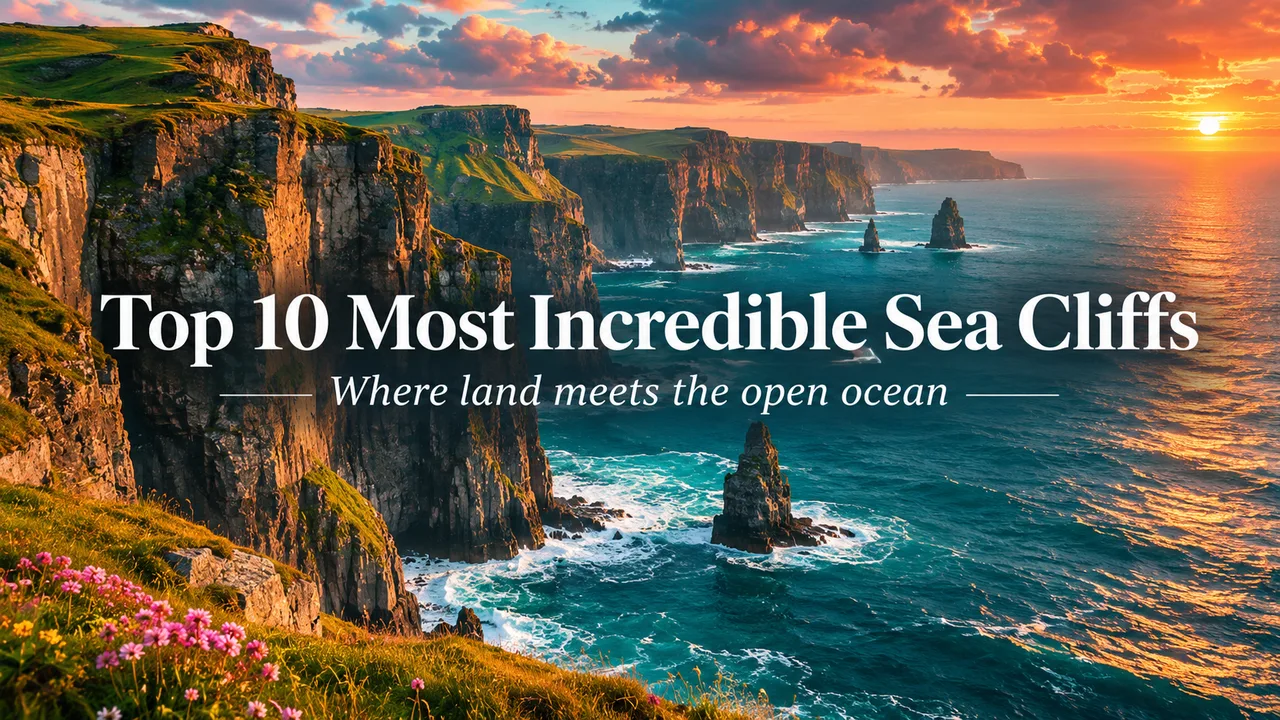
The most incredible sea cliffs in the world are places where land ends abruptly and the ocean takes over, carving vertical walls that can rise hundreds of metres above the surf. They are shaped by waves, wind, ice and time, and many of them record millions of years of geological history in their exposed layers [1].
Sea cliffs form where waves attack a coastline faster than the rock can resist. The sea undercuts the base, the overhang collapses, and the face retreats inland, leaving a steep wall behind. Hard rocks such as basalt and granite create sheer towers, while softer chalk and sandstone produce bright, constantly changing faces [1].
This Finepedia list brings together ten coastal cliffs chosen for height, scale, scenery and cultural fame. It mixes record holders, such as the soaring walls of Molokai, with beloved landmarks like the Cliffs of Moher and the chalk faces of Dover. Heights are approximate, because cliff tops are uneven and sources measure them in different ways.
Key Facts
The table below summarizes the ten sea cliffs in this list, with their location, approximate height and one stand-out feature.
Incredible Sea Cliffs at a Glance
| Rank | Name | Location/Country | Key figure | Notable fact |
|---|---|---|---|---|
| 1 | Molokai sea cliffs | Hawaii, USA | About 1,010 m | Often listed as the highest sea cliffs on Earth |
| 2 | Na Pali Coast | Kauai, Hawaii, USA | Up to about 1,200 m ridges | Reachable mainly by boat, air or the Kalalau Trail |
| 3 | Cliffs of Moher | County Clare, Ireland | About 214 m | Ireland's most visited natural attraction |
| 4 | Slieve League | County Donegal, Ireland | About 600 m | Among the highest accessible sea cliffs in Europe |
| 5 | Croaghaun | Achill Island, Ireland | About 688 m | Highest sea cliffs in Ireland |
| 6 | Preikestolen | Rogaland, Norway | About 604 m above the fjord | Flat-topped rock pulpit over Lysefjord |
| 7 | Cabo Girao | Madeira, Portugal | About 580 m | Glass-floored skywalk at the summit |
| 8 | White Cliffs of Dover | Kent, England | Up to about 110 m | Chalk faces seen as a symbol of Britain |
| 9 | Etretat cliffs | Normandy, France | About 70-90 m | Natural arches painted by Monet |
| 10 | Bunda Cliffs | South Australia | 60-120 m tall, about 100 km long | An unbroken wall facing the Southern Ocean |
1. Molokai Sea Cliffs
The north shore of Molokai in Hawaii holds sea cliffs that rise roughly 1,000 metres straight out of the Pacific, and they are frequently described as the tallest sea cliffs in the world [2]. They formed when a giant section of the East Molokai volcano collapsed into the ocean in a massive landslide, leaving behind a sheer amphitheatre of rock that waves have been sculpting ever since.
The cliffs are draped in green vegetation and laced with slender waterfalls after heavy rain. At their foot lies the Kalaupapa Peninsula, a low lava shelf that was used for more than a century as an isolation settlement for people with Hansen's disease. Today it is part of Kalaupapa National Historical Park [3].
Because there are no roads along most of this coast, the best views come from small aircraft, boats on calm days, or the lookout at Palaau State Park. The combination of record height, remoteness and history easily places Molokai at the top of this list.
2. Na Pali Coast
The Na Pali Coast stretches for about 27 kilometres along the northwest shore of Kauai, the oldest of the main Hawaiian islands. Its name means "the cliffs" in Hawaiian, and its fluted ridges climb to around 1,200 metres inland from the shoreline, cut by narrow valleys and hanging waterfalls [4].
Streams and rain have carved the old volcanic shield into knife-edge ridges known as pali. Ancient Hawaiians lived in the valleys, farming taro on terraces that can still be traced in places such as Kalalau Valley. The coast is now protected as Na Pali Coast State Wilderness Park.
Related: Top 10 Most Bizarre Phobias: Strange Fears That Exist
There is no road along this shoreline. Visitors either hike the demanding Kalalau Trail, take boat tours in summer when the sea is calmer, or view the cliffs from helicopters. The coast has appeared in many films, which has helped make it one of the most photographed seascapes in the Pacific.
3. Cliffs of Moher
The Cliffs of Moher run for about 14 kilometres along the Atlantic coast of County Clare in western Ireland. At their highest point near O'Brien's Tower they reach roughly 214 metres above the sea [5]. Bands of shale and sandstone laid down about 300 million years ago give the face its striped appearance.
The cliffs are a nesting site for thousands of seabirds, including Atlantic puffins, razorbills and guillemots, and they belong to a protected area for birds. O'Brien's Tower, a small stone viewing tower built in 1835, still serves as a landmark on the clifftop path.
Around a million people visit each year, making the site one of the most popular natural attractions in Ireland [5]. A visitor centre built into the hillside keeps the landscape uncluttered, and the cliffs have featured in films such as Harry Potter and the Half-Blood Prince.
4. Slieve League
Slieve League, also spelled Sliabh Liag, is a mountain on the southwest coast of County Donegal whose seaward face plunges about 600 metres into the Atlantic. It is regularly described as having some of the highest sea cliffs in Europe that ordinary visitors can reach [6].
Unlike the Cliffs of Moher, Slieve League sees fewer crowds, so walkers often have long stretches of path to themselves. A narrow ridge called One Man's Pass leads toward the summit, offering dramatic but exposed views of the ocean far below.
The mountain has long had religious significance, with remains of an early Christian pilgrimage site near the top. Its colours shift through red, orange and green as minerals in the rock and changing light play across the face, which is a big reason photographers rank it so highly.
5. Croaghaun
Croaghaun is a mountain on Achill Island in County Mayo, and its northern side ends in sea cliffs about 688 metres high. These are usually listed as the highest sea cliffs in Ireland and among the highest in Europe [7].
Related: The Science Behind Auroras: How Solar Winds Create Colorful Skies
The cliffs are very remote. There are no visitor facilities, and the best way to see their full height is from a boat or by hiking across open bog and moorland from Keem Bay. Walkers who reach the edge look down on a near-vertical drop to the Atlantic.
Glacial corries, small lakes and wild grassland surround the summit, and the island's quiet roads add to the sense of isolation. Croaghaun shows that Ireland's most dramatic coastline is not always its most famous one.
6. Preikestolen
Preikestolen, or Pulpit Rock, is a flat-topped cliff in Rogaland, Norway, that stands about 604 metres above the Lysefjord [8]. Its top is a near-square platform of roughly 25 by 25 metres, which makes it one of the most recognisable viewpoints in Scandinavia.
The rock was shaped during the last ice age, when glacier ice froze water into cracks and pulled blocks away along joints in the granite. A large crack still runs across the plateau, although geologists say it is not expected to cause a collapse any time soon.
Hundreds of thousands of hikers make the roughly four-kilometre walk each year. Although Preikestolen rises over a fjord rather than the open ocean, the fjord is an arm of the sea, which is why it often appears in lists of the world's finest sea cliffs.
7. Cabo Girao
Cabo Girao is a sea cliff on the south coast of Madeira, Portugal, rising about 580 metres above the Atlantic. It is often called one of the highest cliffs in Europe [9].
Related: Top 10 Facts About Dogs
In 2012 a glass-floored skywalk was opened at the top, allowing visitors to stand directly above the drop and look down at small farm terraces clinging to the base of the cliff. These fajas are patches of fertile ground formed by old rockfalls, and some are still farmed today and reached by cable car.
The viewpoint lies close to Funchal, Madeira's capital, which makes it one of the island's most visited attractions. It combines extreme height with easy access, a mix that few cliffs on this list can match.
8. White Cliffs of Dover
The White Cliffs of Dover rise up to about 110 metres along the coast of Kent, facing continental Europe across the Strait of Dover. They are made of chalk built from the skeletons of tiny marine algae that settled on a sea floor during the Cretaceous period [10].
For centuries the cliffs were the first and last sight of England for many travellers. During the Second World War they became a symbol of hope, celebrated in the song "(There'll Be Bluebirds Over) The White Cliffs of Dover". Tunnels dug into the chalk served as a wartime command centre.
The cliffs are slowly retreating as waves undercut the soft chalk, and large falls happen from time to time. Much of the coastline is cared for by the National Trust, which maintains clifftop paths and a lighthouse at South Foreland.
9. Etretat Cliffs
The chalk cliffs of Etretat on the Normandy coast of France are famous for natural arches and a slender rock needle called the Aiguille. The main arches, Porte d'Aval and Manneporte, were carved by waves exploiting weaknesses in the rock [11].
The cliffs rise roughly 70 to 90 metres and frame a pebble beach in the small resort town. In the nineteenth century they inspired painters including Claude Monet and Gustave Courbet, who produced many works of the arches in changing light.
Related: Top 10 Tallest Buildings in the World
Etretat also features in Maurice Leblanc's Arsene Lupin stories, where the Aiguille hides a secret treasure. Its artistic and literary fame, more than sheer height, explains its place among the world's most admired sea cliffs.
10. Bunda Cliffs
The Bunda Cliffs form part of the edge of the Nullarbor Plain in South Australia, running for about 100 kilometres along the Great Australian Bight. They stand roughly 60 to 120 metres tall and face the Southern Ocean [12].
The cliffs expose layers of limestone laid down when the area was a shallow sea, and they are one of the longest unbroken sea cliff lines in the world. Lookouts along the Eyre Highway let travellers pause on one of Australia's longest straight drives.
From May to October southern right whales come close to the shore at Head of Bight to calve, and the cliffs provide a natural viewing platform. Their scale and emptiness make them a striking end to this list.
Conclusion
From the record-breaking walls of Molokai to the painted arches of Etretat, the world's most incredible sea cliffs show how relentlessly the ocean reshapes the land. Some impress with height, some with colour, and others with the stories that have grown around them.
Many of these cliffs are also fragile and dangerous. Edges can crumble without warning, so visitors should stay on marked paths and respect local safety advice while enjoying some of the finest coastal scenery on Earth.
- ^ [1] "Cliff". Wikipedia. Wikipedia: Cliff
- ^ [2] "Molokai". Wikipedia. Wikipedia: Molokai
- ^ [3] "Kalaupapa National Historical Park". U.S. National Park Service. NPS: Kalaupapa
- ^ [4] "Na Pali Coast State Wilderness Park". Hawaii Division of State Parks. Hawaii DLNR
- ^ [5] "Cliffs of Moher". Wikipedia. Wikipedia: Cliffs of Moher
- ^ [6] "Slieve League". Wikipedia. Wikipedia: Slieve League
- ^ [7] "Croaghaun". Wikipedia. Wikipedia: Croaghaun
- ^ [8] "Preikestolen". Wikipedia. Wikipedia: Preikestolen
- ^ [9] "Cabo Girao". Wikipedia. Wikipedia: Cabo Girao
- ^ [10] "White Cliffs of Dover". Wikipedia. Wikipedia: White Cliffs of Dover
- ^ [11] "Etretat". Wikipedia. Wikipedia: Etretat
- ^ [12] "Bunda Cliffs". Wikipedia. Wikipedia: Bunda Cliffs




















Discussion
Log in with