


Top 10 Accidental Inventions That Changed Everyday Life
 By Dhiraj Sharma · Published
Share Post
Loading…
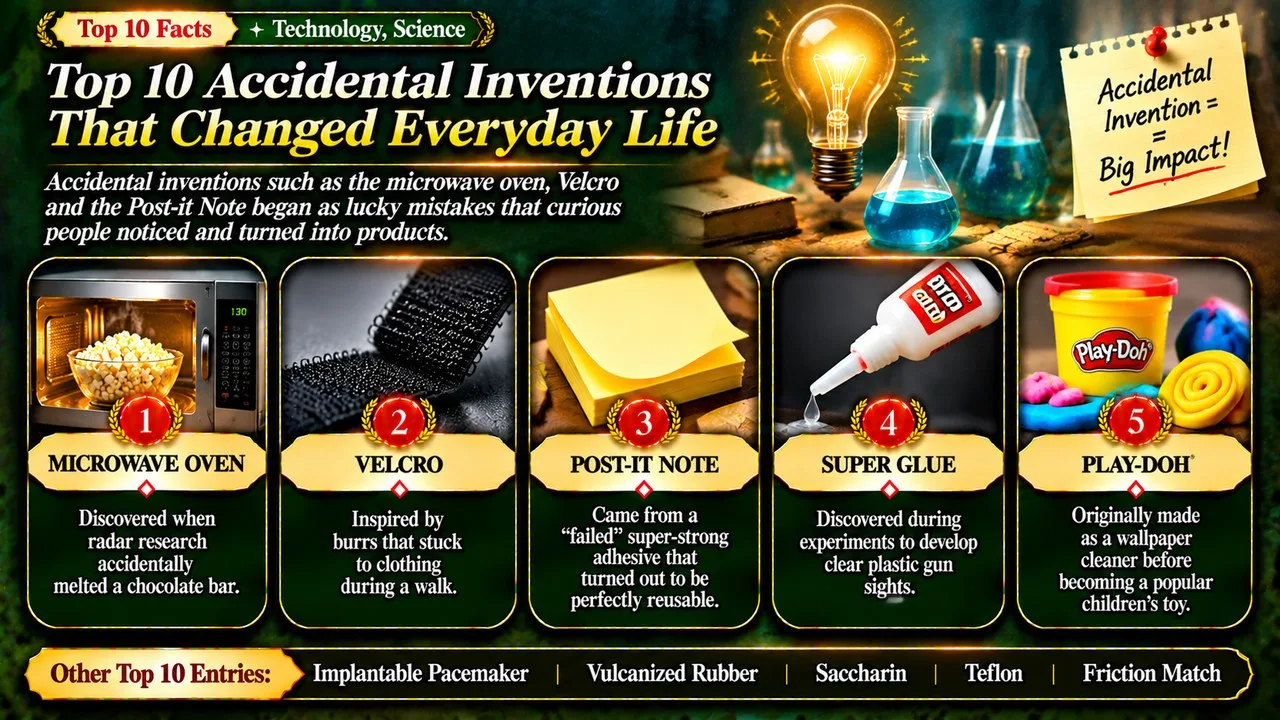
Accidental inventions such as the microwave oven, Velcro and the Post-it Note began as lucky mistakes that curious people noticed and turned into products.
Many famous inventions were not planned. A wrong part fitted to a circuit, a sweet taste on a chemist's hand or a stubborn seed stuck to a dog's coat gave an alert mind the clue it needed. In each case the accident was only the start; the inventor still had to understand what had happened and spend years turning it into something people could use.
This Finepedia guide, written in November 2026, takes its topic from a Listverse list of accidental inventions that changed the world [22], but the selection, order and wording are our own. We kept seven of its entries, added the microwave oven, Teflon and Super Glue, and left out the chocolate chip cookie because its creator, Ruth Wakefield, described adding the chocolate on purpose. Each story below is checked against museum, patent-history or encyclopaedia sources, and we note where a popular version is more legend than record.
Key Facts
This table sums up all ten inventions, who made them and when.
Accidental Inventions at a Glance
| Rank | Name | Inventor | Year of the accident | What went "wrong" |
|---|---|---|---|---|
| 1 | Microwave Oven | Percy Spencer, Raytheon | 1945 patent | A candy bar melted near radar |
| 2 | Implantable Pacemaker | Wilson Greatbatch | 1956 | The wrong resistor in a circuit |
| 3 | Vulcanized Rubber | Charles Goodyear | 1839 | Rubber and sulfur hit a hot stove |
| 4 | Saccharin | Constantin Fahlberg | 1879 | A sweet taste on unwashed hands |
| 5 | Teflon | Roy Plunkett, DuPont | 1938 | A gas cylinder that would not empty |
| 6 | Velcro | George de Mestral | 1941 | Burrs stuck to his dog's fur |
| 7 | Post-it Note | Spencer Silver and Art Fry, 3M | 1968 | A glue that was too weak |
| 8 | Super Glue | Harry Coover, Eastman Kodak | 1951 | Costly lenses glued together |
| 9 | Play-Doh | Noah and Joe McVicker, Kutol | 1955 to 1956 | Wallpaper cleaner used as clay |
| 10 | Friction Match | John Walker | 1826 | A stirring stick scraped on a hearth |
1. Microwave Oven
Percy Spencer was a self-taught engineer from Maine who never finished grammar school but rose to lead the power tube division at Raytheon during the Second World War [1][2]. His team mass-produced magnetrons, the tubes that powered Allied radar, and his method for building them earned him the US Navy's highest civilian award [2].
According to the story he told, Spencer was standing near an active radar set when he noticed that a candy bar in his pocket had melted [1][2]. He tested the idea with popcorn kernels, which popped, and then with an egg inside a kettle, which exploded in the face of a doubtful colleague [2]. Raytheon filed a patent for cooking with microwaves on 8 October 1945 [1][2].
The first Radarange ovens, sold from the late 1940s, stood nearly six feet tall, weighed about 750 pounds and cost around 5,000 dollars [1][2]. Cheaper countertop models followed, and by 1997 about 90 percent of US households owned a microwave oven [2]. Spencer was reportedly paid only Raytheon's standard two-dollar bonus for the patent [2]. Few accidents have changed daily life so widely, so the microwave takes first place.
2. Implantable Pacemaker
Wilson Greatbatch was an American electrical engineer who held more than 325 patents [3]. In 1956, while building a device to record heart rhythms at the University at Buffalo, he fitted the wrong resistor. Instead of recording, the circuit gave out short, regular electrical pulses, much like a heartbeat [4].
He realised that such a circuit could drive a failing heart. Working in a shed at home and using about 2,000 dollars of his savings, he shrank the device to about two cubic inches, and in May 1958 surgeons implanted it in a dog [4]. Working with the surgeon William Chardack at the Buffalo veterans hospital, he saw the device implanted in a 77-year-old man in 1960; the patient lived for another 18 months [4][3].
The Chardack-Greatbatch pacemaker was licensed to Medtronic, which went on to make pacemakers on a large scale [3][4]. Greatbatch later improved the battery with a long-lasting lithium-iodine cell [4][3]. A single wrong component that led to a life-saving medical device earns this invention second place.
Related: Top 10 Engineering Disasters That Changed the Rules
3. Vulcanized Rubber
In the early 19th century natural rubber was a poor material. It turned sticky in summer heat and stiff and brittle in winter, and many early rubber businesses failed [5][6]. Charles Goodyear, a self-taught American inventor, spent years and much of his family's money experimenting to make it stable [5].
In 1839, while working at the Eagle India Rubber Company in Woburn, Massachusetts, he found that rubber mixed with sulfur and heated on a hot stove did not melt as expected but became firm and stayed flexible [5][6]. He called the process vulcanization because of the heat involved, while in England Thomas Hancock also claimed the discovery and patented it there [5]. It took him several more years to perfect the heating, and he received US Patent 3,633 on 15 June 1844 [5][6].
The process made rubber useful for footwear, hoses and, later, tyres, and it created a whole industry in Connecticut's Naugatuck Valley [5][6]. Goodyear himself spent time in debtors' prison and died owing almost 200,000 dollars, and the tyre company that bears his name was founded decades later by other people [5]. The rubber in almost every vehicle on the road owes something to that stove.
4. Saccharin
Saccharin was the first widely used artificial sweetener. It was first made in 1879 by the chemist Constantin Fahlberg, who was working on coal tar compounds in Ira Remsen's laboratory at Johns Hopkins University in Baltimore [7][8].
One evening Fahlberg noticed a strong sweet taste on his hand and traced it back to a compound he had been handling that day, benzoic sulfimide [7]. Remsen and Fahlberg published papers on the substance in 1879 and 1880, describing it as sweeter than cane sugar [7][8]. In 1884, working on his own in New York, Fahlberg applied for patents and named the substance saccharin, which led to a lasting dispute with Remsen over credit [7][8].
Saccharin is about 500 times sweeter than sugar, has no food energy and is stable when heated, though it can leave a bitter or metallic aftertaste [7]. It became popular during the sugar shortages of the world wars and is still used in drinks, sweets and medicines [7][8]. A chemist forgetting to wash his hands gave the world its first calorie-free sweetener.
5. Teflon
Teflon is the brand name for polytetrafluoroethylene, or PTFE, a plastic with one of the lowest friction levels of any solid [11]. It was discovered by chance in 1938 by Roy Plunkett, a young chemist at DuPont's Jackson Laboratory in New Jersey, who was trying to make a new refrigerant gas [9][10].
Related: History of Human Civilization: From Ancient Times to the Modern Age
On 6 April 1938 his assistant Jack Rebok opened the valve on a cylinder of tetrafluoroethylene gas that they had used the day before, and nothing came out [9]. When they cut it open, they found a waxy white powder inside. The gas had linked itself into a new polymer that was slippery, heat-resistant and unaffected by almost every chemical [9][10]. The Science History Institute notes that it was an accidental invention, unlike most other polymer products [10].
One of its first uses was in the Manhattan Project, where it lined valves and seals that handled highly corrosive uranium compounds [11]. In 1954 the French engineer Marc Gregoire, urged by his wife Colette, coated cooking pans with it, which led to non-stick cookware [11]. A failed refrigerant experiment ended up in kitchens around the world.
6. Velcro
In 1941 the Swiss engineer George de Mestral came home from a hunting trip in the Jura mountains with his dog and found his trousers and the dog's fur covered in burdock burrs [13][12]. Curious about why they clung so tightly, he looked at them under a microscope and saw hundreds of tiny hooks that caught on any loop of fabric or hair [13].
He spent years trying to copy the effect with woven fabric. The answer was nylon: one strip carrying tiny stiff hooks and the other carrying soft loops. De Mestral filed a patent in Switzerland in 1951, which was granted in 1955 [12][13]. He named the product Velcro, from the French words velours, meaning velvet, and crochet, meaning hook [12].
Hook-and-loop fasteners took off after NASA used them widely, so many people wrongly believe the space agency invented them [12]. Today they hold together everything from shoes and jackets to medical straps, and WIPO notes that the company de Mestral founded now holds more than 2,100 patents [13]. Nature supplied the design; a curious walker noticed it.
7. Post-it Note
In 1968 Spencer Silver, a chemist at the American company 3M, was trying to develop a very strong adhesive. Instead he produced a weak one that would stick lightly, peel off cleanly and stick again [14][15]. For several years he promoted it inside the company without finding a use.
The answer came in 1974 from his colleague Art Fry, who sang in a church choir and was annoyed that his paper bookmarks kept slipping out of his hymn book [14][15]. Fry remembered Silver's glue and coated a bookmark with it, and soon colleagues were using the sticky slips to leave notes for each other [15]. Even the famous canary yellow colour was a chance choice, taken from scrap paper in a nearby lab [14].
Related: Mark Zuckerberg: The Rise of a Social Media Pioneer
3M first tested the product as Press 'n Peel in four cities in 1977, with disappointing results [14]. After a campaign of free samples and a new name, Post-it Notes went on sale across the United States on 6 April 1980 and became one of the best-known office products in the world [15][14]. A glue that failed its first test found the perfect job.
8. Super Glue
Harry Coover was an American chemist at Eastman Kodak. During the Second World War he tried working with chemicals called cyanoacrylates while searching for a clear plastic for gun sights, but rejected them because they stuck to everything [16][17].
In 1951, at Eastman's chemical plant in Kingsport, Tennessee, Coover's team looked at cyanoacrylates again, this time as a heat-resistant material for jet cockpit canopies [16][17]. While testing one, a fellow researcher, Fred Joyner, spread it between the lenses of a refractometer and found that they were stuck fast [17]. This time Coover saw the value of a liquid that bonded almost instantly without heat or pressure [17].
The adhesive went on sale in 1958 as Eastman 910 and became famous as Super Glue [16][17]. Coover was proudest of its medical use: during the Vietnam War, medics sprayed it on wounds to seal them until soldiers could reach surgery [16][17]. A substance that was rejected twice earns a solid place on this list.
9. Play-Doh
Play-Doh began life as a wallpaper cleaner. In the 1930s the Cincinnati soap company Kutol Products made a soft, reusable putty that people rolled over their walls to lift coal soot [18][19]. After the Second World War, as homes switched from coal heating to gas and washable vinyl wallpaper arrived, demand collapsed and the company faced ruin [18].
The rescue came from a nursery school teacher. Kay Zufall, the sister-in-law of Kutol's Joe McVicker, read that the putty could be used for children's craft projects, tried it with her pupils and in 1955 persuaded him to sell it as a toy [18][19]. She and her husband came up with the name Play-Doh [18].
Related: Ukraine: A Historical Overview of Eastern Europe's Heartland
In 1956 McVicker set up Rainbow Crafts to sell it, and the compound was shown at an educational convention and picked up by department stores [18][19]. Advertising on children's television followed in 1957 [18]. Play-Doh was inducted into the National Toy Hall of Fame in 1998 [19]. Few products have had such a complete change of purpose.
10. Friction Match
John Walker was a chemist and pharmacist in Stockton-on-Tees in north-east England. In the 1820s, lighting a fire still meant using a tinderbox or awkward chemical devices, and Walker was experimenting with mixtures that might ignite more easily [20][21].
In 1826 he scraped a wooden stick he had been using to stir chemicals against his hearth, and the coated tip burst into flame [21][20]. He refined the mixture and sold his first box of friction lights at his shop on 7 April 1827 [21]. His matches were sold in a tin with a piece of sandpaper to strike them on [20].
Walker never patented his invention, even when Michael Faraday urged him to, and he reportedly said that it would be a benefit to the public, so they should have it [20][21]. Others quickly copied and improved the idea, and Walker stopped making matches by about 1830 [20]. His modest shop invention closes our list, since a simple strike now replaced a slow and difficult ritual.
Conclusion
From a melted candy bar to a burr on a dog's coat, these ten inventions show how much depends on noticing the unexpected. In every case the accident only mattered because someone asked why it had happened and then did the slow work of turning it into a product.
Some of these stories have grown in the telling, and inventors often simplified them later, so the dates and details here follow the best available records. For more ideas that shaped the modern world, see Top 10 Inventions That Changed the World and Top 10 Most Important Kitchen Tools.
- ^ [1] "Percy Spencer". Wikipedia. Wikipedia
- ^ [2] "1945: First Patent for the Microwave". American Physical Society News. APS News
- ^ [3] "Wilson Greatbatch". Wikipedia. Wikipedia
- ^ [4] "Wilson Greatbatch obituary". The Guardian. The Guardian
- ^ [5] "Charles Goodyear". Wikipedia. Wikipedia
- ^ [6] "Charles Goodyear and the Vulcanization of Rubber". Connecticut History. Connecticut History
- ^ [7] "Saccharin". Wikipedia. Wikipedia
- ^ [8] "The Pursuit of Sweet". Science History Institute. Science History Institute
- ^ [9] "Roy J. Plunkett". Wikipedia. Wikipedia
- ^ [10] "Roy J. Plunkett". Science History Institute. Science History Institute
- ^ [11] "Polytetrafluoroethylene". Wikipedia. Wikipedia
- ^ [12] "Velcro". Wikipedia. Wikipedia
- ^ [13] "From a Mountain Walk to 2,100 Patents: The Velcro IP Story". WIPO. WIPO
- ^ [14] "Post-it note". Wikipedia. Wikipedia
- ^ [15] "The Invention of the Post-it Note". National Inventors Hall of Fame. National Inventors Hall of Fame
- ^ [16] "Harry Coover". Wikipedia. Wikipedia
- ^ [17] "Harry Coover obituary". The Guardian. The Guardian
- ^ [18] "Play-Doh". Wikipedia. Wikipedia
- ^ [19] "The History of Play-Doh: Good, Clean Fun". The Strong National Museum of Play. The Strong
- ^ [20] "John Walker (inventor)". Wikipedia. Wikipedia
- ^ [21] "John Walker and the friction match". Tees Valley Museums. Tees Valley Museums
- ^ [22] "10 Accidental Inventions That Changed The World". Listverse. Topic reference on Listverse



















Discussion
Log in with