










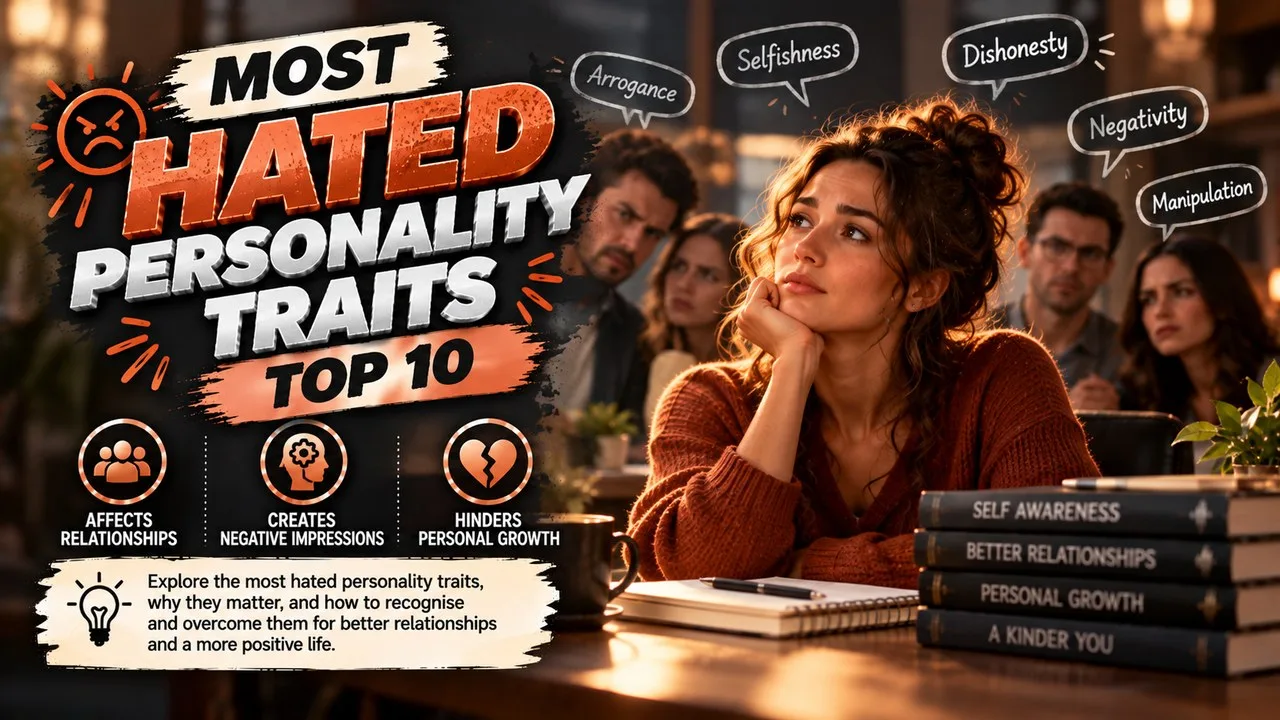
The most hated personality traits, from lying and arrogance to rudeness and unreliability, erode trust fast, yet research shows each one can be changed.
Nobody sets out to be the colleague, friend or partner that others quietly avoid. Yet psychologists have spent more than half a century measuring which qualities people find hardest to like, and the results are remarkably consistent. Honesty and sincerity sit at the very top of what people value, while lying, phoniness, cruelty and contempt sit at the very bottom. This guide ranks them using that research, as of October 2026.
Each trait is scored on a Finepedia scorecard and paired with signs to notice in yourself and realistic ways to change. If you enjoyed our look at why introverts are attractive, think of this as the other side of the coin: the habits that push people away rather than draw them in.
This guide is educational and written for self-reflection. It does not diagnose anyone. Everyone shows some of these behaviours on a bad day; what matters is the pattern. If a trait feels persistent, distressing or out of your control, a qualified mental health professional is the right next step.
How We Ranked the Most Hated Personality Traits
Every trait received a score out of 25 from five factors worth up to 5 points each. A high score means the research strongly links the trait to dislike, the trait does serious damage to trust, it turns up often in daily and working life, other people notice it easily, and observers see it as a choice that could be changed.
| Factor | Max points | What it measures |
|---|---|---|
| Research link to dislike | 5 | How strongly likability, impression or relationship studies tie the trait to negative judgments (5 = bottom of classic likability ratings or repeated experimental evidence) |
| Damage to trust and relationships | 5 | How badly the trait harms trust, cooperation, friendships, marriages or teams once people see it |
| How common it is | 5 | How often the behaviour appears in everyday, family and workplace life according to surveys and observation studies |
| How visible it is to others | 5 | How quickly other people notice it (5 = obvious in a single conversation) |
| Perceived choice and changeability | 5 | How much observers see the trait as controllable, which raises blame, and how responsive it is to deliberate effort |
The last factor matters because research on person perception suggests that people judge moral qualities as more controllable than other traits, and controllable faults attract more blame. Ties were broken first by research link to dislike, then by damage to trust, then by how common the trait is. Scores reflect published research available as of October 2026; they are an editorial ranking, not a clinical scale.
Most Hated Personality Traits at a Glance
| Rank | Trait | Core research signal | Score /25 |
|---|---|---|---|
| 1 | Dishonesty and lying | Liar ranked last of 555 trait words in Anderson's 1968 likability ratings | 23 |
| 2 | Arrogance and self-importance | Self-enhancers impressed at first but were rated negatively after seven weekly meetings | 22 |
| 3 | Rudeness and incivility | 98% of workers polled by Porath and Pearson reported uncivil treatment | 22 |
| 4 | Unreliability | Integrity and dependability are core pillars of trust models | 21 |
| 5 | Insincerity and phoniness | Phony ranked 554th of 555 trait words; humblebraggers liked less than open braggers | 20 |
| 6 | Selfishness | People pay their own money to punish free riders in cooperation experiments | 20 |
| 7 | Condescension and contempt | Gottman's research names contempt the top predictor of divorce | 19 |
| 8 | Hot temper and hostility | Anger and hostility linked to higher heart-disease risk as well as strained relationships | 19 |
| 9 | Controlling behaviour | Controlling environments undermine motivation and wellbeing in self-determination research | 18 |
| 10 | Chronic negativity and complaining | Negative information carries more psychological weight than positive information | 18 |
1. Dishonesty and Lying
Dishonesty takes first place because it attacks the one quality people value above almost everything else in another person. A single discovered lie can make every earlier statement look suspect.
| Attribute | Details |
|---|---|
| What it is | Deliberately misleading others through false statements, half-truths, omissions or fabricated excuses |
| Research signal | Liar was the least likable of 555 trait words (mean 0.26 on a 0 to 6 scale) and dishonest also sat near the bottom (Anderson, 1968) |
| Where it hurts most | Romantic relationships, friendships, hiring, negotiations and any team that depends on accurate information |
| Healthier opposite | Honesty and sincerity, the two most likable trait words in the same study |
| Finepedia score | 23/25 (5 + 5 + 4 + 4 + 5) |
What It Looks Like
Dishonesty is rarely a dramatic con. More often it shows up as small, convenient stories: claiming a task is nearly done when it has not started, inventing a reason for being late, or quietly leaving out a detail that would change someone's decision.
Why People Dislike It
Anderson's classic ratings put the two most likable words, sincere (5.73) and honest (5.55), at one end of the scale and liar (0.26) and phony (0.27) at the other. Later research explains why. In the 2014 studies by Goodwin and colleagues, moral traits such as honesty were judged more central to who a person really is than social warmth, and they predicted overall impressions more strongly in most contexts.
Trust research points the same way. The widely cited 1995 model of organisational trust by Roger Mayer, James Davis and David Schoorman treats integrity, meaning adherence to principles the other person accepts, as one of three pillars of trustworthiness alongside ability and benevolence.
Signs You Might Have It
- You regularly tell people what they want to hear rather than what is accurate.
- You keep track of which version of a story you told to whom.
- Your excuses for missed commitments change from week to week.
- You feel relief, not discomfort, when a small lie goes unnoticed.
- People close to you have started double-checking what you say.
How to Change It
Start by noticing the moment just before a lie, usually a flash of fear about disappointing someone or looking bad. Replace the automatic fib with a short truthful script such as "I have not finished it yet; I can send it by Thursday."
Keep promises small enough to keep, so you are not tempted to cover gaps with stories. When you do slip, correct the record quickly and plainly.
Interesting Facts
- Anderson's likability ratings correlated between .96 and .99 with similar data from three other universities, which is why they are still cited today.
- In a 2010 national survey of 1,000 US adults by Kim Serota, Timothy Levine and Franklin Boster, participants reported an average of 1.65 lies in the previous 24 hours.
- That average hides a skewed pattern: about 60% reported telling no lies at all that day, while roughly 5% of people accounted for almost half of all reported lies.
2. Arrogance and Self-Importance
Arrogance ranks second because it is both easy to spot and corrosive over time. Research suggests that self-promoting confidence can win people over briefly, then wears thin as they get to know the person.
| Attribute | Details |
|---|---|
| What it is | An inflated sense of one's own importance or ability, shown by dismissing others, overclaiming credit and refusing correction |
| Research signal | Workplace arrogance linked to lower performance ratings from supervisors, peers and reports (Johnson et al., 2010) |
| Where it hurts most | Leadership, teamwork, classrooms, family decisions and first dates that never become second dates |
| Healthier opposite | Humility and calm, earned confidence |
| Finepedia score | 22/25 (5 + 4 + 4 + 5 + 4) |
What It Looks Like
Arrogance can be loud, as in constant boasting, or quiet, as in never asking a question because you assume you already know the answer. It includes interrupting experts, treating feedback as an insult, and expecting rules or queues to apply to everyone else.
Why People Dislike It
In a well-known 1998 study, psychologist Delroy Paulhus placed students in small discussion groups that met weekly. People high in trait self-enhancement were rated positively after the first meeting, but after seven weekly sessions their peers rated them negatively, including as less agreeable.
A 2010 study led by Russell Johnson and Stanley Silverman developed the Workplace Arrogance Scale and tested it with 360-degree feedback. More arrogant employees received lower task-performance ratings, and they also tended to score lower on cognitive ability and self-esteem. In other words, arrogance often masks insecurity rather than proving competence.
Signs You Might Have It
- You find it hard to say "I was wrong" or "I do not know".
- You explain things to people who already understand them better than you.
- You see criticism mostly as a sign that the critic does not get it.
- You talk about your achievements far more than you ask about other people's.
- You feel entitled to special treatment that you would not give others.
How to Change It
Practise curiosity on purpose. In each meeting or conversation, ask at least one genuine question and listen to the full answer before responding. Credit specific people for specific contributions, out loud and in writing.
Invite feedback from someone you trust and ask them to name one habit that comes across as superior. Humility is not low self-esteem; it is an accurate view of your strengths alongside a real interest in other people's.
Interesting Facts
- Narcissism is one of the three Dark Triad traits described by Delroy Paulhus and Kevin Williams in 2002; the other two are Machiavellianism and psychopathy.
- In the HEXACO model, low scorers on the Modesty facet see themselves as superior and entitled to privileges others do not have.
3. Rudeness and Incivility
Rudeness is the most common trait on this list. It rarely ends a relationship in one blow, but repeated small disrespect quietly drains goodwill, performance and loyalty.
| Attribute | Details |
|---|---|
| What it is | Disrespectful words or behaviour, from ignoring greetings and checking a phone mid-conversation to public put-downs |
| Research signal | 98% of workers polled over 14 years reported experiencing incivility; half said they faced it weekly in 2011 (Porath and Pearson, 2013) |
| Where it hurts most | Workplaces, customer service, online comment sections, public transport and family dinners |
| Healthier opposite | Civility and everyday courtesy |
| Finepedia score | 22/25 (4 + 4 + 5 + 5 + 4) |
What It Looks Like
Incivility covers low-intensity behaviour that breaks basic norms of respect. Examples include talking over people, ignoring messages, taking credit, mocking someone in front of others, sending curt replies, and treating service staff as if they were invisible.
Why People Dislike It
Christine Porath of Georgetown University and Christine Pearson have tracked workplace incivility for decades, collecting data from more than 14,000 people in the United States and Canada. In a poll of 800 managers and employees across 17 industries, targets of incivility reported clear costs: 48% intentionally decreased their work effort, 66% said their performance declined, 78% said their commitment to the organisation fell, and 12% left their job because of it.
Laboratory work shows rudeness affects thinking, not just feelings. In experiments by Porath and Amir Erez published in 2007, participants whose student group had been belittled by the experimenter performed 33% worse on anagram puzzles and produced 39% fewer creative ideas in a brainstorming task than those treated neutrally. A follow-up study found that people who merely witnessed rudeness also performed worse.
Signs You Might Have It
- You check your phone while people are speaking to you.
- Colleagues stop sharing ideas or bad news with you.
- You are polite to people with power and short with people without it.
- Your messages are often read as angry when you meant them as efficient.
- You rarely say please, thank you or sorry without being prompted.
How to Change It
Pick two or three visible courtesies and make them non-negotiable: greet people by name, put the phone face down in conversations, and thank people for specific help.
Before sending a message under pressure, reread it as if you were the recipient on a difficult day. Ask a trusted colleague whether anything you do lands as dismissive. Porath's research suggests civility is contagious, so modelling it also improves the people around you.
Interesting Facts
- In Porath and Pearson's survey, 80% of targets said they lost work time worrying about the incident and 63% lost time avoiding the offender.
- A quarter of targets admitted taking their frustration out on customers.
- The share of workers reporting weekly rudeness rose from about a quarter in 1998 to half in 2011.
4. Unreliability
Unreliability ranks fourth because it damages trust in the most practical way possible. People may forgive a flaw in style, but they struggle to keep relying on someone who does not show up, follow through or deliver.
| Attribute | Details |
|---|---|
| What it is | A pattern of broken promises, missed deadlines, last-minute cancellations and unfinished tasks |
| Research signal | Conscientiousness was the only Big Five trait consistently linked to job performance across all occupational groups studied (Barrick and Mount, 1991) |
| Where it hurts most | Workplaces, shared households, group projects, friendships and parenting arrangements |
| Healthier opposite | Dependability and conscientiousness |
| Finepedia score | 21/25 (4 + 5 + 4 + 4 + 4) |
What It Looks Like
Unreliable people are often warm and well-meaning. They say yes enthusiastically, then run out of time, forget, or quietly let the commitment slide.
Why People Dislike It
In the Mayer, Davis and Schoorman trust model, people decide whether to trust someone partly on integrity, which includes a consistent match between words and deeds. Each broken commitment is evidence against that match.
Workplace research reinforces the point. A 1991 meta-analysis by Murray Barrick and Michael Mount found that conscientiousness, the Big Five trait that includes dependability and organisation, was the only one consistently related to job performance across professionals, police, managers, sales staff and skilled or semi-skilled workers.
Signs You Might Have It
- You regularly apologise for being late or for forgetting something.
- Your calendar and your promises rarely match.
- Friends confirm plans with you twice, or stop inviting you.
- You agree to requests to avoid awkwardness, not because you have capacity.
- Deadlines arrive as surprises.
How to Change It
Say yes less often and more precisely. Before accepting, check your calendar and add buffer time, because people consistently underestimate how long tasks take. Write every commitment in one trusted place, not scattered across chats and memory.
Turn intentions into if-then plans: "If it is 9 a.m. on Monday, then I will send the report draft." Research on implementation intentions shows this kind of specific plan reliably improves follow-through. When you cannot deliver, tell people early with a new date rather than going silent.
Interesting Facts
- In a 1994 study of the planning fallacy by Roger Buehler, Dale Griffin and Michael Ross, students predicted they would finish their theses in 33.9 days on average; the actual average was 55.5 days.
- Only about 30% of those students finished by the date they had predicted.
- A 2006 meta-analysis by Peter Gollwitzer and Paschal Sheeran, covering 94 tests and 8,461 participants, found a medium-to-large effect of if-then planning on reaching goals.
- The same weaknesses explain much of why people fail to reach their goals, so fixing unreliability helps your own plans too.
5. Insincerity and Phoniness
Phoniness is the close cousin of dishonesty. It may not involve outright lies, but it signals that a person's warmth, praise or modesty is a performance designed to get something.
| Attribute | Details |
|---|---|
| What it is | Fake friendliness, strategic flattery, two-faced behaviour and false modesty |
| Research signal | Phony ranked 554th of 555 trait words (mean 0.27); humblebragging lowers liking through perceived insincerity (Sezer, Gino and Norton, 2018) |
| Where it hurts most | Networking, social media, office politics, friendships and customer relationships |
| Healthier opposite | Sincerity and genuine appreciation |
| Finepedia score | 20/25 (5 + 4 + 3 + 4 + 4) |
What It Looks Like
Insincerity includes praising someone to their face and criticising them behind their back, being charming only to people who can help you, and offering compliments as a setup for a favour. It also includes humblebragging, where a boast is dressed up as a complaint or as modesty, such as complaining about how tiring it is to receive so many awards.
Why People Dislike It
Anderson's ratings put phony just one place above liar at the very bottom of 555 words, which suggests people treat fakeness as almost as bad as lying. A 2018 paper by Ovul Sezer, Francesca Gino and Michael Norton in the Journal of Personality and Social Psychology examined humblebragging directly. Humblebraggers were liked less than people who bragged openly, and complaint-based humblebrags did even worse than plain complaining. The key driver was that humblebraggers were seen as insincere.
The HEXACO model captures the same idea in its Sincerity facet. People who score low tend to flatter others or pretend to like them to obtain favours, while high scorers are unwilling to manipulate.
Signs You Might Have It
- Your tone about someone changes sharply depending on who is in the room.
- You compliment people mainly when you are about to ask for something.
- You frame good news as a complaint so it does not sound like bragging.
- You agree in meetings and disagree afterwards in private.
- People seem polite to you but rarely confide in you.
How to Change It
Make praise specific and unconditional. Say exactly what someone did well and do not attach a request to it. If you want to share good news, share it plainly and with gratitude; the research suggests straightforward self-promotion is better received than disguised boasting.
Aim for consistency: say the same thing about a person whether or not they are present. If you disagree, raise it respectfully in the room.
Interesting Facts
- In Anderson's list, truthful also appeared among the five most likable words, alongside sincere, honest, understanding and loyal.
- The 2018 humblebragging research included both laboratory experiments and a field study.
6. Selfishness
Selfishness ranks sixth because it violates a deep human expectation of fairness. People can tolerate many quirks, but someone who always takes more than they give soon finds others pulling away.
| Attribute | Details |
|---|---|
| What it is | Consistently putting your own wants ahead of others' needs, from hogging resources to ignoring the cost of your choices on others |
| Research signal | In public-goods experiments, many participants paid to punish free riders even with no personal gain (Fehr and Gächter, 2002) |
| Where it hurts most | Shared homes, friendships, teams, family responsibilities and romantic partnerships |
| Healthier opposite | Generosity, fairness and benevolence |
| Finepedia score | 20/25 (4 + 5 + 4 + 3 + 4) |
What It Looks Like
Selfishness shows up in everyday trades: never buying the round, taking the best seat, letting others carry the group project, or making plans that suit only you. It also includes emotional selfishness, such as dominating every conversation with your own problems or showing little interest when others need support.
Why People Dislike It
Economists Ernst Fehr and Simon Gächter reported in Nature in 2002 that people in cooperation games often punish free riders at their own expense, even when they will never meet them again. When punishment was possible, cooperation rose; when it was removed, cooperation fell. Negative emotions toward people who did not contribute helped drive the punishment.
Trust models make the same point in gentler terms. Benevolence, the belief that someone cares about your interests beyond their own, is one of the three pillars in the Mayer, Davis and Schoorman model. Persistent selfishness tells others that benevolence is missing.
Signs You Might Have It
- You keep a mental score of favours you are owed but not those you owe.
- Group plans usually end up matching your preferences.
- You change the subject back to yourself within a few sentences.
- People describe you as fun but hard to rely on in a crisis.
- You feel irritated when someone else's needs disrupt your schedule.
How to Change It
Audit one week of give and take. Count who paid, who drove, who listened and who helped, and compare honestly. Then build one generous habit into each relationship, such as asking a follow-up question, offering help before being asked, or taking turns choosing plans.
Practise perspective-taking by asking, "How would this decision look from their side?" before acting.
Interesting Facts
- In the 2002 experiments, punishment increased the more a free rider's contribution fell below the group's.
- The HEXACO Fairness facet describes people unwilling to take advantage of other individuals or of society at large.
- A 2011 meta-analysis led by Sara Konrath, covering 72 samples of US college students from 1979 to 2009, found declines in empathic concern and perspective taking, especially after 2000.
7. Condescension and Contempt
Condescension means treating someone as less intelligent, capable or worthy than you. Its sharpest form is contempt, and relationship research suggests it is among the most damaging attitudes one person can show another.
| Attribute | Details |
|---|---|
| What it is | Patronising explanations, sarcasm, mockery, eye-rolling and other signals of superiority or disgust |
| Research signal | Contempt is described by the Gottman Institute as the number one predictor of divorce in John Gottman's research |
| Where it hurts most | Marriages, parent-child relationships, management, customer service and online debate |
| Healthier opposite | Respect, appreciation and patience |
| Finepedia score | 19/25 (4 + 5 + 3 + 4 + 3) |
What It Looks Like
Condescension can be subtle: over-explaining simple ideas, using a slow or sugary tone, or calling a colleague's idea "cute". Contempt is more obvious, including hostile humour, name-calling, mimicking, sneering and eye-rolling. Both send the same message: "I am better than you."
Why People Dislike It
Psychologist John Gottman identified four communication patterns that predict relationship breakdown, which he called the Four Horsemen: criticism, contempt, defensiveness and stonewalling. The Gottman Institute describes contempt as the worst of the four and the single strongest predictor of divorce in his research, because it attacks a partner's sense of self rather than a specific behaviour.
The effect is not limited to couples. In the Porath and Erez experiments, simply belittling participants' student group, without insulting them personally, was enough to reduce their performance and creativity.
Signs You Might Have It
- You often begin sentences with "Actually" or "Obviously".
- You use sarcasm as your main form of humour in disagreements.
- You roll your eyes or sigh when others speak.
- You think of certain people as beneath taking seriously.
- Arguments with a partner regularly include mocking or name-calling.
How to Change It
The Gottman Institute's short-term antidote is to describe your own feelings and needs instead of attacking the other person: "I feel stressed when we are late; can you help me with that?" works better than a sarcastic jab. Over the long term, it recommends building a habit of appreciation by noticing and naming what you value in the other person every day.
At work, check understanding before explaining: ask what the person already knows. Assume competence until shown otherwise. If you notice contempt toward a partner, colleague or relative, treat it as a warning sign worth addressing early, with a counsellor if needed. Our guide to why couples argue covers many of the conflicts where contempt tends to creep in.
Interesting Facts
- Gottman's 1998 newlywed study, which followed 130 couples for six years, found that anger itself was not the destructive factor; the Four Horsemen were.
- The Gottman Institute lists hostile humour, mimicking and body language such as sneering among the forms contempt can take.
- Its long-term antidote is described as building a culture of fondness and admiration in the relationship.
8. Hot Temper and Hostility
A hot temper ranks eighth because it is highly visible and frightening to be around, even when outbursts are rare. Moodiness that tips into hostility leaves others walking on eggshells.
| Attribute | Details |
|---|---|
| What it is | Frequent or intense anger, snapping at people, slamming doors, shouting or holding long grudges |
| Research signal | A 2009 meta-analysis linked anger and hostility to a 19% higher risk of coronary heart disease events in initially healthy people (Chida and Steptoe) |
| Where it hurts most | Families, close relationships, workplaces, traffic and sports |
| Healthier opposite | Patience and emotional regulation |
| Finepedia score | 19/25 (4 + 4 + 3 + 5 + 3) |
What It Looks Like
Anger is a normal emotion, and expressing it calmly can be healthy. The problem trait is a pattern of disproportionate reactions: exploding over minor setbacks, blaming others loudly, or staying cold and hostile for days. Being temperamental, with rapid swings from friendly to furious, belongs here too.
Why People Dislike It
Unpredictable anger makes others feel unsafe, so they withdraw, stop raising problems and edit what they say. Gottman's 1998 research is a useful nuance: anger alone did not predict divorce, but the hostile patterns that often travel with it, such as contempt and stonewalling, did.
There is a personal cost as well. Yoichi Chida and Andrew Steptoe's 2009 meta-analysis in the Journal of the American College of Cardiology found that anger and hostility were associated with a 19% higher risk of coronary heart disease events in initially healthy populations, with a stronger link in men.
Signs You Might Have It
- People hesitate before giving you bad news.
- You regularly say things in anger that you later regret.
- Small frustrations, such as slow traffic or a delayed reply, ruin your mood for hours.
- You think in words like "always" and "never" when annoyed.
- Family members describe your mood as something they have to manage.
How to Change It
The American Psychological Association recommends calming the body first: slow breathing from the diaphragm, a calming word or phrase, and short pauses before responding. It also suggests cognitive restructuring, which means replacing exaggerated thoughts such as "everything is ruined" with more balanced ones such as "this is frustrating, but it is not the end of the world."
Identify your triggers, such as hunger, fatigue or specific topics, and plan ahead for them. Agree with family or colleagues on a time-out signal. If anger feels out of control, leads to aggression or is damaging important relationships, a licensed psychologist or counsellor can help with structured anger management. Stress and anger often travel together; our guide to physical symptoms of anxiety explains how stress shows up in the body.
Interesting Facts
- The HEXACO Patience facet describes low scorers as quick to lose their temper and high scorers as having a high threshold for anger.
- The 2009 heart-disease meta-analysis drew on 25 studies of initially healthy people and 18 of patients who already had heart disease, where the risk increase was 24%.
- APA guidance suggests turning demands into desires, for example thinking "I would like" rather than "I must have".
9. Controlling Behaviour
Controlling behaviour ranks ninth. It is less obvious than rudeness at first, but over time it deeply erodes trust, motivation and the sense of being treated as a capable adult.
| Attribute | Details |
|---|---|
| What it is | Micromanaging, insisting on your way, monitoring others and making decisions for people who should make their own |
| Research signal | Self-determination theory finds that controlling environments thwart the need for autonomy and undermine motivation and wellbeing (Ryan and Deci, 2000) |
| Where it hurts most | Romantic relationships, parenting teenagers and adults, management and shared households |
| Healthier opposite | Respect for autonomy and willingness to share influence |
| Finepedia score | 18/25 (3 + 5 + 3 + 3 + 4) |
What It Looks Like
Controlling people may believe they are simply being helpful or organised. In practice they redo other people's work, demand updates on everything, criticise choices that are not theirs to make, and get anxious or angry when plans change. Domineering behaviour, where one person consistently dominates group decisions, belongs in the same entry.
Why People Dislike It
Self-determination theory, developed by Richard Ryan and Edward Deci, proposes that people have three basic psychological needs: autonomy, competence and relatedness. Their research finds that environments built on pressure, surveillance and control thwart those needs, leading to weaker motivation and poorer wellbeing.
Relationship research supports this. In Gottman's 1998 study of 130 newlywed couples followed for six years, husbands who accepted influence from their wives were the ones who ended up in happy, stable marriages.
Signs You Might Have It
- You find it hard to delegate without checking every step.
- You feel uneasy when a partner or colleague makes a decision without you.
- People describe you as intense or say they feel watched.
- You often redo tasks that others have already finished.
- Changes to plans make you disproportionately upset.
How to Change It
Separate outcomes from methods. Agree on what needs to happen and by when, then let others choose how. Replace checking-in with scheduled updates, and resist correcting things that are different from your preference but not actually wrong.
Practise accepting influence by finding something reasonable in another person's suggestion and adopting it. If the urge to control comes from anxiety, address that directly. Important note: controlling behaviour that includes monitoring a partner's phone, restricting money or contact with friends, or threats can be a form of abuse; anyone affected should seek help from local support services or a qualified professional.
Interesting Facts
- Self-determination theory separates autonomous motivation, rooted in genuine interest or values, from controlled motivation driven by pressure, rewards or punishment.
- The 1998 Gottman study found that active listening techniques, long recommended by counsellors, were rarely used by happy couples and did not predict success.
- The same study emphasised gentleness and soothing between partners as key ingredients of lasting marriages.
10. Chronic Negativity and Complaining
Chronic negativity closes the Top 10. One complaint is normal; a steady stream of pessimism, criticism and grumbling makes time with someone feel heavy, and people gradually seek lighter company.
| Attribute | Details |
|---|---|
| What it is | Habitual complaining, expecting the worst, focusing on faults and dismissing good news |
| Research signal | Bad events, feedback and impressions generally carry more psychological weight than good ones (Baumeister et al., 2001) |
| Where it hurts most | Workplaces, friendships, family gatherings and group chats |
| Healthier opposite | Realistic optimism and constructive problem-solving |
| Finepedia score | 18/25 (3 + 3 + 4 + 4 + 4) |
What It Looks Like
Chronic negativity is not the same as honest concern. It is a default setting: describing every plan as doomed, answering good news with a caveat, and turning conversations into lists of grievances. Habitual pessimism is folded into this broader entry.
Why People Dislike It
A landmark 2001 review by Roy Baumeister and colleagues, titled "Bad Is Stronger Than Good", concluded that negative events, emotions, feedback and impressions generally have a greater psychological impact than equivalent positive ones. That means a constant flow of complaints weighs on listeners more than an equal amount of cheerful chat lifts them.
That said, plain complaining was still judged less harshly than complaint-based humblebragging in the 2018 Sezer, Gino and Norton research, so honesty about frustration is not the issue; habit and volume are.
Signs You Might Have It
- You call yourself a realist, but friends seem drained after talking to you.
- You can list what is wrong with a plan far faster than what is right.
- Your first reaction to other people's good news is a "but".
- Most of your group-chat messages are complaints.
- You rarely suggest solutions alongside problems.
How to Change It
Use a simple rule: every complaint comes with one possible next step. Practise cognitive restructuring by catching all-or-nothing words like "always" and "never" and replacing them with accurate ones. Keep a short daily note of things that went well to counterbalance the brain's natural tilt toward the negative.
Limit venting time. Sharing frustration with a friend can help, but set a cap and then move to something constructive or pleasant. If low mood is persistent, affects sleep or appetite, or feels hard to shift, speak to a doctor or mental health professional, since ongoing negativity can sometimes reflect a treatable condition rather than a personality habit.
Interesting Facts
- The 2001 review covered close relationships, emotions, learning, feedback and impression formation, and found the bad-outweighs-good pattern across most of them.
- In the 2017 review of personality interventions, emotional stability, the opposite of chronic worry and negativity, showed the largest change.
- Hudson and Fraley found that vague wishes to change helped little, while specific if-then plans supported real progress.
Scorecard Breakdown
| Rank | Trait | Research link | Trust damage | How common | Visibility | Choice and change | Total |
|---|---|---|---|---|---|---|---|
| 1 | Dishonesty and lying | 5 | 5 | 4 | 4 | 5 | 23 |
| 2 | Arrogance and self-importance | 5 | 4 | 4 | 5 | 4 | 22 |
| 3 | Rudeness and incivility | 4 | 4 | 5 | 5 | 4 | 22 |
| 4 | Unreliability | 4 | 5 | 4 | 4 | 4 | 21 |
| 5 | Insincerity and phoniness | 5 | 4 | 3 | 4 | 4 | 20 |
| 6 | Selfishness | 4 | 5 | 4 | 3 | 4 | 20 |
| 7 | Condescension and contempt | 4 | 5 | 3 | 4 | 3 | 19 |
| 8 | Hot temper and hostility | 4 | 4 | 3 | 5 | 3 | 19 |
| 9 | Controlling behaviour | 3 | 5 | 3 | 3 | 4 | 18 |
| 10 | Chronic negativity and complaining | 3 | 3 | 4 | 4 | 4 | 18 |
Tie-breaks: arrogance placed above rudeness on research link to dislike; phoniness above selfishness on research link; condescension above hot temper on trust damage; controlling behaviour above chronic negativity on trust damage.
Honourable Mentions
These common candidates were merged into a broader entry or had weaker evidence.
| Trait | Why it was not ranked separately |
|---|---|
| Conceit and vanity | Merged into arrogance and self-importance, since both describe an inflated view of oneself |
| Being temperamental or moody | Merged into hot temper and hostility; ordinary emotional ups and downs are human and not a fault in themselves |
| Domineering behaviour | Merged into controlling behaviour |
| Pessimism | Adapted into chronic negativity and complaining; occasional caution about risks is sensible, not a flaw |
| Over-dependence or neediness | Wanting support is normal; the HEXACO model treats need for emotional support as an ordinary facet of Emotionality, so it was not ranked as a hated trait |
| Gossiping | Common, but a 2020 study by Megan Robbins and Alexander Karan found people gossip about 52 minutes a day and that most gossip was neutral rather than malicious |
| Jealousy | Damaging in relationships but often a passing emotion rather than a stable trait; see our guide to staying friends with your ex |
| Entitlement | Covered within arrogance (HEXACO Modesty) and selfishness |
| Lack of empathy | Folded into selfishness and condescension; it is the root of several Top 10 traits rather than a separate behaviour |
Frequently Asked Questions
What is the most hated personality trait?
Research consistently points to dishonesty. In Norman Anderson's 1968 ratings of 555 personality-trait words, liar ranked last and phony second-to-last, while sincere and honest ranked first and second. Later studies show moral traits like honesty shape overall impressions more than friendliness, so being caught lying damages how people see you more than most other faults.
Can you really change your personality traits?
Yes, to a meaningful degree. A 2017 review led by Brent Roberts of 207 studies found that personality traits changed during interventions, especially emotional stability. A 2015 study by Nathan Hudson and Chris Fraley found that people who wanted to change specific traits often reported progress, particularly when they made concrete if-then plans.
Are these traits signs of a personality disorder?
Not on their own. Everyone shows some of these behaviours sometimes, and this list describes everyday patterns, not diagnoses. Only a qualified clinician can assess a personality disorder. If a trait is persistent, causes real distress, or harms work and relationships despite your efforts, speaking with a psychologist or counsellor is a sensible step.
What is the difference between confidence and arrogance?
Confidence is an accurate belief in your abilities that leaves room for other people and for being wrong. Arrogance inflates your importance and dismisses others. Research by Delroy Paulhus found that self-enhancers impressed groups at first but were rated negatively after several weeks, which suggests arrogance fades badly while genuine confidence holds up.
Why do people dislike humblebragging so much?
Because it feels insincere. In 2018 research by Ovul Sezer, Francesca Gino and Michael Norton, people who humblebragged were liked less than people who bragged openly, and complaint-style humblebrags fared worse than plain complaints. Observers saw the disguised boast as fake, and perceived insincerity explained most of the drop in liking.
What is the Dark Triad?
The Dark Triad is a research label for three overlapping traits: narcissism, Machiavellianism and psychopathy. Delroy Paulhus and Kevin Williams described it in 2002. All three involve low agreeableness, and later studies link them strongly to low Honesty-Humility in the HEXACO model. Researchers measure them as everyday traits on a spectrum, not as diagnoses.
How can I tell someone they have one of these traits?
Choose a private, calm moment and focus on a specific behaviour and its effect, not their character. For example, say "When plans change at the last minute, I end up scrambling" rather than "You are unreliable". Describe your own feelings and needs, invite their view, and suggest one concrete change you could both try.
Conclusion
The traits people dislike most share a common thread: they signal that someone cannot be trusted, does not respect others, or puts themselves first. Dishonesty, arrogance, rudeness and unreliability lead the Finepedia scorecard because research ties them most clearly to damaged trust, while phoniness, selfishness, contempt, hostility, control and chronic negativity complete a list that most of us will recognise in someone, and occasionally in ourselves.
The encouraging news is that these are patterns, not life sentences. Studies of personality change suggest that deliberate, specific effort can shift how we behave and how others see us. Pick the one trait on this list that stings most when you read it, choose one small daily habit to counter it, and ask someone you trust to tell you honestly how it is going.
- Anderson, N. H. (1968). Likableness ratings of 555 personality-trait words. Journal of Personality and Social Psychology, 9(3), 272–279. https://doi.org/10.1037/h0025907
- Matthews, G., Deary, I. J. and Whiteman, M. C. Personality Traits, Chapter 1 (Table 1.1, Anderson likability ratings). Cambridge University Press. http://static.booktopia.com.au/pdf/9780521716222-1.pdf
- Melnikoff, D. E. and Bailey, A. H. (2018). Preferences for moral vs. immoral traits in others are conditional. PNAS. https://pmc.ncbi.nlm.nih.gov/articles/PMC5789924/
- Goodwin, G. P., Piazza, J. and Rozin, P. (2014). Moral character predominates in person perception and evaluation. Journal of Personality and Social Psychology, 106(1), 148–168. https://doi.org/10.1037/a0034726
- Serota, K. B., Levine, T. R. and Boster, F. J. (2010). The prevalence of lying in America: Three studies of self-reported lies. Human Communication Research, 36(1), 2–25. https://doi.org/10.1111/j.1468-2958.2009.01366.x
- Mayer, R. C., Davis, J. H. and Schoorman, F. D. (1995). An integrative model of organizational trust. Academy of Management Review, 20(3), 709–734. https://doi.org/10.2307/258792
- Paulhus, D. L. (1998). Interpersonal and intrapsychic adaptiveness of trait self-enhancement: A mixed blessing? Journal of Personality and Social Psychology, 74(5), 1197–1208. https://doi.org/10.1037/0022-3514.74.5.1197
- Scientific American. Why do narcissists lose popularity over time? https://www.scientificamerican.com/blog/beautiful-minds/why-do-narcissists-lose-popularity-over-time/
- Johnson, R. E., Silverman, S. B., Shyamsunder, A. et al. (2010). Acting superior but actually inferior? Correlates and consequences of workplace arrogance. Human Performance, 23(5). https://doi.org/10.1080/08959285.2010.515279
- Paulhus, D. L. and Williams, K. M. (2002). The Dark Triad of personality: Narcissism, Machiavellianism, and psychopathy. Journal of Research in Personality, 36(6), 556–563. https://doi.org/10.1016/S0092-6566(02)00505-6
- Lee, K. and Ashton, M. C. HEXACO-PI-R scale descriptions. https://hexaco.org/scaledescriptions
- Porath, C. and Pearson, C. (2013). The price of incivility. Harvard Business Review. https://hbr.org/2013/01/the-price-of-incivility
- ScienceDaily (2013). Rude behavior at work is increasing and affects the bottom line. https://www.sciencedaily.com/releases/2013/01/130130184048.htm
- Porath, C. L. and Erez, A. (2011). How rudeness takes its toll. The Psychologist, British Psychological Society. https://www.bps.org.uk/psychologist/how-rudeness-takes-its-toll
- Barrick, M. R. and Mount, M. K. (1991). The Big Five personality dimensions and job performance: A meta-analysis. Personnel Psychology, 44(1), 1–26. https://doi.org/10.1111/j.1744-6570.1991.tb00688.x
- Buehler, R., Griffin, D. and Ross, M. (1994). Exploring the planning fallacy. Journal of Personality and Social Psychology, 67(3), 366–381. https://doi.org/10.1037/0022-3514.67.3.366
- Gollwitzer, P. M. and Sheeran, P. (2006). Implementation intentions and goal achievement: A meta-analysis of effects and processes. Advances in Experimental Social Psychology, 38, 69–119. https://doi.org/10.1016/S0065-2601(06)38002-1
- Sezer, O., Gino, F. and Norton, M. I. (2018). Humblebragging: A distinct and ineffective self-presentation strategy. Journal of Personality and Social Psychology, 114(1), 52–74. https://doi.org/10.1037/pspi0000108
- Fehr, E. and Gächter, S. (2002). Altruistic punishment in humans. Nature, 415, 137–140. https://www.nature.com/articles/415137a
- Konrath, S. H., O'Brien, E. H. and Hsing, C. (2011). Changes in dispositional empathy in American college students over time: A meta-analysis. Personality and Social Psychology Review, 15(2), 180–198. https://doi.org/10.1177/1088868310377395
- The Gottman Institute. The Four Horsemen: Contempt. https://www.gottman.com/blog/the-four-horsemen-contempt/
- The Gottman Institute. Manage conflict: Accepting influence. https://www.gottman.com/blog/manage-conflict-accepting-influence/
- University of Washington News (1998). Husband's willingness to be influenced by wife, share power are key predictors of newlywed happiness, stability. https://www.washington.edu/news/1998/02/20/husbands-willingness-to-be-influenced-by-wife-share-power-are-key-predictors-of-newlywed-happiness-stability-uw-study-shows/
- Chida, Y. and Steptoe, A. (2009). The association of anger and hostility with future coronary heart disease: A meta-analytic review of prospective evidence. Journal of the American College of Cardiology, 53(11), 936–946. https://www.jacc.org/doi/10.1016/j.jacc.2008.11.044
- American College of Cardiology. Anger and hostility harmful to the heart, especially among men. https://www.acc.org/about-acc/press-releases/2010/02/22/13/35/9-2
- American Psychological Association. Control anger before it controls you. https://www.apa.org/topics/anger/control
- Ryan, R. M. and Deci, E. L. (2000). Self-determination theory and the facilitation of intrinsic motivation, social development, and well-being. American Psychologist, 55(1), 68–78. https://doi.org/10.1037/0003-066X.55.1.68
- Baumeister, R. F., Bratslavsky, E., Finkenauer, C. and Vohs, K. D. (2001). Bad is stronger than good. Review of General Psychology, 5(4), 323–370. https://doi.org/10.1037/1089-2680.5.4.323
- Robbins, M. L. and Karan, A. (2020). Who gossips and how in everyday life? Social Psychological and Personality Science, 11(2), 185–195. https://doi.org/10.1177/1948550619837000
- UC Riverside News (2019). UC Riverside study busts myths about gossip. https://news.ucr.edu/articles/2019/05/03/uc-riverside-study-busts-myths-about-gossip
- Roberts, B. W. et al. (2017). A systematic review of personality trait change through intervention. Psychological Bulletin, 143(2), 117–141. https://doi.org/10.1037/bul0000088
- Hudson, N. W. and Fraley, R. C. (2015). Volitional personality trait change: Can people choose to change their personality traits? Journal of Personality and Social Psychology, 109(3), 490–507. https://doi.org/10.1037/pspp0000021
- Reference topic prompt only (order and wording not reused): https://10mosttoday.com/10-most-hated-personality-traits-you-might-possess/


















Log in with