





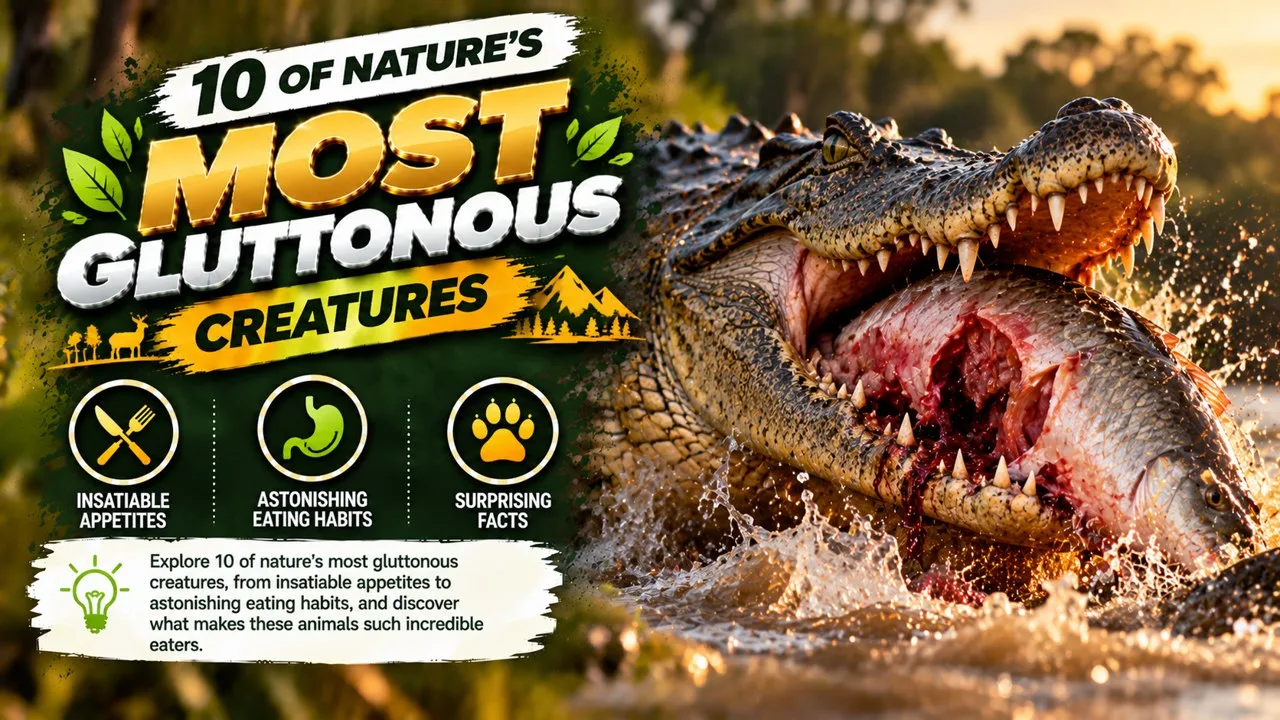
Nature's most gluttonous creatures, from the blue whale and the desert locust to shrews and hummingbirds, eat astonishing amounts of food because their bodies, lifestyles and environments demand it. Calling an animal a glutton is a human joke, of course. No wild animal overeats for pleasure in the way people sometimes do. Every one of the "big eaters" in this list is solving a real problem: fuelling a huge body, keeping a tiny body warm, growing at breakneck speed, or surviving between rare meals.
This Finepedia guide, written in October 2026, looks at ten animals whose appetites stand out, explains the biology behind each one, and separates well-measured figures from the exaggerated numbers that circulate online. Where scientists disagree or where a figure is only an estimate, we say so. If you enjoy animal stories, you may also like Finepedia's most amazing animal stories, most dangerous wild animals in Canada and cutest cat breeds in the world.
How We Chose Nature's Most Gluttonous Creatures
"Eats the most" can mean several different things, and each one produces a different winner. A blue whale eats more food by weight than any other animal alive, but relative to its body size it eats far less than a shrew. A caterpillar may not eat much in absolute terms, yet it can multiply its body mass thousands of times in a few weeks. A python may eat only a handful of times a year, but each meal can be close to its own body weight.
To make the list fair, Finepedia scored candidates on four questions:
- Total intake: how much food the animal eats in a day or a feeding season, measured in kilograms or tonnes.
- Relative intake: how much it eats compared with its own body weight.
- Single-meal size: the largest meal it can take at once, again compared with its body.
- Quality of evidence: whether the figures come from field studies, tagging data, zoo records or peer-reviewed research rather than repeated internet claims.
An animal had to stand out strongly on at least one of the first three questions and have reasonable evidence for it. The ranking is a guide to how extreme each appetite is, not a scientific league table, and figures vary with season, age, sex, habitat and the method used to measure them.
Why Some Animals Need So Much Food
Three biological rules explain most of the animals in this list.
- Size and total energy: big bodies need more total energy, so the largest animals eat the largest absolute amounts.
- Surface area and heat loss: small warm-blooded animals have a lot of skin relative to their volume, so they lose heat fast. To stay warm they must burn fuel quickly, which means eating constantly.
- Food quality: animals that live on low-energy food, such as bamboo, grass or leaves, must process large volumes to extract enough nutrients.
Cold-blooded animals such as snakes follow a different strategy. Because they do not spend energy keeping their bodies warm, they can go weeks or months between meals, then take one enormous meal when the chance arrives.
Nature's Most Gluttonous Creatures at a Glance
| Rank | Animal | What makes its appetite extreme | Typical figure (approximate) |
|---|---|---|---|
| 1 | Blue whale | Largest total intake of any animal | Several tonnes of krill a day in feeding season |
| 2 | Desert locust | Swarms eat crops on a regional scale | About its own body weight in fresh plants per day |
| 3 | Shrews | Very high intake relative to tiny body | Often 80–125% of body weight per day |
| 4 | Hummingbirds | Highest metabolic rate of any bird group | Many times body weight in nectar per day, mostly water |
| 5 | Caterpillars | Explosive growth in weeks | Body mass can increase thousands of times before pupating |
| 6 | African elephant | Huge bulk of low-quality plant food | Often 100–200 kg of vegetation per day |
| 7 | Giant panda | Low-nutrition bamboo diet | About 12–38 kg of bamboo per day |
| 8 | Sea otter | Stays warm in cold water without blubber | About 20–25% of body weight per day |
| 9 | Common vampire bat | Must feed almost every night | Up to roughly half its body weight in blood per meal |
| 10 | Burmese python | Enormous single meals | Prey can approach or exceed the snake's own weight |
1. Blue Whale: The Biggest Eater on Earth
The blue whale (Balaenoptera musculus) is the largest animal known to have lived, reaching around 30 metres in length and well over 100 tonnes in weight. Feeding a body that size takes a staggering amount of food, almost all of it tiny shrimp-like crustaceans called krill.
How It Feeds
Blue whales are lunge feeders. A whale accelerates towards a dense patch of krill, opens its mouth wide and engulfs a volume of water and prey that can be comparable to its own body mass. Pleated grooves on its throat expand like an accordion to hold the load. The whale then pushes the water out through baleen plates, comb-like structures made of keratin that hang from the upper jaw, and swallows the trapped krill.
Each lunge is costly, because opening the mouth at speed creates enormous drag. The strategy only pays off when the krill patch is dense enough, which is why blue whales spend much of their time searching for the richest swarms.
How Much It Eats
Older textbooks often stated that a blue whale eats around 4 tonnes of krill a day. A large study published in Nature in 2021, led by Matthew Savoca and colleagues, used tags on whales, sonar measurements of krill swarms and drone photographs to estimate intake more directly. It concluded that large baleen whales eat roughly three times more than earlier estimates suggested, and that an eastern North Pacific blue whale may eat around 16 tonnes of food a day during its feeding season.
That figure applies to the months when whales feed intensively in productive waters. Blue whales eat far less, and sometimes hardly at all, during migration and the breeding season, living off the energy reserves built up while feeding.
Why It Matters
Whale feeding matters well beyond the whale. When whales feed at depth and release faeces near the surface, they recycle nutrients such as iron that help plankton grow. Researchers behind the 2021 study argued that the collapse of great whale populations through commercial whaling in the twentieth century may have reduced this nutrient recycling in parts of the ocean. Blue whales are listed as Endangered by the IUCN, and protecting their feeding grounds from ship strikes and noise is a major conservation focus.
2. Desert Locust: The Swarm That Eats Like a City
A single desert locust (Schistocerca gregaria) weighs only about two grams, but locusts are on this list because of what happens when millions of them gather.
From Grasshopper to Swarm
Desert locusts usually live as solitary grasshoppers. When good rains produce plenty of vegetation and populations rise, crowding triggers a dramatic change. Repeated contact with other locusts, especially on the hind legs, causes changes in behaviour, colour and body shape. The insects become gregarious, march in bands as wingless young, and later fly as swarms that can travel long distances with the wind.
How Much a Swarm Eats
According to the Food and Agriculture Organization of the United Nations (FAO), an adult desert locust can eat roughly its own weight in fresh food every day. A swarm can contain tens of millions of locusts per square kilometre, and the FAO estimates that a swarm covering one square kilometre can eat about the same amount of food in a day as 35,000 people.
Real-World Impact
Desert locust plagues have affected farmers across Africa, the Middle East and South Asia for thousands of years. The 2019–2021 upsurge, fuelled by unusual cyclones and heavy rains, spread across East Africa, Yemen, Iran, Pakistan and India and became the worst outbreak in decades in several countries. The FAO's Desert Locust Information Service monitors weather, vegetation and locust reports to give early warnings, because controlling young bands before they can fly is far easier than fighting mature swarms.
3. Shrews: Tiny Bodies, Ceaseless Hunger
If any animal deserves the reputation of an endless appetite, it is the shrew. These small, mouse-like mammals are not rodents at all; they belong to the order Eulipotyphla, along with moles and hedgehogs.
A Life Lived Fast
Shrews have some of the highest metabolic rates of any mammal. The Etruscan shrew (Suncus etruscus), one of the smallest mammals by mass, weighs only around 1.8 grams, and its heart can beat more than 1,000 times a minute when active. Small size means rapid heat loss, so shrews must burn fuel continuously just to stay warm.
How Much Shrews Eat
Many shrew species eat roughly their own body weight in food each day, and some small species can eat more. Common figures for the Eurasian common shrew and pygmy shrew range from about 80 to 125 percent of body weight per day, depending on season and temperature. Shrews hunt insects, worms, spiders, snails and other small invertebrates, and they typically feed every few hours around the clock.
The popular claim that a shrew will starve to death after just a few hours without food is an exaggeration in its most dramatic form, but it contains truth. Small shrews have very small energy reserves and can die within a day or so without food, especially in cold weather.
Clever Survival Tricks
Some shrews have evolved remarkable ways to cope with their energy demands.
- Venom: the northern short-tailed shrew of North America has venomous saliva that can paralyse prey, allowing it to store live food for later.
- Shrinking in winter: the common shrew shows the Dehnel phenomenon, in which its skull, brain and some organs shrink in autumn and partly regrow in spring, which is thought to reduce winter energy needs.
- Torpor: some species, especially in the subfamily Crocidurinae, can enter short periods of torpor, a controlled drop in body temperature that saves energy.
4. Hummingbirds: Feathered Fuel-Burners
Hummingbirds live at the extreme edge of what a warm-blooded animal can do. Hovering is one of the most energy-hungry forms of movement in nature, and hummingbirds hover every time they feed at a flower.
The Fastest Metabolism Among Birds
Hummingbirds have the highest mass-specific metabolic rates measured in birds. During hovering, the heart of some species beats more than 1,000 times a minute, and wingbeats in small species can exceed 50 per second. To power that work, a hummingbird must refuel throughout the day, visiting hundreds or even more than a thousand flowers.
How Much They Eat
Popular sources often say a hummingbird drinks up to twice its body weight in nectar each day, or even more. These figures are plausible in volume terms, but most of nectar's weight is water. A better way to say it is that a hummingbird must take in a very large amount of sugar relative to its body, and it processes that sugar extraordinarily quickly. Research on rufous and Anna's hummingbirds has shown that they can fuel their hovering almost entirely with sugar they ate within the previous hour.
Nectar is not their only food. Hummingbirds also eat small insects and spiders, which supply the protein, fats and minerals that sugar water lacks.
Surviving the Night
At night a hummingbird cannot feed, so many species enter torpor. Body temperature and heart rate drop sharply, cutting energy use dramatically. A 2020 study of hummingbirds in the high Andes recorded a black metaltail lowering its body temperature to about 3.3 °C, the lowest ever measured in a bird or non-hibernating mammal.
5. Caterpillars: Eating Machines With One Goal
A caterpillar's job is simple: eat and grow. Everything about its body, from powerful chewing mandibles to a gut that runs most of its length, serves that purpose.
Growth Measured in Thousands
Caterpillars grow through stages called instars, shedding their skin several times as they enlarge. Over a few weeks many species increase their body mass by a factor of hundreds or thousands. A monarch caterpillar, for example, typically increases its weight around 2,000 times between hatching and pupating, according to monarch research programmes in North America.
A frequently repeated claim says the polyphemus moth caterpillar eats about 86,000 times its birth weight in its first 56 days. This figure appears in many books and websites, but Finepedia could not trace it to a clear original study, so it is best treated as a striking illustration rather than a precise measurement.
Why Eat So Much?
In many moths and butterflies, the adult stage feeds little or not at all. Some adult moths, including the luna and polyphemus moths, have reduced mouthparts and do not eat. The energy for metamorphosis, mating and egg laying therefore comes largely from what the caterpillar ate. That makes the larval stage a race to store resources before winter, predators or parasites end it.
Impact on Forests and Farms
Some caterpillar species can strip trees bare during outbreaks. The spongy moth, previously called the gypsy moth, is an introduced species in North America whose caterpillars can defoliate large areas of forest in outbreak years. Farmers also battle crop pests such as the fall armyworm, which spread from the Americas to Africa in 2016 and to Asia soon after.
6. African Elephant: A Day Spent Eating
The African bush elephant (Loxodonta africana) is the largest living land animal. Adult males can weigh around 6 tonnes, and the largest individuals considerably more.
Eating Most of the Day
Elephants are herbivores that eat grasses, leaves, bark, roots, fruit and twigs. Much of this food is tough and low in nutrients, and elephants digest only a relatively modest share of what they eat. As a result they spend a large part of each day feeding, often between 12 and 18 hours. Estimates for an adult's daily intake commonly fall in the range of 100 to 200 kilograms of vegetation, with water intake that can exceed 100 litres when water is available.
Elephants as Ecosystem Engineers
An elephant's appetite reshapes landscapes. By pushing over trees and stripping bark, elephants can open up woodland and help maintain grassland. Their dung spreads seeds over long distances, and some tree species in African and Asian forests rely heavily on elephants for seed dispersal. In fenced reserves with high elephant densities, however, the same appetite can damage vegetation, which is one reason managing elephant populations is a complex conservation issue.
7. Giant Panda: A Carnivore That Chose Bamboo
The giant panda (Ailuropoda melanoleuca) belongs to the order Carnivora and has the short, simple gut of a meat-eater. Yet more than 99 percent of its diet is bamboo, one of the least nutritious foods an animal can choose.
The Bamboo Problem
Bamboo is low in protein and high in fibre that pandas digest poorly. To get enough energy, a panda must eat a great deal of it. Commonly cited figures say a giant panda eats about 12 to 38 kilograms of bamboo a day, depending on whether it is eating leaves, stems or high-water-content shoots, and spends roughly 10 to 16 hours a day feeding.
Saving Energy as Well as Eating More
A 2015 study published in Science found that giant pandas have a daily energy expenditure that is unusually low for an animal of their size, comparable to that of a three-toed sloth relative to body mass. The researchers linked this to low physical activity, reduced sizes of some organs and low levels of thyroid hormone. In other words, the panda copes with its poor diet by both eating a lot and spending as little energy as possible.
Conservation Success
In 2016 the IUCN downgraded the giant panda from Endangered to Vulnerable, reflecting population growth and habitat protection in China. A national survey reported 1,864 wild giant pandas in 2014. Protecting bamboo forests and linking fragmented habitats remain central to their future.
8. Sea Otter: Warmth From Food, Not Fat
The sea otter (Enhydra lutris) lives in the cold coastal waters of the North Pacific. Unlike whales and seals, it has no thick layer of blubber. It relies instead on the densest fur of any animal, with up to about one million hairs per square inch in some areas, and on a very high metabolic rate.
How Much a Sea Otter Eats
To generate enough heat, a sea otter must eat about 20 to 25 percent of its body weight every day. For an adult weighing around 30 kilograms, that means several kilograms of sea urchins, crabs, clams, mussels and other invertebrates daily. Sea otters are famous for using stones as tools to crack open hard shells while floating on their backs.
A Keystone Appetite
The sea otter is a classic example of a keystone species. Sea urchins graze on kelp, and where urchin numbers are unchecked they can create bare "urchin barrens". By eating large numbers of urchins, sea otters help kelp forests survive, and those forests in turn support fish, birds and many other species. Research comparing Alaskan islands with and without otters in the 1970s helped establish this relationship.
Sea otters were hunted almost to extinction for their fur by the early twentieth century. International protection from 1911 allowed populations to recover in parts of their range, although the southern sea otter of California remains listed as threatened under the US Endangered Species Act.
9. Common Vampire Bat: Living Meal to Meal
The common vampire bat (Desmodus rotundus) of Central and South America is one of only three bat species that feed entirely on blood. Despite its reputation, it rarely feeds on humans, and its main targets are livestock and other mammals.
A Very Large Meal
A common vampire bat weighs around 25 to 40 grams. In a single feeding it can drink an amount of blood equal to a large share of its body weight, with figures of up to roughly 50 percent commonly cited. To manage the extra load, its kidneys begin removing water from the blood very quickly, and the bat often urinates soon after starting to feed, which reduces the weight it must carry when flying.
Why It Can't Skip Meals
Blood is rich in protein but poor in fat and carbohydrate, so vampire bats cannot store much energy. Studies by Gerald Wilkinson in the 1980s found that a bat that fails to feed for about two to three nights in a row is at serious risk of starving.
Sharing Food With Friends
That risk led to one of the most famous examples of cooperation in animals. Vampire bats that have fed successfully often regurgitate blood to roost-mates that went hungry, and they are more likely to share with individuals that have shared with them before. Research in the decades since has explored how these social bonds form and how bats maintain them.
10. Burmese Python: The Biggest Meal Relative to Size
The Burmese python (Python bivittatus) of Southeast Asia is one of the largest snakes in the world, with individuals exceeding 5 metres in length. In Florida's Everglades, where it is an invasive species, it has become a symbol of what an outsized appetite can do to an ecosystem.
Eating Big, Eating Rarely
Like all snakes, the Burmese python swallows its prey whole. Its flexible jaw connections and stretchy skin allow it to swallow animals wider than its own head. Pythons can take prey close to or even exceeding their own body weight, though such meals are exceptional. In 2022, researchers in Florida documented a python of about 52 kilograms that had swallowed a white-tailed deer fawn weighing roughly 35 kilograms.
A Body That Rebuilds Itself
The Burmese python's digestion is a famous case study in physiology. After a large meal, its metabolic rate can jump many times above resting levels, and organs such as the heart, liver, kidneys and intestine can grow significantly in size within days. Once digestion is complete, the organs shrink back. A python can then go weeks or months before eating again.
Problem Predator in Florida
Burmese pythons became established in South Florida after releases or escapes of pet snakes, and a population was recognised in Everglades National Park in the early 2000s. Studies have linked the pythons to steep declines in some mammals in the park, including raccoons, opossums and bobcats. Florida runs removal programmes and public challenges to reduce python numbers.
Honourable Mentions
Wolverine
The wolverine's scientific name, Gulo gulo, comes from the Latin for "glutton", and in some languages it is still called the glutton. The name reflects its reputation for eating large amounts at once, especially when scavenging carcasses in winter. In reality, the wolverine is better described as an efficient opportunist that caches food in snow and cold places to eat later.
Star-Nosed Mole
The star-nosed mole of North America is not a big eater by volume, but it is one of the fastest. Research by neuroscientist Kenneth Catania, published in Nature in 2005, found that it can identify and eat a small prey item in about 120 milliseconds at its fastest, and around 230 milliseconds on average. Speed helps it profit from very small prey.
Pygmy Hippopotamus and Cows
Large grazers such as cattle and hippos also eat large volumes of plants, but much of the work of digestion is done by microbes in their guts. They show that a big appetite often depends on a partnership with bacteria and other microorganisms.
Myths About Gluttonous Animals
Some of the most widely shared "fun facts" about animal appetites are exaggerated, outdated or impossible to trace. Here are a few that need care.
- "Shrews die after three hours without food." Small shrews do need frequent meals and can die quickly without them, but a fixed three-hour limit is not a reliable rule for all species.
- "Hummingbirds eat twice their weight every day." True in rough volume terms for nectar, which is mostly water, but misleading if it suggests solid food.
- "A blue whale eats 4 tonnes of krill a day." This older estimate has been revised upwards for the feeding season by modern tagging research.
- "Pythons can unhinge their jaws." Snakes do not literally dislocate their jaws. Their lower jaw bones are connected by stretchy ligaments, which allows the wide gape.
Why Studying Appetites Matters
Understanding how much animals eat helps scientists answer bigger questions. Feeding rates reveal how much food an ecosystem must produce to support its predators, how climate change might alter food supplies, and how human activities such as fishing, farming and habitat loss affect wildlife. For endangered species such as the blue whale, knowing how much food a population needs helps define which ocean areas deserve protection.
Appetite also connects animals to people directly. Locust swarms and caterpillar outbreaks threaten food security, while elephants and pythons create difficult choices for wildlife managers. Seen this way, the "gluttons" of nature are not greedy at all. They are animals whose survival strategies happen to involve eating on a scale that astonishes us.
Frequently Asked Questions
Which animal eats the most food in total?
The blue whale. During its feeding season, a large blue whale may eat several tonnes and possibly around 16 tonnes of krill a day, according to the 2021 study in Nature.
Which animal eats the most for its size?
Among mammals, small shrews are strong contenders, often eating around their own body weight daily. Growing caterpillars are even more extreme in terms of growth, multiplying their body mass by thousands.
Do any animals eat only once in a long while?
Yes. Large snakes such as pythons and some crocodilians can go weeks or months between big meals because, as cold-blooded animals, they need far less energy than mammals of similar size.
Is the wolverine really a glutton?
The name is more legend than science. Wolverines do eat large meals when food is available, but they also store food carefully for later.
Conclusion
Nature's most gluttonous creatures reveal how differently animals have solved the problem of staying alive. The blue whale eats tonnes because it is enormous, the shrew eats nonstop because it is tiny, the panda eats for half the day because bamboo is poor food, and the python eats rarely but spectacularly because its cold-blooded body can wait. Next time an animal seems greedy, it is worth remembering that its appetite is usually the most efficient answer evolution has found.
- Savoca, M. S. et al. (2021), "Baleen whale prey consumption based on high-resolution foraging measurements", Nature.
- Food and Agriculture Organization of the United Nations, Desert Locust Information Service and Locust Watch resources.
- Nie, Y. et al. (2015), "Exceptionally low daily energy expenditure in the bamboo-eating giant panda", Science.
- Catania, K. C. and Remple, F. E. (2005), "Asymptotic prey profitability drives star-nosed moles to the foraging speed limit", Nature.
- Wilkinson, G. S. (1984), "Reciprocal food sharing in the vampire bat", Nature.
- Wolf, B. O. et al. (2020), "Extreme and variable torpor among high-elevation Andean hummingbird species", Biology Letters.
- Secor, S. M. and Diamond, J. (1998), "A vertebrate model of extreme physiological regulation", Nature.
- IUCN Red List assessments for the blue whale, giant panda and sea otter.
- US Fish and Wildlife Service and National Park Service resources on sea otters and Burmese pythons in Florida.
- Monarch Watch and Monarch Joint Venture educational resources on monarch development.























Log in with