

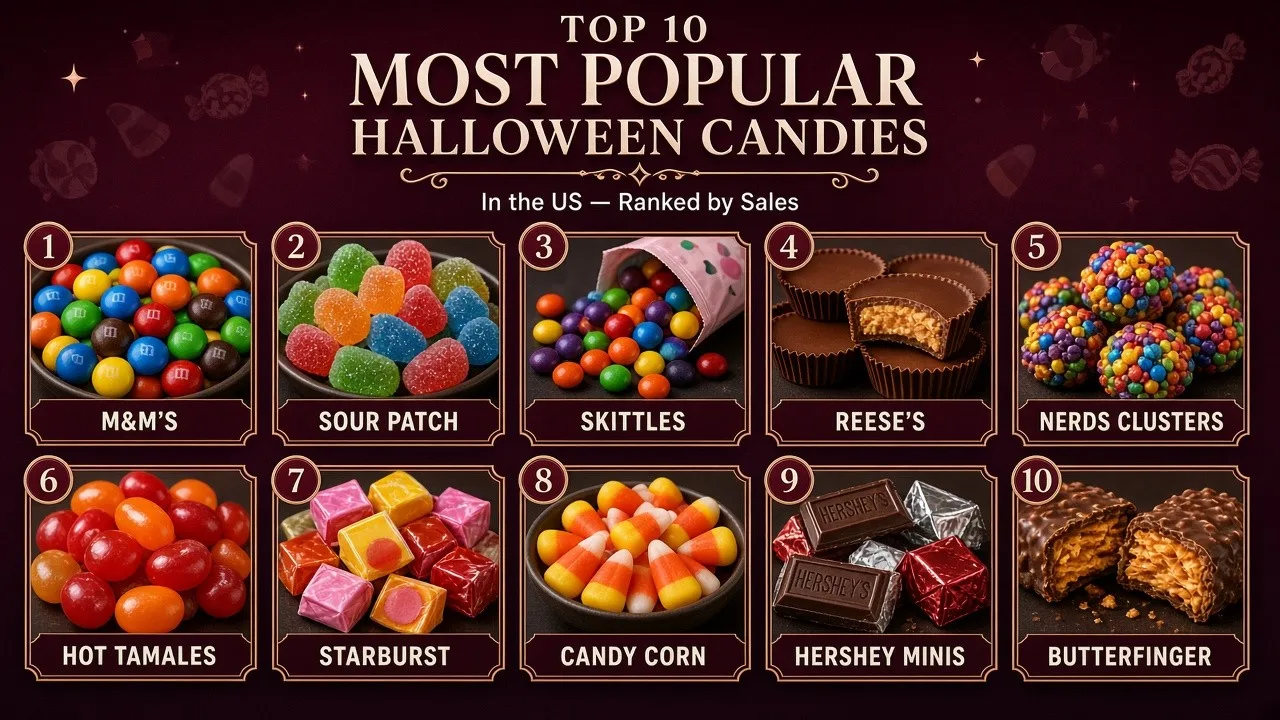
The most popular Halloween candies of 2026 are led by M&M's, Sour Patch Kids and Skittles, ranked by pounds sold in CandyStore.com's state-by-state data.
Every October, American households stock up on bulk bags of wrapped treats for trick-or-treaters, office bowls and the inevitable midnight raid on the leftovers. Handing out candy is still the single most common way people mark the holiday: 61% of consumers planned to do it in 2026, according to the National Retail Federation. This Finepedia guide walks through the ten candies Americans actually buy most for the season, with a profile of each brand's history, what makes it work as a giveaway, and where it wins on the map.
This is an updated list. Many rankings that still circulate online date from 2020, when Skittles sat on top and treats such as Salt Water Taffy and Tootsie Pops made the national ten. The 2026 picture looks different: a gummy newcomer has crashed the top five, sour candy has caught chocolate, and Reese's has slipped on one major map while dominating another. Below you will find the current order, the reasons behind it, and the context that explains why two respected datasets can disagree.
How We Ranked the Most Popular Halloween Candies
The order on this page follows CandyStore.com's 2026 edition of its Most Popular Halloween Candy by State study, updated on 30 September 2026. The retailer combines its own bulk Halloween orders with sales data shared by major candy manufacturers and distributors, covering every Halloween season from 2008 through 2025. Recent seasons are weighted more heavily than older ones, and the result is a projection of the 2026 season rather than a live count.
Key points about the method:
- Popularity is measured in pounds, not dollars or pieces, so a sack of candy corn and a case of full-size bars sit on the same scale
- Each state gets a top three; the national order adds up projected pounds across every state where a candy finished in that top three
- No surveys or search trends feed the ranking, only purchases
- Changes are measured against the previous edition, published in 2024
A different method gives a different winner. Instacart's 2026 Halloween report, built from ounces of candy ordered through its grocery platform, puts Reese's Peanut Butter Cups first and names it the top seller in 40 of 51 states and DC, followed by Peanut M&M's, Hershey's Milk Chocolate, M&M's and Snickers. That is not a contradiction. Instacart measures one grocery-delivery channel over a short window, while CandyStore leans on bulk Halloween buying over 18 seasons. Read together, they show that chocolate still dominates everyday grocery baskets, while sour, gummy and chewy candy has surged in the big bags bought specifically for trick-or-treaters.
At a Glance: The 2026 Top 10
| Rank | Candy | Maker | Type | Change vs 2024 |
|---|---|---|---|---|
| 1 | M&M's | Mars Wrigley | Candy-coated chocolate | Same |
| 2 | Sour Patch Kids | Mondelez International | Sour gummy | Up 1 |
| 3 | Skittles | Mars Wrigley | Fruit chew | Up 1 |
| 4 | Reese's Cups | The Hershey Company | Chocolate and peanut butter | Down 2 |
| 5 | NERDS Gummy Clusters | Ferrara Candy Company | Gummy with crunchy shell | New |
| 6 | Hot Tamales | Just Born | Cinnamon chewy candy | Same |
| 7 | Starburst | Mars Wrigley | Fruit chew | Down 2 |
| 8 | Candy Corn | Brach's (Ferrara) and others | Mellowcreme | Down 1 |
| 9 | Hershey's Mini Bars | The Hershey Company | Chocolate assortment | Same |
| 10 | Butterfinger | Ferrara Candy Company | Crispy peanut butter bar | Same |
Only four of the ten are chocolate-based. That balance would have looked unusual a decade ago, and it is the clearest trend in this year's ranking.
1. M&M's
| Attribute | Details |
|---|---|
| Maker | Mars Wrigley (Mars, Incorporated) |
| First produced | 1941, Newark, New Jersey |
| Type | Chocolate centre inside a hard sugar shell |
| 2026 national rank | 1 (unchanged from 2024) |
| States won in 2026 | 10, including California, Oregon, Washington, Pennsylvania and Virginia |
Origins and History
M&M's grew out of a partnership between Forrest Mars Sr., son of the Mars company founder, and Bruce Murrie, whose father was president of the Hershey Chocolate Company. Their surnames supplied the two letters. Mars received a patent for the coating process in March 1941, and production began that year in Newark. Early demand came from the US Army, which valued chocolate that could survive warm climates without melting, and during the Second World War the candies went almost entirely to the military.
The brand built its identity through the following decades. A printed letter m appeared on each piece in 1950, first in black and then in white from 1954, the same year Peanut M&M's arrived. Red pieces vanished in 1976 during a public scare over certain red food dyes, even though M&M's did not use the dye in question, and returned in 1987.
Key Features
- A hard sugar shell that keeps chocolate tidy in small hands and warm pockets
- Fun-size packs that are easy to portion for large numbers of trick-or-treaters
- A wide family of centres, from peanut and pretzel to caramel and peanut butter
- Bright colours that suit seasonal packaging and themed bowl mixes
- Long shelf life compared with softer chocolate bars
Significance
M&M's is one of only two candies on the 2026 map that wins states in all four US Census regions. It owns the West Coast and stretches east through Iowa, Kansas, Montana, North Carolina, Pennsylvania, Vermont and Virginia, with Montana and Virginia newly switching to it this year. Its staying power at the top comes from appealing to almost everyone: children like the colours, adults buy it for themselves, and the shell avoids the melted-mess problem that plagues chocolate on a warm October evening.
On the Instacart grocery list, plain and peanut M&M's both sit in the top five, which reinforces how widely the brand reaches across shopping channels. Few candies place this high under two very different measuring systems.
Interesting Facts
- The candy shell was the selling point from day one: chocolate that stays solid in the hand was the whole reason the Army bought in.
- Mars later moved production to a larger plant in Hackettstown, New Jersey, and opened a second factory in Cleveland, Tennessee, in 1978.
- Bruce Murrie sold his minority stake to Mars in 1949, leaving the brand fully under Mars control.
- M&M's are now sold in more than 100 countries.
2. Sour Patch Kids
| Attribute | Details |
|---|---|
| Maker | Mondelez International |
| Roots | Gummy figures first sold in Canada as Mars Men, renamed in the mid-1980s |
| Type | Soft gummy dusted with sour sugar |
| 2026 national rank | 2 (up from 3) |
| States won in 2026 | 10, including New York, Texas, Illinois, Arizona and Alaska |
Origins and History
The gummy kids trace back to confectioner Frank Galatolie, who developed them while working at Jaret International. In the late 1970s, Cadbury and the Malaco Licorice Company formed the Allen Candy Company in Hamilton, Ontario, to produce them. The candy was originally sold as Mars Men before adopting the Sour Patch Kids name in the mid-1980s. Production passed to what is now Mondelez International after the Allen Candy Company was acquired in the late 1990s.
The formula is simple and effective. A soft, sweet gummy is coated in sour sugar made from citric acid, tartaric acid and sugar. The sharp acid hits first and fades into the sweet centre, a sequence the brand has long marketed with lines such as Sour Then Sweet.
Key Features
- A two-stage flavour, sour on the outside and sweet inside
- Soft, chewy texture that suits children and adults alike
- No chocolate, so no melting and no seasonal cocoa-price worries for shoppers
- Easy to share from bulk bags or individual Halloween packs
- Spin-offs ranging from cereal to Sour Patch Kids Oreo cookies released in 2024
Significance
Sour Patch Kids is the breakout story of the 2026 study. It picked up Arizona, Massachusetts and South Carolina, drew level with M&M's at ten state wins each, and rose from third to second in national volume. Like M&M's, it wins in all four regions: Maine, Massachusetts and New York in the Northeast; Illinois and Nebraska in the Midwest; Delaware, South Carolina and Texas in the South; Alaska and Arizona in the West.
Its rise mirrors a wider taste shift toward sour and fruity candy. Even on Instacart's chocolate-heavy list, Sour Patch Kids is the first non-chocolate candy to appear, at seventh, and Rhode Island is the one state where it tops Instacart orders outright.
Interesting Facts
- Sour Patch Kids Extreme adds malic acid for an even sharper hit than the original.
- A Sour Patch Kids video game, World Gone Sour, was released in 2011.
- The brand moved into gum in 2014 and into breakfast cereal in 2018.
- In France the same candy has been sold under the Carambar Very Bad Kids name.
3. Skittles
| Attribute | Details |
|---|---|
| Maker | Mars Wrigley |
| Origin | Britain in the 1970s; made in the US from 1982 |
| Type | Chewy fruit centre inside a thin sugar shell |
| 2026 national rank | 3 (up from 4) |
| States won in 2026 | Alabama and Florida; second or third in ten more |
Origins and History
Skittles began in Britain in the 1970s, and Mars registered the name as a US trademark in 1974. The candy was widely distributed across the United States by 1979, and American production started in 1982. Its name comes from skittles, the old pub and lawn game whose pins resemble the little round sweets. In 2008, when Mars acquired Wrigley, its non-chocolate brands, Skittles included, moved under the Wrigley division.
The famous Taste the Rainbow theme was created by the New York advertising agency D'Arcy Masius Benton and Bowles, and it gave Skittles one of the most recognisable identities in American candy. Each piece carries a printed lowercase s, a visual nod to its chocolate cousin with the m.
Key Features
- Fruit flavours in a mix of bright colours, with Tropical, Wild Berry and Sour variants
- A shell that keeps pieces from sticking together in a candy bowl
- Chewy centres that are softer than hard candy but firmer than gummies
- Free of animal gelatin since 2009, which widens its appeal to vegetarians
- Fun-size packs that are light and easy to stock in volume
Significance
Skittles is a model of breadth over peaks. It wins only two states outright, Alabama and Florida, yet it finishes second or third in ten more, the most of any candy on the 2026 map. Showing up in so many state top threes is how it climbs to third nationally. Florida's switch from Reese's to Skittles is also one of the clearest examples of the chocolate-to-fruit shift in this edition.
Interesting Facts
- Skittles has become known for unconventional Super Bowl marketing, including a 2018 commercial shown to only one viewer.
- Each June the brand has run colourless Pride editions in support of LGBT charities.
- Skittles featured in a 2002 action-adventure video game called Darkened Skye.
- Its official website was briefly turned into a social media overlay in 2009, an experiment marketers still discuss.
4. Reese's Cups
| Attribute | Details |
|---|---|
| Maker | The Hershey Company (H. B. Reese Candy Company) |
| Created | 1928, Hershey, Pennsylvania |
| Type | Milk chocolate cup with peanut butter filling |
| 2026 national rank | 4 (down from 2) |
| States won in 2026 | Kentucky and New Hampshire |
Origins and History
H. B. Reese worked for Milton Hershey as a dairy farmer and shipping foreman before starting his own candy business in Hershey, Pennsylvania, in 1923. He used Hershey chocolate from the start, and his peanut butter cups, created in 1928 and first sold as penny cups, soon outsold everything else he made. After his death in 1956, his six sons ran the company until they merged it with Hershey in 1963. By 1969 the cups were Hershey's top-selling product.
Over the decades the brand added miniatures in 1978, a king-size pack in 1987 and the thicker Big Cup in the 2000s, along with endless seasonal shapes. For Halloween, pumpkin-shaped cups and bulk bags of miniatures are a familiar sight on supermarket shelves.
Key Features
- The salty-sweet pairing of peanut butter and milk chocolate
- A soft, slightly crumbly filling that contrasts with the chocolate shell
- Multiple sizes, from snack minis to full cups, for every kind of handout
- Strong seasonal line-up, including Halloween pumpkin shapes
- Contains peanuts, so allergy-aware households often keep a non-nut alternative nearby
Significance
Reese's had a rough year on the CandyStore map. It slid from second to fourth nationally, losing Florida to Skittles and Wyoming to Salt Water Taffy, and kept outright wins only in Kentucky and New Hampshire. The same study's best-candy survey also crowned Snickers first, the first time Reese's had not taken that title.
Yet on Instacart's grocery data Reese's Peanut Butter Cups are the clear national leader by ounces. The split suggests that Reese's remains a powerhouse in everyday shopping, while bulk trick-or-treat buying has tilted toward non-chocolate mixes, helped along by high cocoa prices. In 2026 the brand also drew headlines when H. B. Reese's grandson criticised recipe changes on some products; Hershey said its classic cups were unchanged and that a small share of items, such as certain minis and shapes, would return to classic milk and dark chocolate by 2027.
Interesting Facts
- The H. B. Reese Candy Company still operates as a Hershey subsidiary and also makes Kit Kat for the US market.
- Reese's was the best-selling candy brand in the United States in 2012, with sales of about 2.6 billion dollars.
- The 2026 recipe debate centred on compound coatings used in a few line extensions, not the standard cup.
- Hershey says the standard cups use peanut butter it makes itself from roasted peanuts.
5. NERDS Gummy Clusters
| Attribute | Details |
|---|---|
| Maker | Ferrara Candy Company (Ferrero Group) |
| Launched | 2020, as a spin-off of NERDS, which debuted in 1982 |
| Type | Gummy centre coated in tiny crunchy NERDS |
| 2026 national rank | 5 (new entry) |
| States won in 2026 | Indiana; top three in seven states |
Origins and History
The original NERDS, tiny tangy crunchy candies sold in a two-chamber box, were launched in 1982 under the Willy Wonka Candy Company name and rolled out nationally in 1984. After strong early sales, the brand spent decades as a steady middle-of-the-aisle performer. Ferrara, part of the Ferrero Group, took it over when it bought Nestlé's US candy business in 2018.
Everything changed with NERDS Gummy Clusters in 2020. The format wraps a soft gummy ball in a rough shell of miniature NERDS, giving a crunch-then-chew bite that went viral on social media. A celebrity post in 2021 and Super Bowl commercials in 2024 and 2025 turned it from a novelty into one of the fastest-growing candy brands in the country.
Key Features
- Two textures in one piece: crunchy outside, chewy inside
- Bright rainbow colouring that photographs well for social media
- Fruity and tangy flavour without any chocolate
- Bite-size Halloween packs suited to big handout bowls
- Strong appeal to teens and young adults who drove the brand's online buzz
Significance
No candy had a bigger 2026 debut. NERDS Gummy Clusters had never placed in a single state on the CandyStore map, then finished top three in seven: first in Indiana, second in Arizona, Georgia, North Carolina and Washington, and third in Oregon and Texas. That was enough to debut at fifth nationally, ahead of Hot Tamales and Starburst, as the only newcomer in the top ten.
It is liked as well as bought. In CandyStore's separate 2026 survey of the best Halloween candy, where people vote on taste rather than purchases, NERDS Gummy Clusters debuted at third. Agreement between the shopping cart and the opinion poll is rare for a candy this new.
Interesting Facts
- The two-chamber box of classic NERDS was designed after research into how children like to eat small candy.
- Gummy Clusters are made by moulding gummy centres and then tumbling them in a bowl of tiny sugar pieces.
- Each classic NERDS piece starts as a sugar crystal that is coated layer by layer.
- Indiana switched its state favourite from Starburst to NERDS Gummy Clusters in 2026.
6. Hot Tamales
| Attribute | Details |
|---|---|
| Maker | Just Born |
| Introduced | 1950 |
| Type | Cinnamon-flavoured chewy candy |
| 2026 national rank | 6 (unchanged) |
| States won in 2026 | Minnesota, Nevada, New Mexico and Wisconsin |
Origins and History
Hot Tamales were developed in 1950 by Bob Born, son of Just Born founder Sam Born. The name borrows from the spicy reputation of tamales, and the candy delivers a sweet, fiery cinnamon heat rather than the fruit flavours that dominate the chewy aisle. Just Born is a family-run Pennsylvania company also known for Peeps marshmallow treats and Mike and Ike fruit chews, the closest sibling to Hot Tamales in shape and texture.
Over time the brand has added hotter and fruitier spin-offs, including a three-heat mix in 2011, a hotter Fire version, a Tropical Heat line in 2014 and a Fire and Ice pairing with spearmint pieces in 2018.
Key Features
- A distinctive cinnamon heat that stands out in a mixed candy bowl
- Small capsule-shaped pieces, sold in boxes and bulk bags
- Chocolate-free, so they keep well in warm weather
- Several heat levels for people who like a stronger kick
- Appeals to adults as much as to children
Significance
Hot Tamales prove that a regional following can add up to national weight. The candy wins four states split between the upper Midwest and the desert Southwest, with Nevada and Wisconsin newly in its column for 2026, and that combination keeps it steady at sixth. Few brands with such a specific flavour profile reach the national top ten, which says a lot about its loyal fan base.
Shape plays a quiet role in how any food tastes, a point our guide to popular pasta shapes and the sauces they suit makes for the dinner table. With Hot Tamales, the small, dense capsule releases its cinnamon heat gradually as you chew rather than all at once.
Interesting Facts
- Hot Tamales was the top-selling cinnamon candy in the US in 1999.
- A spearmint Hot Tamales Ice version was sold in the late 2000s, then later returned as part of Fire and Ice.
- Hot Tamales won Minnesota, Nevada, New Mexico and Wisconsin in 2026, an unusual geographic mix.
- Just Born is based in Bethlehem, Pennsylvania.
7. Starburst
| Attribute | Details |
|---|---|
| Maker | Mars Wrigley |
| Origin | Britain, around 1960, as Opal Fruits |
| Type | Square fruit chew, individually wrapped |
| 2026 national rank | 7 (down from 5) |
| States won in 2026 | Michigan |
Origins and History
Starburst began life in Britain as Opal Fruits, produced at a Mars factory in Slough, Berkshire. The name came from a public competition, and the original four flavours were strawberry, lemon, orange and lime. The chews reached the United States in the late 1960s, where they took the Starburst name, a word usually read as a promise of bursting flavour and often linked to the Space Race mood of the time. In the US, cherry later replaced lime in the original pack.
Britain kept the Opal Fruits name until 1998, when Mars switched to Starburst to standardise the brand around the world. Since the 2008 Wrigley deal, Starburst has been part of the Mars Wrigley non-chocolate family alongside Skittles.
Key Features
- Each square is individually wrapped, ideal for hygiene-conscious Halloween bowls
- Long-lasting chew that releases flavour gradually
- Classic red, pink, orange and yellow colours, plus Tropical, Sour and FaveREDs mixes
- No chocolate, so no melting in warm-weather regions
- Firm enough to survive a crowded treat bag without being crushed
Significance
Starburst slipped two places to seventh in 2026, overtaken by the NERDS newcomer and the fast-rising sour category. It also lost Indiana to NERDS Gummy Clusters, leaving Michigan as its only outright win. Even so, its wrapped squares remain a reliable bulk-bag staple, and the brand benefits from the same chocolate-to-fruit trend that lifted Skittles and Sour Patch Kids.
Interesting Facts
- The winner of the Opal Fruits naming competition reportedly received a prize of 5 pounds sterling.
- In the US, Starburst contains gelatin, while the UK version is labelled suitable for vegetarians.
- Mars briefly revived the Opal Fruits name in the UK in 2008 and again in 2020.
- Starburst was withdrawn from New Zealand in 2021 and Australia in 2022.
8. Candy Corn
| Attribute | Details |
|---|---|
| Largest maker | Brach's (Ferrara Candy Company); also made by Jelly Belly and others |
| Invented | 1880s, Philadelphia |
| Type | Tri-colour mellowcreme with honey and vanilla notes |
| 2026 national rank | 8 (down from 7) |
| States won in 2026 | Maryland, North Dakota and Utah |
Origins and History
Candy corn is credited to George Renninger of the Wunderle Candy Company in Philadelphia, which began producing it in 1888. It was first called Chicken Feed, fitting the farm-themed marketing that confectioners used for a largely rural country. The Goelitz Confectionery Company, known today as Jelly Belly, began making it in 1898. For much of the twentieth century it was sold as a year-round penny candy.
Its link to Halloween firmed up around the 1950s, when households began handing out wrapped candy to trick-or-treaters. The yellow, orange and white bands echo harvest colours, and today Brach's is by far the largest producer. The National Confectioners Association even promotes 30 October, the day before Halloween, as National Candy Corn Day.
Key Features
- Three bold bands of yellow, orange and white
- Soft, waxy bite with a honey-vanilla flavour
- Made by moulding hot candy in cornstarch trays, a method largely unchanged for over a century
- Seasonal variants such as harvest corn with a cocoa end
- Sold in bulk bags that weigh heavily on pound-based rankings
Significance
No candy divides the country like candy corn. In 2026 it reclaimed the title of most hated Halloween candy in CandyStore's survey, yet in the same year it ranks eighth by weight sold and wins three states outright, with North Dakota new to the list. People clearly vote one way and shop another. Part of its weight advantage is practical: it is sold loose in large bags, and pound-based methods reward that format.
Candy corn also fits neatly into wider Halloween traditions, from table decorations to the porch displays described in our guide to creative uses for pumpkins after the jack-o-lanterns come down.
Interesting Facts
- US production was about 35 million pounds a year as of 2016, or almost 9 billion pieces.
- Brach's makes around 7 billion pieces of candy corn annually.
- Christmas, Valentine's Day, Easter and Independence Day versions exist, each with different colours.
- Instacart's 2026 data shows Colorado and Wyoming ordering candy corn far more than most states.
9. Hershey's Mini Bars
| Attribute | Details |
|---|---|
| Maker | The Hershey Company |
| Introduced | 1939, as Hershey's Miniatures |
| Type | Assortment of small chocolate bars |
| 2026 national rank | 9 (unchanged) |
| 2026 state movement | Lost first place in Hawaii and Nevada |
Origins and History
Hershey's Miniatures were introduced in 1939 as an assortment of five of the company's most popular bars at the time: the Hershey bar, Krackel, Mr. Goodbar, the Bitter-Sweet bar now known as Hershey's Special Dark, and a Nougat-Almond bar. The Nougat-Almond was discontinued in 1942 under wartime restrictions. The assortment that remains today contains the classic milk chocolate bar, Mr. Goodbar with peanuts, Krackel with crisped rice and Special Dark.
The mini bars ride on the fame of the Hershey milk chocolate bar, first sold in 1900. For Halloween, they arrive in large mixed bags and seasonal packs.
Key Features
- Four flavours in one bag: milk, dark, peanut and crisped rice
- Small, flat bars that are easy to share or tuck into treat bags
- Familiar American chocolate taste with a broad, multigenerational appeal
- Good option for mixed bowls where people like to pick favourites
- Contains milk and, in some bars, peanuts
Significance
Hershey's Mini Bars held ninth place nationally even after losing state crowns in Hawaii, which went to Butterfinger, and Nevada, which went to Hot Tamales. Their steady showing reflects how much Halloween buying still rests on classic chocolate assortments. On Instacart's 2026 list, Hershey's Milk Chocolate ranks third by ounces, another sign that the brand's core bar remains a household staple.
Interesting Facts
- A 2014 label redesign was estimated to save about 270,000 pounds of paper a year.
- A Nut Lovers line extension pairing chocolate with nuts arrived in 2004.
- Hershey has released patriotic red, white and blue bags of the assortment for summer holidays.
- Special Dark started life under the name Bitter-Sweet.
10. Butterfinger
| Attribute | Details |
|---|---|
| Maker | Ferrara Candy Company (Ferrero Group) |
| Invented | 1923, Curtiss Candy Company, Chicago area |
| Type | Crispy, flaky peanut butter core with chocolatey coating |
| 2026 national rank | 10 (unchanged) |
| States won in 2026 | 3, including newly won Hawaii |
Origins and History
Butterfinger was invented in 1923 by Otto Schnering, who had founded the Curtiss Candy Company near Chicago the year before. The name came from a public contest. Early publicity stunts included dropping Butterfinger and Baby Ruth bars from airplanes over American cities, and the bar was promoted in the 1934 Shirley Temple film Baby Take a Bow.
Ownership changed many times, passing to Standard Brands, Nabisco and RJR Nabisco before Nestlé bought it in 1990. In 2018 Ferrero acquired Nestlé's US candy brands, and its Ferrara unit reformulated the bar in 2019 with roasted peanuts, more cocoa and milk in the coating, and fewer additives.
Key Features
- A light, flaky, crunchy core unlike any other mainstream bar
- Peanut butter flavour with a chocolatey shell
- Available as fun-size bars and bite-size Butterfinger Bites
- Instantly recognisable yellow-and-blue wrapper
- Contains peanuts, which matters for allergy-aware treat bowls
Significance
Butterfinger kept tenth place nationally but had a bruising year on the state map, losing Massachusetts, South Carolina, Virginia and Wisconsin and picking up only Hawaii. It went from six state wins to three. That still leaves a solid core of fans in the South, and its unique texture keeps it a regular in mixed bags.
Interesting Facts
- The Simpsons advertised Butterfinger from 1988 to 2001, and Bart Simpson's catchphrase about nobody laying a finger on his Butterfinger became famous.
- A 2008 April Fool's Day prank claimed the bar had been renamed The Finger.
- Nestlé withdrew Butterfinger from German shops in 1999 after a campaign over genetically modified ingredients.
- The 2019 recipe change was marketed with the label Better Butterfinger.
CandyStore 2026 vs Instacart 2026 vs the 2020 List
| Rank | CandyStore 2026 (pounds, bulk) | Instacart 2026 (ounces, grocery) | 2020 list still shared online |
|---|---|---|---|
| 1 | M&M's | Reese's Peanut Butter Cups | Skittles |
| 2 | Sour Patch Kids | Peanut M&M's | Reese's |
| 3 | Skittles | Hershey's Milk Chocolate | M&M's |
| 4 | Reese's Cups | M&M's | Starburst |
| 5 | NERDS Gummy Clusters | Snickers | Salt Water Taffy |
The comparison shows how much the measuring method shapes the result. Grocery orders reward the everyday chocolate brands people buy all year. Bulk Halloween purchases reward cheaper, non-melting mixes and newer trends. Older lists, meanwhile, miss the newest arrivals entirely.
The Bigger Picture: Halloween Candy Spending in 2026
Halloween is a major event for the confectionery industry. According to the National Confectioners Association's State of Treating 2025 report, which uses Circana retail data, Halloween confectionery sales reached 7.4 billion dollars in 2024, up 2.2%. The NRF's 2026 survey, published on 22 September, expects total Halloween spending to reach a record 13.5 billion dollars, with 4.1 billion of that on candy.
| Measure | Figure | Source |
|---|---|---|
| Halloween confectionery sales, 2024 | 7.4 billion dollars (+2.2%) | NCA / Circana |
| Total planned Halloween spending, 2026 | 13.5 billion dollars | NRF |
| Planned candy spending, 2026 | 4.1 billion dollars | NRF |
| Consumers planning to buy candy, 2026 | 96% | NRF |
| Average planned candy spend per person, 2026 | 34.79 dollars | NRF |
The Shift From Chocolate
Non-chocolate candy has been gaining ground for a decade. NCA figures cited by CandyStore show its share of US confectionery rising from about a third of sales in 2015 to 40.9% in 2025, and Circana data found that non-chocolate candy outsold chocolate by volume in Halloween packaging last season, with a 52% share. High cocoa prices accelerated that change. On the 2026 CandyStore map, seven of the twelve states that changed favourites swapped a chocolate winner for a non-chocolate one, and not one went the other way.
Price and Loyalty
Prices matter too. Candy and gum cost 8.1% more in August 2026 than a year earlier, according to the Bureau of Labor Statistics, so higher planned spending does not necessarily mean more candy. Yet the NCA found that 64% of consumers would rather buy less candy than give up a favourite, which helps explain why 38 of the 50 states kept the same winner as in 2024.
If you are trying to balance treats with healthier habits, our guide to unhealthy foods to limit and better swaps offers practical ideas, and small fun-size candy packs also make easy additions to the best snacks to bring on a plane.
Honourable Mentions
Several well-loved treats fall outside the 2026 national ten but still matter on the map or in surveys:
- Snickers: first in CandyStore's 2026 best-candy survey and fifth on Instacart's grocery list
- Hershey's Kisses: fell from eighth to eighteenth nationally, keeping only Colorado
- Salt Water Taffy: took Wyoming outright in 2026
- Tootsie Pops: the favourite in New Jersey, and an Instacart standout in Louisiana
- Jolly Ranchers: the top candy in Georgia
- BUBS: a Swedish candy that debuted on the map in 2026, third in Kentucky and New York
Frequently Asked Questions
What is the most popular Halloween candy in America in 2026?
M&M's ranks first in CandyStore.com's 2026 national ranking, based on pounds sold over 18 Halloween seasons with recent years weighted more heavily. Sour Patch Kids and Skittles follow. M&M's and Sour Patch Kids are tied for the most state wins, with ten each, and both win in all four regions.
Why do some lists put Reese's first?
Different datasets measure different things. Instacart ranks candy by ounces ordered through its grocery platform, where Reese's Peanut Butter Cups lead clearly. CandyStore measures bulk Halloween-season purchases by weight across many years. Both are valid snapshots, and together they show chocolate strong in groceries while non-chocolate candy gains in trick-or-treat bags.
Is candy corn really the most hated Halloween candy?
In CandyStore's 2026 survey of the worst Halloween candy, candy corn took back the most-hated title. Yet it still ranks eighth nationally by weight sold and wins Maryland, North Dakota and Utah. Its love-or-hate reputation is strong, but plenty of households still buy it every autumn.
What new candy entered the top ten in 2026?
NERDS Gummy Clusters is the only newcomer. It had never placed in any state before, then finished top three in seven states, won Indiana outright and debuted at fifth nationally. It also ranked third in CandyStore's separate survey of the best Halloween candy, showing people like it as well as buy it.
How much do Americans spend on Halloween candy?
The National Retail Federation expects Americans to spend 4.1 billion dollars on Halloween candy in 2026, out of a record 13.5 billion dollars in total Halloween spending. About 96% of consumers plan to buy sweets, spending an average of 34.79 dollars each on candy for the season.
Is chocolate losing popularity at Halloween?
Chocolate is still huge, but non-chocolate candy is growing faster. Circana data show non-chocolate candy outselling chocolate by volume in Halloween packaging last season, and seven of the twelve states that changed favourites in 2026 swapped chocolate for sour, gummy or chewy candy. High cocoa prices have sped up the trend.
Conclusion
The most popular Halloween candies of 2026 reflect a country in transition. M&M's holds the crown, but Sour Patch Kids, Skittles and newcomer NERDS Gummy Clusters show how far sour, gummy and fruity candy has advanced on chocolate's turf. Reese's remains a giant in grocery orders, candy corn keeps selling despite its critics, and steady names such as Hot Tamales, Hershey's Mini Bars and Butterfinger round out a varied top ten. Whatever you plan to hand out, the safest bet is your own state's favourite, plus a little extra for the grown-ups.
For more ranked guides, browse the Top 10 Facts collection and the Food and Nutrition category, or read about the comforting rituals behind why we love coffee.
- CandyStore.com, Most Popular Halloween Candy by State (2026 edition, updated 30 September 2026): https://www.candystore.com/apps/blog/halloween-candy-map-popular/
- National Confectioners Association, State of Treating 2025: https://candyusa.com/state-of-treating-2025/
- National Retail Federation, 2026 Halloween survey press release: https://nrf.com/media-center/press-releases/nrf-halloween-survey-shows-consumer-spending-expected-to-reach-13-5-billion
- NRF Halloween Data and Trends: https://nrf.com/research-insights/holiday-data-and-trends/halloween
- Instacart, 2026 Halloween Sweet Tooth Report: https://company.instacart.com/data-trends/instacart-s-halloween-sweet-tooth-report-reese-s-is-1-regional-candy-quirks-and-the-iconic-banana-costume
- Instacart, 2025 Candy and Decor Trends (October 2024 data): https://company.instacart.com/data-trends/americas-halloween-sweet-tooth
- Confectionery News, Hershey returns to real chocolate in Reese's products (April 2026): https://www.confectionerynews.com/Article/2026/04/01/hershey-returns-to-real-chocolate-in-reeses-products/
- USA Today, Hershey to shift some Reese's products back to classic recipes (April 2026): https://www.usatoday.com/story/money/food/2026/04/02/reeses-founders-grandson-slams-hersheys-classic-recipe-change/89435285007/
- Brand history cross-checks (Wikipedia entries for M&M's, Sour Patch Kids, Skittles, Reese's Peanut Butter Cups, Nerds, Hot Tamales, Starburst, Candy corn, Hershey's Miniatures and Butterfinger): https://en.wikipedia.org/wiki/M%26M%27s
- Topic inspiration only (nothing copied; 2020 ranking and wording not used): 10MostToday Halloween candy roundup, 28 October 2020 (site: 10mosttoday.com)
















Log in with