





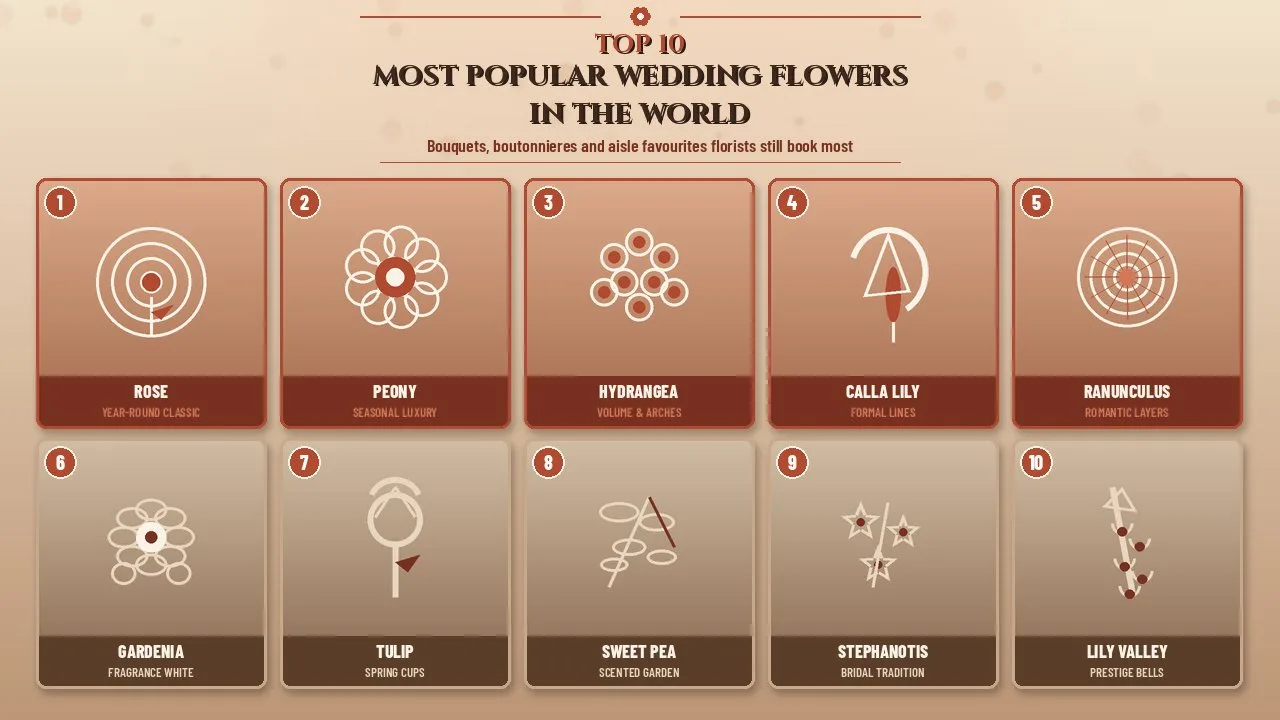
The most popular wedding flowers shape bouquets, boutonnieres and aisle décor worldwide, from roses and peonies to callas and lily of the valley.
Couples and florists do not choose blooms only for colour. They weigh season, stem strength, fragrance, symbolism and how a flower behaves under lights, travel and long ceremony hours. As of 2026, wholesale calendars, greenhouse supply and social-media trends still place the same classic names at the centre of bridal work, even when local wildflowers or dried stems fill supporting roles.
This list ranks ten flowers for wedding popularity: how often they appear in bridal bouquets, boutonnieres, corsages, centrepieces and ceremony structures. The order is original. Beauty alone is not the theme; Finepedia already covers that angle elsewhere. Here the question is what florists and couples reach for most when the day must look intentional from first photo to last dance.
Most Popular Wedding Flowers at a Glance
| Rank | Flower | Peak season | Typical wedding roles | Classic symbolism |
|---|---|---|---|---|
| 1 | Rose | Year-round (greenhouse) | Bouquets, boutonnieres, arches | Love, joy, beauty by colour |
| 2 | Peony | Late spring to early summer | Bridal bouquets, centrepieces | Good fortune, happy marriage |
| 3 | Hydrangea | Summer (plus forced supply) | Volume, arches, large centrepieces | Gratitude, understanding |
| 4 | Calla Lily | Year-round (imported/grown) | Formal bouquets, boutonnieres | Beauty, elegance |
| 5 | Ranunculus | Late winter to spring | Layered bouquets, boutonnieres | Charm, attraction |
| 6 | Gardenia | Warm months / greenhouse | Corsages, hair, small clusters | Purity, joy |
| 7 | Tulip | Spring (Dutch and greenhouse) | Fresh spring bouquets | Perfect love |
| 8 | Sweet Pea | Late spring to midsummer | Fragrant garden bouquets | Pleasure, lasting delight |
| 9 | Stephanotis | Warm season / greenhouse | Traditional bridal work | Marital happiness |
| 10 | Lily of the Valley | Spring (short natural window) | Prestige bouquets, sprigs | Happiness, return of spring |
How These Wedding Flowers Were Ranked
The ranking answers one question: which blooms stay most in demand for weddings when florists plan real orders. Four ideas shaped the order.
- Frequency in bridal and party flowers: how often the bloom appears as a hero or supporting stem in modern wedding design.
- Season and supply reliability: whether couples can book it for many calendar months without extreme scarcity.
- Versatility across formats: bouquets, boutonnieres, corsages, table work and ceremony structures.
- Cultural staying power: symbolism and tradition that keep the flower in briefs even when trends shift.
Price alone did not decide rank. Lily of the valley can cost more per stem than roses yet ranks lower because its natural window is short and many couples only request it for prestige looks. Local wildflowers and dried grasses matter in 2026 styling, but they rarely displace these ten names from the core shopping list.
1. Rose
| Attribute | Details |
|---|---|
| Botanical group | Rosa cultivars; hybrid tea, garden and spray types dominate weddings |
| Peak wedding use | Year-round via greenhouse and import supply |
| Common colours | Red, white, blush, cream, peach, yellow and dyed specials |
| Main roles | Bridal and bridesmaid bouquets, boutonnieres, corsages, arches |
| Why it ranks first | Unmatched global demand, colour range and year-round availability |
No other flower matches the rose for wedding ubiquity. Hybrid tea roses give classic long stems and high centres. Garden roses bring looser, romantic petals that suit soft bridal styles. Spray roses add clusters for texture without dominating a design. Together they cover almost every palette and formality level a couple might request.
Origins and History
Roses have been cultivated for thousands of years across Asia, Europe and the Middle East. Victorian floriography assigned colour meanings that still appear in wedding briefs: red for romantic love, white for purity or new beginnings, pink for gratitude and admiration, yellow for friendship when couples want a non-romantic accent. Those meanings are cultural shorthand, not botanical law, yet florists still hear them in consultations every week.
Modern wedding supply depends on industrial greenhouse production and air freight as much as on garden romance. Ecuador, Colombia, Kenya, the Netherlands and many regional growers feed the same colour families into wholesalers worldwide. That logistics backbone is why roses remain bookable for winter ballrooms and summer gardens alike.
Key Features
- Thousands of commercial cultivars across hybrid tea, garden and spray groups
- Strong stems that survive transport, wiring and long event hours when conditioned well
- Colour storytelling that couples already understand without a botany lesson
- Fragrance that ranges from almost none in some hybrid teas to rich perfume in garden types
- Compatibility with almost every other flower on this list in mixed designs
Significance
Roses rank first because popularity is a volume story. They are the default answer when a couple wants a flower that reads as wedding without explanation. Boutonnieres, mother corsages and bridal bouquets can all start from the same colour family, which simplifies planning and photography. Trends come and go; the rose remains the safe, flexible centre of professional wedding floristry as of 2026.
Interesting Facts
- Spray roses are often preferred for boutonnieres because smaller blooms sit neatly on a lapel.
- Garden roses photograph with softer petal edges that many couples prefer for romantic styles.
- Colour meaning is cultural: the same red rose can signal romance in one tradition and celebration in another.
- Thorn removal and hydration are routine prep steps that keep stems guest-safe and camera-ready.
- Roses pair cleanly with peonies, ranunculus and hydrangeas when a design needs both classic and trendy notes.
2. Peony
| Attribute | Details |
|---|---|
| Botanical group | Paeonia lactiflora and related garden peonies; tree peonies less common in cut work |
| Peak wedding use | Roughly April to June in the Northern Hemisphere; short natural window |
| Common colours | Blush, white, coral, deep pink and cream |
| Main roles | Hero bridal bouquets, lush centrepieces, statement aisle markers |
| Why it ranks high | Intense seasonal demand and strong social-media bridal association |
Peonies surged in wedding popularity because their full, cupped blooms look luxurious in photographs and feel generous in the hand. A few open stems can fill a bouquet that would otherwise need many smaller flowers. Couples who marry in late spring often build entire colour stories around blush or white peonies.
Origins and History
Peonies are native across temperate Asia, Europe and western North America. China has a long ornamental and symbolic history with the flower, and Indiana later named the peony its state flower. In Greek myth the plant name links to Paeon, a healer figure, which explains older herbal associations; modern wedding writing should treat those stories as folklore, not medical advice.
Cut-flower peonies travel from specialty growers and cold-chain wholesalers. Florists often buy them in tight bud and open them carefully so the wedding day catches peak bloom rather than shattered petals. The short season is part of the mystique and part of the planning risk.
Key Features
- Large, multi-petaled blooms that create instant volume
- Soft fragrance that supports romantic styling without overwhelming a room
- Excellent camera presence for bridal portraits
- Limited natural season that drives advance booking
- Good companions for garden roses, ranunculus and sweet peas
Significance
Peonies rank second because popularity in weddings is seasonal but intense. When they are available, they often displace other soft blooms as the first request on a mood board. Outside peak months, couples may accept garden roses or ranunculus as stand-ins, which itself proves how central the peony look has become to contemporary bridal taste.
Interesting Facts
- Ants on garden peony buds are a garden myth in cut-flower prep; commercial stems arrive clean for design work.
- Tight buds can open over one or two days with warm water and careful conditioning.
- Coral and deep pink cultivars photograph differently under tungsten versus daylight, so lighting tests matter.
- Tree peonies are beautiful shrubs but less common as standard cut wedding stems than herbaceous types.
- Many florists warn couples early if the wedding date sits outside reliable peony weeks.
3. Hydrangea
| Attribute | Details |
|---|---|
| Botanical group | Hydrangea macrophylla and related cut types |
| Peak wedding use | Summer peak; greenhouse and dyed stems extend the calendar |
| Common colours | White, green, pink, blue and antique tones |
| Main roles | Volume filler, arches, hanging installations, large table pieces |
| Why it ranks high | One stem covers space that many small blooms cannot |
Hydrangeas win on coverage. A single mophead can replace a handful of smaller flowers in an arch or urn, which matters when budgets and labour hours are tight. White and green hydrangeas especially appear in large ceremony structures and in foam-free designs that need mass without endless wiring.
Origins and History
Hydrangeas are woody plants with major ornamental centres in East Asia and the Americas. Gardeners know that blue versus pink mopheads can shift with soil chemistry, a fact that also shows up in wholesale colour lots. Cut stems need aggressive hydration; thirsty hydrangeas wilt dramatically and then recover when properly conditioned, which is why experienced wedding teams dunk and watch them early.
Contemporary designers use hydrangeas both as soft clouds of colour and as structural bases under roses or peonies. That dual role keeps them on order sheets even when the hero flower is something else.
Key Features
- Large flower heads that create quick visual mass
- Colour range from crisp white to vintage greens and blues
- Useful as a base layer under premium focal blooms
- Sensitivity to water stress that rewards careful conditioning
- Strong presence in arches, chuppahs and backdrop walls
Significance
Hydrangeas rank third for practical popularity. They are not always the emotional favourite on a Pinterest board, but they are among the stems florists actually buy in bulk for wedding scale. When a couple wants a flower-heavy aisle or a full floral wall, hydrangeas often carry the volume that makes the design possible.
Interesting Facts
- Floating hydrangea heads in water bowls is a classic reception trick when full stems are limited.
- Antique and green varieties hide their age better under evening lights than bright dyed blues sometimes do.
- Some designers split heads to weave smaller florets into boutonnieres when the palette must match.
- Foam-free mechanics still rely on hydrangeas because the heads hide chicken wire and branches well.
- Colour lots can vary between farms, so sample stems before locking a precise blue or lavender brief.
4. Calla Lily
| Attribute | Details |
|---|---|
| Botanical note | Zantedeschia; calla lily is the common wedding name, not a true Lilium |
| Peak wedding use | Year-round through specialty growers |
| Common colours | White, ivory, yellow, orange, pink, plum and near-black |
| Main roles | Sleek bridal bouquets, tall centrepieces, modern boutonnieres |
| Why it ranks high | Instant formality and clean architectural lines |
Calla lilies read as formal even in small numbers. The spathe wraps around a central spadix in a trumpet shape that photographs as a single decisive line. Mini callas suit boutonnieres and compact bouquets; larger stems build dramatic cascades or tall table work.
Origins and History
Zantedeschia species are native to southern Africa and entered Western ornamental trade as greenhouse specialties. The common name calla comes from Greek associations with beauty, which matches how wedding stylists still sell the bloom: elegant, minimal and intentional. Unlike many garden flowers, callas are chosen as much for silhouette as for colour.
In mid-century and contemporary formal weddings alike, white callas signal a clean, modern classic look. Coloured cultivars later opened the flower to sunset palettes and moody evening designs without losing that architectural identity.
Key Features
- Distinct trumpet silhouette that needs few stems to look complete
- Long, smooth stems suited to hand-tied and cascading forms
- Mini and standard sizes for different wedding roles
- Strong colour options beyond classic ivory
- Relatively low petal shatter compared with fuller blooms when handled well
Significance
Callas rank fourth because they remain a default for formal and modern briefs. Couples who dislike fluffy garden styles often land on callas as the alternative that still feels unmistakably bridal. Florists value them for clarity: a calla bouquet does not need many supporting characters to look finished.
Interesting Facts
- Despite the name, callas are arums (Zantedeschia), not true lilies of the genus Lilium.
- Sap can irritate skin; designers usually wear gloves during heavy conditioning.
- Mini callas are popular for groomsmen because they sit flat and graphic on a suit.
- Ivory callas under warm reception lighting can shift toward cream in photographs.
- Pairing callas with orchids or simple greenery keeps the modern line intact.
5. Ranunculus
| Attribute | Details |
|---|---|
| Botanical group | Ranunculus asiaticus and related cut cultivars |
| Peak wedding use | Cool-season peak from late winter through spring |
| Common colours | Cream, blush, peach, coral, yellow, white and deep jewel tones |
| Main roles | Layered romantic bouquets, boutonnieres, delicate centrepieces |
| Why it ranks high | Trendy petal density at a friendlier price than peonies |
Ranunculus flowers look like miniature peonies or roses with tightly packed, paper-thin petals. That texture made them a favourite for soft, editorial bridal bouquets in the 2010s and 2020s. Couples who cannot book peonies often find ranunculus delivers a similar romantic density for part of the year.
Origins and History
Persian buttercup types moved from Mediterranean and western Asian gardens into commercial cut production. Dutch and other specialty growers now supply a wide colour range for cooler months. The flower's Victorian-leaning symbolism of charm still appears in florist copy, but modern demand is driven more by how the bloom photographs than by floriography.
Because stems are thinner than roses, designers often cluster ranunculus rather than rely on single hero blooms. That clustering habit suits today's garden-style bouquets.
Key Features
- Dense, spiral petal layers with a soft, almost tissue-paper look
- Excellent colour range for sunset and pastel palettes
- Works in both bridal bouquets and small personal flowers
- Cool-season availability that complements spring tulip weddings
- Generally more accessible pricing than peonies in many markets
Significance
Ranunculus ranks fifth as the contemporary workhorse of romantic styling. It bridges classic rose designs and peony-season luxury when the calendar or budget demands a middle path. As of 2026 it remains one of the first flowers junior designers learn to love for bridal work.
Interesting Facts
- Closed buds continue opening after design if stems are well hydrated.
- Hanoi and similar series names help wholesalers sort petal form and colour intensity.
- The thin stems bruise easily, so bunches need gentle handling in transit.
- Pairing ranunculus with sweet peas amplifies fragrance and garden texture.
- Deep jewel tones can dominate photos; many bridal briefs stay in cream-to-coral ranges.
6. Gardenia
| Attribute | Details |
|---|---|
| Botanical group | Gardenia jasminoides and related fragrant cultivars |
| Peak wedding use | Warm months and greenhouse supply; sensitive to bruising |
| Common colours | White to cream with glossy dark foliage |
| Main roles | Corsages, hair flowers, boutonniere accents, small clustered bouquets |
| Why it ranks here | Fragrance and classic white form still define formal personal flowers |
Gardenias are less about big bouquet volume and more about scent and polish. A few waxy white blooms can perfume a corsage or hair pin in a way few other wedding flowers match. That makes them enduringly popular for mothers' flowers, groom accents and intimate ceremonies even when larger designs use other white blooms.
Origins and History
Gardenias are evergreen shrubs with native ranges across parts of Africa, Asia and the Pacific. They entered Western ornamental culture as prized greenhouse plants. In wedding tradition they became a shorthand for elegant white fragrance, especially in mid-twentieth-century corsage culture that still influences formal events.
The blooms bruise and brown if handled roughly or left without humidity, which is why many florists treat gardenias as last-minute personal flowers rather than all-day arch material.
Key Features
- Intense sweet fragrance that defines the guest experience up close
- Creamy white petals against shiny green leaves
- Ideal scale for corsages, hair and compact bouquets
- Sensitivity to browning that rewards cool, careful handling
- Strong association with formal and vintage-inspired weddings
Significance
Gardenias rank sixth because popularity here is specialised but persistent. They may not fill an entire reception the way hydrangeas do, yet they remain a top request whenever fragrance and classic white personal flowers matter. That niche demand keeps them on the global wedding flower shortlist.
Interesting Facts
- Florists sometimes float gardenia blooms in shallow water to reduce handling stress.
- The scent can be overwhelming in small closed rooms; a few stems often suffice.
- Leaves are part of the design language; stripping them changes the look completely.
- Gardenias pair with stephanotis and roses in traditional white bridal schemes.
- Humidity packs and refrigeration timing are as important as the design itself.
7. Tulip
| Attribute | Details |
|---|---|
| Botanical group | Tulipa hybrids; French and single-stem types common in weddings |
| Peak wedding use | Spring peak; greenhouse tulips extend availability |
| Common colours | Almost every bridal palette, including white, pink, purple and bi-colours |
| Main roles | Fresh spring bouquets, modern centrepieces, simple hand-ties |
| Why it ranks here | Huge spring demand and clean, recognisable form |
Tulips bring spring energy into wedding design. Their cups open and move after arranging, which means a morning bouquet can look softer by evening. Couples marrying in March through May often ask for tulips before any other seasonal stem.
Origins and History
Tulips are strongly linked to Central Asia and to the Netherlands' later bulb industry, including the famous seventeenth-century speculative boom. For weddings, that history matters less than the modern fact of massive, colour-accurate spring supply. Dutch auctions and regional greenhouses still set much of the colour availability couples see in consultations.
Symbolism of perfect or deep love appears in popular flower guides and suits romantic spring ceremonies, though most couples choose tulips for colour and freshness rather than coded meaning.
Key Features
- Clean cup shape that reads clearly in photos
- Wide colour assortment for monochrome or mixed palettes
- Stems that continue to grow and curve after arranging
- Strong association with spring garden weddings
- Works alone in modern designs or mixed with ranunculus and sweet peas
Significance
Tulips rank seventh because their popularity is seasonal yet enormous. In peak weeks they can outsell many year-round flowers in wedding coolers. Outside spring, greenhouse stems still appear, but the cultural wedding moment for tulips remains the fresh spring celebration.
Interesting Facts
- Designers often cut tulips under water and use tall vessels because stems keep elongating.
- French tulips with longer stems suit cascading and contemporary forms.
- Petals can open fully in warm ceremony spaces, changing the silhouette by vows.
- Parrot and double tulips add drama but need more careful transport.
- Simple all-tulip bouquets photograph as modern even without expensive accents.
8. Sweet Pea
| Attribute | Details |
|---|---|
| Botanical group | Lathyrus odoratus climbing annuals and related cut strains |
| Peak wedding use | Late spring into midsummer for fragrant garden looks |
| Common colours | Soft pinks, lavenders, whites, corals and bi-colours |
| Main roles | Fragrant accents, garden-style bouquets, loose centrepieces |
| Why it ranks here | Scent and romantic movement that couples specifically request |
Sweet peas are the fragrance specialists of garden wedding design. Ruffled blooms on climbing stems add motion and perfume that stiff greenhouse roses cannot copy. They rarely carry an entire large installation alone, but they elevate bouquets whenever a couple asks for a garden that smells like a garden.
Origins and History
Sweet peas are associated with Sicily and Mediterranean cultivation before intensive British and later global breeding for colour and scent. Perfume houses have long borrowed the name and mood; wedding florists borrow the actual cut stems when the season allows. Modern breeding balances scent with stem length and shipping toughness, though the most fragrant types can still be delicate.
In floriography, sweet peas often stand for pleasure or lasting delight, a soft message that fits celebratory rather than solemn wedding tones.
Key Features
- Distinctive fragrance that guests notice without being told
- Ruffled petals and vine-like movement in hand-tied bouquets
- Pastel and jewel colour options for romantic palettes
- Best as accent or co-hero rather than sole structural flower
- Seasonal charm that signals garden intimacy
Significance
Sweet peas rank eighth because their popularity is qualitative. Couples who discover them often refuse to drop them from the brief. They may not match rose volume globally, yet in garden, vineyard and backyard weddings they are among the most requested scent flowers as of 2026.
Interesting Facts
- Many highly scented strains have shorter vase life, so same-day design is common.
- Climbing habit means stems arrive with tendrils that designers may keep for wild texture.
- Soft colours bruise if packed too tightly in cooler boxes.
- Pairing with garden roses and ranunculus is a standard romantic recipe.
- Some guests with fragrance sensitivity prefer lightly scented cultivars; ask before heavy use near dining seats.
9. Stephanotis
| Attribute | Details |
|---|---|
| Common names | Stephanotis, Madagascar jasmine |
| Peak wedding use | Warm season and greenhouse flowering; traditional bridal staple |
| Common colours | White, waxy star-shaped blooms |
| Main roles | Classic bridal bouquets, wired sprays, veil and hair accents |
| Why it ranks here | Long tradition of marital symbolism and white bridal formality |
Stephanotis is a vine flower with thick, waxy white stars and a sweet scent. It rarely headlines modern editorial shoots the way peonies do, yet it remains deeply popular in traditional bridal work where white, fragrance and marital symbolism still guide the order.
Origins and History
Stephanotis floribunda is linked to Madagascar and related warm regions and is often grown under glass for cut and potted supply. English-language wedding culture nicknamed it a flower of marital happiness, which kept it in etiquette books and florist training long after other vines faded from fashion.
Because blooms are individually small, designers wire or cluster them into sprays. That labour-intensive method is part of why stephanotis feels special in a bouquet even when the stem count looks modest on an invoice.
Key Features
- Waxy white star flowers with lasting shape
- Sweet fragrance suited to intimate bridal moments
- Strong traditional association with marriage happiness
- Needs wiring or clustering for bouquet scale
- Pairs naturally with gardenias, roses and lily of the valley
Significance
Stephanotis ranks ninth for heritage popularity. It may not dominate Instagram grids in 2026, but it still appears whenever couples or families ask for classic white bridal flowers with meaning. Florists who serve traditional ceremonies keep it in their core vocabulary for that reason.
Interesting Facts
- Individual florets are often wired so they face outward in a bouquet.
- The plant likes consistent warmth; cool stress can reduce flowering in production.
- Scent is noticeable up close but usually gentler than gardenia in enclosed rooms.
- Madagascar jasmine is a common retail name on plant tags and wholesale lists.
- Combining stephanotis with orange blossom traditions appears in some classic European bridal styling histories.
10. Lily of the Valley
| Attribute | Details |
|---|---|
| Botanical name | Convallaria majalis |
| Peak wedding use | Short spring window; forced stems extend limited supply |
| Common colours | White bell sprays (pink forms exist but are rarer in weddings) |
| Main roles | Prestige bridal bouquets, royal-inspired sprigs, delicate accents |
| Safety note | Toxic if eaten; keep away from curious pets and unsupervised children |
Lily of the valley is the prestige spring wedding flower. Tiny white bells on slender stems photograph as quiet luxury, and royal bridal history keeps the bloom in the public imagination. It ranks tenth on this popularity list not because demand is weak, but because supply is scarce, stems are costly, and many couples only request it for heirloom or high-budget looks.
Origins and History
Convallaria majalis is native to cooler parts of Europe and Asia and naturalises in shaded gardens. It became a European bridal favourite for its delicate bells and association with the return of happiness in spring. Famous royal bouquets helped cement the modern prestige image.
Important safety note for wedding teams and guests: lily of the valley is toxic if ingested. Older popular articles sometimes repeated unverified healing claims; those claims do not belong in wedding guidance. Florists should treat the plant as ornamental only and keep fallen florets away from food surfaces and pets.
Key Features
- Small, fragrant white bells on arching stems
- Extremely strong association with classic and royal bridal style
- Short natural season and high per-stem cost
- Best used sparingly as a hero accent or full miniature bouquet
- Requires careful handling because stems and florets are delicate
Significance
Lily of the valley closes the list as a high-desire, low-volume wedding flower. When couples can get it, it often becomes the emotional centre of the bridal bouquet. When they cannot, they may choose stephanotis, gardenia or white sweet peas as softer substitutes. Popularity here is measured in how often it is requested relative to how rarely it can be supplied at scale.
Interesting Facts
- Forced greenhouse stems help some spring weddings outside the brief wild bloom window.
- A full bouquet can require large stem counts because each spray is small.
- Fragrance is sweet and noticeable in close portraits.
- Designers often cage or tightly bind stems to protect the bells during the processional.
- Never present the plant as medicine; toxicity makes that both inaccurate and unsafe.
Seasonality and Florist Practice as of 2026
| Flower | Planning tip for couples |
|---|---|
| Rose | Book colour early; nearly always available if the palette is flexible. |
| Peony | Confirm the wedding week against local peak; have a rose or ranunculus backup. |
| Hydrangea | Plan water and shade logistics for outdoor summer ceremonies. |
| Calla Lily | Decide mini versus standard size when approving boutonniere samples. |
| Ranunculus | Best for cool-season dates; ask for colour lots from the same farm when possible. |
| Gardenia | Schedule personal flowers late in the prep timeline to limit browning. |
| Tulip | Expect movement and opening during the day; photograph early if a closed cup is desired. |
| Sweet Pea | Prioritise scent samples if guests are fragrance-sensitive at dinner tables. |
| Stephanotis | Budget labour time for wiring if you want a full traditional look. |
| Lily of the Valley | Reserve early, accept substitutes if supply fails, and brief staff on toxicity. |
As of 2026, many studios mix these classics with local seasonal branches, herbs and dried elements. The ten flowers above still form the commercial core of wedding popularity because wholesalers, greenhouse calendars and client mood boards keep reinforcing the same names.
Frequently Asked Questions
What are the most popular wedding flowers for a classic white bouquet?
Roses, gardenias, stephanotis, calla lilies and lily of the valley are the usual white-forward choices. Peonies and ranunculus in cream also appear when the season allows. The final mix depends on season, budget and whether you want fragrance, architecture or soft garden texture as the main effect.
Which wedding flowers are available year-round?
Roses and many calla lilies have the most reliable year-round wholesale supply. Hydrangeas and gardenias appear more often in warm months but can be forced or imported. Peonies, tulips, sweet peas and lily of the valley remain more seasonal even with greenhouse help.
Are peonies always better than roses for a bridal bouquet?
Not always. Peonies offer lush seasonal volume, but roses give wider colour control and dependable supply. Many 2026 designs combine both when the calendar allows, or use garden roses and ranunculus when peonies are out of peak.
Is lily of the valley safe around children and pets at a wedding?
Treat it as toxic if eaten. Keep bouquets and fallen florets away from dessert tables, toddler reach and pets. Ask your florist for secure mechanics and clear breakdown instructions so decorative use stays ornamental only.
What flowers work best for boutonnieres?
Spray roses, mini callas, ranunculus buds, stephanotis florets and small gardenia blooms are common because they stay neat on a lapel. Avoid oversized hydrangea heads unless they are broken into tiny florets and firmly wired.
How far in advance should couples lock flower choices?
For peak-season peonies or lily of the valley, decide as soon as the date and florist are set. For roses and callas, colour and stem counts can often flex later, but major arches still need early quantity planning for labour and sourcing.
Can fragrant flowers like gardenia and sweet pea overpower a reception?
Yes, in small rooms or when placed beside every place setting. Use fragrance as an accent near the couple and entry moments, and keep dining tables lighter if guests are sensitive. Your florist can balance scented and unscented stems in the same palette.
Conclusion
The most popular wedding flowers succeed because they solve real planning problems: colour, season, symbolism, scent and camera-ready form. Roses lead for global versatility, peonies and ranunculus drive romantic seasonal demand, hydrangeas build volume, and callas deliver modern formality. Gardenias, tulips, sweet peas, stephanotis and lily of the valley round out the list with fragrance, spring freshness and bridal tradition. Choose for the date you have, not only for the mood board you saved, and the flowers will still feel intentional when the last dance ends.
- Specialty cut-flower grower and wholesaler seasonality guidance for roses, peonies, hydrangeas, callas, ranunculus, tulips and related wedding crops (industry practice as of 2026).
- Botanical identity references for Rosa, Paeonia, Hydrangea, Zantedeschia (calla), Ranunculus, Gardenia, Tulipa, Lathyrus odoratus, Stephanotis floribunda and Convallaria majalis.
- Poison control and horticultural safety summaries noting Convallaria majalis (lily of the valley) toxicity if ingested; ornamental use only.
- Cultural floriography overviews for commonly cited wedding meanings (love, purity, happiness, marital fortune), treated as tradition rather than scientific fact.
- Reference topic awareness only: 10MostToday, "10 Most Popular Wedding Flowers in the World" (original ranking, structure and wording throughout; healing claims for lily of the valley rejected).

















Log in with