








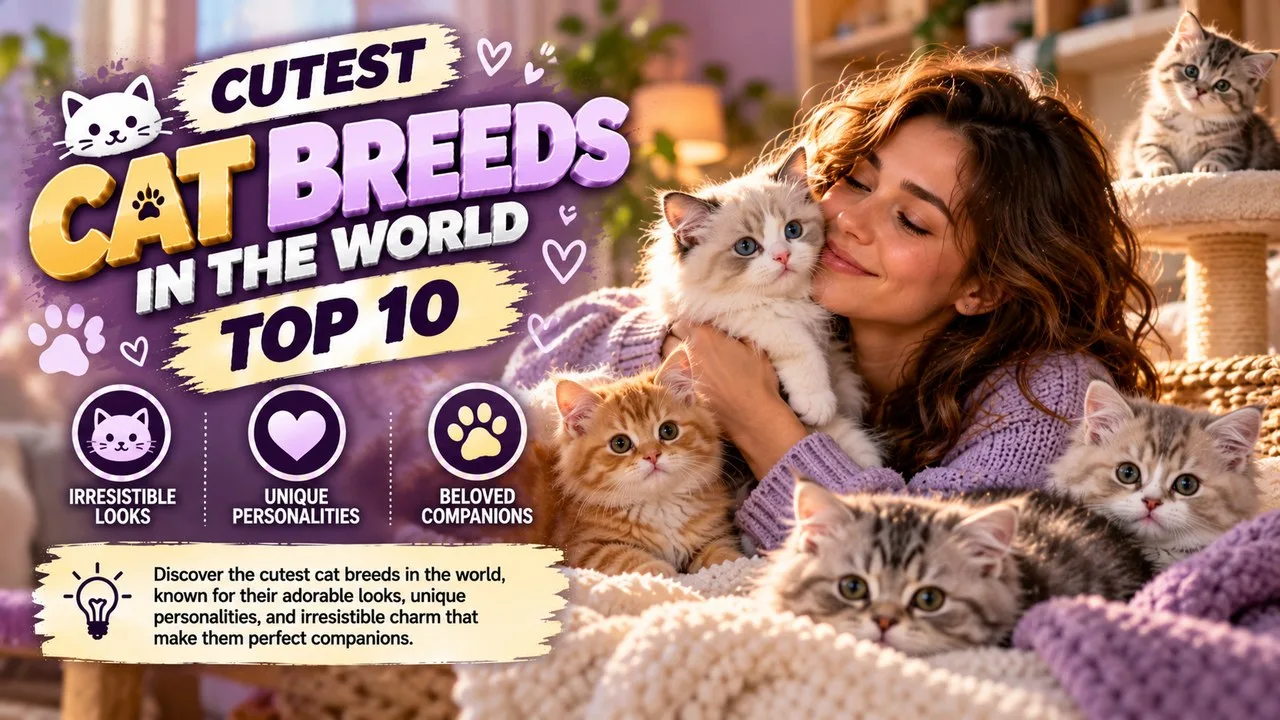
The cutest cat breeds in the world, led by the Exotic Shorthair, Persian and Ragdoll, earn Finepedia ranks on a transparent five-trait cuteness scorecard. Cute is not a scientific unit, but it is not pure guesswork either. Psychologists who study baby schema, or Kindchenschema, note that round faces, large eyes relative to the head, soft outlines and slightly exaggerated features tend to trigger caretaking attention in people. Cat breeds differ sharply in how strongly they show those cues. Some look like living plush toys. Others look majestic, athletic or exotic in ways that are striking without being doll-like. This Finepedia listicle, written as of October 2026, ranks ten recognised breeds with a published scorecard rather than a string of personal opinions. The reference topic that prompted the article listed ten favourites with short blurbs and no method. Finepedia replaces that approach with five observable factors, dual-sourced breed facts from the Cat Fanciers' Association (CFA), The International Cat Association (TICA) and veterinary genetics notes where health is part of the story, and a clear place for breeds that almost made the cut.
The list is meant for curious readers and thoughtful adopters, not as a shopping order you must follow. A healthy mixed-breed cat with round eyes can out-cute a poorly bred show cat on any day of the week.
Readers who already enjoy Finepedia's animal lists may also like general knowledge facts about cats, the most playful dog breeds, the most hilarious dog breeds and affordable dog breeds. Pets and cities collide in America's most pet-friendly cities, while animals with extreme hearing shows how far mammalian senses can go.
How We Ranked the Cutest Cat Breeds
Every breed on the shortlist received a Finepedia cuteness score out of 25. The score is an editorial tool for transparent ranking. It is not a veterinary diagnosis, a show-ring score or a claim that one cat is objectively more lovable than another.
| Factor | Max | What it measures |
|---|---|---|
| Neoteny / baby-face cues | 5 | Round head, short muzzle and large eyes relative to the face (classic Kindchenschema signals) |
| Distinctive coat or ear/face features | 5 | Soft fluff, folds, curls, points, gloves or other features that people commonly read as cute |
| Eye size and colour appeal | 5 | Large, vivid or highly expressive eyes called out in breed standards |
| Size and proportion cuteness | 5 | Compact, fluffy or doll-like proportions rather than purely athletic or imposing ones |
| Popular recognition / cultural fame | 5 | CFA 2024 registration Top 10 (published 2025) plus widely reported cultural fame |
Entry preference went to breeds recognised by CFA, TICA or the Governing Council of the Cat Fancy (GCCF), so origin and standard facts can be checked. Ties were broken first by the neoteny score, then by distinctive features, then by a better (lower-number) place in CFA's 2024 registration ranking. Individual cats still vary with genetics, health and care. Two welfare notes are required and appear in the relevant entries: the Scottish Fold fold gene is linked to osteochondrodysplasia, and the Munchkin's short legs remain debated among registries and veterinary bodies.
Cutest Cat Breeds at a Glance
| # | Breed | Score /25 | Signature cute cue | CFA 2024 pop. rank |
|---|---|---|---|---|
| 1 | Exotic Shorthair | 24 | Persian face on a plush teddy coat | #4 |
| 2 | Persian | 23 | Round face, huge eyes, cloud of fur | #3 |
| 3 | Ragdoll | 23 | Blue eyes, points and a doll-soft look | #2 |
| 4 | Scottish Fold | 22 | Forward-folded ears and owl-round face | Outside Top 10 |
| 5 | Birman | 21 | Blue eyes plus white gloves | Outside Top 10 |
| 6 | British Shorthair | 20 | Teddy-bear roundness, especially blue | #7 |
| 7 | Devon Rex | 20 | Pixie face, huge ears, wavy coat | #5 |
| 8 | Singapura | 19 | Tiny frame with oversized eyes | Outside Top 10 |
| 9 | American Curl | 19 | Ears that curl gently backward | Outside Top 10 |
| 10 | Maine Coon | 18 | Lynx tips, ruff and gentle-giant fluff | #1 |
1. Exotic Shorthair
| Attribute | Details |
|---|---|
| Origin and recognition | United States; short-haired Persian type; CFA championship breed |
| Size | Medium to large; cobby, low-on-the-legs build shared with the Persian |
| Coat | Dense, plush, soft medium-length coat with a thick undercoat |
| Cuteness score | 24 of 25 (neoteny 5, distinctive features 4, eyes 5, proportion 5, fame 5) |
| Signature look | Round head and large round eyes on a living teddy-bear silhouette |
Origins and History
The Exotic Shorthair was developed as a short-haired version of the Persian. Breeders wanted the Persian's round head, sweet expression and calm manners without the daily grooming load of a floor-length coat. The result kept the cobby body and baby-faced head while swapping the flowing coat for a dense, plush medium coat.
Early programmes crossed Persians to American Shorthairs and then bred back toward Persian type, which is why today's Exotics share a show standard so closely with Persians that only coat length truly separates them at a glance. In excellent coat an Exotic can look like a stuffed animal that stood up and walked to the food bowl.
CFA's 2025 countdown of pedigreed breeds, based on calendar-year 2024 registrations, places the Exotic fourth overall and nicknames it the plush teddy bear of the feline world. That combination of registry popularity and an explicitly teddy-like silhouette is why the breed leads this cuteness list.
Key Features
- Large, round, brilliantly coloured eyes set far apart for a sweet expression
- Small, rounded ears set low on a massive round head
- Short, snub nose with a break between the eyes, matching Persian type
- Dense plush coat that stands away from the body because of a rich undercoat
- Cobby, low, broad body with short strong legs and a short tail
Care and Personality
Exotics are typically calm, affectionate and content as indoor companions. They enjoy play in short bursts and long naps afterward. The coat needs regular combing to manage the thick undercoat, but far less intensive daily work than a full Persian coat. As with Persians, responsible breeders screen for breed-associated issues and select for open nostrils and sound breathing.
Interesting Facts
- CFA marketing for the 2025 popularity list literally calls the Exotic a plush teddy bear.
- In CFA registration statistics for 2024 the Exotic sat just behind the Persian and ahead of the Devon Rex.
- The same head type that reads as cute also demands ethical breeding focused on health, not flatter faces.
- Pointed Exotics compete in CFA and can look like compact, plush cousins of colourpoint Persians.
2. Persian
| Attribute | Details |
|---|---|
| Origin and recognition | Longhaired breed with early European records from Persia; CFA cornerstone breed |
| Size | Medium to large; cobby, massive across shoulders and rump |
| Coat | Long, thick, glossy coat with immense ruff and full brush tail |
| Cuteness score | 23 of 25 (5+5+5+3+5); Neoteny edge over the Ragdoll in the tie-break |
| Signature look | Round face, huge round eyes and a cloud of soft fur |
Origins and History
Longhaired cats reached Western Europe in the seventeenth century. CFA's breed history notes the Italian traveller Pietro della Valle describing an impressive heavily coated cat from Persia in 1626, distinct from the Turkish Angora that arrived around the same era. Over centuries of selective breeding the modern show Persian developed the extreme round head, large eyes and short nose that dominate today's cuteness image, while traditional or doll-faced lines keep a less extreme profile. In CFA's 2024 registration ranking the Persian placed third, just ahead of the Exotic. Martha Stewart's public fondness for Persians is one of many cultural signals that the breed remains a glamour icon as well as a lap cat.
Key Features
- Round head with full cheeks and large, round, level-set eyes
- Short, broad nose; CFA standard requires nostrils open enough for free breathing
- Immense ruff and long coat that stands off the body
- Short, thick legs and a short tail carried below the back line
- Many colour and pattern divisions, from solids to bi-colours and pointed Himalayan-type coats in some registries
Care and Personality
Persians are classic quiet companions. They prefer calm homes, gentle play and predictable routines. The trade-off for that cloud of fur is serious grooming: daily combing, eye-area cleaning for many individuals, and professional help for mats if brushing slips. Buyers should meet the breeder's adults, ask about breathing and tear staining, and prefer lines that balance type with comfort.
Interesting Facts
- CFA still treats the Persian as one of its flagship longhair breeds across multiple colour divisions.
- The Himalayan look (Persian type with Siamese-style points and blue eyes) is handled as a colourpoint Persian variety in some associations and as a separate breed in others.
- Despite the aristocratic image, Persians often enjoy short, silly play sessions with wand toys.
- Grooming training from kittenhood is half the secret of an easy adult Persian.
3. Ragdoll
| Attribute | Details |
|---|---|
| Origin and recognition | Riverside, California, 1960s (Ann Baker); CFA registration 1993, championship 2000 |
| Size | Medium to large; males may reach or exceed 20 pounds (about 9 kg) |
| Coat | Moderately long, silky, minimal undercoat; colourpoint with optional white patterns |
| Cuteness score | 23 of 25 (4+5+5+4+5) |
| Signature look | Vivid blue oval eyes on a pointed, plush, doll-soft body |
Origins and History
Ann Baker of Riverside, California, developed Ragdolls in the 1960s from domestic longhairs. The foundation queen Josephine was a white longhair carrying the colourpoint gene. Baker selected for a laid-back temperament and a striking pointed look. The breed name comes from early claims that the cats went limp when held, like a rag doll. CFA accepted the breed for registration in 1993 and advanced it to championship in 2000. Ragdolls held CFA's number-one registration spot for 2022 and 2023 before the Maine Coon took the 2024 crown. In the 2025 countdown they remain second, still among the world's most registered pedigreed cats.
Key Features
- Large, vivid blue oval eyes required by the CFA standard
- Colourpoint pattern (seal, blue, chocolate, lilac, red, cream and tortie/lynx variants) with colourpoint, mitted, bicolour and van patterns
- Soft semi-long coat with abundant guard hairs and little woolly undercoat
- Long rectangular body, heavy boning and a gentle expression
- Slow maturity: full colour around two to three years, full size often later
Care and Personality
CFA describes Ragdolls as docile, placid and affectionate. They usually greet people, follow their owners and accept handling well, which is why they suit families that want a soft, people-focused cat. Weekly or twice-weekly combing is usually enough because the coat lacks a heavy undercoat. Breeders commonly screen for hypertrophic cardiomyopathy. Portion control matters: Ragdolls often love food.
Interesting Facts
- All Ragdolls are pointed; white mittens or inverted facial Vs appear only in certain patterns.
- CFA notes that the limp-when-held trait is not typical of every modern Ragdoll, even though it inspired the name.
- Many Ragdolls can learn to fetch and come when called.
- Females are usually substantially smaller than males of the same lines.
4. Scottish Fold
| Attribute | Details |
|---|---|
| Origin and recognition | Tayside, Scotland, 1961; CFA recognised; not recognised as a breed in Scotland |
| Size | Medium; rounded body and short neck |
| Coat | Short or long; soft and dense; weekly combing typical |
| Cuteness score | 22 of 25 (5+5+5+4+3) |
| Signature look | Forward-folded ears on an owl-round face |
| Welfare note | Fold gene linked to osteochondrodysplasia (see Care) |
Origins and History
In 1961 shepherd William Ross noticed a white farm cat named Susie with folded ears in Scotland's Tayside region. Susie's daughter Snooks became the practical foundation of the breed. Folded-ear kittens are born with straight ears; the fold appears around three to four weeks of age. CFA recognises the Scottish Fold, and the breed is famous worldwide for its owl-like silhouette. TICA notes that Scotland itself does not recognise the Fold as a breed because of joint-health concerns. That tension between adorable appearance and cartilage genetics is why Finepedia ranks the Fold high for cuteness while insisting on a clear welfare note.
Key Features
- Ears fold forward and down, rounding the already round head
- Large, round, widely spaced eyes and a sweet, open expression
- Rounded body, paws and even ear tips in show preference
- Straight-eared siblings (Scottish Straights) occur in the same litters
- Both shorthair and longhair coats appear in the breed
Care and Personality
Folds are typically affectionate, quiet and people-oriented. Grooming is straightforward for shorthairs and only moderately heavier for longhairs. The serious care issue is genetic. The University of California, Davis, Veterinary Genetics Laboratory explains that a dominant TRPV4 mutation produces the folded ears and is associated with Scottish Fold osteochondrodysplasia, which can affect cartilage and bone. Cats with two copies of the mutation are at higher risk of severe problems. Ethical breeders never mate Fold to Fold, screen carefully, and educate buyers about monitoring mobility and pain. Anyone choosing this look should read current veterinary guidance, not only photo galleries.
Interesting Facts
- TICA popularised the breed's Buddha sit, where Folds sit upright like a prairie dog or small person.
- Pop star Taylor Swift's cats Meredith Grey and Olivia Benson are widely reported Scottish Folds and amplified the breed's cultural fame.
- Hearing is not reduced simply because the ears fold.
- About half the kittens in a typical Fold litter may develop folded ears, according to TICA's breed overview.
5. Birman
| Attribute | Details |
|---|---|
| Origin and recognition | France from Burmese imports ~1919; Sacred Cat of Burma; CFA recognised |
| Size | Medium to large; substantial boning |
| Coat | Silky medium-long coat without a heavy undercoat; colourpoint with white gloves |
| Cuteness score | 21 of 25 (4+5+5+4+3) |
| Signature look | Deep blue eyes and contrasting white gloves on every paw |
Origins and History
The Birman is steeped in temple legends, but the documented European foundation is more concrete. CFA records that a breeding pair was shipped from Burma to France around 1919; the female arrived pregnant and founded the French lines. The name comes from Birmanie, the French form of Burma. The breed later spread internationally as the Sacred Cat of Burma, prized for its colourpoints and white gloves.
Key Features
- Colourpoint coat with a pale body and darker face, legs and tail
- Pure white gloves on the front paws and laces on the back paws
- Striking deep blue eyes
- Broad, rounded head with a medium-length Roman nose
- Silky coat that mats less than many other longhairs because undercoat is limited
Care and Personality
Birmans are sweet, sociable and usually gentle with families. Weekly combing keeps the coat gleaming because there is little undercoat to mat. They take roughly three years to reach full maturity and substance, so a lanky adolescent may still grow into a heavier adult. Like other pointed cats, their colour contrast deepens with age and in cooler rooms.
They rarely need the marathon grooming sessions a Persian demands, which makes them a practical choice for people who want longhair elegance without a full-time brush routine. Provide climbing space and interactive toys; Birmans enjoy company and can look lonely if left without daily attention. Ask breeders about screening practices common in pointed breeds and meet at least one adult from the line before reserving a kitten.
Interesting Facts
- Only four solid point colours were originally recognised; tabby, red, cream and tortie points came later.
- The white gloves are a defining breed requirement, not optional markings.
- CFA highlights folk tales about temple cats even while acknowledging that real history is murkier than the legends.
- Birmans often bond closely with people without demanding constant athletic play.
- A well-kept Birman coat should feel silky rather than cotton-wool dense.
6. British Shorthair
| Attribute | Details |
|---|---|
| Origin and recognition | Britain; Crystal Palace-era show favourite; CFA recognised |
| Size | Medium to large; males may reach about 17 pounds (about 8 kg) |
| Coat | Short, dense, crisp plush coat |
| Cuteness score | 20 of 25 (5+3+4+4+4); Neoteny edge over Devon Rex |
| Signature look | Broad teddy-bear face, especially in the classic blue |
Origins and History
British Shorthairs descend from the sturdy landrace cats of Britain and became early stars of Victorian cat shows at London's Crystal Palace. Two world wars damaged breeding programmes, and Persians plus ordinary domestic cats were used to rebuild type. The modern breed is the stocky, plush-coated cat many people picture when they imagine a cartoon British blue with copper eyes. CFA's 2024 registration ranking places the British Shorthair seventh among pedigreed breeds, confirming that the teddy-bear look still sells.
Key Features
- Massive round head, full cheeks and a broad face
- Dense, resilient short coat that feels like plush upholstery
- Powerful, compact body with a broad chest
- Medium ears set wide apart so they do not spoil the round outline
- Many colours; the solid blue with copper eyes remains the cultural icon
Care and Personality
British Shorthairs are calm, quiet and people-tolerant without usually being clingy. They mature slowly, often not reaching full size until about three years of age. A weekly brush controls shedding from that dense coat; during seasonal moults a rubber curry or comb helps lift the dead undercoat. They suit apartments and families that want a solid, undramatic companion rather than a high-octane athlete.
Because the breed looks naturally stocky, owners should weigh cats regularly and keep treats modest so the teddy-bear outline does not become overweight. British Shorthairs usually accept other pets if introductions are gradual. They may not demand laps every evening, yet they often choose a favourite chair near their people and stay contentedly nearby.
Interesting Facts
- CFA notes males can grow as large as about 17 pounds while females stay smaller.
- The breed's chubby look should come from bone and coat, not overfeeding.
- British Longhairs share similar type with a longer coat and appear in some registries as a related breed.
- Their unflappable manner makes them frequent choices for first-time pedigreed-cat homes.
- The classic blue-with-copper-eyes look is only one of many accepted colours and patterns.
7. Devon Rex
| Attribute | Details |
|---|---|
| Origin and recognition | Devon, England, late 1950s; CFA recognised |
| Size | Medium, fine-boned, long-legged appearance |
| Coat | Short, soft, wavy or rippled rex coat; may feel sparse |
| Cuteness score | 20 of 25 (4+5+4+3+4) |
| Signature look | Huge low-set ears, big eyes and an elfin, pixie face |
Origins and History
The Devon Rex appeared in England in the late 1950s from a spontaneous curly-coated mutation. The breed standard celebrates an atypical head with large eyes and very large ears that sit low on the skull, creating an alert pixie or elf expression. CFA's 2025 popularity countdown ranks the Devon Rex fifth overall and calls it the most popular shorthair breed on that particular list.
Key Features
- Short wavy coat caused by the Devon rex gene
- Oversized ears and large eyes on a short wedge-shaped head
- Slender body with a broad chest and long toes
- Playful, mischievous expression that matches an active personality
- Coat density varies; some individuals look almost suede-soft
Care and Personality
Devon Rex cats are famous for clownish energy, heat-seeking laps and an urge to be involved in whatever their people are doing. The coat needs gentle handling rather than heavy brushing; a soft cloth or fingers often work better than a stiff brush. Because the coat offers less insulation, many Devons prefer warm indoor spots, heated beds and winter jumpers if their household runs cold. They usually want more interactive play than a Persian or British Shorthair.
Plan on puzzle feeders, wand toys and daily conversation. A bored Devon invents counter surfing. Nail trims and ear checks should be part of routine care, and baths are sometimes used before shows to fluff the wave pattern. Choose breeders who discuss heart screening and skin comfort, since sparse coats can show oil build-up more readily than dense coats.
Interesting Facts
- Devon Rex and Cornish Rex are separate mutations with different coat genetics and head types.
- CFA's 2024 registration data put the Devon Rex ahead of the Abyssinian and British Shorthair.
- Their large ears are part of the cuteness score as a distinctive facial feature, not a hearing claim.
- Many Devons enjoy shoulder-riding and high perches.
- CFA's popularity write-up for 2025 literally calls the breed an elfin charmer.
8. Singapura
| Attribute | Details |
|---|---|
| Origin and recognition | Singapore street cats refined in the US from 1975; CFA natural breed |
| Size | Smallest widely recognised CFA breed; males about 6–7 lb, females about 4–5 lb |
| Coat | Very short, close-lying ticked sepia agouti only |
| Cuteness score | 19 of 25 (4+3+5+5+2) |
| Signature look | Tiny muscular body with oversized eyes and ears |
Origins and History
Singapura is the Malay name for Singapore. CFA presents the breed as a natural type linked to Singapore's street cats and nicknamed Kucinta, the Love Cat, in its homeland. Americans Hal and Tommy Meadow returned to the United States in 1975 with five Singapuras; a sixth arrived in 1980. Later controversy about whether some foundation cats had earlier US ties was investigated by CFA, which retained the breed's natural-breed status.
Key Features
- Dramatic large eyes that may be hazel, green or yellow
- Large ears on a rounded medium-length head
- Sepia agouti ticked coat that appears to sparkle in sunlight
- Small but solid and muscular body, not fragile
- Blunt tail and an alert, curious expression
Care and Personality
Singapuras are affectionate, busy and sometimes bossy for their size. The tiny coat needs only light weekly combing. Their doll-like proportions drive a high size/proportion cuteness score, while limited registration numbers keep the fame score modest compared with Maine Coons or Ragdolls.
Expect a curious shadow that investigates cupboards and joins video calls. They thrive with climbing trees scaled to small bodies and with owners who enjoy conversation. Because breeders are relatively few, waiting lists are common; use that wait to visit a show or meet adults so the lively temperament is not a surprise. Keep them indoors or in secure outdoor enclosures, since a four-pound explorer is easy prey outdoors.
Interesting Facts
- CFA shows the breed in only one colour: sepia agouti.
- Males often weigh about 6 to 7 pounds; females may stay near 4 to 5 pounds.
- Despite the small frame, Singapuras are described as strong and muscular, not dainty weaklings.
- Their eye-to-face ratio is one of the strongest Kindchenschema signals on this list.
- In Singapore the nickname Kucinta means love cat, a marketing gift for any cuteness list.
9. American Curl
| Attribute | Details |
|---|---|
| Origin and recognition | Lakewood, California, 1981 (Shulamith); CFA recognised |
| Size | Medium; females about 5–8 lb, males about 7–10 lb |
| Coat | Shorthair or longhair; silky, minimal undercoat |
| Cuteness score | 19 of 25 (3+5+4+4+3) |
| Signature look | Ears that curl backward away from the face |
Origins and History
In 1981 a stray black kitten with unusual ears appeared on a doorstep in California. Named Shulamith, she became the foundation of the American Curl. Joe and Grace Ruga worked with CFA judges to write a standard for a graceful cat that resembled no existing breed. The curl is an autosomal dominant trait: one copy of the gene can produce the look.
Key Features
- Ears curl back from the face toward the centre of the skull
- Kittens are born with straight ears; curling begins in days and sets around 16 weeks
- Sweet, alert expression with a modified wedge head
- Silky coat in both longhair and shorthair, easy to groom
- Medium, elegant body rather than cobby Persian type
Care and Personality
Curls are energetic, affectionate and people-focused without the extreme flat face of Persian-type breeds. Ears must be handled gently when cleaned; work carefully away from the canal and never force a curled tip. Because the coat has little undercoat, brushing a few times a month usually suffices for both coat lengths. Degree of curl varies; not every kitten is show quality, and pet homes are happy with softer curls.
They keep a kitten-like playfulness well into adulthood and usually welcome guests. Provide vertical space and rotating toys. When comparing curly-eared breeds, remember that the American Curl's cartilage bend is not the same mutation as the Scottish Fold's forward fold, and responsible programmes keep those genetics separate.
Interesting Facts
- The ear set cannot be judged accurately until about sixteen weeks of age.
- Curled ears do not mean the breed hears better or worse than other cats.
- American Curls come in many colours and patterns.
- Crossing Curls to Folds is discouraged in veterinary discussions of stacking ear and cartilage mutations.
- Foundation cat Shulamith was a black stray whose unexpected ears launched an entire breed.
10. Maine Coon
| Attribute | Details |
|---|---|
| Origin and recognition | Maine, USA; official state cat; CFA #1 by 2024 registrations |
| Size | One of the largest domestic breeds; long, substantial body |
| Coat | Long, shaggy, water-resistant coat with ruff and bushy tail |
| Cuteness score | 18 of 25 (2+4+3+4+5) |
| Signature look | Lynx-like ear tufts, lion ruff and gentle-giant fluff |
Origins and History
The Maine Coon is a North American landrace refined in the state of Maine, where it is the official state cat. Harsh winters favoured a weatherproof coat, tufted ears and a sturdy frame. All major registries recognise the breed. CFA's countdown based on 2024 registrations crowned the Maine Coon the most popular pedigreed cat breed for 2025, ending the Ragdoll's recent streak at number one.
Key Features
- Large size with a rectangular body and heavy bone
- Lynx tipping on the ears and a long, flowing plume of a tail
- Shaggy, uneven coat that is shorter on the shoulders and longer on the britches and belly
- Sociable, often chirpy voice and dog-like follower habits
- Slow to mature; full grandeur may take three to five years
Care and Personality
Maine Coons earn the gentle giant label: imposing in photos, usually soft-mannered in the living room. They need space to climb, regular combing to prevent mats in the ruff and britches, and owners who enjoy an interactive, playful adult cat. Water dishes may become paw toys; many Maine Coons dabble more than other breeds.
Budget for a large litter box, sturdy scratching posts and a diet matched to a substantial frame. Ask about hip dysplasia and heart screening common in big breeds. Their cuteness score is lower on pure baby-face neoteny because the look is majestic rather than doll-like, but ear tufts, fluff and unmatched CFA fame keep them firmly in the Top 10.
Interesting Facts
- CFA registrations for 2024 placed the Maine Coon first, ahead of the Ragdoll and Persian.
- The breed is frequently described as dog-like for its willingness to play fetch and follow people from room to room.
- Polydactyl Maine Coons appear in some lines and have a separate TICA recognition path, but classic CFA show cats follow the standard foot.
- A well-bred Maine Coon should feel solid and balanced, not simply oversized.
Honourable Mentions
Several breeds scored well or appear on the 2019 reference list but did not make Finepedia's Top 10 under this scorecard.
| Breed | Why it is mentioned | Why it is not Top 10 here |
|---|---|---|
| Himalayan / Colourpoint Persian | Blue eyes, points and Persian fluff; on the reference list | Often a Persian colour division in CFA; scored as Persian-type rather than a separate tenth slot |
| Siberian | CFA #8; lush triple coat and sweet expression | More athletic forest-cat proportions; slightly lower neoteny than the teddy-bear breeds |
| Munchkin | On the reference list; doll-like short legs (TICA championship since 2003) | Not CFA-recognised; dwarfism welfare debates and breeding bans in some places |
| British Longhair | On the reference list; plush British type with long coat | Overlaps strongly with British Shorthair type; shorthair already represents the teddy look |
| Ragamuffin | Soft Ragdoll-related look and cuddly reputation | Lower global fame than Ragdoll; similar niche already covered |
| Norwegian Forest Cat | Tufted ears and dramatic ruff | Majestic climber look, not baby-schema cuteness |
| Selkirk Rex | Curly teddy coat | Smaller cultural footprint than Devon Rex on CFA rankings |
| Japanese Bobtail | Charming pom-pom tail and folklore fame | Elegant rather than round-faced cuteness |
| Sphynx | CFA #9; huge ears and wrinkled charm | Hairless look divides opinion; distinctive more than classically cute |
Welfare and Buying Notes
Cuteness lists can accidentally encourage unhealthy extremes. For Persian-type faces, prefer breeders who select for clear airways and comfortable eyes. For Scottish Folds, never support Fold-to-Fold matings, and ask for veterinary screening history. For Munchkins and other skeletal novelty breeds, read current registry and veterinary positions, including jurisdictions that discourage or ban breeding. Visit pet-friendly cities only after you have a healthy individual matched to your home, not the other way around.
Frequently Asked Questions
What is the cutest cat breed in the world?
On Finepedia's October 2026 scorecard the Exotic Shorthair ranks first with 24 of 25 points, thanks to Persian-style baby-face cues on a plush teddy-bear coat and strong CFA popularity. Cute remains partly subjective, so another home might prefer a Fold's ears or a Ragdoll's blue eyes.
Are Scottish Fold cats unhealthy?
The folded-ear gene is the same TRPV4 mutation linked to osteochondrodysplasia, a cartilage and bone disorder. Severity varies; cats with two copies are at higher risk. Ethical programmes breed Fold to straight-eared partners only and monitor joints. Scotland does not recognise the breed for these reasons.
Is a Himalayan different from a Persian?
A Himalayan combines Persian type with colourpoints and blue eyes from Siamese ancestry. Some registries list it separately; CFA treats colourpoint patterns within Persian divisions. Finepedia therefore covers the look under Persian and Honourable Mentions rather than as a second full Top 10 entry.
Which cute cat breeds need the least grooming?
Singapura, Devon Rex, American Curl shorthairs and British Shorthairs usually need only light weekly care. Ragdolls and Birmans need regular combing but lack heavy undercoats. Persians need the most daily coat work.
Why is the Maine Coon only tenth if it is CFA's most popular breed?
Popularity is only one of five cuteness factors. Maine Coons score maximum fame but lower neoteny because their look is majestic and lynx-like rather than round and doll-faced. They still clear the Top 10 on fluff, ear tufts and cultural presence.
Are Munchkin cats recognised everywhere?
TICA granted championship status in 2003. CFA does not recognise the Munchkin. Some countries and veterinary bodies discourage breeding dwarf cats. Finepedia therefore places Munchkins in Honourable Mentions with a welfare note rather than in the scored Top 10.
Do big eyes always mean a breed is cute?
Large eyes help, which is why Singapuras and Exotics score well on that factor, but cuteness on this list also needs head shape, coat or ear features, proportions and real-world recognition. An athletic cat with big eyes can look striking without ranking as a top cute breed.
Conclusion
The cutest cat breeds succeed when baby-face geometry, soft or surprising features and cultural fame line up. Finepedia's leaders — the Exotic Shorthair, Persian and Ragdoll — combine those cues with verifiable registry histories. Scottish Folds prove that the most meme-friendly look can carry genetic costs that buyers must face honestly. Whether you want a plush lap ornament or a gentle giant with lynx tips, use the scorecard as a map, then meet healthy individual cats before you fall for a photograph.
- Cat Fanciers' Association breed pages: Ragdoll, Persian, Exotic / popularity profile, Scottish Fold, British Shorthair, Birman, Maine Coon Cat, American Curl, Singapura, Devon Rex — https://cfa.org/
- CFA, Most Popular Breeds for 2025 (2024 registration year) — https://cfa.org/cat-talk/most-popular-breeds-for-2024/
- PR Newswire, Countdown of Cuteness: CFA Reveals the Top 10 Pedigree Cat Breeds for 2025 (21 March 2025)
- UC Davis Veterinary Genetics Laboratory, Scottish Fold (TRPV4) test information — https://vgl.ucdavis.edu/test/scottish-fold
- TICA, Scottish Fold breed page — https://tica.org/breed/scottish-fold/
- TICA, Munchkin breed page — https://tica.org/breed/munchkin/
- Takanosu et al., Osteochondrodysplasia in Scottish Fold cross-breed cats, Journal of Veterinary Medical Science / PMC7804039
- Encyclopaedia context and secondary corroboration via Britannica and Wikipedia summaries for origin narratives already stated by CFA (Persian, Ragdoll, Maine Coon, Singapura, Munchkin recognition debates)
- Topic prompt only (order and wording not reused): 10mosttoday, World's 10 Cutest Cat Breeds, 16 February 2019 — https://10mosttoday.com/worlds-10-cutest-cat-breeds/


















Log in with