









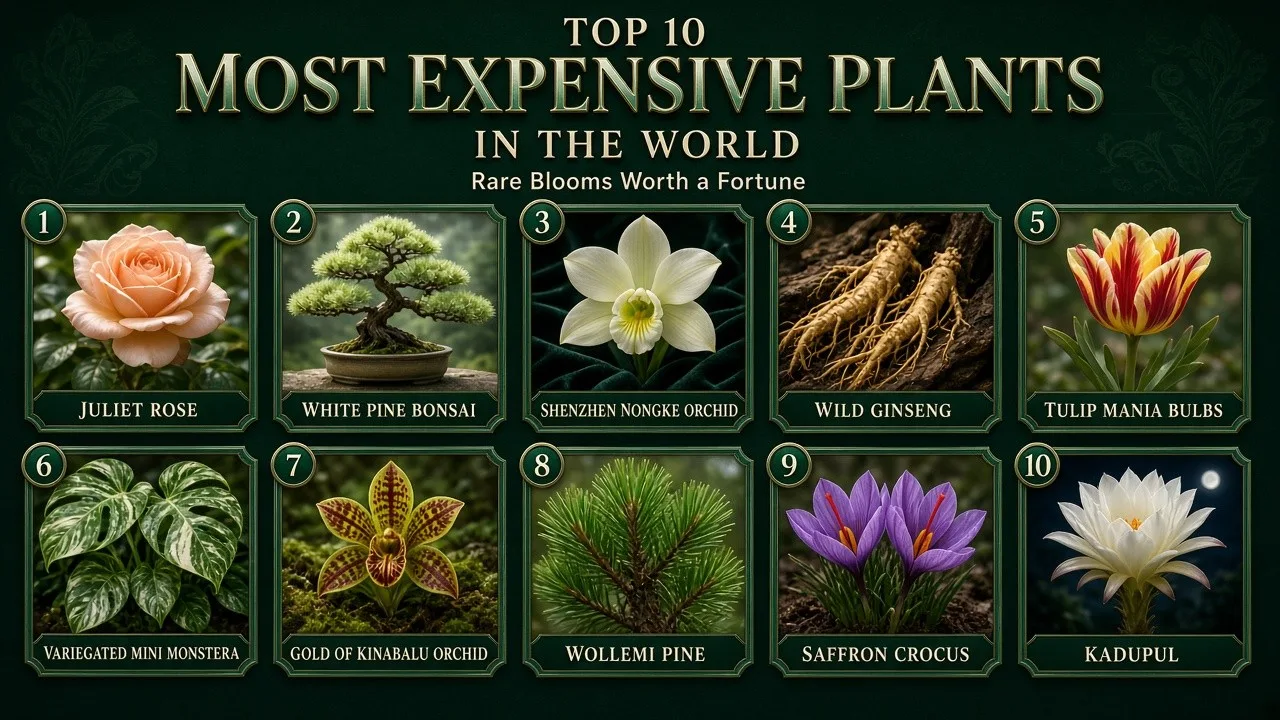
The most expensive plants in the world include a £3 million rose breeding project, a $1.3 million bonsai and orchids auctioned for about $200,000.
Most garden plants cost a few dollars. A small group breaks that rule completely. Some took more than a decade of careful breeding before the first commercial bloom appeared. Others changed hands at specialist auctions for six or seven figures. A few are so rare that international law forbids ordinary commercial trade, while one famous night bloom is traditionally treated as unsellable because it collapses before dawn.
This Finepedia guide ranks ten plants and plant products by meaningful, documented cost as of October 2026. The ranking mixes different kinds of money on purpose: breeding programme budgets, verified auction sales, historic bulb contracts, illicit collector prices reported by conservation sources, first-generation conservation auctions and spice yield economics. Cheap florist stems that sell for a few dollars apiece are left out. For each entry you will find a Quick Facts table, origins, key features, significance and a short list of interesting facts.
How We Ranked the Most Expensive Plants
There is no single global price list for rare plants. A laboratory orchid sold once at auction is not the same kind of cost as a rose that took fifteen years to breed, and a spice priced by the kilogram is not the same as a centuries-old bonsai. Treating every plant as if it had one retail sticker would mislead readers.
Four kinds of cost sit behind this list:
- Documented breeding or research investment, where the money was spent before the variety reached the market
- Verified auction or private-sale prices for individual specimens
- Historic contract prices for bulbs during speculative bubbles, converted carefully and treated as history rather than modern retail
- Ongoing rarity premiums, including black-market figures cited by conservation agencies and spice prices driven by labour-intensive harvest
Within that mix, the order follows the strongest documented money signal attached to a single plant or specimen, with the Juliet rose placed first because its £3 million budget is the largest verified sum tied to one variety. Collective totals, such as the full Wollemi pine auction, are noted but not used to lift an individual plant above a more expensive single specimen.
Where a widely repeated figure could not be traced to a credible sale or official report, it is left out or flagged. The $15.8 million figure sometimes attached to the Juliet rose is one of those discarded claims. The breeding budget of about £3 million is the figure used here instead.
Most Expensive Plants in the World at a Glance
| No. | Plant | Documented cost type | Headline figure | Region or origin |
|---|---|---|---|---|
| 1 | Juliet Rose | Breeding investment | About £3 million over ~15 years | England (David Austin) |
| 2 | Japanese white pine bonsai | Private sale at convention | About ¥100 million (~US$1.3 million, 2011) | Japan |
| 3 | Shenzhen Nongke orchid | Reported auction sale | About 1.68 million yuan (~US$200,000), 2005 | China |
| 4 | Wild mountain ginseng | Documented Korean sale | About 350 million won (~US$310,000) for four roots (avg ~US$77,000 per root), 2018 | South Korea |
| 5 | Tulip mania bulbs | Historic forward contracts | Thousands of guilders per rare bulb, 1636–37 | Dutch Republic |
| 6 | Variegated Rhaphidophora tetrasperma | Online auction record | NZ$27,100 (~US$19,300), 2021 | New Zealand sale; SE Asia native |
| 7 | Gold of Kinabalu orchid | Reported collector price | Up to about US$5,000 per plant | Mount Kinabalu, Malaysia |
| 8 | Wollemi pine | Conservation auction | Single trees ~A$2,000–A$7,000 (avg ~A$3,600), 2005 | Australia |
| 9 | Saffron crocus | Spice yield economics | Premium spice often US$1,100–$11,000 per kg | Iran, Kashmir, Mediterranean |
| 10 | Kadupul / Queen of the Night | Cultural unsellability | Bloom lasts one night; cut flower traditionally not sold | Widely cultivated tropical cactus |
1. Juliet Rose
| Attribute | Details |
|---|---|
| Breeder | David Austin Roses, Albrighton, England |
| Cultivar code | Ausjameson |
| Cost type | Breeding and development budget, not a one-off flower sale |
| Headline figure | About £3 million across roughly 12–15 years of work |
| Timeline | Work began in 1992; launched in 2004; showcased at the Chelsea Flower Show in 2006 |
Origins and History
David Austin built his reputation on English garden roses with cupped, many-petalled blooms. In the 1990s the nursery turned that programme toward cut roses that could survive the florist trade while keeping the old-rose look. Juliet, registered as Ausjameson, was among the first commercial successes of that cut-flower line. Contemporary British reporting around the Chelsea Flower Show described multi-year, multi-million-pound research behind the new series. Later trade coverage from the nursery and floristry press settled on the familiar shorthand of the £3 million rose and a breeding timeline of about fifteen years.
Juliet is an apricot-peach cupped rose with a light tea fragrance. It became a favourite for weddings and high-end events because the open bloom looks very different from standard hybrid-tea cut roses. When commercial stem production moved to Kenya, Juliet adapted well, while two of its launch sisters grew too fast in the warmer climate and lost flower size, according to the company at the time. That survival test is part of why Juliet, rather than its siblings, became the famous one.
Key Features
- Soft apricot to peach petal colour with a full, cupped rosette form
- Light tea fragrance rather than a heavy perfume
- Bred specifically as a cut rose for floristry, not only as a garden shrub
- High recognition by brand name among wedding and event florists
- Born from a programme that, in 2006, made more than 150,000 hand crosses a year and trialled seedlings for about nine years
Significance
Juliet matters on this list because the money is a verified development cost, not a mythical single-stem sale. Many viral lists claim the rose sold for tens of millions of dollars. That figure does not match contemporary reporting from the company or the British press. The honest story is still extreme: a commercial flower programme spent years and about £3 million before the variety became a bridal staple. As of 2026, stems are sold through florist channels at ordinary luxury cut-flower prices; the record belongs to the breeding investment, not to a bouquet.
Interesting Facts
- Juliet was part of an early Shakespeare-themed cut-rose set that also included names such as Olivia and Portia.
- In 2006 the breeding programme produced about 400,000 seeds a year from hand crosses, of which roughly 250,000 germinated.
- The rose is often requested by brand name, which is unusual in the commodity cut-flower trade.
- UK trade suppliers still list Juliet as sometimes known as the £3 million rose.
- David Austin, the founder, was 80 when the cut roses took centre stage at Chelsea in 2006 and was still involved in breeding.
2. Japanese White Pine Bonsai
| Attribute | Details |
|---|---|
| Species | Pinus parviflora (Japanese white pine / five-needle pine), grafted Miyajima type reported |
| Age cited | About 300 years |
| Sale setting | 11th Asia-Pacific Bonsai and Suiseki Convention, Takamatsu, Japan, November 2011 |
| Headline figure | Asking and reported sale around ¥100 million (about US$1.3 million at then rates) |
| Seller / buyer notes | Offered via Seiji Morimae (S-Cube); reported buyer a private collector from Fukushima Prefecture |
Origins and History
Bonsai is the art of training trees in containers so that age, trunk movement and branch structure read like a miniature landscape. Japanese white pine is one of the classic species for high-end display trees. At the 2011 ASPAC convention in Takamatsu, a very large, roughly three-century-old white pine carried a price tag of 100 million yen. Specialist bonsai writers covering the event reported that the tree did change hands near that figure, with later commentary putting the dollar conversion around US$1.28–1.3 million on the sale day.
The tree had reportedly been off public display for decades, which added to collector interest. Large, old pines with refined branch pads are scarce because they take generations of training and because fewer collectors can house trees of that size.
Key Features
- Centuries of training compressed into a single living sculpture
- Grafted Japanese five-needle pine lineage associated with high-status display trees
- Very large size for a bonsai (over a metre tall in contemporary reports)
- Provenance tied to a major international bonsai convention rather than a private rumour
- Value driven by age, trunk character, nebari, branch structure and rarity of comparable material
Significance
Among living ornamental plants with a public price tag, few documented sales approach the Takamatsu pine. The figure dwarfs almost every orchid or houseplant auction of the past twenty years. It also shows that plant value can sit in cultural labour: centuries of pruning, wiring and seasonal care, not only in genetics. For Finepedia readers comparing luxury categories, this bonsai belongs nearer to fine art than to nursery stock.
Interesting Facts
- Contemporary coverage noted heavy Chinese collector presence at ASPAC 2011, which pushed prices on containers and trees.
- Bonsai specialists caution that asking prices and completed sales are not the same thing; in the Takamatsu case, a bonsai writer later confirmed the transfer at about US$1,282,000.
- A different white pine, the Yamaki pine at the US National Arboretum, survived the 1945 Hiroshima bombing and was gifted in 1976; it has never been for sale.
- The pine had not been exhibited since around the 1940s according to reports circulating at the show.
- Ordinary nursery pines sold as beginner bonsai cost a tiny fraction of this figure and should not be confused with master-grade material.
3. Shenzhen Nongke Orchid
| Attribute | Details |
|---|---|
| Developer | Shenzhen Nongke Group agricultural research programme, China |
| Cost type | Reported single-plant auction sale |
| Headline figure | About 1.68 million yuan in 2005 (roughly US$200,000–$230,000 at period exchange rates) |
| Development time | About eight years of laboratory breeding cited in secondary reports |
| Verification note | Widely repeated from Chinese media; buyer remained anonymous |
Origins and History
In the mid-2000s, Chinese reports described an orchid hybrid developed by researchers at the Shenzhen Nongke Group. After years of controlled breeding, a plant was offered at a flower and gardening auction and sold for about 1.68 million yuan. International design and luxury outlets soon repeated the figure, and the plant entered viral most-expensive-flower lists as the Shenzhen Nongke orchid.
Independent Western auction houses did not catalogue the lot, and the anonymous buyer never published a follow-up. Orchid specialists still treat the 2005 price as the highest widely cited orchid sale while noting that primary paperwork is thin. No later public orchid sale has clearly beaten that headline number.
Key Features
- Laboratory-bred hybrid rather than a wild-collected species
- Long development timeline before flowering
- Developed by an agricultural science group rather than a hobby breeder
- Orchids carry deep prestige in China as one of the Four Gentlemen of classical painting, with plum, bamboo and chrysanthemum
- Record rests on a single reported auction event
Significance
Even with caveats, the Shenzhen Nongke story marks the upper published band for orchid commerce. It is useful as a contrast to Rothschild's slipper orchids, which are expensive because of wild rarity and legal protection, not because of a single lab auction. Readers should separate verified conservation biology from viral price mythology: the yuan figure is consistently reported, but the plant lineage is not a mass-market nursery cultivar with transparent pricing today.
Interesting Facts
- Secondary articles sometimes claim the orchid is edible or lightly scented; those traits are not as well documented as the price claim.
- Its eight-year development is close to the nine years David Austin spends trialling a new rose.
- Anonymous high bids are common in prestige plant auctions because buyers want privacy.
- Ordinary supermarket Phalaenopsis orchids remain among the cheapest flowering houseplants.
- No public 2020s resale of an authenticated Shenzhen Nongke clone at a higher price has been widely confirmed.
4. Wild Mountain Ginseng
| Attribute | Details |
|---|---|
| Plant | Panax ginseng and related wild mountain forms (Korean cheonjong sansam tradition) |
| Cost type | Documented auction or private sale of aged wild roots |
| Headline sale | Four roots about 130 years old fetched about 350 million won (~US$309,597) in 2018 |
| Recent appraisal example | Twelve-root Mount Jiri find appraised at 243 million won in May 2026 (appraisal, not sale) |
| Why so costly | Extreme age, rarity of true wild mountain roots, cultural medicinal demand |
Origins and History
Ginseng has been used in East Asian medicine for centuries. Cultivated roots are common and relatively affordable. True wild mountain ginseng that germinated naturally and grew for many decades is another category. In Korea, specialist foragers and associations grade roots by age markers, form, colour and fragrance. Because a wild root may add only about a gram of mass over a decade, century-scale specimens are scarce.
In November 2018, Maeil Business News Korea reported that four wild roots from Mohusan in Hwasun, South Jeolla Province, presumed around 130 years old and weighing about 75 grams in total, fetched about 350 million won (roughly US$310,000 at the time). In May 2026 the Korea Traditional Simmani Association publicised a Mount Jiri cluster of twelve roots, including a mother root estimated near 100 years, appraised at 243 million won. Appraisals are not sales, but they show that six-figure valuations remain part of the living market conversation.
Key Features
- Value concentrates in the root, not in a decorative above-ground plant
- Age estimates based on morphological markers used by forager associations
- Wild mountain material distinguished from field-cultivated ginseng
- Buyers range from private collectors to research centres; a 2005 Mohusan root went to a local ginseng research centre
- Legal and conservation rules increasingly matter because wild stocks are limited
Significance
Wild ginseng shows that plant wealth is not limited to flowers. A handful of slow-grown roots can outprice most ornamental specimens. It also sits at the intersection of medicine, folklore and speculation, which means buyers should treat miracle-cure claims with care even when the auction price is real. For this ranking, only documented Korean price reports are used; sensational single-root figures from less clear overseas auctions are set aside when they cannot be verified.
Interesting Facts
- Korean reporting sometimes compares wild ginseng gram prices to gold multiples, which is a market saying rather than a fixed formula.
- Korea's ginseng forager association regards roots found in October or November as the most potent.
- Cultivated ginseng farms supply most commercial tea, extract and candy products at far lower prices.
- Overharvesting and habitat pressure make genuine century-old wild roots rarer each decade.
- Related American ginseng (Panax quinquefolius) has its own high-value wild market in North America, with separate regulations.
5. Tulip Mania Bulbs
| Attribute | Details |
|---|---|
| Species | Tulipa cultivars, especially broken (virus-flamed) rarities |
| Peak period | Dutch Republic, roughly 1634–February 1637 |
| Famous types | Semper Augustus; Admirals and Generals such as Admirael van Enkhuizen |
| Documented sale example | Violetten Admirael van Enkhuizen with offset: 5,200 guilders at Alkmaar orphan auction, 5 February 1637 |
| Cost type | Historic bulb and forward-contract prices, not modern florist tulips |
Origins and History
Tulips reached the Dutch Republic from Ottoman and Central Asian routes in the sixteenth century and became a luxury garden fashion. By the mid-1630s, rare bulbs with dramatic flame patterns (later understood as tulip mosaic virus effects) traded at extraordinary prices. Forward contracts let traders buy and sell bulbs that were still in the ground. Prices accelerated through late 1636 and collapsed in February 1637.
Economic historians debate how many ordinary households were ruined and how bubble-like the episode truly was. What is not in doubt is that some rare bulbs and contracts reached prices comparable to skilled annual wages many times over, or to the cost of a comfortable house. The Alkmaar orphanage auction of 5 February 1637 recorded high individual results, including 5,200 guilders for an Admirael van Enkhuizen bulb with an offset. Semper Augustus, a white flower with carmine flames, was repeatedly cited as the most prized type; some period and later accounts place peak figures near 5,000–10,000 guilders, though not every famous anecdote is backed by a surviving notarised deed.
Key Features
- Value concentrated in rare broken bulbs rather than ordinary bedding tulips
- Forward markets and tavern colleges enabled rapid resale of contracts
- Virus-induced colour breaks created one-off visual patterns that could not be stably seed-bred
- Collapse in February 1637 left many contracts disputed
- Modern historians such as Anne Goldgar and Peter Garber reassessed older moralising accounts
Significance
Tulip mania remains the classic story of plant speculation. It belongs on a most-expensive-plants list because the documented contracts are among the highest plant-related prices in European economic history, even after scholars trim Charles Mackay's exaggerated folklore. Modern tulip bulbs for spring gardens are inexpensive; the historic episode is about scarcity, fashion and financial contracts layered on living bulbs.
Interesting Facts
- Naming conventions used titles such as Admiral and General to signal prestige.
- A parliamentary and guild response in early 1637 reinterpreted many late contracts more like options, capping buyer exposure.
- The Semper Augustus look depended on a virus that also weakened plants, so the most beautiful bulbs were often the most fragile.
- Hyacinths and other novelty flowers later showed similar early high prices that fell as stocks multiplied.
- Converted modern euro estimates for Semper Augustus peak quotes land around six figures, but conversions are approximate.
6. Variegated Rhaphidophora tetrasperma
| Attribute | Details |
|---|---|
| Common names | Mini Monstera, Ginny philodendron (trade names); variegated forms prized |
| Native range | Southern Thailand and Malaysia |
| Sale | Trade Me online auction, New Zealand, June 2021 |
| Headline figure | NZ$27,100 (about US$19,297), 248 bids |
| Specimen | Eight leaves plus a ninth unfurling; strong white variegation; 14 cm pot |
Origins and History
Rhaphidophora tetrasperma is an aroid with split leaves that remind buyers of Monstera without the same mature size. During the early-2020s houseplant boom, highly variegated clones became trophies. In June 2021 a white-variegated specimen listed on New Zealand auction site Trade Me drew more than 100,000 views and sold for NZ$27,100 after a last-minute bidding war. CNN and local outlets reported Trade Me calling it the most expensive houseplant sold on the platform at that time.
The sale captured a wider market moment when rare aroids, philodendrons and monsteras briefly traded like collectibles. Prices for many rare aroids later cooled as supply grew, but the Trade Me result remains a clear documented spike.
Key Features
- Fenestrated leaves on a compact climbing aroid
- Stable high-contrast white variegation across leaf and stem in the record plant
- Easy indoor culture compared with many orchid rarities
- Value driven by variegation stability and scarcity of good clones in 2021
- Native Southeast Asian origin with global indoor cultivation
Significance
This entry proves that even a small pot plant can briefly join the expensive-plant club when fashion, lockdown hobbies and scarcity collide. Unlike CITES orchids or century-old ginseng, the species itself is not endangered. The money was attached to one striking variegated clone. For collectors in 2026, similar plants are usually far cheaper than the 2021 peak, which makes the auction a snapshot of boom psychology as much as botany.
Interesting Facts
- Trade Me said average indoor-plant prices on the site had more than doubled between 2019 and 2021.
- The same seller had earlier sold a variegated Monstera for thousands of New Zealand dollars.
- Variegation is chimeric; cuttings that revert to all-green lose most of their premium.
- As more growers propagated variegated aroids, prices for many lines eased after the 2021 peak.
- Trade Me said the listing gathered more than 1,600 watchlists before it closed.
7. Gold of Kinabalu Orchid
| Attribute | Details |
|---|---|
| Scientific name | Paphiopedilum rothschildianum |
| Common names | Gold of Kinabalu orchid; Rothschild's slipper orchid |
| Wild range | Endemic to Mount Kinabalu area, Sabah, Malaysia |
| Conservation | Critically endangered; CITES Appendix I |
| Reported price band | Up to about US$5,000 per plant in illicit or specialist collector trade reports |
Origins and History
Rothschild's slipper orchid was described in the nineteenth century and then obscured by false locality data that sent collectors to the wrong island. Populations were rediscovered near Mount Kinabalu in the late 1950s. The species produces tall spikes of large striped flowers with petals held nearly horizontally, a look that helped earn it the nickname King of Orchids.
Illegal collection for specialist markets has been a major threat even inside protected park land. Conservation summaries and orchid references have long cited plant prices reaching about US$5,000, reflecting black-market and grey-market demand rather than a supermarket tag. International commercial trade of wild specimens is tightly restricted under CITES Appendix I. Nursery-raised seedlings from legal programmes exist but remain slow to flower, often needing four to five years.
Key Features
- Large multi-flowered slipper-orchid inflorescences
- Distinctive near-horizontal petals with striped patterning
- Ultramafic soils and streamside habitats on Kinabalu slopes
- Warm-to-cool growing temperatures with a useful day-night drop
- Very small, declining wild population despite park protection
Significance
Gold of Kinabalu is expensive for the worst reason: people will pay thousands for a plant that nature can barely replace. Unlike the Juliet rose or the Trade Me aroid, buying wild-origin slipper orchids can harm a species already on the brink. Legal, documented nursery plants are the only ethical route for hobbyists. The Finepedia ranking includes the reported price band because it is widely cited in conservation writing, not because readers should seek illicit plants.
Interesting Facts
- The flower tricks certain flies by resembling aphid-infested surfaces, aiding pollination.
- Peak flowering in habitat is often cited around April to May.
- Early dealers deliberately published a false New Guinea locality to hide the Sabah sites.
- Kinabalu Park protection has not fully stopped poaching pressure historically.
- Related Paphiopedilum species across Southeast Asia face similar collection threats.
8. Wollemi Pine
| Attribute | Details |
|---|---|
| Scientific name | Wollemia nobilis |
| Discovery | September 1994, Wollemi National Park gorges, New South Wales |
| Wild population | Fewer than 100 adult trees (some counts under 60) in secret sites |
| Headline auction | Sotheby's Sydney, 23 October 2005: 292 first-generation pines in 148 lots |
| Results | Every lot sold; about A$1.06 million in total; single trees about A$2,000–A$7,000; average near A$3,600 |
Origins and History
In 1994 canyon explorers found an unfamiliar conifer in remote sandstone gorges about 150 km north-west of Sydney. Botanists recognised a living member of Araucariaceae that did not match any known living genus. The tree was named Wollemia nobilis after the park and discoverer David Noble. Wild sites remain confidential because the population is tiny and genetically almost uniform after an ancient bottleneck.
To fund conservation and reduce collecting pressure, authorities propagated cuttings and released first-generation collector plants. Sotheby's auctioned 292 of those pines in Sydney on 23 October 2005. Every lot sold. Detailed contemporaneous accounts put the total near A$1.06 million including buyer premiums and GST, with an average around A$3,600 per tree. The Sir Joseph Banks Collection of fifteen trees, one from each wild parent used for cutting material, was reported at between A$115,000 and A$150,000. Single trees commonly sold between roughly A$2,000 and A$7,000. Commercial garden plants followed later at far lower prices.
Key Features
- Knobbly chocolate-brown bark often compared to puffed cereal
- Multi-trunked habit from coppicing
- Unusual branch architecture that terminates in cones
- Extreme wild rarity paired with successful ex-situ cultivation
- Conservation story that later included defending wild trees during the 2019–20 Australian fires
Significance
The Wollemi pine is a dinosaur-adjacent marketing story with real science behind it. Its auction matters because the high prices were designed to build a cultivated population and raise conservation funds, not only to glorify rarity. Garden-centre Wollemi pines available in later years are interesting ornamentals but no longer extreme luxuries. The 2005 first-generation lots remain the expensive chapter.
Interesting Facts
- Genetic tests suggest wild trees are nearly identical, consistent with a severe bottleneck thousands of years ago.
- Rangers believe unauthorised visitors carried the Phytophthora water mould into the wild stand, detected in 2005.
- Firefighters used irrigation and retardant to protect the secret grove in the Black Summer fires.
- Kew and other botanic gardens received early cultivated trees that later produced cones.
- Selling cultivated plants was partly a strategy to make illegal wild collecting less attractive.
9. Saffron Crocus
| Attribute | Details |
|---|---|
| Scientific name | Crocus sativus |
| Product | Dried red stigmas sold as saffron spice |
| Labour rule of thumb | Roughly 150,000–200,000 flowers per kilogram of dried saffron |
| Price band | Wholesale/retail commonly about US$1,100–$11,000 per kg depending on grade and market; premium lots higher |
| Cost type | Yield economics of a sterile, hand-harvested crop |
Origins and History
The saffron crocus is a sterile triploid unknown in the wild as a spontaneous population. It is propagated by digging and dividing corms. Each autumn flower yields only three precious stigmas. Those threads must be picked by hand at peak bloom and dried. Iran dominates modern production, with important output from Afghanistan, Kashmir, Spain, Greece and Italy.
Because the harvest is so labour-heavy, saffron regularly ranks as the world's most expensive culinary spice by weight. ISO 3632 grading scores colour, flavour and aroma compounds. Prices swing with drought, geopolitics and fraud (cheaper dyes and lookalike petals are common adulterants). In April 2025, The Economic Times reported that Indian retail prices for top-grade saffron had climbed to about five lakh rupees per kilogram after supplies from Afghanistan were disrupted, roughly the price of 50 grams of gold at the time. Global wholesale prices for genuine threads still often sit in the low-to-mid thousands of dollars per kilo.
Key Features
- Sterile crop: no seed route, only corm division
- Three stigmas per flower, harvested mid-morning when blooms open
- Intense colour from crocin, bitter taste from picrocrocin, aroma from safranal
- Autumn flowering purple blooms that are ornamental as well as agricultural
- Extreme price-to-weight ratio compared with almost any other kitchen plant product
Significance
Individual saffron corms are not luxury houseplants. The plant earns its place because the flower crop creates one of the costliest agricultural products on Earth. That is a different kind of expensive from a bonsai auction, but it is more economically important to farming communities. For cooks, a gram still seasons many dishes; for farmers, tens of thousands of flowers stand behind each jar.
Interesting Facts
- Historical European markets once policed saffron fraud with harsh penalties.
- Pennsylvania Dutch growers carried corms to North America in the eighteenth century.
- Women perform a large share of harvest labour in several producing countries.
- Turmeric and safflower are common cheap colour substitutes but do not match true saffron flavour.
- Each corm typically yields only one or two flowers per season, and Indian traders estimate a single gram of saffron takes the threads of about 160–180 flowers.
10. Kadupul / Queen of the Night
| Attribute | Details |
|---|---|
| Scientific name | Epiphyllum oxypetalum (Kadupul is the Sri Lankan name in popular use) |
| Other names | Queen of the Night, Dutchman's pipe cactus, princess of the night |
| Native range | Mexico and Central America; widely cultivated and naturalised in the tropics |
| Bloom behaviour | Large fragrant white flowers open after dark and wilt before dawn |
| Cost type | Cultural unsellability of the cut bloom; plant itself is not a high-priced rarity |
Origins and History
Viral lists often call the Kadupul flower priceless and claim it cannot be sold. The botanical reality is more precise. Epiphyllum oxypetalum is a widely grown night-blooming cactus. Nurseries sell rooted cuttings for ordinary ornamental prices across Asia and beyond. What cannot be sold as a lasting cut flower is the bloom itself: it opens at night, pours out a strong perfume, and collapses by morning. In Sri Lanka, where the plant is widely grown, that fleeting beauty made the flower a symbol of rare, unbuyable moments. In Chinese-speaking communities, where it is called tan hua, friends sometimes gather just to watch a plant open, a custom shown in Crazy Rich Asians.
So Kadupul closes this list as a reminder that expense is not only a bank transfer. Some plant experiences refuse the market because time, not scarcity of the species, is the limiting factor.
Key Features
- Flat, scalloped epiphytic stems rather than spiny desert-cactus pads
- Flowers up to roughly 30 cm long and 17 cm wide in botanical descriptions
- Nocturnal anthesis with wilting before dawn
- Very strong fragrance while open
- Easy tropical cultivation compared with true alpine or slipper-orchid rarities
Significance
Including Kadupul keeps the ranking honest about popular culture while correcting the common myth that the species is a priceless commodity. It is not. The bloom is ephemeral; the plant is common in cultivation. That contrast helps readers spot weak expensive-plant listicles that mix $6 florist stems with laboratory orchids without explaining the difference.
Interesting Facts
- The species is not a true night-blooming Cereus of tribe Cereeae, despite the shared nickname.
- Fruit can form after successful pollination and is oblong and purplish red.
- The bloom-watching party in Crazy Rich Asians comes from Kevin Kwan's novel of the same name.
- Traditional medicine uses are reported in several Asian cultures, separate from the floral spectacle.
- Large mature specimens can produce several flowering flushes in a warm season.
Honourable Mentions and What We Left Out
A few famous names did not make the ranked ten because their price claims could not be pinned to a documented sale or budget.
- Wood's cycad (Encephalartos woodii): found in 1895 by John Medley Wood in South Africa's oNgoye Forest, now extinct in the wild. Every plant in cultivation is a clone of a single male, and no female has ever been found. Offsets are famously costly, but published prices vary too widely to rank.
- Florist favourites such as hydrangea, lisianthus, gloriosa and lily of the valley: lovely and sometimes pricey per bunch, but ordinary stems cost a few dollars and do not compare with the specimens above.
- Viral record claims, such as a Juliet rose selling for millions per flower, which do not match any traceable sale.
Price and Rarity Comparison
| Plant | Best verified money signal | Still extreme in 2026? | Main risk or caveat |
|---|---|---|---|
| Juliet Rose | ~£3 million breeding budget | As history of investment, yes; stems are normal luxury flowers | Viral $15.8 million sale claim is unsupported |
| White pine bonsai | ~$1.3 million sale, 2011 | Yes for comparable master trees | Few public comps; asking ≠ selling |
| Shenzhen Nongke orchid | ~$200,000 reported, 2005 | Record still cited; market opaque | Thin primary documentation |
| Wild ginseng | ~$310,000 for four aged roots, 2018 | Yes for century-class wild roots | Appraisals ≠ sales; legality and authenticity matter |
| Tulip mania bulbs | Thousands of guilders, 1637 | Historic only | Modern garden tulips are cheap |
| Variegated R. tetrasperma | ~$19,300, 2021 | Boom peak; typical prices far lower now | Fashion-driven spike |
| Gold of Kinabalu | ~$5,000 reported | Yes, and legally sensitive | Wild trade harms a critically endangered species |
| Wollemi pine | Multi-thousand AUD first-gen lots, 2005 | First-gen lots yes; garden plants no | Later commercial plants diluted scarcity |
| Saffron crocus | Thousands of USD per kg of spice | Yes for top grades | Adulteration is common |
| Kadupul bloom | Not sold as lasting cut flower | Experiential rarity | Species itself is easy to buy |
Frequently Asked Questions
What is the most expensive plant in the world?
It depends what you measure. The largest documented living-plant sale on this list is the Japanese white pine bonsai near US$1.3 million in 2011. The largest breeding budget cited is the Juliet rose at about £3 million. The highest widely reported orchid auction figure is the Shenzhen Nongke plant near US$200,000 in 2005.
Is the Juliet rose really worth millions of dollars per flower?
No. The £3 million figure is a breeding and development cost spread over many years. Cut stems sell through florist channels at high-end wedding prices, not at million-dollar tags. Claims that a single Juliet bloom sold for US$15.8 million are not supported by David Austin reporting.
Why are some orchids so expensive?
Lab-bred prestige clones can bring one-off auction records, as the Shenzhen Nongke orchid did in 2005. Wild slipper orchids such as Paphiopedilum rothschildianum are costly because they take years to flower, grow on a single mountain and are legally protected. High illicit prices are a conservation warning, not a shopping tip.
Can I buy a Wollemi pine today?
Yes. Cultivated Wollemi pines have been sold to the public since general release followed the 2005 auction, and garden centres in several countries stock them. Ordinary garden specimens cost nowhere near the first-generation auction averages of about A$3,600 per tree. Wild localities remain secret, and collecting from them is not allowed.
Why is saffron so expensive if crocus bulbs are cheap?
Because each flower gives only three stigmas and harvesting is entirely by hand. Growers estimate roughly 150,000 to 200,000 flowers for a single kilogram of dried spice, all picked within a few autumn weeks. The plant is common in cultivation; the labour is not.
Is the Kadupul flower actually priceless?
The night bloom cannot be sold as a lasting cut flower because it wilts by morning. The plant species, however, is widely cultivated and sold at normal ornamental prices. Priceless refers to the fleeting experience, not to a nursery scarcity premium.
Did tulip mania bulbs really cost as much as houses?
Some rare bulbs and contracts reached prices in that neighbourhood in 1636–37, and the Alkmaar orphan auction recorded sales of several thousand guilders for individual lots. Historians still argue about how broad and destructive the crash was, but extreme prices for elite bulbs are well attested.
Conclusion
The most expensive plants in the world are not the prettiest supermarket bouquets. They are breeding programmes that burned through millions of pounds, bonsai trained across centuries, wild roots graded like treasure, orchids wrapped in auction mystique or conservation law, historic bulbs that helped invent financial mania, and crops whose flowers are worth more dried than many metals by weight. Cheap florist fillers such as ordinary hydrangea or lisianthus stems do not belong in the same conversation.
If you love rare plants, the ethical path is clear: buy legally propagated nursery stock, treat wild-collected endangered orchids as off-limits, and enjoy night-blooming spectacles without needing a six-figure receipt. The money stories above are fascinating. Most of them are also warnings about scarcity, speculation and care.
- David Austin / FloralDaily trade coverage of Juliet (Ausjameson) as the £3 million rose: https://www.floraldaily.com/article/9073139/every-rose-has-to-exude-exceptional-charm-and-grace-before-it-achieves-our-david-austin-hallmark/
- The Independent, Chelsea Flower Show reporting on David Austin cut-rose research costs: https://www.independent.co.uk/news/uk/this-britain/flower-power-at-chelsea-in-search-of-the-perfect-rose-570950.html
- Bonsai Bark on the Takamatsu 2011 ¥100 million / ~$1.3 million white pine sale: https://bonsaibark.com/2011/12/04/million-dollar-plus-bonsai-in-perspective/
- Maeil Business News Korea / Pulse on four ~130-year wild ginseng roots fetching about 350 million won: https://pulse.mk.co.kr/news/english/8567594
- Seoul Economic Daily on a May 2026 Mount Jiri wild ginseng appraisal: https://en.sedaily.com/society/2026/05/20/wild-ginseng-worth-243-million-won-found-in-mount-jiri
- Luxuo and orchid references summarising the 2005 Shenzhen Nongke 1.68 million yuan auction report: https://www.luxuo.com/business/collectibles/flower.html
- CNN on the NZ$27,100 Trade Me variegated Rhaphidophora tetrasperma sale: https://www.cnn.com/2021/06/13/asia/new-zealand-houseplant-trademe-auction-trnd
- CITES species page for Paphiopedilum rothschildianum: https://cites.org/eng/taxonomy/term/33159
- Dendrology / Wollemi Pine Watch accounts of the 23 October 2005 Sotheby's Sydney auction: https://www.dendrology.org/publications/dendrology/wollemi-pine-auction-ids-yearbook-2005/
- New Scientist summary of the Wollemi pine conservation auction: https://www.newscientist.com/article/1879802-ancient-rare-pine-auctioned-to-saved-it/
- The Economic Times on Indian saffron prices in April 2025: https://economictimes.indiatimes.com/industry/services/retail/supply-setback-sends-saffron-past-rs-5-lakh-mark/articleshow/120742736.cms
- Smithsonian Magazine on the Yamaki pine bonsai: https://www.smithsonianmag.com/history/390-year-old-tree-survived-bombing-hiroshima-180956157/
- Kew Gardens on Wood's cycad: https://www.kew.org/read-and-watch/wood-like-to-meet-the-loneliest-plant
- Wikipedia extracts consulted for botanical background (Tulip mania, Saffron, Crocus sativus, Epiphyllum oxypetalum, Wollemia, Paphiopedilum rothschildianum, Encephalartos woodii, Panax ginseng, Rhaphidophora tetrasperma, Bonsai)
- Topic reference only (not copied): https://10mosttoday.com/10-most-expensive-plants/




















Log in with